 |
| 1st grader reading a book about different types of farms. |
I wonder if the singular use of the
Developmental Reading Assessment 2 (DRA-2) as the sole reading assessment at some schools doesn't inadvertently contribute to reading difficulties. I wonder this not because there is something right or wrong with the assessment, but rather because over reliance on a single measure seems to also be a
substitute for the necessary and critically important knowledge primary grade teachers must cultivate in order to best match children with books that are easy, instructional, and challenging to read. Instead of understanding that reading levels are at best an approximation of what children might be able to read, I am seeing evidence that the DRA score is taken so literally that it determines what level books to put in the hands of the child. As reading performance is influenced by prior knowledge, item knowledge (sight words, vocabulary, strategies), and interest--a single reading level can largely be erroneous, especially when determined using a single measure. Some district's use of the DRA-2 is replacing teacher know-how with the 'proven test.' And this is a tragic mistake. The teacher must be able to determine which books in whose hands make sense. One tool to do that is a DRA-2. Additionally, teachers need to generate other methods to determine how they will help to grow early readers.
The DRA-2 is a standardized reading test. According to the Pearson website, the DRA 2:
"provides teachers with a proven diagnostic reading assessment
that not only establishes each student’s reading level but also gives
the teacher a Focus for Classroom Instruction designed to assist
students’ progression to the next reading level.
- Students and teachers meet in a one-on-one conference – giving the
teacher invaluable insight as to each student’s strengths and weaknesses
- Progress Monitoring now included! Teachers are now able to monitor
progress during a brief conference with struggling readers, providing a
great tool to measure the effectiveness of current intervention
strategies
- DRA2’s assessment of reading comprehension is the most extensive of
any assessment; truly designed to provide teacher’s guidance in
pinpointing areas of need"
 |
| 1st graders talking. |
While the DRA 2 might complement a teacher's knowledge about students, it cannot be a substitution for the necessary knowledge. Teaching reading rests in teachers' hands, especially for the challenged reader.
A second concern with exclusively using the DRA-2 is that it is not a sensitive measure for a lot of the prerequisite knowledge necessary for reading, specifically phonological and alphabetic knowledge. Knowing a child's reading performance was scored Level A does not allow a teacher to better understand what a child can do and what that child needs to learn. Knowing the oral reading rate, oral reading accuracy, and comprehension skills are important, but at the early levels of reading there are more critical skills to be developed. The
DRA Word Analysis test does provide potential information about phonological awareness, metalanguage, letter/word recognition, phonics and structural analysis. Again though, the teacher needs to understand what those aspects of reading mean. Knowing how to conduct the assessment and follow the directions is not an apt substitute for deep knowledge about children and reading.The cost for these two assessments per classroom is a little less than $500.00.
What is a concern is that the purchase of both kits does not ensure good, let alone great, reading instruction. Great reading instruction needs a teacher especially for youngsters who are experiencing difficulty. A good test for districts is to ensure that all primary grade teachers are knowledgeable and practiced at assessing early readers with and without kits.
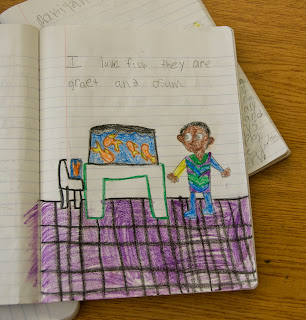 |
| "I love fish. They are great and awesome." 1st grader's journal. |
When I want to better understand a young reader I tend to do a few things:
- I like to observe the child and see what he or she is interested in and curious about as he/she plays and often will join the child as a participant/observer as this stance allows me to better understand not only what the child has learned, but also what the child is on the cusp of learning (think Vygotsky's ZPD). Watching a child at play allows me to see how the child problem solves at points of difficulty, how the child establishes goals, and the skill level in physical play. It also often provides me a context in which to engage the child in conversation.
- I talk with the child and also listen as the child talks with another child. Oral language is the foundation upon which reading rests. How articulate is the child? Marie Clay's Record of Oral Language is an excellent resource and it will cost you $15.00 instead of $500.00. Further instead of just learning how to administer and score an assessment, Clay's text will provide important background information. It is a professional text.
- I also appreciate taking a look at what the child has produced as 'written' text. When I think of written text, I specifically am interested in the generation of image, letter, words, phrases, and sentences. I am interested in seeing what language the child can produce that is correct and approximate. Again Marie Clay's Becoming Literate is a deep resource that can help a teacher understand development. Understanding what is meant by inner strategic control is of critical importance. A study group of kindergarten and first grade teachers reading Becoming Literate is an antidote to reading failure.
- Last thing I tend to do is to read with the child. Like a DRA system, I pull together a collection of books that have been leveled and engage the child in reading some of these texts. What is different though about my pulled together collection of books and a DRA 2 is that my collection of books is based on what I have observed about the child and choice in text is offered right from the beginning as I have controlled for level. Choice in text is so very important.
 |
| My son pretending to be an astronaut. |
Once when I was making a film about administering the DRA (for graduate students who were becoming reading specialist), I asked my son (he was 6 at the time) to help me by allowing me to administer a DRA on video tape. What happened is important. His first grade teacher had indicated at conference time that Dev was at DRA level 4 and she was sure that was a mistake, but that was what the test indicated. It was fall of first grade (Thanksgiving time) and my son allowed me to administer two DRA texts while being videotaped. That day he read text level 6 and text level 8 DRA books at an instructional level. He was able to retell the stories (such as they are) and concluded that he did not like either as they didn't seem to make a lot of sense. He asked if we could stop and instead read picture books like
The Librarian of Basra: A True Story from Iraq. He said to me, "
I want to read books like we do at bedtime, Mommy." Later that day, I was in the kitchen making dinner and I overheard my son who was sitting next to his grandmother ask her if she wanted to hear a story. She said, yes and he read
The Berenstain Bears Play T-Ball (a text level 16 book) with fluency and nary an error.
So what was happening? How might a child score at 4, 6, 8, and 16 within the space of a couple of days? Like many first graders, my son had holes in his item knowledge. He knew many sight words, but was missing some key ones which held him back on measures like the DRA. He also was motivated to read the Berenstain Bear's book, had familiarity with the book and with T-Ball and wanted to please his grandmother. These factors influenced his performance. We did a little at home work on sight words, and by the next month he was reading with confidence and considerable skill.
None of the tasks or DRA assessments on their own provided a clear picture of what my son knew, what knowledge he was approximating, and which of those things might be most important. Piecing that together required a knowledgeable adult, not a test. So whereas the DRA 2 might provide interesting and perhaps even important information, it is the teacher who needs to translate the findings, especially contrary findings, into actions.
Young readers would be better off if school district's invested $500 in professional learning, rather than in tests.

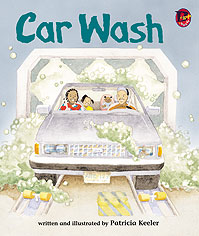 This is a sample high intensity guided literacy lesson using the Lee & Low published text, Car Wash
(text level F or 10) that we designed this summer (using Jan Richardson's lesson plan) for
the primary grade summer school project that was held at 16 school
sites in Newark, NJ.
This is a sample high intensity guided literacy lesson using the Lee & Low published text, Car Wash
(text level F or 10) that we designed this summer (using Jan Richardson's lesson plan) for
the primary grade summer school project that was held at 16 school
sites in Newark, NJ. 


