Showing posts with label guided literacy lesson. Show all posts

Friday, August 17, 2012

Guided Literacy Lesson for Transitional Readers


Guided literacy lesson being conducted by second grade teacher with students this summer in Newark, NJ.

This is a sample high intensity guided literacy lesson using the text, Carlos and the Cornfield/Carlos y milpa de maiz (text level L, DRA 20, Lexile level 660) that we designed this summer (using Jan Richardson's lesson plan) for the primary grade summer school project that was held at 16 school sites in Newark, NJ.


This lesson is designed for a small group (4 to 6 children) reading at a transitional level. The three day 20-minute lesson plan connects reading, phonics, and writing and makes it far superior to traditional guided reading.  This is an example of the work that was done this summer to prevent reading difficulties.


Title: Carlos and the Cornfield   Level: L     
Group: ________________________________________________________________
Strategy: Theme/Main Idea

Day 1 Date______________ Pages_____
Introduce New Book:  In this book, Carlos and the Cornfield, Carlos wants to purchase a red knife and finds a way to do so that involves him doing a job for his Papá.  Let’s read to see what work Carlos does and what he learns as a result of his actions.
New vocabulary: pedaled, reap, sow, good fortune, harvested
Day 2 Date______________ Pages_____
(Continue first reading) Notes/Observations
___________________________________
___________________________________
___________________________________
___________________________________
___________________________________
___________________________________
___________________________________
___________________________________
­­­­­Teaching Points: Choose 1 or 2 each day
Decoding strategies:                                       Vocabulary Strategies:
q  Reread & think what would make sense.      Reread the sentence and look for clues.
q  Cover (or attend to) the ending.                 Check the picture or visualize.
q  Use a known part. (e.g. shouted)                 Use a known part. (e.g. compound words)
q  Use analogies. (e.g. saw – jaw)                    Comprehension Strategies:
q  Chunk big words. (re-mem-ber)                  Fiction:                       Nonfiction:
Fluency & Phrasing                                          BME                                     Recall information
q  Phrasing.                                                     5-finger Retell                     Write key words
q  Attend to bold words.                                S-W-B-S                               Compare/contrast
q  Dialogue, intonation & expression.              Compare characters              Ask questions
q  Attend to punctuation.                               Track character’s feelings   Summarize w/support
                                                                   Flag the V.I.P                        Main Idea/Details

Discussion Prompt 1: Why does Carlos want to give back the knife to the store owner?  Why does he need the money?
Discussion Prompt 2: Carlos doesn't know where blue corn cornmeal came from. Why is he embarrassed when his father tells him?  What lesson does he reap (learn) as a result of his actions?
or
Discussion Prompt 3: What does it mean when Papá says, “You reap what you sow”? Turn and discuss with your partner.


Word Study 
Making Words: Letters - a, c, e, l, m, n, o, r

1.     Take four letters and make the word corn.
2.    Add one letter and make the word acorn.
3.    Change one letter to make the word carol.
4.    Take away one letter to make the word cola.
5.    Rearrange the letters to make the word coal.
6.    Change two letters to make the word, mole.
7.    Add one letter to make mole say lemon.
8.    Rearrange the letters to make lemon say melon.
9.    Take away a letter and add another letter to make the word, lone.
10.  Add one letter to make the word, alone.
11.   Add one letter to make the word, loaner.
12.  Remove two letters and make the word, real.
13.  Change one letter to make the word, meal.
14.  Now add the remaining letters to make our mystery word that was in our story. (cornmeal)

Word Study
Making Words: Letters – a, d, e, l, n, p. t

1.     Take three letters and make the word lad.
2.    Change one letter and make the word lap.
3.    Add one letter to make the word plan.
4.    Add a letter and make the word, plant.
5.    Add a letter and make the word, planet.
6.    Remove a letter and make it say plant.
7.    Now use all the letters to make our mystery word. (planted).

Day 3 Reread the book for fluency (5-10 min.) & Guided Writing (10-15 min.)
q  Beginning-Middle-End       5-finger retell      X SWBS     Character Analysis
q  Problem – solution    Compare or contrast   Event – detail      Other:

Write a summary of the story using SWBS (Somebody, Wanted, But So).
Generate this chart with students but have them complete the final column on their own sheets.  They then use this information to write a summary of the story, answering the question: What did Carlos learn?

Somebody
Wanted
But
So
Carlos
A red knife
He did not have enough money
(complete)
Opening Sentence:


Closing Sentence:


Thursday, August 16, 2012

Early Guided Literacy Lesson for First Graders

Ms. Crawford listens as a first grader reads from his journal.


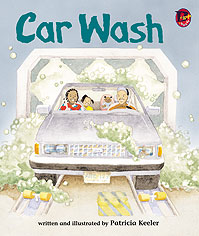
Car Wash CoverThis is a sample high intensity guided literacy lesson using the Lee & Low published text, Car Wash (text level F or 10) that we designed this summer (using Jan Richardson's lesson plan) for the primary grade summer school project that was held at 16 school sites in Newark, NJ.

This lesson is designed for a small group (4 to 6 children) reading at an early level. The two day 20-minute lesson plan connects reading, phonics, and writing and makes it far superior to traditional guided reading.  This is an example of the work that was done this summer to prevent reading difficulties.

In crunching more exiting data, children who attended summer school at least 80% of the time gained at least one reading level and added foundational skills. All of the students in Amber Crawford's first grade (shown above) made progress, with many children reaching the district's grade level benchmarks. Teachers like Ms. Crawford make huge differences in children's lives.


Early Guided Reading Lesson Plan
Title: Car Wash  Level: _F_ Strategy Focus: ________________ Lesson #____

Day 1       Date: _________
Day 2       Date: _________
Sight-Word Review-Writing (optional)
here,  look,  all
Sight-Word Review-Writing

Introduction of New Book:  This book is called Car Wash and it’s about a little girl and her family who take their car through a car wash to get it clean, but a surprise happens. Let’s read to see what surprise happens.

New vocabulary: foaming (p. 4),

Continue Reading Yesterday’s Book
(and other familiar books)
Observations:


Text Reading With Prompting
· Check the picture. Does it look right and make sense? Reread the sentence.
· Check the end (or middle) of the word. What would look right and make sense?
· Cover the ending. Is there a part you know?
· Break the word into parts.
· Do you know another word that looks like this one? 
· What can you try? What can you do to help yourself?
· Put some words together so it sounds smooth. (fluency)
· Read it like the character. (expression)
· What did you read? What’s the problem? How might they solve it? (comprehension)
Select one or two teaching points each day after reading. 
Word-solving strategies:                                     Fluency & Expression:
· Monitor                                                       · Attend to bold words
· Reread at difficulty                                  · Reread page ______ for expression
· Attend to endings                                                    Comprehension
· Use known parts                                        · Recall information
· Contractions      (we’re)                         · Retell events in sequence
· Use analogies                                               · Five-finger retell
· Chunk big words                                           · Discuss characters’ feelings
Discussion Prompt:
Read with expression.  Read the refrain: “We’re going through the car wash. Wash it! Wash it! Here we go!” 
Discussion Prompt:
Tell me what you just read. What happened at the beginning? Middle? End?
Teach 1 Sight Word: through
What’s missing? 
Mix & Fix 
Table Writing   
Whiteboard 
Word Study (choose 1): Making Words w/ magnetic letters: e, n, s, t, t, w


· Making words: we, wet, went, west, test, tent, tend, send, sent, tents,

Guided Writing: 
Retell the events in sequence by writing three sentences that capture the beginning, middle and end of the story.
Beginning (1 sentence)
Middle (1 sentence)
End (1 sentence)

Tuesday, August 14, 2012

Sample Guided Literacy Lesson for Beginning Readers

Ms. Zaczkowska conducting a guided literacy lesson with kindergarten children from Newark, NJ in July 2012.

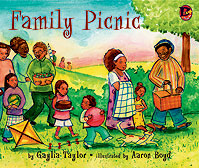
This is a sample high intensity guided literacy (not just reading) lesson using the Lee & Low published text, Family Picnic, that we designed this summer (using Jan Richardson's lesson plan) for the primary grade summer school project that was held at the 16 school sites in Newark, NJ.  It is the type of lesson that the teacher pictured above was conducting with her students this summer.

Family Picnic Cover
Family Picnic by Gaylia Taylor
This lesson is designed for a small group (4 to 6 children, but given the early level I think 4 works better). The two day 20 minute lesson plan connects reading, phonics, and writing and makes it far superior to traditional guided reading.  This is an example of the work that was done this summer to prevent reading difficulties.

In crunching some of the exiting data, it appears that children who attended summer school at least for 16 out of the 25 days made good progress--growing at least one level during the month and adding important foundational skills. Imagine what gains could be garnered if this type of instruction (along with the other components we did) was typical, not simply limited to summer!


Emergent Guided Reading Lesson Plan


Levels A-C; DRA 1-4

Title: Family Picnic  Level: A   Group #____________________    Lesson #____


Day 1  Date: 
Day 2  Date:
Sight word review-writing: Dictate the words already been studied & have children write them correctly.
is, we, I
Sight word review-writing Dictate words already been studied && children write them correctly. is, we, I

Introduce New Book:  This book is Family Picnic and it’s about a boy and his family who have a reunion at a park.
 
New vocabulary: picnic

Reread Yesterday’s Book (and other familiar books):         Observations Notes:
Text Reading with prompting:
Get your mouth ready.”
“Does that make sense?  Check the picture.”
“Does that sound right and look right?”
“Show me the word _____.” (for sight words)

Teaching Points after Reading:

  • One-to-one matching (Discourage pointing after level C.)
  • Use picture clues (Meaning)
  • Monitor with known words
  • Use beginning letter cues
  • Crosschecking picture & beginning letter (always do with levels A & B)

Teaching Points after Reading:

  • One-to-one matching (Discourage pointing @ level C.)
  • Use picture clues (Meaning)
  • Monitor with known words
  • Use beginning letter cues
  • Crosschecking picture & beginning letter
 

Discussion Prompt: Turn and tell your partner one thing the boy and his family did at the park. 

Discussion Prompt: What from the story tells you that the boy loves his family?

Teach Sight Word: my
  1. What’s missing?
  2. Mix & Fix
  3. Table writing
  4. Writing on a whiteboard (do all 4 steps both days)
Teach Same Sight Word: my
  1. What’s missing?
  2. Mix & Fix
  3. Table writing
  4. Writing on a whiteboard

Word Study

Sound Box (2 boxes): Students should say each sound as they write the corresponding letter in the box. See template in next page. Make 3 copies of the template for each child.

me, go, no, he, we
Guided Writing:  Dictated sentence. [Have children repeat the sentence to hear the sounds. Prompt as needed, encourage them to take risks as they spell, & reread their sentence to help them remember the next word.]

My dog is my best pal.


Sound Box Template


(Cut apart) --------------------------------------------------------------------------------------------