Showing posts with label interactive read aloud. Show all posts

Monday, September 7, 2015

Merging Read Aloud, Shared, Guided & Independent Reading: Teaching With Text Sets in Grade 1: All About Seeds

Grade 1 Topic:  Seeds


1. Read Aloud Books

Read aloud books provide students with the occasion to develop world knowledge through vocabulary development, to deepen and complicate comprehension, and to write in response to text through modeled, shared, interactive and independent writing.
  1. Aston, Dianna Hutts. (2007). A Seed is Sleepy. Illustrated by Sylvia Long. San Francisco, CA: Chronicle Books. (750L)
  2. Codell, Esme Rajo. (2012). Seed by Seed: The Legend and Legacy of Johnny “Appleseed” Chapman. Illustrated by Lynne Rae Perkins. New York: Greenwillow. (940L)
  3. Gringsby, Susan. (2010).  In the Garden with Dr. Carver. Illustrated by Nicole Tadgell. Morton Grove,  IL: Albert Whitman & Company. (990L)
  4. Messner, Kate. (2015). Up in the Garden, Down in the Dirt. San Francisco, CA: Chronicle Books. 
  5. Peterson, Cris. (2010).  Seed, Soil, Sun: Earth's Recipe for Food. Photographs by  David R. Lundquist. Honedale, PA: Boyds Mills Press. (1050L)
  6. Pfeffer, Wendy. (2004). From Seed to Pumpkin. Illustrated by James Graham Hale. New York: HarperTrophy. (640L)
  7. Richards, Jean.  (2002). A Fruit is a Suitcase for Seeds. Illustrated by Anca Hariton. Minneapolis, MN: First Avenue Editions. (No Lexile Level)
  8. Museum of Chicago Television. (1980/2008). George Washington Carver. Video. Retrieved 8.1.13 from https://www.youtube.com/watch?v=aClMTQ5UvIk 


Childcraft The Tiny Seed Big Book - Softcover - 36 Pages

2. Shared Reading Texts

Shared reading texts provide students with the occasion to develop world knowledge, book handling concepts, and foundational reading skills.

  1. An Apple a Day. Newbridge.
  2. Seeds Get Around. Newbridge.
  3. The Tiny Seed (Eric Carle, Level L/20, 400 L)
  4. Up, Down, and Around (180L)
  5. The Farmer and In Daddy's Arm from In Daddy's Arms I Am Tall: African Americans Celebrating Fathers  (Steptoe)
  6. Planting a Rainbow (Lois Ehlert)
  7. Seeds Get Around (Newbridge)
from Yum, Apples

3. Small Group Reading & Familiar Rereading Texts

Texts used for small group guided reading and then familiar independent rereading provide students with the occasion to practice what they have begun to learn during read aloud and shared reading first in a guided setting and then independently.

Plants (Level A)
This Pumpkin (Level A)
Yum, Apples (Level B)
Hello Flower (Level C)
Plant Parts We Eat (Level D)
From Seed to Apple (Level D/6)
Grow Seed Grow (Level E)
Apple Tree Year (Level E)
From Seeds (Level E/8)
Little Critter—My First I Can Read!™: A Green, Green Garden (Level E/9)
Gus Grows a Plant (Level F/10)
This is the Sunflower (Level F/10)
What Does a Garden Need? (Level G/11)
I'm A Seed (Level G/12)
Green and Growing (Level H)
And Then It's Spring (Level H/14)
If You Hold a Seed (I/16, 270L)
How a Seed Grows (Level I/16, 400 L)
Jack's Garden (Level I/16)
One Bean (Level I16, 520L)

Thursday, September 3, 2015

Early Literacy Series #7: Teaching Comprehension & Fluency

This is the seventh of seven posts about early literacy.


One of the challenges in helping children learn how to read is providing a variety of daily experiences that develop fluency and comprehension. In this last post of the series, I outline few instructional practices teachers can use during interactive and shared reading and interactive writing.

Fluency Chart

Fluency

  1. Model oral reading with expression in patterned and familiar storybooks during shared reading.
  2. Create opportunities for student to read chorally with you as you read familiar refrains. This works well when the text can be seen by the students through the use of big books, charts, and projected text.
  3. Choose patterned text, including familiar nursery rhymes and poems, to have students practice reading with phrasing and expression. Again it is important that students see the text. 
  4. Consistently uses one-to-one matching with new text (reads almost exclusively word-by-word, usually pointing with finger).
  5. Model pointing as needed in shared reading and interactive writing.
  6. Encourage beginning readers to point to each word as he or she reads.
  7. Encourage peer to peer talk.

Comprehension

Retelling Anchor Chart
  1. When reading aloud (interactive and shared reading) encourage students to elaborate on details from the story by providing prompts like, then what happened?
  2. Select meaningful texts for reading aloud and as guided reading materials. Consider text quality and context.
  3. Ask students to tell how details in pictures relate to the story. 
  4. Encourage students to point to the pictures as they talk about details in the story.
  5. Encourage student to look back at text and pictures as you discuss the text after reading.
  6. Create opportunities for discussion of read-aloud and shared reading text.
  7. Pose a question for student about text and as he formulates answers ask, "What in the picture tells you that? What in the text tells you that?"
  8. Create an anchor chart where you record the information from pictures and text.
  9. Create anchor charts as you work together to identify story elements.
  10. Model talking about parts of text in sequence during shared reading. Teach students about the prompts as well (i.e. Tell me more, what makes you think that? etc.). 
  11. During guided reading prompt students to talk about parts in sequence.
  12. Give student multiple opportunities to identify and discuss the story elements as you work together in texts.
  13. Thoughtfully chunk text (create stopping points) as you plan for guided reading, shared reading and interactive read aloud opportunities.
  14. At chosen stopping points ask student, What do you think will happen next? to encourage careful predictions.
  15. Give student multiple opportunities to discuss predictions with peers and/or teacher.
  16. Confirm or change predictions as you continue reading text together. 
  17. During interactive read-alouds model making predictions based on illustrations or parts of stories. 
  18. Teach students what it means to make predictions. 
  19. Create an anchor chart about making predictions to refer to during later teaching about predictions.
  20. Teach students to monitor predictions during interactive read aloud.
  21. Pose questions that invite children to infer at spots in the text and across the text.
  22. A student's questions recorded during a read aloud.
  23. Teach students how to pose their own questions and privilege this work.


Students' Inferring Chart Kept During Guided Reading


Sunday, July 14, 2013

Comprehension, Vocabulary & Writing Development in Grade 2: Previewing a New E-Book

I am just getting ready to publish the second volume of read aloud instruction on iTunes for grade 2. This is a continuation in a series of ebooks I have produced. In this ebook, there are seven units of study.  Within the units of study there is direct instruction focusing on comprehension, vocabulary, and writing in response to text, as well as independent reading.

The texts below are referenced in this ebook. For each text  there is a multi-day lesson.


Unit 1: Inspiring People
Bruchac, Joseph. (2009). Rachel Carson: Preserving a Sense of Wonder. Illustrated by Thomas Locker. Golden, CO: Fulcrum. (No Lexile Level Available)
Lawlor, Laurie. (2012). Rachel Carson and Her Book That Changed the World. Illustrated by Laura Beingessener. New York: Holiday House. (890L)
McGinty, Alice B. (2013). Gandhi: A March to the Sea. Illustrated by Thomas Gonzalez. Las Vegas, NV: AmazonChildren’s Publishing. (No Lexile Level Available)
Roth, Susan & Cindy Trumbore. (2011). The Mangrove Tree: Planting Trees to Feed Families. Collages by Susan Roth. New York: Lee and Low Books. (1180L)
Winter, Jeanette. (2011). The Watcher: Jane Goodall’s Life with the Chimps. New York: Schwartz & Wade/Random House. (820L)
Winter, Jonah. 2009. Sonia Sotomayor: A Judge Grows in the Bronx: La juez que crecio en el Bronx. Illustrated by Edel Rodriguez. New York: Atheneum. (840L)

Unit 2: Soil Habitats
Aston, Dianna Hutts. (2012). A Rock is Lively. Illustrated by Sylvia Long. San Francisco, CA: Chronicle Books. (1110L)
Bial, Raymond. (2000). A Handful of Dirt. New York: Walker Childrens. (1190L)
BodhaGuru Videos. (2012). Science - Soil Formation and Soil Layers. Retrieved 5.12.13
Murray Raymond C. (2005). Collecting Crime Evidence from Earth. Geotimes. (1280L)
Tomacek, Steve. (2007). Jump into Science: Dirt. Illustrated
by Nancy Woodman. Washington DC: National Geographic. (840L)


Unit 3: Noticing an Author’s Language
Christian, Peggy. (2008). If You Find a Rock. Photos by Barbara Hirsch Lember. New York: Sandpiper. (980L)
Collins, Pat Lowery. (1994). I Am an Artist. Illustrated by Robin Brickman. Millbrook Press. (1210L)
Hesse, Karen. (1999). Come On, Rain. Illustrated by Jon Muth. New York: Scholastic. (760L)


Unit 4: American Tall Tales
Kellogg, Steve. (2004). Paul Bunyan. New York: HarperCollins. (1030L)
Lester, Julius. (1999). John Henry. Illustrated by Jerry Pinkney. New York: Puffin. (720L)
Mora, Pat. (2005). Dona Flor: A Tall Tale about a Giant Woman with a Great Big Heart. Illustrated by Raul Colon. New York: Alfred A. Knopf.(860L)
Nolen, Jerdine. (2003). Thunder Rose. Illustrated by Kadir Nelson. San Diego, CA: Silver Whistle/Harcourt. (910L)
John Henry Video. Retrieved 7.11.13 from https:// www.youtube.com/watch?v=5MuCLvu0CkU
S.E. Schlosser, S.E. Casey Jones: A Tennessee Legend.

Unit 5: The Power of Community
Cohn, Diana. (2002). ¡Si, Se Puede! Yes, We Can! Janitor Strike in L.A. Illustrated by Francisco Delgado. El Paso, TX: Cinco Puntos Press. (No Lexile Level)
DiSalvo-Ryan, DyAnne. (1994). City Green. New York: HarperCollins. (480L)
McKissack, Patricia. (2008). Stichin’ and Pullin’: A Gee’s Bend Quilt. Illustrated by Cozbi A. Cabrera. New York: Random House. (No Lexile Level Available)
Tate, Don. (2012). It Jes Happened: When Bill Traylor Started to Draw. Illustrated by R. Gregory Christie. New York: Lee and Low Books. (840L)


Unit 6: All About Trees

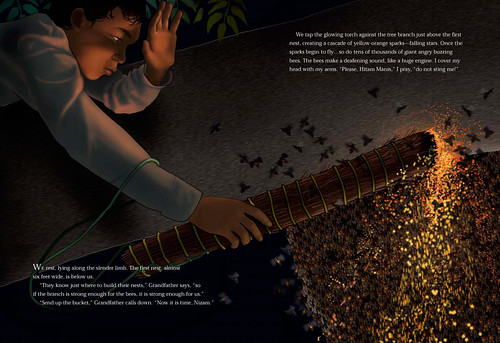
Buchmann, Steven and Diana Cohn. (2012). The Bee TreeIllustrated by Paul Mirocha. El Paso, TX: Cinco Puntos Press. (1190L)
Chin, Jason. (2009). RedwoodsNew York: Roaring Brook Press. (1100L)
Guiberson, Brenda. (2009). Life in a Boreal Forest. Illustrated by Gennady Spirin. New York: Henry Holt. (860L)

Unit 7: Wants and Needs

Elya, Susan Middleton. (2006).  Home at Last. Illustrated by Felipe Davalos. New York: Lee & Low Books. (No Lexile Level)
English, Karen. (2004). Hot Day on Abbott Avenue. Illustrated by Javaka Steptoe. New York: Clarion Books. (640L)
Johnson, Angela. (2003). I Dream of Trains. Illustrated by Loren Long. New York: Simon & Schuster. (No Lexile Level)
Larson, Jennifer S. (2012). Do I Need It? Or Do I Want It? Minneapolis, MN: Lerner Publications. (510L)
Park, Linda Sue. (2004). The Firekeeper’s Son. Illustrated by Julie Downing. New York: Sandpiper. (450L)

Saturday, March 9, 2013

Acquiring Knowledge in Kindergarten through Read Alouds Handbook

Multi modal book curated by Blueprints for Learning.


A new professional text I recently published using iBookAuthor.


Professional Text for Primary Educators: Acquiring Knowledge in Kindergarten through Read Alouds Handbook

High-quality literature read aloud offers children access to important ideas, rich vocabulary, and the opportunity to actively problem solve and discuss emerging understandings with peers and their teacher. Teacher-conducted read-alouds can be important sources of world knowledge for children. In this text, I designed two read aloud units of study for use with kindergarten children. For each text there are comprehension engagements, vocabulary instruction, and text-dependent questions that are aligned to the CCSS.  


Unit 1: Traditional Stories and Wheat

Galdone, Paul . (1985 ). The Little Red Hen. New York: Sandpiper. (550L)
Gershator, David and Phillis Gershator. (1998). Bread is for Eating. Illustrated by Emma Shaw-Smith. New York: Henry Holt. (450L)
Hairston, Meredith. (2011). Little Red Hen. Illustrated by Jes Golden. Digital Story/Video. Retrieved 12.31.12 from: https://www.youtube.com/watch?v=RPrhPiOiNEY 
Paulsen, Gary. (1998). The Tortilla Factory. Illustrated by Ruth W. Paulsen. New York: Sandpiper. (550L)
Sturges, Philemon. (2002). The Little Red Hen Makes Pizza. Illustrated by Amy Walrod. New York: Puffin. (320L)


Unit II. Libraries and Reading


Gonzalez, Lucia. (2008). The Storyteller’s Candle: La velita de los cuentos. Illustrated by Lulu Delacre, San Francisco, CA: Children’s Book Press. (730 L)
Hest, Amy. (2007). Mr. George Baker. Illustrated by John J. Muth. Cambridge, MA: Candlewick Books. (520L)
Mora, Pat. (2000). Tomas and the Library Lady. Illustrated by Raul Colon. New York: Dragonfly Books. (440L)
Ruurs, Margaret. (2005). My Librarian is a Camel: How Books are Brought Around the World. Honesdale, PA: Boyds Mills Press. (980L)
Winter, Jeanette. (2005/ 2012). The Librarian of Basra (Digital Version). Boston: Houghton Mifflin. Retrieved 12.31,12 from: http://www.youtube.com/watch?v=K5xp-KOVbmw