Showing posts with label 2nd grade. Show all posts

Thursday, March 5, 2015

Learning That Gets Made in 2nd Grade (#SOL15, Day 5)

Stop Holding Us Back (M.A. Reilly, 2014)
I.

I spent yesterday teaching small groups of second graders from Newark Public Schools as their teachers and other visitors looked on. These are children I have taught before. We have shared good books together and so the work unfolds in ways that are both predictable and not. During the morning session, one group of children partner-read The Emperor's New Clothes and then independently wrote responses to three questions. The teachers and I reviewed their work during lunch. Rather than traditional guided reading, this type of guidance focuses more exclusively on comprehension. Reading their written responses allows me to see some of the confusions the children have about the text--and it is a complicated text to read--as well as what they seem to understand. This knowledge helps me to plan for a possible conversation the children and I will have after lunch.

II.

It's 1:30 in the afternoon when I meet with the children again and what is most noticeable, and not surprising, is that all of them from time to time offer responses that are not rooted in the actual text at all, but rather represent truths they know and want to apply. We talk for an hour and the children work hard to determine why the emperor continues parading without his clothing after he hears the child say he is wearing no clothes.  Edmund offers that the emperor doesn't believe the child. Juliana says that's not true and is able to locate in the text where the emperor directly states that he believes the child. This prompts all of us to reconsider what else might be influencing the emperor to continue doing something that is at best embarrassing. This is a challenging question and one that has caused each child to ponder what they know, what they know to be true about the emperor, and to consider what might be worse than parading without clothing.

"Why would the emperor do that?" asks James with a certain amount of indignity.
Why indeed? I think.

III.

In all the boisterous talk that follows, it is the quiet utterance that is most important to hear. Marc says the single word, dignity, in response to what the emperor loses. His statement catches the ears of his peers and they begin a heated discussion about the emperor, his relationship with his subjects, and how his actions protect his job, but cost him the respect of his subjects. I physically sit back in the chair as I know they will wrangle with this question and no longer need the language I was loaning them.  Now that language is too bulky, too much in the way. They have found their own words and are trying out some big ideas, such as:

  • The emperor is a bad leader. He cares only about himself.
  • He cares more about keeping his job than being honest with his citizens.
  • The emperor is not courageous.
  • The emperor would rather be without clothes than have his advisers think he is unfit for his job.
  • The emperor is not honest.
  • The emperor knows he is lying.
  • The emperor has lost his dignity.
  • The emperor has lost his money and he won't say anything to the swindlers because he has to keep up the lie.

IV.

I listen and when there is a lull in the conversation I ask the children, "Do you think if you reread the book tomorrow and talked a bit more about why the emperor makes the final decision to continue parading without clothes that you might be able to write a response to question 3?"  They wear big smiles on top of their confidence and nod their heads indicating, yes. I next ask them: "Would you agree to allow your teacher to send me what you write as I'll be in Boston tomorrow? I'd like to read what you had to say." Again, they indicate yes.

At that moment, it's almost as if their collective confidence was a living thing in the room alongside us. It's big. Present. Powerful. And I know they have caught fire when the school day ends and they will not leave the classroom.  Thirty minutes later and they are still trying to figure out where they can get their hands on copies of the book and other stories by Hans Christian Anderson so they can read it again at home. Juliana tells me she's going to go to the library as soon as her mom can take her.

"You can take out the book and they let you keep it for ten whole days," she tells me as only an 8-year-old can sound.  I listen and make a silent nod of thanks that we still have public libraries in our country.

Others in the group are already planning to borrow the book so they can bring it home to read again. And they look to their teacher who lets the know this is possible.  I listen as they finally leave the classroom and notice that they are continuing the conversation about the emperor and his lack of leadership on their own as they make their way down the long hallway.

V.

Learning requires the space to be wrong--as does good teaching. This shift from more traditional approaches to guided reading to guiding children's reading through conversation is challenging and necessary. When the teachers ask how they might best prepare for such conversations we talk about reading the text carefully, sharing your perspective with another teacher, preparing, asking, and answering good questions, recognizing that the conversation will take twists you did not plan for, and becoming comfortable as the lesson will not turn out the way you may have intended as the lesson no longer rests solely in your hands.

The learning is a made thing that happens among people. This is a liberating truth: the work that is made does not and cannot rest solely in the hands of the teacher. This is, in part, what makes it so powerful.

Saturday, December 20, 2014

Multi-Day Read Aloud Lessons to Teach Characterization in Primary Grades

This is a multi-day lesson designed to introduce second grade children to methods of characterization by inferring about a character's actions. This is the last book read in a unit about the Himalayan Mountains. Students have heard and interacted with the following texts:

  1. Martin, Jacqueline Briggs. (2010). The Chiru of High Tibet: A True Story. Illustrated byLinda Wingerter. Boston, MA: Houghton Mifflin Books.
  2. Jenkins, Steve. (2002). The Top of the World: Climbing Mount Everest. New York: Sandpiper.
  3. Reynolds, Jan. (2007). Himalaya: Vanishing Cultures. New York: Lee & Low Books.


Text: Soros, Barbara. (2003). Tenzin’s Deer. Illustrated by Danuta Mayer. Cambridge, MA: Barefoot Books.

Day One/1st Reading
Book Introduction: This is a story about a Tibetan boy named, Tenzin, who finds an injured musk deer and cares for her. Eventually the deer heals and Tenzin is faced with making an important choice. Let’s read in order to find out what challenge Tenzin faces and what choice he makes.
Vocabulary: poached, extinction

Note: It is recommended that you read this book through once stopping only briefly to respond to children’s questions/wonderings. During subsequent re-readings, the following questions can be explored.
After 1st reading: Have students create a story map with you. 

When retelling the children should be able to:
  1. Retell what happened
  2. Why it happened
  3. The effect on Tenzin's mental state
  4. Be able to emphasize connections between earlier and later parts in the story. 


Day Two/Second Reading

Question 1: Listen as I reread the opening to the story (this should be written on chart paper so that students can use the written text to help them answer the question) and ask yourself: ‘What similarities are there between this story and The Chiru of High Tibet (Note: Place copy of the book on easel so students can see it):
The musk deer is a small, shy, solitary animal found throughout the forested regions of Asia and Russia. Musk, the oil base used in a number of perfumes, is one of the world’s most expensive natural products; up to five times more expensive than gold. The musk deer is widely poached for its precious scent gland and, as a result, this beautiful creature is facing extinction.
Turn and tell your partner one similarity between this book and The Chiru of High Tibet. (RL.2.9)

Question 2: Listen as I reread the first page and study the illustrations carefully. Roughly-hewn stones are stones that have been shaped with hard blows from a cutting instrument like an ax. 
What can you infer about Tenzin and the characters in this story based on what I have read and the other books we have read together?  Turn and tell your partner what you are thinking. (RL.2.3, RL.2.9)
Allow children to discuss their inferences and then show the chart below and model one inference you made and how you supported your inference with reasons from the text. Invite students to offer their inferences and then reread the passage and have students listen for and identify reasons that support their inferences. (RL.2.7, RL.3.5)


Question 3: What happened to the deer when Tenzin first finds her? Which words in the passage directly tell you? Reread page that begins: “Help me I am in pain...but he did not know what would happen now.” (RL.2.1)


Question 4: Tenzin’s first dream leads him to treat the deer. How does his dream connect with the actions he took to remove the arrow? (Reread the dream and the action. ) Turn and tell your partner. (RL.2.1)

Day 3/Third Reading

Question 5: Let’s recount each dream Tenzin has and explain how the dream leads him to care for Jampa. (RL.2.1) 


Question 6: How are Tenzin and Jampa similar? (RL.2.3)

Question 7: How did Tenzin use the myrobalan flower to heal Jampa? Explain this to your partner.(RL.2.1)

Question 8: Why does Tenzin decide to release Jampa so she can return to the wild? Turn and tell your partner. Why is this difficult for him to do?   Turn and tell your partner what he learns as a result of releasing Jampa. (RL.2.1, RL.2.2)

Question 9: How does Tenzin’s earlier years and experiences caring for Jampa prepare him to be a fine doctor?  Discuss with your partner and then write an explanation in your notebook. (RL.2.1)

Day 4 /Fourth Reading

Listen as I reread. Let’s think about specific times when we wonder while reading this story.   Use this frame: 
The moment I heard...I wondered. 


Day 5/Fifth Reading

Task 1: This time when I reread the story, let’s think about the actions that Tenzin takes in the story and what those actions suggest about the person he is. To help us keep track of our thinking we will record the actions Tenzin takes in the left column and we will record what we think motivated him in the right column. 

When you hear or think of something we should record, please raise your thumb and I will stop reading. (RL.2.3)


Task 2: We can learn a lot about a character from his actions and what we think motivates those actions. Let’s reread our chart, think about the Tenzin's actions and motivations, and then name some character traits that fit Tenzin. (Reread chart and then flip page to show Character Traits. ) To get us started I recorded some character traits on this chart. Let’s read through them chorally and as we read let’s think about which ones best describe Tenzin.


Turn and tell your partner which traits best describe Tenzin. Then in your notebook record the trait and explain why. (RL.2.3)

Task 3: Now that we have discussed traits, let’s think about the story and find evidence that supports our thinking. For example, if I think that Tenzin was dependable what evidence from the story can I find to support that idea? Who can help me complete this statement?

Tenzin shows he is dependable by taking care of Jumpa until she is healed.

Continue this chart by recording the first portion of the sentence and having students name the trait and evidence. (RL.2.3)

Tenzin shows he is ________________ by ___________________________________ . 

Task 4: Now that we have described Tenzin, have thought about his actions, and have connected those actions with our description of him--let’s write a paragraph to explain what Tenzin is like and support our ideas with evidence from the story. Note: You may want to differentiate this task by having students do as much of this work independently as possible. (RL.2.3)

Task 5: Most stories have a message, moral, or lesson about life. Let’s think about the ways Tenzin was courageous in the story.  Courageous means to be brave and not to be stopped by pain. (RL.2.2)
  • What did Tenzin do that caused him pain?  
  • What does he learn from this experience? 
  • What do we learn from Tenzin? 
Record a written response to these questions in your notebook.

Sunday, July 14, 2013

Comprehension, Vocabulary & Writing Development in Grade 2: Previewing a New E-Book

I am just getting ready to publish the second volume of read aloud instruction on iTunes for grade 2. This is a continuation in a series of ebooks I have produced. In this ebook, there are seven units of study.  Within the units of study there is direct instruction focusing on comprehension, vocabulary, and writing in response to text, as well as independent reading.

The texts below are referenced in this ebook. For each text  there is a multi-day lesson.


Unit 1: Inspiring People
Bruchac, Joseph. (2009). Rachel Carson: Preserving a Sense of Wonder. Illustrated by Thomas Locker. Golden, CO: Fulcrum. (No Lexile Level Available)
Lawlor, Laurie. (2012). Rachel Carson and Her Book That Changed the World. Illustrated by Laura Beingessener. New York: Holiday House. (890L)
McGinty, Alice B. (2013). Gandhi: A March to the Sea. Illustrated by Thomas Gonzalez. Las Vegas, NV: AmazonChildren’s Publishing. (No Lexile Level Available)
Roth, Susan & Cindy Trumbore. (2011). The Mangrove Tree: Planting Trees to Feed Families. Collages by Susan Roth. New York: Lee and Low Books. (1180L)
Winter, Jeanette. (2011). The Watcher: Jane Goodall’s Life with the Chimps. New York: Schwartz & Wade/Random House. (820L)
Winter, Jonah. 2009. Sonia Sotomayor: A Judge Grows in the Bronx: La juez que crecio en el Bronx. Illustrated by Edel Rodriguez. New York: Atheneum. (840L)

Unit 2: Soil Habitats
Aston, Dianna Hutts. (2012). A Rock is Lively. Illustrated by Sylvia Long. San Francisco, CA: Chronicle Books. (1110L)
Bial, Raymond. (2000). A Handful of Dirt. New York: Walker Childrens. (1190L)
BodhaGuru Videos. (2012). Science - Soil Formation and Soil Layers. Retrieved 5.12.13
Murray Raymond C. (2005). Collecting Crime Evidence from Earth. Geotimes. (1280L)
Tomacek, Steve. (2007). Jump into Science: Dirt. Illustrated
by Nancy Woodman. Washington DC: National Geographic. (840L)


Unit 3: Noticing an Author’s Language
Christian, Peggy. (2008). If You Find a Rock. Photos by Barbara Hirsch Lember. New York: Sandpiper. (980L)
Collins, Pat Lowery. (1994). I Am an Artist. Illustrated by Robin Brickman. Millbrook Press. (1210L)
Hesse, Karen. (1999). Come On, Rain. Illustrated by Jon Muth. New York: Scholastic. (760L)


Unit 4: American Tall Tales
Kellogg, Steve. (2004). Paul Bunyan. New York: HarperCollins. (1030L)
Lester, Julius. (1999). John Henry. Illustrated by Jerry Pinkney. New York: Puffin. (720L)
Mora, Pat. (2005). Dona Flor: A Tall Tale about a Giant Woman with a Great Big Heart. Illustrated by Raul Colon. New York: Alfred A. Knopf.(860L)
Nolen, Jerdine. (2003). Thunder Rose. Illustrated by Kadir Nelson. San Diego, CA: Silver Whistle/Harcourt. (910L)
John Henry Video. Retrieved 7.11.13 from https:// www.youtube.com/watch?v=5MuCLvu0CkU
S.E. Schlosser, S.E. Casey Jones: A Tennessee Legend.

Unit 5: The Power of Community
Cohn, Diana. (2002). ¡Si, Se Puede! Yes, We Can! Janitor Strike in L.A. Illustrated by Francisco Delgado. El Paso, TX: Cinco Puntos Press. (No Lexile Level)
DiSalvo-Ryan, DyAnne. (1994). City Green. New York: HarperCollins. (480L)
McKissack, Patricia. (2008). Stichin’ and Pullin’: A Gee’s Bend Quilt. Illustrated by Cozbi A. Cabrera. New York: Random House. (No Lexile Level Available)
Tate, Don. (2012). It Jes Happened: When Bill Traylor Started to Draw. Illustrated by R. Gregory Christie. New York: Lee and Low Books. (840L)


Unit 6: All About Trees

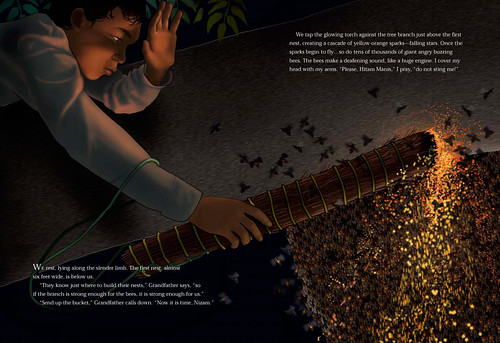
Buchmann, Steven and Diana Cohn. (2012). The Bee TreeIllustrated by Paul Mirocha. El Paso, TX: Cinco Puntos Press. (1190L)
Chin, Jason. (2009). RedwoodsNew York: Roaring Brook Press. (1100L)
Guiberson, Brenda. (2009). Life in a Boreal Forest. Illustrated by Gennady Spirin. New York: Henry Holt. (860L)

Unit 7: Wants and Needs

Elya, Susan Middleton. (2006).  Home at Last. Illustrated by Felipe Davalos. New York: Lee & Low Books. (No Lexile Level)
English, Karen. (2004). Hot Day on Abbott Avenue. Illustrated by Javaka Steptoe. New York: Clarion Books. (640L)
Johnson, Angela. (2003). I Dream of Trains. Illustrated by Loren Long. New York: Simon & Schuster. (No Lexile Level)
Larson, Jennifer S. (2012). Do I Need It? Or Do I Want It? Minneapolis, MN: Lerner Publications. (510L)
Park, Linda Sue. (2004). The Firekeeper’s Son. Illustrated by Julie Downing. New York: Sandpiper. (450L)