Friday, April 24, 2020

Craving the Familiar: Notes from the Pandemic


From my side yard. 
I.

An acre of land surrounded the house where I lived. Every garden on that land was one that I planted. By now I would have had some pots of herbs growing inside and I would have had them ready to go outside soon. I would have had some containers of vegetables started too. Delicate green shoots pushed up through that loamy dirt. Fragrant. Stems that would thicken. Later there would be tomatoes.

The side patio was slate and lined with wide, curved garden beds. A bird bath Rob and I bought years ago in Maine sat in a small garden of hydrangeas. A copper bath birds came to swim and splash in. The many Mother Day plants I received are still growing in those many gardens.

Astilbe.
Butterfly bushes.
Crocuses.
Daffodils.
Delphinium.
Hostas.
Hydrangeas.
Lavender.
Peony.
Shasta daisies.
Tulips.

Nothing says miracle like a perennial.

Surrounding the side and back lawns were trees thick enough for bears and deer to roam, home to any number of uncounted birds. My back deck was large and comfortable. I painted there. Served family meals there. Listened to and watched birds wing from branch to branch, tree to tree. I spent every season outside there. Even in winter, Rob cleared the path of snow to the grill. Even in winter as it snowed, I would photograph from that deck, aiming the lens of my camera towards the woods.

II.

This is the first spring in the new place I live and it is industrial in design. No real gardens. A small slice of lawn, overly planned. Antiseptic. What was I thinking when I moved here?

III.

A need arises within me as I finish the 6th week of staying home. This pandemic has me craving the familiar.

The way the third stair from the top creaked.
The way birds made nests on the light fixtures.
How light settled and silvered the leaves of old growth trees.
The way I knew a storm was coming by hearing the birds grow industrious.
The hum of the generator as it tested itself every Sunday morning.
The way silence settled like an old friend each evening.

Nothing says safety like home.


Saturday, April 18, 2020

White Privilege and COVID 19 - A Deadly Combination: Notes from the Pandemic


I. 

Jax Weaver and her daughter want everything opened again in Texas regardless of Coronavirus.  They made a sign saying so.  They went to a rally with others and said so again.  Apparently, Ms. Weaver is confident they are healthy enough to fight the virus.  The NY Times reported, 
Jax Weaver, 33, an out-of-work photographer who lives in Austin and came to the protest with her daughter, Brooklyn, 7, said she was frustrated with the limits on daily life. Among other things, her wife was forced to cancel her in vitro fertilization."


from Tx
Ms. Weaver doesn't understand science, or worse, she doesn't care about the outcomes of a virus on the run.  Everyone who comes in contact with her, if she is positive for COVID 19, can become infected, and those who do will likely then infect others (especially in Texas where things are opening up). Some among the infected will not be as healthy as Ms. Weaver thinks she and her 7-year-old are.  Those people won't like their odds against a deadly, deadly virus. Some of those would never risk their child to such a gamble. But it won't be their decision. Ms. Weaver and those like her are making that decision for 320,000,000 citizens.

But that's a gamble Ms. Weaver is willing to take, so she and her 7-year-old daughter aren't "frustrated with the limits on daily life."


II. 

Ms. Weaver's frustration is an apt example of white privilege. White privilege says, 
I am so important and my needs are so important that it is only logical that my needs must be answered. I am entitled. My wants are critical. My judgment is the best. I know truth. I am truth. 
As a white woman I tell you we are trained from early life to believe such dangerous rhetoric, such dangerous beliefs about our own self importance and the "god-given" importance of white people. Full blown white privilege means that I would not even have a glimmer of recognition that someone else's needs might be more significant than mine, because I have been told daily by the institutions I visit and am part of that my whiteness sends me to the head of the line (well a little behind white men and white boys). Recognizing that privilege, understanding it, and working against that privilege every day matters. 

In light of COVID 19 that mattering is more overt.  White privilege is deadly.  I don't mean that metaphorically. I mean it literally. 


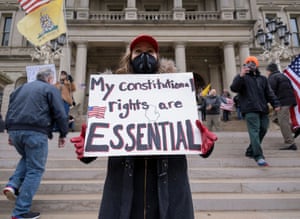
A woman wearing a face mask holds a placard as supporters of the Michigan Conservative Coalition protest against the state’s extended stay-at-home order.
A woman wearing a face mask holds a placard as supporters
of the Michigan Conservative Coalition protest
against the state’s extended stay-at-home order.
Photograph: Seth Herald/Reuters Guardian
In Texas as of today there are 17,371 confirmed cases.  Maybe Ms. Weaver has less to worry about. Although whites make up 73.5% of Texas population, they account for only 34% of the COVID 19 cases (2018 US Census Bureau). In contrast African Americans in Texas make up 12.5% of the population and yet, they account for 10% of the COVID 19 cases in Texas. 

AP news reported, "African Americans account for more than one-third of COVID-19 deaths in the U.S. where the race of victims has been made publicly known. Data from states, cities and counties show black people are regularly overrepresented compared to their share of the population:


III.

About the same time racial breakdown of COVID 19 was being first reported, the beginning protests were also starting. What do you notice about the crowds (pictured above and below)?

Angry? (check).
White? (check)


from here.  Perhaps I am just seeing photographs of the crowds who are white and angry and are demanding states "open up" and allow COVID  19 to spread.  It does seem like a trend though.


IV.

Way east of Texas, where I live in northern NJ, there are 81,420 confirmed COVID 19 cases. On April 1 that number was 22,255 and that represented a significant spike from the week before when the number of cases was 3,675. That's why we have been trying our best to stay home and stop infecting ourselves and others.

Near here there are children living in homes with their dead relatives. They are right now waiting for some adult to come and remove the bodies of those they love. They don't understand what is happening apart from what they now know about dying. 

Given the morbidity rate of COVID 19 by race, many of those children are likely African Americans. They, unlike Ms. Weaver's 7 year old daughter, don't have time to make signs and go out and complain about their "freedom" and "rights" and "frustrations with the limits on their daily life."  

What we do know is that their daily lives will never be the same. 

I want people like Ms. Weaver who are put out, frustrated, economically challenged and so on to remember those children who never had to witness their loved ones die had the president acted when he was first briefed and shut down the country (something he never did) in January 2020. Instead of telling us COVID 19 was a democratic hoax, that it was contained, that it would dissolve in April like magic and other sick lies, had Mr. Trump acted responsibly and ordered the shut down and the development of tests, we would not be where we are today.

Those children waiting for help would be out playing, like Ms. Weaver's privileged child is likely doing today. 


Thursday, April 16, 2020

#PoetryBreak: The Doorway by Louise Glück


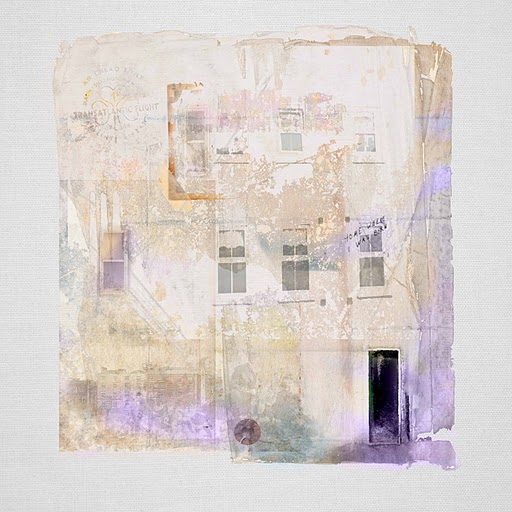
The Years Passing (M.A. Reilly)

The Doorway

 - by Louise Glück
I wanted to stay as I was
still as the world is never still,
not in midsummer but the moment before
the first flower forms, the moment
nothing is as yet past-

not midsummer, the intoxicant,
but late spring, the grass not yet
high at the edge of the garden, the early tulips
beginning to open-

like a child hovering in a doorway, watching the others,
the ones who go first,
a tense cluster of limbs, alert to
the failures of others, the public falterings

with a child’s fierce confidence of imminent power
preparing to defeat
these weaknesses, to succumb
to nothing, the time directly

prior to flowering, the epoch of mastery

before the appearance of the gift,
before possession.

#SOL20 - A Doorway: Notes from the Pandemic

Trying to Find Home (M.A. Reilly, Watercolor, Mixed media)


I.

On Thursday night he went home. He wasn’t feeling well. That week, like past weeks he worked as he had for decades as a plumber in a school system.  By other people's accounts he was an honorable and kind man, skilled at the work he did.  

By Saturday his wife had gotten him into a hospital. By Monday afternoon he was dead.

I think of him, a man I really did not know, just now know of, as he made his way through what would be his last week of life. He made his way through that week not knowing that he would never see another week.

I think of his wife who is making her way through this week.

II.

Loss is incalculable. At first it is numbing. There is no here to hold. There is a travelling of sorts that moves a body across the weeks that follow the death. The perfunctory is performed. The death is forgotten and remembered, forgotten and remembered, a tangle where the beginning piercing of pain shows itself.

Then there is the pain. 
It hurts in ways that steal the breath. It is a full body hurt.

And within all that hurt is a doorway--one that is impossible to actually know at the moment. Not knowing though, does not make it less real.

It is real and it requires us to walk through it.


David Whyte explains.


Pain is the doorway to the here and now. Physical or emotional pain is an ultimate form of ground, saying, to each of us, in effect, there is no other place than this place, no other body than this body, no other limb or joint or pang or sharpness or heartbreak but this searing presence. Pain asks us to heal by focusing not only on the place the pain is felt but also the actual way the pain is felt. Pain is a form of alertness and particularity; pain is a way in.


III.

America, like the rest of the world is poised at that doorway. Each death diminishes us. Each death is a weight we carry. The number of dead is numbing.  


IV.

The door we must walk through reminds us of what we carry in the here and now. It is an odd blessing to stand where your feet are.


Cited:
Whyte, David. Consolations: The Solace, Nourishment and Underlying Meaning of Everyday Words . Many Rivers Press. Kindle Edition. 

Wednesday, April 15, 2020

What Young People Say About the Pandemic (Newark, NJ): Notes from the Pandemic


I. 

The other night I was listening to pundits and experts on a news show discuss the pandemic. I thought about the high school students I had met the previous week in an English 12 class I had sat in on and the video and audio stories I had viewed and listened to that are part of the new project, Stories from the Pandemic. The distance between the concerns and stories the students shared and the talking heads on TV couldn't have been further apart.  The concerns of youth are not well represented when I listen to the discussions about the pandemic from Washington DC or state houses across the country. 

We need to listen to youth.

In thinking about the kind of assignments that might make a difference in our young people's lives, colleagues from Newark Public Schools in NJ teamed with a professor and a media company to launch, Stories from the Pandemic. Timothy Raphael, Director for the Center for Migration and the Global City and an associate professor at Rutgers-Newark and colleagues from Newark Public Schools, NJ (Brian Mooney, Liana Summey and 18 high school teachers) and department chairpersons) have teamed together with Dr. Raphael and Talking Eyes Media to produce the project.  

The site will feature the stories by high school students from American History High School, Central High School, Eagle Academy, East Side High School, Malcolm X. Shabazz High School, Technology High School, University High School, and Weequahic High School--all public schools in Newark, NJ. This is the beginning of that project. 

Tim writes:


Young people in Newark, NJ, an area with one of the highest rates of COVID-19 in the country, are adjusting to life under quarantine while processing the potential impact on their families’ health and economic security. In response, Newest Americans has created Stories from the Pandemic, a web platform for young people to document their experience in real time using photography, video, writing and audio. Our goal is to give students an opportunity to observe, reflect, and share their personal stories in order to feel less isolated while becoming frontline documentarians for their local community and beyond.

II. 

Here is the first assignment.


Digital Storytelling Project
Assignment *

Through an audio recording, video recording, or photograph(s),
  1. Capture how this virus has disrupted your school year—including sporting events, concerts, assemblies, dances.
  2. Discuss how your daily life has been disrupted.
  3. Share the effect it has had on your friends and family.
  4. Describe the situation at home. How many people are you quarantined with? Who does that include?
  5. Discuss the changes that have occurred in Newark since you first learned about the virus.
  6. Include your name, age, and school.


MAINTAIN YOUR SAFETY
Do this reporting from your home, out your window, via Skype/Zoom/Facetime. Do not leave your home for this project, but do document if you go out for some other reason like shopping or walking.

This is followed by ways to upload audio, video, and photographic stills.

* Discussion questions adapted from from Kelly Gallagher http://www.kellygallagher.org/instructional-materials


III.

Take a look and listen to the first set of stories.  We need to learn from students. High school and college age students can share stories here


Monday, April 13, 2020

#PoetryBreak: Love After Love


 A page from one of my art journals.


Love After Love
 - by Derek Walcott
The time will come
when, with elation
you will greet yourself arriving
at your own door, in your own mirror
and each will smile at the other’s welcome,
and say, sit here. Eat.
You will love again the stranger who was your self.
Give wine. Give bread. Give back your heart
to itself, to the stranger who has loved you
all your life, whom you ignored
for another, who knows you by heart.
Take down the love letters from the bookshelf,
the photographs, the desperate notes,
peel your own image from the mirror.
Sit. Feast on your life.

#SOL20 - Finding Meaning: Notes from the Pandemic


I. 

"I'm trying to see this place even as I'm walking through it," is the conclusion to Catherine Pierce's poem, "Planet." That closing line has stayed with me the last few days. It expresses the way I have felt this last month. Not so much a stranger, but rather one who needs to better understand the overly familiar in some new ways. 

Pandemics shift the familiar, not by fundamentally changing what we see, but rather by changing who we are as we see. It's not the landscape that has been changing. Rather, how we see the landscape has been changing due to what we now are able to see. 

It is those new insights that I want to write about today.


II. 

Emily Esfahani Smith (2017), the author of The Power of Meaning: Finding Fulfillment in a World Obsessed With Happiness tells us that it is in searching for meaning that solace is created.  She writes, 

"When we devote ourselves to difficult but worthwhile tasks...our lives feel more worthwhile...The most important parts of life require hard work and sacrifice...Only by facing challenges head-on can we truly find meaning in our lives" (p. 36). 

Years ago when Rob told me to live brilliantly. I first thought it was how I did tasks. Be the best mother. Live artistically. Teach well. Brilliantly was the driver of that sentence. 

As grief lifted, I began to see flickers of new insight. The verb, live,  seemed to be the most important part of the sentence. 

Live. 
How we live. 
How we respond to life is what matters most. 

It wasn't what I was doing that mattered as much as it was how I lived.

What we will make of this present moment is defining in many ways.  The question I wonder for myself is: In what ways will I compose better versions of myself?