Showing posts with label thinking. Show all posts

Tuesday, July 26, 2016

#SOL16: When Language is Sloppy

from my art journal (M.A. Reilly, 2016)

This morning I was listening to The Brian Lehrer Show when I heard Cenk Uygur and Ana Kasparian, hosts of the show "The Young Turks" speaking with Brian. I was stopped when I heard Cenk say this,
"Millennials are far better educated than older listeners and viewers. And so they get their information online which means they can actually do research and they can find out policy positions. If you just watch TV you will find out almost nothing about policy of Hillary Clinton, Bernie Sanders...so that's why millennials were more upset. They were more correct. Their progressive position lost."
I was born towards the end of the Baby Boomers and so I am clearly not a millennial (although I have taught hundreds) and according to Cenk I am in the second group--older listeners and viewers--and by default I therefore must be less educated and a poor user of the Internet (apparently the only place one can accomplish research). Perhaps if I tell Columbia this info they will return the dollars I paid while earning a doctorate.  But I digress.

What is irksome is the faulty thinking that frames these careless words, perhaps tossed out more for effect than for substance. But perhaps not. For this well may be a belief that has become a personal truth for Cenk and perhaps for others too.  And isn't it an easy truth to repeat?

We're great. You're misinformed.

But personal truths are not universal. Easy narratives, like Cenk's are often examples of bias, of arrogance. And I felt poorly served by his words for his language was faulty. For example, it is faulty reasoning to assume millennials know more than older voters because they (and apparently only they) can access information via the net. So what? Accessing information should never be confused with reasoning. Reasoning is a rather different animal. Pointing and clicking and even passing the eyes over a brief is not the same thing as deconstructing an argument, researching contrasting points of view, juxtaposing belief alongside fact, considering the weight of bias. Research is never a point and click matter.

Reading a policy brief or as Sanders' situates these--issues, should not be confused with being well informed--in crafting a position of your own, in comparing and contrasting points of views. And though I regularly do use the net (imagine I don't need help of a 20+ to do so), I also value learning through non-electric means as well. As a teacher and professor, I have been listening to the narratives of Baby Boomers, Gen X and Y -ers, Millennials, and most important, those beautiful young minds we have yet to attach a label. Listening matters and I had hoped to hear something compelling in the exchange this morning. Mostly I felt discounted.

Had I a phone at the time what I wanted to say to Cenk was that sloppy thinking does not a revolution make. A revolution requires far more thought. Sloppy thinking mostly divides us unnecessarily, creating camps when we are better served by more humble understandings of other.

You can hear the full exchange among Brian, Cenk and Ana here.  Curious what you make of it.


Sunday, February 8, 2015

Adding Content (Pass It On!)

Guiding students to add relevant content to their writing is a critical task. Often students state that they have noting more to add to the text they are writing when answering content-based questions. The writing technique, "Adding Content (Pass it On)" can help students to have more to say that is relevant. This technique makes use of three important scaffolds:


  1. Using questions (5Ws & H) to generate relevant writing,  
  2. Prompting the recall of knowledge based on peers' responses, and
  3. Rereading.  


Below is a chart that outlines what the teacher does and what students do during this brief writing engagement.

from Think Literacy Cross-Curricular Approaches, Grades 7-12
Teacher Resource from Think Literacy Cross-Curricular Approaches, Grades 7-12


Student Resource from Think Literacy Cross-Curricular Approaches, Grades 7-12


Saturday, January 31, 2015

Writing Well Begins With Critical Reading: Talking Back to Scripted Programs


Pandora Story Map Based on Kimmell Version of the Myth
I. Greek Mythology Unit Designed by Teachers

For the last few weeks I have been working with a group of fourth grade teachers.  We co-designed a unit of study focusing on Greek Mythology that embedded reading, writing, speaking-listening, and language standards throughout the unit. Students had the opportunity and responsibility to listen to, read and view Greek myths--and to respond to those texts through discussion and writing. 

Through interactive read aloud with an emphasis on critically retelling and vocabulary development, and through guided reading that privileged comprehension conversations students read deeply.  They also engaged in shared, guided, and independent writing. Students were able to demonstrate a keen understanding of what they heard, read, and viewed through their whole class, small group and partner discussions and their writings.  Students heard, read and viewed multiple versions of each myth (print, visual arts, and video). This allowed them to compare versions and to complicate their understanding. This critical reading work represented the foundation that students' writings rested upon.


II. Anchoring What Is Heard/Viewed/Read

In order to anchor what was heard, viewed, and read--students created different types of story maps in response to the read aloud texts, such as the two Pandora story maps pictured here.  To analyze the myths, students first needed to be able to retell the story accurately.  It is impossible to analyze a text well if literal understanding is absent or faulty. Therefore, students with the help of their teachers, created a story map for each text. Teachers began this process by having students retell the myth. A deep retelling included:
Pandora Story Map Based on Burleigh/Colon Version of the Myth

  1. Retell what happened.
  2. Why it happened
  3. The effect on the characters’ mental state
  4. Be able to emphasize connections between earlier and later parts in the story.
  5. Retell with emphasis on character insight, touching on genre-specific elements and attempting to use the vocabulary or figurative language used in the text.


They also created character analysis anchor charts focusing on explicating indirect methods of characterization by naming and then analyzing what a character does, thinks, and says and then asking what might be inferred.  For example, when studying the Pandora myth, the class created an anchor chart. They named Pandora's actions, thoughts and speech and then analyzed what might be inferred. What did Pandora's actions, thoughts, and speech reveal about her character? This work allowed them to later step into the character in response to a writing task (see below).

III. Writing Rests on Reading

After studying two or more versions of the Pandora story (read aloud and guided reading), students responded to the prompt pictured below by writing a narrative that continues the story.
First major writing task in the mythology unit.


Attempting to enter into the myth at the point depicted in the visual art required students to read the painting, to consider the two or more versions of the story they had read, and to think about the inferences they had made in order to craft a believable text. I want to emphasize that no graphic organizers were used or needed during the writing because students deeply understood the myth.  Instead of some formula to guide their writing, students rested their work on what they had read and analyzed. By critically reading, discussing and writing they had already walked in Pandora's shoes. Because students had so closely studied different versions of the myth and had analyzed the characters--their responses were well grounded.

Standard W.4.9a asks students "to draw evidence from literary texts to support analysis, reflection, and research." Specifically, students are asked to "[a]pply grade 4 Reading standards to literature (e.g., “Describe in depth a character, setting, or event in a story or drama, drawing on specific details in the text [e.g., a character’s thoughts, words, or actions].”).  To do this well, students needed to use their knowledge of Pandora through the analyses they had done, drawing on specific details from one or more versions of the myth in order to extend the story.  Let's look closely at how one student did this.

IV. Studying One Student's Writing

Below is an example of one student's response (Catherine Esteves) from Jacqueline Peguero's fourth grade classroom in Newark, NJ.   Notice how the details Catherine crafts fits with the tone of the myth and re-establishes a credible setting ("Darkness circled around me..."). Notice how Catherine uses story language ("Then I sank into a deep sleep.") to forward the narrative. Notice her diction ("bat-like creatures hurrying," "ropes loosened") and the blend of narration and dialogue to forward the plot.  In Catherine's guided reading work she read Nathaniel Hawthorne's story, The Paradise of Children, and we can see how she borrows from Hawthorne's retelling of Pandora by having Epimetheus assume some of the blame for releasing evil into the world, as well. She also draws from the painting by Gerhartz by referencing the flowers. Yet she doesn't merely mimic what she has read or viewed for in Catherine's version she couples together the goodness of the world by having Love, Kindness, Grace and Caring (to name but a few) join Hope--thereby resettling the world. As Catherine has learned through reading, she closes her version of the myth with a statement to her reader: Remember, good will always be stronger and have more power than bad. We sense the author behind the work.

Page 1 from Catherine's writing.

Page 2 from Catherine's writing.


Through diction and character action, Catherine crafts a believable and controlled piece of writing that helps us to understand the painting and the written myths more fully. 


V. When Teachers Author

I have had the pleasure of working as an external consultant with Jackie and her colleagues (Waleska Burgos and John Feinstein) for the last few years.  In a conversation with Jackie a week ago she mentioned that her students' parents were commenting on how much their children were enjoying the mythology unit.  Jackie said that what surprised her the most was that parents had nothing to say during the Expeditionary Learning module they had done earlier in the year and that made her wonder how well that work had been received. 

When teachers author academic studies they can better respond to what emerges as well as build from one portion of the year to the next and from year to year. We had decided to write our own unit in order to replace an Expeditionary Learning (EL) module as the teachers and I thought that the EL work was not sturdy enough academically (especially with regard to writing and deep analysis), nor could a unit made by another in an earlier time and place be responsive to emerging academic and social needs and strengths we saw occurring with the children. We also wanted to ensure that students continued to explore mythology. 

Kindergarten children at these schools are listening to folk tales through read alouds and beginning in first grade students begin reading traditional literature in guided reading. These reading efforts are supported through read aloud units in grades 1, 2, and 3. In first grade, children are introduced to cautionary tales (Red Riding Hood versions), fables and tall tales in grade 2, and in grade 3 they study mythology generated by indigenous people. These earlier works set the stage for the work being conducted in grade 4. Alongside this work, teachers in earlier grades are able to help students respond to text through whole class shared writing and through guided practice during guided reading.  For example, in Suzanne Capuano's second grade I taught a small group of struggling reader last week. I taught the group in response to a concern Suzanne raised about the children's reading. She said that she noticed that the children were having difficulty remembering what they were reading during retelling. By identifying a learning challenge, Suzanne set the stage for us to problem solve.

During guided reading, I asked the students to respond to a Red Riding Hood story by charting the actions of the wolf or Red Riding Hood. The children read the text first and then during a rereading of the text, they partnered and completed the chart with guidance (see below). 


One of the teachers (grades 1, 2 an 3 teachers viewed) observing the lesson said that what was most notable was that the children's confidence increased  as did the lateral discussion that happened as the children worked through the text. The children knew they were successful, no gold star was necessary. 

Children in this class learned to think about what a character does and says during earlier read aloud units when their teacher created anchor charts that helped students to think about what a character says and does and what we infer based on those actions and speech. I built on that knowledge. Students also have daily opportunities to interpret what characters say as is evidence below in a second grader's response to a read aloud about Sonia Sotomayor.


Christopher's response to a quote from Jonah Winter's book about Sonia Sotomayor.
Christopher interprets through writing and drawing the quote: "Success comes to those who make the most of the chances they are offered in life."   He wisely tells us: "When you get chances that can change your life take risks. If you can't take (a) chance you might not succeed."

VI. Risk Taking

The weave among read aloud, guided and independent reading, and writing is critical and needs to be designed and organized by teachers who are working with children in the here and now--not by corporations who mass produce units of study and distributed them like cheap pens. We all ought to worry when we see teachers being confined to enacting scripted programs, not simply because the programs may or may not be lacking, but more importantly authoring is a critical and necessary practice for teaching and learning. At the schools where Jackie, Waleska, John and Suzanne work they are provided with the professional respect by their leadership to think, design, and redesign. Excellence does not come by handing teachers already completed units of study and limiting them to merely enacting them. This is a grave error.  We need to follow Christopher's advice and take risks.  'Fool' proofing curriculum is an epic failure. 


Monday, September 23, 2013

Teaching Writing: A Few Resources

Happiness Is The Longing for Repetition. (M.A. Reilly, 2009)

I. Repetition

I cannot imagine teaching writing without writing daily . Janna Malamud Smith writes:
I posit that life is better when you possess a sustaining practice that holds your desire, demands your attention, and requires effort; a plot of ground that gratifies the wish to labor and create—and, by so doing, to rule over an imagined world of your own. (Kindle Locations 66-67). 
How often do young leaners have the time and agency "to rule over an imagined world of your own"?

Steven Pressfield opens The War of Art by describing the rituals of his writing. He writes:
I get up, take a shower, have breakfast. I read the paper, brush my teeth. If I have phone calls to make, I make them. I've got my coffee now. I put on my lucky work boots and stitch up the lucky laces that my niece Meredith gave me. I head back to my office, crank up the computer. My lucky hooded sweatshirt is draped over the chair, with the lucky charm I got from a gypsy in Saintes-Maries-de-la-Mer for only eight bucks in francs, and my lucky LARGO name tag that came from a dream I once had. I put it on. On my thesaurus is my lucky cannon that my friend Bob Versandi gave me from Morro Castle, Cuba. I point it toward my chair, so it can fire inspiration into me. I say my prayer, which is the Invocation of the Muse from Homer's Odyssey, translation by T. E. Lawrence, Lawrence of Arabia, which my dear mate Paul Rink gave me and which sits near my shelf with the cuff links that belonged to my father and my lucky acorn from the battlefield at Thermopylae . It's about ten-thirty now. I sit down and plunge in. When I start making typos, I know I'm getting tired. That's four hours or so. I've hit the point of diminishing returns. I wrap for the day. Copy whatever I've done to disk and stash the disk in the glove compartment of my truck in case there's a fire and I have to run for it. I power down. It's three, three-thirty. The office is closed. How many pages have I produced ? I don't care. Are they any good? I don't even think about it. All that matters is I've put in my time and hit it with all I've got. All that counts is that, for this day, for this session, I have overcome Resistance. (Kindle Locations 70-81)
WHAT I KNOW There's a secret that real writers know that wannabe writers don't, and the secret is this: It's not the writing part that's hard. What's hard is sitting down to write. What keeps us from sitting down is Resistance. (Kindle Locations 82-84). 

What rituals do learners make inside of classrooms?  How might these rituals inform/become content we need to learn?

II.  Loss

An odd truth, perhaps, but writing like fine teaching, requires something to have been lost--something beyond our naming and what we think we know at the beginning.  It is in this losing that the work we craft is the work we become. This is not something I think you can learn easily from reading a book about writing.  Rather, it is work that requires more of you and the you you are becoming alongside others.

So before venturing on to the list below, if you are not already writing daily, I hope you will make time to do so.  Perhaps 10 minutes a day to start...

III. A Few Lists...Largely Arbitrary

A Few Books That Inspire Me to Look Closely (Really this list is arbitrary.  Perhaps substitute with those texts you cannot help but put down/pick up/put down/pick up/Turn towards and away... and so on)

Bateson, Mary Catherine. 2010. Composing a Further Life: The Age of Active Wisdom. New York: Knopf.
Berger, John & Jean Mohr. 2011. Another Way of Telling. New York: Vintage.
Berry, Wendell. 1996. The Unsettling of America: Culture & Agriculture. Sierra Club Books.
Danticat, Edwidge. 2011. Create Dangerously: The Immigrant Artist at Work. New York: Vintage.
Diaz, Junot. 2012. This is How You Lose Her. New York: Riverhead.
Dillard, Annie. 2013. Teaching a Stone to Talk: Expeditions and Encounters, Revised Edition. New York: Perennial.
Gaiman Neil. 2013. The Ocean at the End of the Lane: Audio CD. New York: William Morrow. (I could listen to hime= read for weeks and weeks.)
Heaney, Seamus. 1997. The Spirit Level: Poems. New York: Farrar, Straus & Giroux. 
Heaney, Seamus. 2011. Human Chain: Poems. New York: Farrar, Straus & Giroux. 
hooks, bell. 1997. Bone Black: Memoirs of a Girlhood. New York: Holt.
Morrison, Toni. 2008. What Moves at the Margin: Selected Nonfiction. University Press of Mississippi.
Solnit, Rebecca. 2010. A Field Guide To Getting Lost. New York: Penguin.

A Few Books To Strengthen Your Own Art as Writer

King, Stephen. 2000. On Writing: A Memoir of the Craft. New York: Scribner.
Lamott, Anne. 2007. Bird by Bird: Some Instructions on Writing and Life. New York: Anchor Books.
Pressfield, Steven. 2011. The War of Art. New York: Black Irish Entertainment LLC.

A Few Books To Complicate Your Teaching Practices

Dyson, Anne Haas. 1993. Social Worlds of Children Learning to Write in Urban Primary Schools.New York: Teachers College Press.
Dyson, Anne Haas. 1997. Writing Superheroes: Contemporary Childhood, Popular Culture, and Classroom Literacy.New York: Teachers College Press.
****Dyson, Anne Haas.2013. ReWRITING the Basics: literacy Learning in Children's Cultures. New York: Teachers College Press.
Graves, Donald. 2003. Writing: Teachers and Children at Work –Twentieth Anniversary Edition. Portsmouth, NH: Heinemann.
Heard, Georgia and McDonough. 2009. A Place of Wonder. Portland, ME: Stenhouse Publishers.

****Reading now.

Cited
Smith, Janna Malamud. 2012. An Absorbing Errand: How Artists and Craftsmen Make Their Way to Mastery. Berkeley, CA Counterpoint.

Friday, November 23, 2012

50 Professional Texts that Influence My Thinking: An Eclectic Set


Dreaming of Kurt Schwitters (M.A. Reilly, 2011)

An eclectic set of professional texts  that I have read that influence my thinking. Curious as to which books you would include in a list. 

  1. Albers, Joseph. (2006). Interaction of Color. New haven, CT: Yale University Press.
  2. Alexander, Christopher; Sara Ishikawa, and Murray Silverstein. (1977). A Pattern Language: Towns, Buildings, Construction.  London: Oxford University Press.
  3. Arnheim, Rudolf. (2004). Visual Thinking: Thirty-fifth Anniversary. Berkeley, CA: University of California Press. 
  4. Bachelard, Gaston. (1958/1994). The Poetics of Space. Maria Jolas, translator. Boston: Beacon Press.
  5. Bakhtin, M.M. (1981). The Dialogic Imagination: Four Essays. Michael Holquist, editor. Vadim Liapunov, translator. Austin, TX: University of Texas Press.
  6. Bakhtin, M.M. (1986). Speech Genres and Other Late Essays. Caryl Emerson & Michael Holquist, editors. Vern W. McGee, translator. Austin, TX: University of Texas Press.
  7. Bang, Molly. (2000). Picture This: How Pictures Work. San Francisco, CA: Chronicle Books.
  8. Barthes, Roland. (2010). Camera Lucida: Reflections on Photography. New York: Hill and Wang.
  9. Bateson, Mary Catherine. (1995). Peripheral Visions: Learning Along the Way. New York: HarperCollins.
  10. Benjamin, Walter. (1969).  Illuminations: Essays and Reflections. Schocken.
  11. Berger, John. (1995). Another Way of Telling. New York: Vintage.
  12. Berger, Ron. (2003). The Ethics of Excellence: Building a Culture of Craftsmanship with Students. Portsmouth, NH: Heinemann.
  13. Bhabha, Homi K. (2004). The Location of Culture. London: Routledge.
  14. Brookfield, Stephen & Steven Presskill. (2005). Discussion as a Way of Teaching: Tools and Techniques for Democratic Classrooms, 2nd Ed. San Francisco, CA: Jossey Bass.
  15. Bruner, Jerome. (1986). Actual Minds: Possible Worlds. Cambridge, MA: Harvard University Press.
  16. Butler, Judith. (2005). Giving an Account of Oneself. New York: Fordham University Press.
  17. Deleuze, Gilles & Felox Guattari. (1987). A Thousand Plateaus: Capitalism and Schizophrenia. Minneapolis, MN: University of Minnesota Press.
  18. Deleuze, Gilles & Claire Parnet. (2002).  Dialogues, Second Ed. New York: Columbia University Press.
  19. Dewey, John. (2005). Art as Experience. New York: Perigee Trade.
  20. Eisner, Elliott. (2004). The Arts and the Creation of Mind. New Haven, CT: Yale University Press.
  21. Elbow, Peter. (1973/1998). Writing without Teachers: 25th Anniversary Edition. New York: Oxford University Press.
  22. Freire, Paulo. (2000). Pedagogy of the Oppressed. 30th Anniversary Edition. Myra Bergman Ramos, translator. New York: Continuum.
  23. Gee, James. (2011). Social Linguistics and Literacies: Ideology in Discourse. London: Routledge.
  24. Gonzalez, Norma, Luis Moll, and Cathy Amanti (Eds).(2005).  Funds of Knowledge: Theorizing Practices in Households and Classrooms. Mahwah, NJ: Lawrence Erlbaum.
  25. Greene, Maxine. (2000). Releasing the Imagination: Essays on Education, the Arts, and Social Change. San Francisco: Jossey Bass.
  26. Greene, Maxine. (1988). The Dialectic of Freedom. New York: Teachers College Press.
  27. Grumet, Madeleine. (1988). Bitter Milk: Women and Teaching. Amherst, MA: The University of Massachusetts Press.
  28. Hayles, N. Catherine, (2012). How We Think: Digital Media and Contemporary Technogenesis. Chicago, IL: University of Chicago Press. 
  29. Heath, Shirley Brice. (1983). Ways with Words: Language, Life and Work in Communities and Classrooms. Cambridge, MA: Cambridge University Press.
  30. Henry Jenkins, Henry, Ravi Purushotma, Margaret Weigel, Katie Clinton, Alice J. Robison (2009). Confronting the Challenges of Participatory Culture: Media Education for the 21st Century (The John D. and Catherine T. MacArthur Foundation Reports on Digital Media and Learning).  Cambridge MA: MIT Press.
  31. hooks, bell. (2003). Teaching Community: A Pedagogy of Hope. London: Routledge.
  32. Huizinga, Johan. (1971). Homo Ludens: A Study of the Play-Element in Culture. Boston, MA Beacon Press.
  33. Iser, W. (1974). The implied reader: Patterns of communication in prose fiction from Bunyan to Beckett. Baltimore: Johns Hopkins University Press.
  34. Ito, Mizuko, Heather A. Horst, Megan Finn, Arthur Law, Annie Manion, Sarai Mitnick, David Schlossberg and Sarita Yardi. (2009). Hanging Out, Messing Around and Geeking Out: Kids Living and Learning with New Media. Cambridge, MA: MIT Press. 
  35. Latour, Bruno. (2007). Reassembling the Social: An Introduction to Actor-Netwok-Theory. Oxford.
  36. Lefebvre, Henri. (19920. The Production of Space. London: Wiley-Blackwell.
  37. Newkirk, Thomas, (2011). The Art of Slow Reading: Six Time Honored Practices for Engagement. Portsmouth, NH: Heinemann.
  38. Pinar, William. (2011). What is Curriculum Theory? 2nd Edition. London: Routledge.
  39. Rogoff, Barbara. (1991). Apprenticeship in Thinking: Cognitive Development in Social Context. London: Oxford University Press.
  40. Rosenblatt, Louise.  (1978/1994). The Reader, The Text, and the Poem: Transactional Theory of the Literary Work. Carbondale, IL: Southern Illinois University Press.
  41. Soja, Edward. (1997/2011). Postmodern geographies: The reassertion of space in critical social theory. New York: Verso.
  42. Sumara, Dennis. (1996). Private Readings in Public: Schooling the Literary Imagination. New York: Peter Lang.
  43. Sutton-Smith, Brian. (2001). The Ambiguity of Play. Cambridge, MA Harvard University Press.
  44. Tharp, Roland & Rolland Gallimore. (1988). Rousing Minds to Life: Teaching, Learning & Schooling in Social Context. Cambridge University Press
  45. Thomas, Doug  & John Seely Brown. (2011). A New Culture of Learning: Cultivating the imagination for a World of Constant Change. CreateSpace.
  46. Vinz, Ruth. (1996). Composing a Teaching Life. Portsmouth, NH: Heinemann.
  47. Vygotsky, Lev. (1986). Thought and Language. Cambridge, MA: MIT Press.
  48. Weinberger, David. (2012). Too Big To Know: Rethinking Knowledge Now That Facts Aren't the Facts, Experts are Everywhere, and The Smartest Person in the Room is the Room. New York: Basic Books.
  49. Weschler, Lawrence. (2009). Seeing is Forgetting the Name of the Thing One Sees. University of California Press.
  50. Wheatley, Margaret J. (2002). Turning to One Another: Simple Conversations to Restore Hope. San Francisco, CA: Berrett-Kohler.

Sunday, November 18, 2012

Read Aloud Books About Wondering: K-3

Fishing (M.A. Reilly, 2012)

Wonder is a word to wonder about. It contains a mixture of messages: Something marvelous and miraculous, surprising, raising unanswerable questions about itself, making the observer wonder, even raising questions like, "I wonder about that." Miraculous and marvelous are clues; both words come from an ancient Indo-European root meaning simply to smile or to laugh. Anything wonderful is something to smile in the presence of in admiration (which, by the way comes from the same root, along with, of all telling words, "mirror") (Lewis Thomas, pp. 55-56).


A. Noticing, Hearing, & Observing

Anderson, Stephen. (2001). I Know the Moon. Illustrated by Greg Couch. New York: Philomel.

Baylor, Byrd. (1997). The Other Way to Listen. Illustrated by Peter Parnall. New York: Aladdin.

Brown, Margaret Wise. (1990). The Important Book. Illustrated by Leonard Weisgard. New York: HarperCollins.

Bruchac, Joseph. 2004. Rachel Carson: Preserving a Sense of Wonder. Illustrated by Thomas Locker. Golden, CO: Fulcrum Publishing. 

Fleming, Candace. (2001). Gabriella's Song. Illustrated by Giselle Potter. New York: Atheneum.

Frost, Helen. (2012). Step Gently Out. Illustrated by Rick Lieder. Cambridge, MA: Candlewick Press. 

Lach, William. (2006). Can You Hear It? New York: Harry N. Abrams.

Showers, Paul. (1993). The Listening Walk. Illustrated by Aliki. New York: HarperCollins. 
Standbridge, Joanne. (2012). The Extraordinary Music of Mr. Ives: The True Story of a Famous American Composer. New York: Houghton Mifflin. 
Zhang, Song Nan. (1998). The Children of China: An Artist’s Journey. Toronto, ON: Tundra Books. 
from Outside Your Window
B. Exploring the World
Brandt, Deanna. (1998). Bird Log Kids: A Kid's Journal to Record Their Birding Experiences.Cambridge, MA: Adventure Publications.
Davies, Nicola. (2012). Outside Your Window: A First Book of Nature. Illustrated by Mark Hearld. Cambridge, MA Candlewick Press.

Engle, Margarita. (2010). Summer Birds: the Butterflies of Maria Merian. Illustrated by Julie Paschkis. New York: Henry Holt.
McCloskey, Robert (1989). Time of Wonder. New York: Puffin. 
McLerran, Alice. (2004). Roxaboxen. Illustrated by Barbara Cooney. New York: HarperCollins.
Silver, Donald. (1993). One Small Square: Backyard. Illustrated by Patricia J. Wynne. New York: Learning Triangle Press. 
Silver, Donald. (1998). One Small Square: The Night Sky. Illustrated by Patricia J. Wynne. New York: Learning Triangle Press. New York: McGraw Hill. 
Slodovnick, Avi. (2010). The Tooth. Illustrated by Manon Gauthier. La Jolla, CA: Kane-Miller.


C. Playing & Imagining
Brideges, Shirin. (2008). The Umbrella Queen. Illustrated by Taeeun Yoo. New York: Greenwillow. 
Browne, Anthony. (2003). The Shape Game. New York: Farrar, Straus and Giroux. 
Catchpool, Michael. (2012). The Cloud Spinner. Illustrated by Alison Jay. New York: Knopf Books. 

Christian, Peggy. (2008). If You Find a Rock. Illustrated by Barbara Hirsch Lember. San Anselmo, CA: Sandpiper Press. 
Dematons, Charlotte. (2001). Let's Go. Rotterdam: Lemniscaat.
Manning, Maurie J. (2008). Kitchen Dance. New York: Clarion. 
Hutchins, Hazel & Gail Herbert. (2008). Mattland. Illustrated by Dusabn Petricic. Vancouver, BC: Annick Press. 
Johnson, Angela. (2004). Violet’s Music. Illustrated by Laura Huliska-Beith. New York: Dial Books. 
Lee, Suzy. (2010). Shadow. San Francisco, CA: Chronicle Books.
Lee, Suzy. (2007). The Zoo. La Jolla, CA: Kane-Miller.
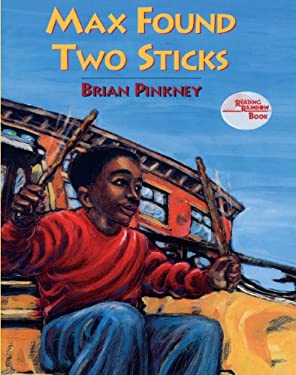
Pinkney, Brian. (1997). Max Found Two Sticks. New York: Simon & Schuster. 
Prats, Joan. (2005). Sebastian's Roller Skates. Illustrated by Francesc Rovira. La Jolla, CA: Kane-Miller.
Stein, Mathilde. (2012). Dear Daisy Dunnington. Illustrated by Chuck Groenink. New York: Lemniscaat.
van der Heife, Iris. (2006). The Red Chalk. Illustrated by Marije Tolman. New York: Lemniscaat.
Young, Cybele. (2011). A Few Blocks. Toronto, ON: Groundwood Books.

from On My Block
D. Coming to Know Other Creative People
Christensen, Bonnie. (2011). Fabulous: A Portrait of Andy Warhol. New York: Henry Holt. 
Goldberg, Dana (Ed.) (2012). On My Block: Stories and Paintings by Fifteen Artists. San Francisco, CA: Children’s Book Press.
Golio, Gary. (2012). Spirit Seeker: Coltrane’s Musical Journey. Illustrated by Rudy Gutierrez. New York: Clarion. 
Hill, Larry Carrick. (2010). Dave the Potter, Artist, Poet, Slave. Illustrated by Bryan Collier. New York: Little, Brown. 
Medina, Tony (2009). I and I: Bob Marley. Illustrated by Joshua Watson New York: Lee & Low.

From: When The Moon Forgot
E. Pondering & Problem Solving
Fitzpatrick, Mary Louise. (2009). There. New York: Roaring Brook Press.

Forest, Heather. (2006). Wonder Tales from Around the World. Little Rock, AK: August House. 

Jeffers, Oliver. (2011). Stuck. New York: Philomel.
Kamkwamba, William and Bryan Mealer. (2012). The Boy Who Harnessed the Wind: Young Readers Edition. Illustrated by Elizabeth Zunon. New York: Dial. 

King, Martin Luther, Jr. (2012). I Have a Dream. Illustrated by Kadir Nelson. New York: Schwartz and Wade. 

Liao, Jimmy. (2009). When the Moon Forgot. New York: Little Brown. 
Meinderts, Kos & Annette Fienieg. (2012). The Man in the Clouds. New York: Lemniscaat.
Pennypacker, Sara. (2009). Sparrow Girl. Illustrated by Yoko Tanaka.New York: Hyperion.
Saltzberg, Barney. (2010).  Beautiful Oops! New York: Workman Publishing Company. 
Stoop Naoko. (2012). Red Knit Cap Girl. New York: Little, Brown. 
Veldkamp, Tjibbe. (2011).  Tom the Tamer. Illustrated by Philip Hopman. New York: Lemniscaat.
Young, Cybele. (2011). Ten Birds. Toronto, ON: Kids Can Press.

from The Conductor
F. Looking Closely (Wordless Books)
Dematons, Charlotte. (2006). The Yellow Balloon. Rotterdam: Lemniscaat.
Devernay, Laetitia. (2011). The Conductor. San Francisco, CA: Chronicle Books.
Schubert, Dieter. (2011). The Umbrella. New York: Lemniscaat. 

Seeger, Laura Vaccaro. (2012). Green. New York: Roaring Brook Press. 

Sheen Dong Il. (2002). Yellow Umbrella. Illustrated by Jae-Soo-Liu.  La Jolla, CA: Kane-Miller. (Please note this is a wordless book and comes with a music CD. Plenty to notice via the illustrations and to hear via the CD). 

Tolman, Marije & Ronald Tolman. (2012). The Island. New York: Lemniscaat.
Tolman, Marije & Ronald Tolman. (2010). The Tree House. New York: Lemniscaat.

from Infinity and Me
G. Asking Questions

Bley, Anette. (2007). And What Comes After a Thousand? La Jolla, CA: Kane & Miller.
Hosford, Kate. (2012). Infinity and Me. Illustrated by Gabi Swiatkowska. Minneapolis, MN: Carolrhoda Books.

Prap, Lisa. (2009). Why? La Jolla, CA: Kane-Miller.
Ray, Mary Lynn. (2011). Stars. Illustrated by Marla Frazee. New York: Beach Lane Books.  
Reibstein, Mark. (2008). Wabi Sabi. Illustrated by Ed Young New York: Little, Brown.
Van Camp, Richard. (2003). What’s the Most Beautiful Thing You Know About Horses? Illustrated by George Littlechild (Cree). San Francisco, CA: Children’s Book Press. 

Vaccaro, Laura Seeger. (2010). What If? New York: Roaring Brook Press. 


From: What's The Most Beautiful Thing You Know About Horses?