Showing posts with label schooling. Show all posts

Monday, September 22, 2014

Things Fall Apart: Schooling, Becoming, Not Being

Want (M.A. Reilly, 2009)

I. Becoming

I read a lot that education is broken.  A worn and tired lot, that.

It's easy, perhaps even comfortable, to lay the brokenness we feel at the feet of public education as it saves us from looking more closely beyond the institution into a void we cannot quite name. Consistency which has held us so closely is less the friend we thought. We fear seeing beyond, for our public institutions are composed to reflect the current reality we believe is whole.

It is not whole.

Our vision of what reality is--a stable, coherent ground--has not worked with fidelity for some time. Claire Colebrook (2001) reminds us:
To see any thing as actual also requires the virtual synthesis of time: we see things only by retaining the memory of past perceptions and anticipating and connecting future perceptions (p.127).
Synthesis is a stream flowing. Becoming requires us to assemble/reassemble/deconstruct. There is no standing still.

Is this fracture, standing still in a stream that moves, not the impetus, in part, for our constant warring?  Our inarticulate speech?  Stability is myth--and it is costly. The internet connects as it disrupts the ways we are in the world and the ways we experience the world.  Its fastness allows us to experience the collisions. A tacit knowing. And experiencing what we have deemed as actual now as myth, perhaps fleeting at first--a glimpse we quickly move away from, has grown more consistent, shaking "foundations" we thought we knew to be true.

There is no one Truth. There is only flow.

We are always becoming regardless of Descarte's insistence on being.  This understanding has deepened across the last century disrupting the center we hold to that says stability is our core.  It is not. Think Yeats, who nearly 100 years ago told us "the centre cannot hold".

The poets know first.

II. Schooling

Public education is built on that faux rock that says we can code the world and transmit it and what we transmit is Truth, not someone's truth, but Truth with a capital T.  Schooling has been built on the belief that we can keep ourselves whole by teaching this truth to our children who can teach it to their children and so on.  Lost in this translation is the reality that we are coding, decoding and recoding often in ways that feel and are simultaneous.  Living connected lives across vast geographies helps us to know this even as we work to deny it.  And so we are a bit like Simon Laplace, hopeful that with some measurements at hand we can name the universe--that it will hold still for us as if we were somehow apart from it.

Nothing living holds still.

Power maintainers situate curricula and pedagogies as measurements of the known universe. Educational standards, high stakes tests, school-based grading and courses often work as the means to maintain the stability myth and alongside it the power of those who get to name. Social media offers us enough clear spaces to (re)name/(un)name the world.  We don't need to hold big power to do so. The power is not in us.  The power resides across the shifting and moving things we make/break/remake.  We are animals with language.  Again, Colebrook (2001) says:
We think of language as a ‘tool’ for speakers, rather than as a differential force that produces speaking positions (p. 76).
And as more and more people connect across these vast geographies, the universe that standards and test results portray reveal speaking positions, not Truth. We come to doubt and as that doubt is echoed we can see not only the cracks undermining the ground education sits upon, but we feel the stream rushing us along.

This movement is not lost on the young, who have less time invested in the maintenance of powerful and established mythologies.  Their knowing is not limited to their selves.  Technologies that connect the young also make more explicit that they are less the individual and more the collective--calling into doubt Wittgenstein's statement, "What we cannot speak about we must pass over in silence."

They are not silent. They are roaring, moving, connecting. And it is this that creates long tails of difference with regard to how learning is organized, named, needed, desired.  We need not (re)create the system of education as this continues the myth of ground. Education reform is a sordid redundancy.  Rising without our permission are alternatives that young people already turn to as they invent.  Think of them as tribes, as PLNs, as collectives, as affinity groups.

We know more than we can say, Polyani would tell us. That's where we are, tentatively but even as I pen this, the ground beneath is moving and we are moving too.

Learning is more flow, less rocks in the stream.  And so, the space we call school is being cleared.


Cited
Colebrook, Claire (2001). Gilles Deleuze (Routledge Critical Thinkers) (p. 127). London: Taylor and Francis.


Friday, May 23, 2014

Immaturity. Arrogance. Profit.

from here. 


I. 

On the plane home from Wales, I was handed The Independent, and read a brief article that summarized findings from an editorial in the British Medical Journal claiming schools in England are neglecting children by their singular focus on academic achievement.  When I arrived home, I read the actual editorial published in the British Medical Journal that states that schools in England and the US are neglecting and may be actively harming, the physical and mental health of children by overemphasizing academics, and underemphasizing health.  

Chris Bonall, Neil Humphrey, Adam Fletcher,  Laurence Moore, Rob Anderson and Rona Campbell authors of the editorial, state:
Education policy in England increasingly encourages schools to maximise students’ academic attainment and ignore their broader wellbeing, personal development, and health.
They report that:  
...in school systems that focus on narrow academic metrics, such as those in England and the United States, some schools respond by focusing on the more able students, and not engaging other students or recognising their efforts. This is associated with many students, especially those from disadvantaged backgrounds, disengaging from school and instead investing in “anti-school” peer groups and risk behaviours, such as smoking, taking drugs, and violence. Furthermore, research suggests that “teaching to the test,” which commonly occurs in school systems with a narrow focus on attainment, can harm students’ mental health. (citation: Kruger LJ, Wandle C, Struzziero J. Coping with the stress of high stakes testing. J Appl School Psychol2007;23:109-28)
Some fairly straight words from medical doctors about the potential outcomes for educational policy.  But is anyone listening? In The Independent (May 16, 2014) there was a follow up article in which a spokesperson for the Government said:
A DfE spokesperson said the Government refused to apologise for “encourag[ing] schools to maximise students’ academic attainment”.
Cover of Time. Rhee was sweeping out the trash.

Refuse to apologize.

This is the arrogance of the new educational reformers--charlatans with little to no actual education experience. They seem to be unable to listen to anything other than their own rhetoric. This is the same tone that Michelle Rhee's infamous Time cover in which she posed with a broom signaling that the way to fix America's schools was to sweep out the trash.  This is the same woman who asked reporter John Merrow is he wanted to watch her fire a principal when she was Chancellor of Schools in Washington D.C.  

Is this really the type of person we want near children?

II.

Seated next to me on the airplane was a former primary grade teacher from England who had opted for early retirement as she could not condone the immense amount of foolish testing that she was required to do to her 5-year-old pupils.  She explained that teaching assistants who at one time worked alongside her and the children were now charged with making ticks on pieces of paper in order to record everything each child did or said so that data would be plentiful. 

When I was first teaching, she told me, we would stop class if a butterfly entered  our room. That new moment would become a lesson. We could seize upon the now. 

She lamented the singular focus on a narrow interpretation of school academics and how sand and water tables, paints and singing had been replaced with worksheets and textbooks.  As I listened to her I thought about the outrage from some parents in New York when their children's kindergarten teachers and acting principal cancelled the school show so that the children could become more career and college ready. There is an absence of imagination on the part of the teachers and the principal who cannot connect performance with important learning.

As experienced teachers, like the woman who sat next to me on the plane, leave the profession who remains to mentor beginning educators?  One of the mythologies promulgated by the new ed reformers is that experience doesn't matter--I wonder if this is because so many of them have little actual education experience to claim and it shows in how they fail to work well with others.  

III. 

In Chicago the teachers' union unanimously voted last week to not support the Common Core State Standards. Michelle Gunderson in a blog post for CTU explains why. 

The authors of the Common Core view the purpose of education as college and career readiness. We view the purpose of public education as a means for educating a populace of critical thinkers who are capable of shaping a just and equitable society in order to lead good and purpose-filled lives.
With our philosophical underpinning so drastically divergent from that of the Common Core we did not see any room for common ground. 
That is why we say no to Common Core. 
Some union locals have asked for a longer roll out of Common Core implementation. Others ask for the standards to be re-written. We say no. We are not asking the Bill Gates and Rahm Emanuels of our world to do a better job controlling the curriculum of our schools. We want them gone from the process. 

Education Reform
from here.
IV.

A rallying cry of the new ed reformers is that "Children should not be the victims of the ZIP code they live in when their education is at stake."  It's interesting that the only way to reduce that victim status is through education.  I never hear any of these same pundits arguing for income equality, for universal health care, for universal access to public housing. We won't find them supporting job creation bills. 

It is an unjust society that creates the zip code differences, not the public schools where the children land. 

I have wanted to believe that even these new ed reformers with their little experience in leadership and education still have in mind (if not heart) the very children they wax so eloquently about when provided with a media minute. It's challenging to hold on to that belief in light of the profit making that has and continues to occur. I'm reading Mercedes Schneider's A Chronicle of Echoes . She outlines the profits made and the connections forged among these new ed reformers.  It's hard to hold on to hope in light of the scheming that has happened.  

Monday, April 14, 2014

Let's Stop (re)Inventing The Committee of Ten: Getting Over School


Committee of Ten History & Government Subcommittee from here.


1. A Story, A Story

What if we have it mostly wrong? 
What if our assumption that school grades and state tests are apt indicators of academic success?  
What if our assumptions that learning discrete subjects as the means for becoming 'college and career ready' are too narrow or misinformed?
What if the goal of becoming 'college and career ready' is narrow, naive, or perhaps inappropriate?

I think about these questions each and every time I read a narrative by someone who 'failed' at school and is now successfully writing for a living.  I wonder about the dissonance between school failure and being a writer.  In the Times there was an interesting essay, The Art of Distraction, by Hanif Kureishi who writes:
As a teenager, in particular, I wanted to be good at things, to shine, but like the Ritalin boy, I fell badly behind at school, finding myself not only unable to learn but at the bottom of my class. I walked out of secondary school, and a semi-skinhead violent street culture, with three “O” levels, feeling as if I’d been badly beaten for five years.
What does it mean to be at the bottom of a class? How is such a position even allowable, let alone the conditions that would give rise to exiting high school feeling as if you had been badly beaten?  What does it mean to succeed at high school?  'School success' as measured by GPAs has a lot to do with compliance: the dutiful student who completes the assignments on time (or ahead of schedule), regurgitates teachers' language for the Friday quizzes and tests, pays attention in class (or at least looks that way), keeps a 'good notebook' filled with the notes the teachers have given, scores well on State assessments, completes test prepping packages, and doesn't cause any trouble or fall asleep in class.  One might argue given the current emphasis on accountability as measured by single tests, that a similar 'compliant' teacher may be more prized than one who 'causes trouble, agitates for a different system.'  Excellence may really be noting more than compliance.

2. Getting over Readiness

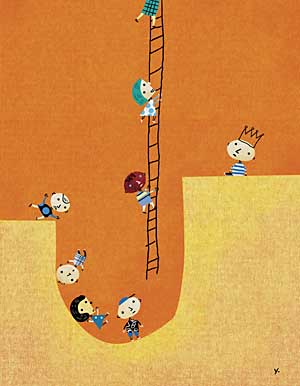
Art By James Yang
I have spent a fair amount of time in K-12 schools and recently I was walking through the hallways of a school I had not been to before.  In room after room the same two scenes were occurring: in some young people sat at single desks and whether they were in rows or small groups--they all were watching the front of the classroom where the teacher talked and talked.  In other rooms, young people sat at single desks and looked busy doing seat work while a teacher sat at his/her desk and did seat work of some sort too. Occasionally the monotony of the scene was broken with a student standing at the teacher's desk or a teacher standing at a student's desk.  In several rooms some students rested their heads on top of folded arms on their desks.  Almost always these were young people seated towards the back of the classroom and usually they were boys.

Room after room.
Floor after floor.
Nary a difference.

In recalling this school and others like it, I think about the irony of readiness, a pernicious concept, if ever there was.  How can we say to parents, "Based on our readiness tests, your child is not ready for school...." Ready for what?  To watch the adult? To fill in endless worksheets and work assignments? To be bored? To fall asleep day after day? To feel as if you had been badly beaten for five years?

3. The Committee of Ten Again, Again 

I know there are aspects of education we are doing wrong, even as I acknowledge that there are wonderful exceptions to the classrooms and school I described above. I have been in schools and classrooms where learning is vibrant, dynamic, thoughtful, edgy.  In conversations with many of these educators though they openly talk about the countless pressures they face to stop the excellence they do with students in order to attend to the given and sanctioned curriculum; the state test content; test prepping and other absurdities.  Excellence cannot be had outside of the now, the ever emerging present.  Excellence does not occur via a sealed past, an epic construct.  It emerges alongside people making and doing, failing and figuring out.  It is inherently idiosyncratic as it is communal.

The standardization of teaching, learning, and measuring that corporations, governments, some school and district leaders, as well as some parents seem to be embracing with increasing interest will only lessen student learning and interest in learning. It will confuse, not illuminate, what excellence looks and sounds like--as we will be in the business of producing a country of Harrison Bergeron's.

In Democracy and Education, John Dewey (1916) wrote:
Schools are, indeed, one important method of the transmission which forms the dispositions of the immature; but it is only one means, and, compared with other agencies, a relatively superficial means. (Kindle Locations 139-140). Public Domain Books. Kindle Edition.
55 years later in Deschooling Society, Ivan Illich (1971) stated:
Most learning is not the result of instruction. It is rather the result of unhampered participation in a meaningful setting (p. 18).
In thinking about Dewey and Illich, I believe that the idea of a place called school as the single method for formal learning may well have outlived its usefulness. Since NCLB & reiteratied through RTTT, the standardization of schools, curriculum, teaching, and learning methods has alarmingly increased and now with the Common Core State Standards, the upcoming Smarter Balanced Assessment Consortium (SBAC) and the Partnership for the Assessment of Readiness for College and Careers (PARCC) testing, and the standardization feels even more exponential. We are now faced with a product that will be the basis of measuring what constitutes privileged academic performance at most schools: a single set of standards, preferred instructional methods (close reading), learning materials, curriculum maps, professional learning modules, and continuous high stakes, national-state testing of children throughout their entire school careers. 

You only have to revisit the assumptions made by the Committee of Ten to understand that inclusiveness in groups who want to standardize, may not be in the best interest of learners or a democracy.

Found on Pearson Website here.
Achieve, Inc. photographs from their Facebook Page
I often wonder how different school might be had the NEA task force, Committee of Ten, (a group of 90 elite men) determined that observation, reasoning, and judgment could be cultivated through multiple methods and studies as opposed to tying each to a discrete subject. I often wonder how different their recommendations might have been had a few women, some newly arrived immigrants, some
people of color, some students,  and representatives who hailed from work other than teaching been part of the committee.  How might the recommendations have been different?  Replacing 90 elite men who served on the Committee of Ten in the 1890s with corporations in the 2010s who are informing the Common Core really isn't much of a change. I think here of Marx who wrote, "...one must become conscious of how an ideology reflects and distorts ... reality ... and what factors ... influence and sustain the false consciousness which it represents -- especially reified powers of domination."


If you take 90 men, hailing from elite schools (college presidents, headmasters, professors) and ask them to name what an excellent education contains--we should not be surprised that their answers (all were in agreement) will reflect their lives, their truths. Habermas told us that without a metalanguage to challenge the given assumption, power tends to  serve up itself as the model of excellence. Today it is Achieve, Inc., Pearson, McGraw Hill, ETS, state DOE, federal DOE who are the new Committee of Ten. Meet the new boss, same as the old boss...

4. Alternatives
  • Imagine if 'school' was organized not solely by discrete subjects, but by people--local, indigenous to a common ground and connected across physical, social, economic, and political geographies. Decisions about learning are made in such places, at such locations. 
  • Imagine a curriculum based on rich conversations engendered within participatory cultures where connecting, collaborating, creating and contextualizing are norm.
  • Imagine if learning was understood as natural, human--that which happens all of the time. As such, learners are by nature and nurture, capable of learning. No one need 'get ready' for learning. Failure is natural and necessary and does not warrant front page reporting, retention.
  • Imagine if learning opportunities and occasions could be curated by learners (students and teachers) for themselves and other learners? That these processes were imbued with choice.
  • Imagine if curriculum was situated as complicated conversation that learners, mentors, teachers, and community members engaged in often, daily even.
  • Imagine if work and learning were not separated so rigidly and apprenticeship was an option for learners based on their interests, needs, economies, passions and communities.
  • Imagine if the learning occurring in passion affinity spaces, in local community-based locales were privileged. Imagine if we leaned in and began to name the thinking that was being done at such 'places' what new importance might emerge.
  • Imagine if readiness was retired. 
  • Imagine if we stopped emphasizing measurement by single high stakes test and end of course grades.
  • Imagine if we did not confuse the well made argument with truth.
  • Imagine if we shifted measurement from being a far-from-student task done by 'others' and instead rested it in the hands of learners as necessary and important learning tasks that a community supported.


Monday, September 2, 2013

I Wish You The Privilege of Struggling

Darkness Becomes a Reservoir (M.A. Reilly, 2011)
I. The Copy

I have been thinking a lot the last few weeks about the business of schooling.  The mad rush to show results.  The belief now situated as truth that value is how students perform on a handful of state-sanctioned tests.   Against such beliefs, schools are being made.  


Yet, schools are not populated by students and educators--but rather they temporarily house individuals with sovereignty.  Failure to see self and other in this manner, leaves us as composites, apt consumers of myth, and it is this that is replicated in factory schools. 

Think simulacrum.  Thus, those toiling at school are not individuals with sovereignty but rather specimens or abstractions--ones that can be duplicated with great ease.


II. The Creature


At the conclusion of Walker Percy's fascinating essay, "The Loss of Creature" he observes:

the student should know what a fight he has on his hands to rescue the specimen from the educational package. The educator is only partly to blame. For there is nothing the educator can do to provide this need of the student. Everything the educator does only succeeds in becoming, for the student, part of the educational package.  The highest role of the educator is the maieutic role of Socrates: to help the student come to himself not as a consumer of experience but as a sovereign individual.
Percy though does not limit his discussion of sovereignty to that of a tourist or a student.  He tells us that we are all,
special cases of a predicament in which everyone finds himself in a modern technical society--a society, that is, in which there is a division between expert and layman, planner and consumer, in which experts and planners take special measures to teach and edify the consumer. The measures taken are measures appropriate to the consumer: The expert and the planner know and, but the consumer needs and experiences.
Giving name need not be understood as knowing or unknowing. There is room here to get lost.

III. The Manifold


In Toward a Philosophy of the Act, Bakhtin warned that we should not mistake the theoretical world for the lived one. He told us that 


…this world is fundamentally and essentially indeterminable either in theoretical categories or in categories of historical cognition or through aesthetic intuition...Only love is capable of being aesthetically productive, only in correlation with the loved is the manifold possible...  
Manifold.   Yes.  

Think of Adorno tonight who penned: "Because art is what it has become, its concept refer to what it does not contain" (2004, p.3).  There's an idea there, along with Percy and Bakhtin we need to heed.  


Cited:

Adorno, T.W. (2004). Aesthetic Theory. Trans. by Robert Hullot-Kentor. Minneapolis: University of Minnesota Press.
Bakhtin, M.M. (1993). Toward a Philosophy of the Act. Translated by Vadim Liapunov. Austin, TX: University of Texas Press. 


Friday, March 8, 2013

Schooling and Learning and Tech, Oh My!

Gathering Landscape (M.A. Reilly, 2011)

I.

It begins this way: I'm at a coffee shop and I overhear two teachers talking about a shift to a 1-to-1 environment at their school next September.  I learn that each student will be issued a Macbook Air. The teachers' voices sound excited and more than the words, their tone catches my ear and I lean a bit closer just as one says to the other:
"It will make note taking so easy."
"Absolutely. We can email our PowerPoints to the kids."
II.

A few days later I am perusing the table of contents for the March issue of ASCD's Ed Leadership, Technology-Rich Learning.  As I read I think, there's an absence here, especially an absence of young voices, of counter narratives.

III.

Maybe we need a new language. One that affords us ways of (un)seeing education--of recasting
this familiarity in new cloth--
      [seeing what is before us
                          in ways we have trouble naming--in utterances that feel
   unfamiliar to the mouth, that

(hopefully)
   give us

                   pause].

IV.

I have long been fascinated by a passage from Martin Heidegger's Building Dwelling Thinking.  It is one I have kept nearby, read and reread, and misunderstood for years.

An odd friend at that.

In explaining the function of the bridge, Heidegger writes:
The bridge swings over the stream "with case and power. It does not just connect banks that are already there. The banks emerge as banks only as the bridge crosses the stream. The bridge designedly causes them to lie across from each other. One side is set off against the other by the bridge. Nor do the banks stretch along the stream as indifferent border strips of the dry land. With the banks, the bridge brings to the stream the one and the other expanse of the landscape lying behind them. It brings stream and bank and land into each other's neighborhood. The bridge gathers the earth as landscape around the stream.

It is this mind that sees the bridge as that which gathers earth as landscape around the stream that we most need now.

V.

Much of what we talk about when we talk about technology (note the singularity of the term) remain still lifes that fit inside an old frame--a dressed up transmission model with consumption as its main aim and stability as its rudder.

Here there is always a teacher and always a student, regardless of the presence or absence of a school building.

Yet, when I listen to teenagers talk about learning, I think we have run aground.

VI.

I live with a teenager and so it's not too unusual then that I was listening for him and his friends in the Ed Leadership issue. Would we talk less about teaching and more about learning?  Would we understand that dwelling is a requisite of building and thinking comes from dwelling?  I appreciated the questions Will Richardson raised in the first article in the issue, "Students First, Not Stuff" and especially cheered when he quoted Seymour Sarason (2004) who told us, “productive learning is the learning process which engenders and reinforces wanting to learn more” (p. x).

Where is more?

VII.

When I ask my son what he might say about learning and technologies, he tells me:  It's about not knowing where you are or perhaps headed. There is no (pre)made map you can consult. And maybe that's why you can't wait to be in it, even when you don't know where in is.

My son would tell you that programming is a key literacy in his life. Java and Apple Script are giving way to an emerging interest in C++ and PHP.  As I listen to him easily list these interests, I understand that it isn't just the languages that matter,  but also the idea and practice of emergence and agency that permit desire to become dimensional.

After Will's article, I find less and less dimension and more prescription.


VIII.

We, who are so practiced at fixing, need to become unmoored, unsettled, ungrounded. We must remind each other that "the banks emerge as banks only as the bridge crosses the stream."

We keep getting that backwards, thinking we can outrun the very logic that undoes us.

IX.

"Only if we are capable of dwelling, only then can we build," says Heidegger and I wondered who among us dwells and how such dwelling resituates our talk about schooling as learning.

X.

The real plight of dwelling, Heidegger concludes is that in our search "for the nature of dwelling" we "must ever learn to dwell."

That's what is most absent in conversations about schooling and technologes and learning--the raw admission that we too must dwell.

XI.

When I think about the changes upon us that I sometimes can name, I understand that

It's less about readiness and more about doing.
It's less about discovering and more about being.
It's less about journeying and more about nomadism.
It's less about expert and novice distinctions and more about participation.
It's less about the dichotomy of right and wrong and more about context.
It's less about the prescribed curriculum and more about the made curriculum.
It's less about the fixed organization of student, teacher, and content be them flipped or not and more about middle spaces where (un)forming has infinite gesture.
XII.

Perhaps most startling is that it is less about them, and more about us.
They have already left and we are still unseeing.

XIII.

We have so much to jettison if we are to see the banks emerge.


Saturday, November 10, 2012

School as Silo: The Space that Waits to Be More Than Itself

I.  A Tweet

I was reading a few tweets and one caught my eye that had been retweeted. It said:

Education will be fixed by teachers. Yes! Leave it to the professionals. 

My first response was that the statement is partial, incomplete and filled with terms that need to be clarified. I have no doubt that the people who were tweeting and retweeting shared a context I am not knowledgeable about.  With that said, I was nonetheless concerned about two things:

  1. What exactly needs fixing? What is broken?  From whose perspective?
  2. How is it even possible that only teachers can be the single fixers of socially complex and ideological institutions, like schools? 

One of the challenges of education reform is that in lieu of sustained discourse among learners, parents, community members and educators within and across geographic/social/political/ideological spaces--schools are situated as silos.

Ideas are siloed.

Learners too.

You (and me) too.

William Carlos Williams in "Deep Religious Faith" said it best:

                                                      Shame on our poets,they have caught the prevalent fever:                impressed                                by the "laboratory,"they have forgot                 the flower!                                  which goes beyond alllaboratories!                  They have quit the job                                    of invention. Theimagination has fallen asleep                   in a poppy-cup.

Reawakening the imagination is at the center of re-seeing schools, re-situating learning.


II. A Silo

Tree in Silo by Ken Wolf. Found here. 
In farming silos are used to store different grains. The structure of the silo allows for the separation of grains, so that none mix.  Yet nothing in life holds still, remains the same. Time and intention alter use and need in silos and in schools.

In a New York Times article (4.30.12), Amid Rural Decay, Trees Take Root in Silos, A.G. Sulzberger opens the article by writing:
EUDORA, Kan. — The sight is a familiar one along the dusty back roads of the Great Plains: an old roofless silo left to the elements along with decaying barns, chicken coops and stone homesteads.This is the landscape of rural abandonment that defines a region that has struggled with generations of exodus.

Sulzberger chronicles how many silos, left to decay, are being reclaimed by trees.  The silo oddly protects the seeds from which the trees grow, as well as the maturing trees from wicked winds and other challenging weather.  
The midwest is a landscape in transition, 
like schools, 
like you,  me.
III. Mad Farmer
William Kloefkorn's poem about a mad farmer (Wendell Berry) who sings offers us a way to frame the school as silo conundrum.  Have a listen:

The Mad Farmer Shuts Himself inside His Silo to Sing Away the StormFor and after Wendell Berry
Because the silo is round
each note is round,
each note eternity in a nutshell,
and knowing this the mad farmer
knows also that his song can never be lost,
never exhausted, never indefinitely contained,
that the notes will circle and circle
until the storm relents,
until the door left open permits them
freedom 
and they will go then inevitable as seed
to the four great corners of the universe,
there to put themselves together over and over,
becoming over and over the song
that now at the height of the storm
the mad farmer hat in his hand
stands singing: 
O la and la and earth and water and wind,
sunlight and shadow,
la and la and hands deep into the soil,
and work and love,
and the greatest of these is work
and love and hands, la and la and
the immaculate equation of knowhow
and concern
until the silo spins with the mad farmer's song,
until the storm with its thunder and lightning
joins in,
la and la and crack and rumble,
and knowing these, and the fathers
and the mothers and the children of these,
the mad farmer hat yet dripping in his hand
invents a final verse, releasing each word
with its attendant note whole as faith
into the space that waits to be more than itself
when the storm relents
and the sun does its own savage work
and the harvest behold! is in.
IV. Reform/Revision/Singing Up the Country
I love the close to the poem--the wise insight the poet offers:
the mad farmer hat yet dripping in his hand
invents a final verse, releasing each word
with its attendant note whole as faith
into the space that waits to be more than itself


I think of schools as the space that waits to be more than itself. 

And we, are perhaps mad farmers, who need to invent, not replicate.  

Reform, revision, signing up the country is not about replication or  finding the one good idea that will transform schools. Rather, the action we most need is invention.

The act. 
Not the outcome.  

Yes, teachers need to invent, as do learners, moms and dads, siblings, aunts, the local grocer (if s/he still exists), the community worker, the banker, and so on. 

Out of that inventing will come the habit of invention, which is the reform, the song.
It is in reinventing self and school that we will come to name how we are:

there to put (our)selves together over and over,becoming over and over the song


Monday, October 8, 2012

Getting it Wrong: Life Out of Balance

Prairie (2010, M.A Reilly)
I.
We recently hired a landscaper--a man in his mid thirties. Salt of the earth type. He stopped by this evening to pick up the signed contract and signed proposal and check and explained the timeline to us.  One thing led to another and he spent the next hour talking about learning. It was fascinating to hear him talk about the value he placed on the leaning he did in woodworking, auto shop, and horticultural classes he had as a teenager. He's a dad to two young children, but because he volunteers time and work at area middle and high schools he's noticed that the very things he most valued at school are disappearing completely.

It's important to make stuff, he tells us, adding that he wouldn't have made it through school without the special education and shop teachers he had and coaches. He tells us that he wasn't good at the classes that kept you inside and the ones where you didn't move, like math and English.

One story he told was most poignant.  When he was first starting high school, the school had just hired a teacher to teach horticultural class. "He was like my idol," he told us.  I said to him, "You mean I can learn about landscape and architecture and not just cut lawns?" The career he would build began alongside that relationship. Today he runs a very successful business.

II.
Later, after he's gone and dinner is over--I can't get his story out of my mind.  I keep replaying it. As I think about what he has said, I wonder how many young people right now are learning that what they are not very good at or perhaps even interested in, such as math and English, constitute what is most valued at school. How does our myopic focus on school math and reading marginalize learners?  If the most important things you do at school are narrowed so severely, where is there room for young people who experience school math and reading as tedious to learn about learning?  Do these young people come to doubt themselves? To doubt their choices? Do they label themselves partially proficient? 1s?  Stupid?

Do they know they are being lied to?  How many are harmed when the woodwork program is cut so that the suite of CCSS prep classes can be added?

Who is it that will help them to know that they can dream bigger than school math and reading?  Who will help them to know that they they can embody learning, not be resigned to only being a big head? Who is it who will help them to realize the very 'non-school' dreams they have been nurturing? Are we actually surprised that so many teens don't want to be at school?

Our insane attention to measuring through high stakes test, school math and reading, reminds me of lives out of balance.  It's like we are requiring public schools to live a hyper version of the film Koyaanisqatsi and we keep forgetting the very moral and asking children and teachers to go faster and faster in order to focus more and more on math and reading, reading and math.


This madness
 

                         must end.


We must rebalance.

Tuesday, September 4, 2012

Learning from Verbs: The Shape of Knowledge

Knowmadic (2012, M.A. Reilly)
I. Photographing

I read a post, What Schools Can Learn from the World of Photography by George Couros in which he outlines four lessons from the field that he says are lessons we can apply to school. In thinking about how digital photography has altered that industry, Couros makes these insightful claims:
  1. The technology is better and cheaper which changes everything. 
  2. Communities make us (or force us to be) better.
  3. Create a culture where risks are accepted.
  4. The more access, the more we have to rethink the way we have always done things
What interested me, apart from the four examples cited, is the significant shift with regard to authority that occurred alongside the rise of the digital image/camera.

Access matters.

Who can make, not only an image, but a worthy one altered alongside the technology. This is a story about an industry that had its sanctioned experts and altered into a growing collective of professionals/aspiring/amateurs whose expertise rests not in sanctioned individuals, but more so in the collective. In opening the field, the idea of image making also changed, broadening in ways that could not have been understood 20 years ago. We have new ways of expressing, knowing/unknowing, and sharing because we can now easily (and cheaply) think through a lens.  It is this shift from lone expert to collective that disrupts authority and resituates knowledge. This shift fascinates me and I suspect is beneath the four examples Couros cites.

II. Schooling

A parallel between digital photography and school then, may well be a story about knowledge being the community (a nod to Dave Cormier) and how that transition disrupts more traditional understandings of authority.

It's rhizomes all over again.

David Weinberger (2012)  in  Too Big to Know makes several related points about the shape of knowledge and how the changing shape is also about authority.  He writes:

Shape matters. When knowledge was a pyramid, when it was based on firm foundations shared by all members of the community, when it consisted of contents filtered by reliable authorities, when we knew what was in and what was out, when it had a form and shape, knowledge had an easy authority... Knowledge now is the unshaped web of connections within which expressions of ideas live.
If knowledge is more a node and nodes are contextualized by that which they connect and are connected to, then knowledge is without a foundation. Such thinking asks us to question many of our most trusted assumptions about what counts as important knowledge and whether any ideas can be valued apart from the context in which they occurred. Weinberger explains:
Architecturally, the Net’s lack of an overall permission system makes knowledge less like self-standing content—bricks, in Bernard Forscher’s sense—and more like nodes that cannot be fully credited or even fully understood outside of the network that connects them. (Kindle Locations 3009-3011).
If schooling has been shaped by our expressions of knowledge as bounded, listable, and transferable-- then is it not expected that a new shape of learning is emerging that mimics a networked understanding of knowledge?

Borrowing from Weinberger's description of networking scientific knowledge, we could think about the shift from schooling as institution to networked learning as being:
(1) huge, (2) less hierarchical, (3) more continuously public, (4) less centrally filtered, (5) more open to differences, and (6) hyperlinked. (Kindle Locations 2104-2105)

III. Mapping is So Yesterday

Now an oddity here is how the list above conflicts with the recent push to standardize, control, centralize, and limit what counts as important knowledge via undertakings such as the Common Core State Standards (CCSS). I want to suggest here that what we see in this gesture (expensive at that) is perhaps a last (?) vestige to a past where knowledge, like authority, remained stable and known.  Modeled from within a perspective of paper-based knowing, the CCSS is a contained world punctuated by stops.  There is little, if any, middle as it is beginnings and ends that dominate. Again, Weinberger characterizes paper-based knowledge in this manner:

We created knowledge as a system of stopping points both because that’s what paper enabled and because it’s a highly efficient strategy.(Kindle Locations 2983-2984).
Stopping points.

The institution of school is filled with big stopping points. Just consider these: curriculum mapping, grade levels, student-teacher roles, school calendar, graduation, report cards, diploma, attendance, seat time, core subjects. The choice of being definitive is a stopping point.

Perhaps a rule to adopt is if you can map it, it may not be worth traversing?


Work Cited:

Weinberger, David (2012-01-03). Too Big to Know: Rethinking Knowledge Now That the Facts Aren't the Facts, Experts Are Everywhere, and the Smartest Person in the Room is the Room . Perseus Books Group. Kindle Edition.


Sunday, September 2, 2012

Down and Out in America

Children from the Martinique Hotel by Matt from here. 


"Success within the lives of those I’ve known for all these years is as much a matter of their inward growth—in decency, in character—as of their outward victories. And, at the end, uncertainties remain..." Jonathan Kozol, (Kindle Locations 2001-2002).

I.

"History, Stephen said, is a nightmare from which I am trying to awake." I've often puzzled over that line that Joyce penned--until today.

II.

It is the stories Jonathan Kozol tells that makes each and every work by him stay with me and well after I finish the actual reading reveal ways of seeing that I almost knew before. I finished reading Fire in the Ashes: Twenty-Five Years Among the Poorest Children and am feeling anger, sadness, impotence, and gross incompetence.  The history of poor children living in Manhattan and then later in the South Bronx that Kozol writes about occurs while I am an adult.  This is a history and yet it is not one from a distant time.  It is from the time I have lived.  As such, I feel an ownership that comes alongside such neglect.

Neither geography nor time can distance us from what happened and failed to happen in the lives of the children and families Kozol chronicles.  In the end of the 1980s while children were living at the Martinique Hotel I was living just across the river, falling in love, teaching, traveling, and beginning a doctorate at an uptown university.  The distance between that life and the one being forged at the Martinique gives me pause.

What Kozol describes feels like a nightmare--a distance that those there could not claim.

III.

We spend an inordinate amount of time discussing education in the United States and very little time, if any, discussing the economic injustices that give rise to poverty and make it feel inevitable.   Since the rise of right-wing conservatism that was fully ushered in via Ronald Reagan the conversation about shared sacrifice and equity which framed the conversations coming out of the 60s and 70s have been silenced so that we might argue about family values, education, marriage, health care, abortion while ignoring those among us who are forced to do without even the basics.

IV.

In 1988, Reagan when asked about U.S. homelessness said this:
“Well, it’s been so exaggerated. Millions, there aren’t millions. Real research reveals probably 300,000 or less, nationwide. And a lot of those are the type of people that have made that choice. For example, more than 40% of them are retarded, mentally deficient people, that is the result of the ACLU. Look at the girl in NY who went to court after Koch had ordered her to get off the street and be put in a shelter. She went to court and actually fought, under her Constitutional rights, to go on living in that cardboard box on the street.“ (from here). 

This is the same man for whom airports, libraries, and other monuments have been built to honor.  I didn't see it then and I certainly don't understand it now.  The meanness of Reagan's rhetoric continues today and is stunningly unapologetic as it finds voice in conservatives who claim to love. I don't doubt they do love, just that such love is awful stingy.  Just consider how Mitt Romney can say this without hesitation even as he tries to gain your confidence in the way of a vote:


“I’m in this race because I care about Americans. I’m not concerned about the very poor. We have a safety net there. If it needs repair, I’ll fix it." (from here). 

V.

If poverty is in need of repair?  As an artist, I have been making images of people down and out in America for the last few years. Here's one look:


Work Cited
Kozol, Jonathan (2012-08-28). Fire in the Ashes: Twenty-Five Years Among the Poorest Children in America, Random House, Inc.. Kindle Edition.


Saturday, August 25, 2012

Pied Pipers Need Not Apply: Harnessing Technology to Track Children

Banner topping web page for Northside ISD in Texas. Found here. 
I. Pied Piper

A few days ago, Rob gave me Alan Block's book, I'm Only Bleeding: Education as the Practice of Violence Against Children, and asked me to read the chapter, "School as the Product of Adult Fantasy of a World Without Children." The chapter opens with Block describing a run he was taking through his neighborhood late summer when he realized how unnaturally quiet the town was and remembered that the children were all at school. As he runs he begins to link the Pied Piper story with the function of schools. He writes:

So I think of the story of the Pied Piper as I run. And I think of the story's relation to school. You see, I begin to think that school is a vast cave to which children today have been piped; that solid red brick building over there is the cave to which our laughing and dancing children have been led. I am alarmed as I suddenly realize that school may be the product of an adult fantasy of a world without children...I wonder, with whom did we negotiate in such bad faith to have lost our children to this place..." (p.127).

When I read it, I thought it to be over the top. The sinisterness of the Pied Piper did not seem an apt metaphor for schooling.  Block does go on to write some convincing arguments to support the belief that we situate children as "empty vessels into which the state might pour its standardized materials" (p. 129). Nonetheless, the sinisterness of the Pied Piper story gets to me and I can't see the parallel between it and schools as the Piper's task is ultimately harmful.

II. No Piping Needed, Just Tracking


I'm thinking about the Piper when I follow the tweet about two schools in Texas. Starting this school year at Jay High School and Jones Middle School in San Antonio, TX, students will be issued 'smart' ID cards containing RFIDs (radio transmitter becons) and be required to wear their IDs while at school.  These are the same transmitters used to track cattle and boxes at Walmart and now children in San Antonio.

At each school site, hundreds of readers have been installed across the campuses so that the administrators can track the movement of each and every child.  One reason for the tracking says administration spokesperson is that parents insist that school officials know where their children are each and every moment. Another reason is about money.

“If they're not in their chair when roll is taken, we need to find them,” says district spokesman Pascual Gonzales. “The state will not give us money for that child to support that school if they're absent from school...We have got to maximize every revenue stream we can.” (from here).
Huh? This school system is tagging kids in order to maximize the money they receive from the state?  

“In our high schools we have 200 digital cameras,” says Gonzales. “You don't go anywhere in a school without being on-camera. Now the important thing to keep in mind and for the public is that this technology doesn't extend beyond the walls of the school. We don't care if they're at McDonalds at night. That's not our problem or issue. But we do want to know between 8 and 4:00 where they are in our schools.”
Yet, according to Papers, Please blog, the ID cards can be read by anyone who possess a reader.

The school district’s spokesperson also claims that, “The important thing to keep in mind and for the public is that this technology doesn’t extend beyond the walls of the school.” And the school district’s website says categorically that, “‘Smart’ ID Cards will only work inside the school.” But that simply isn’t true. Students carrying RFID badges can be tracked by anyone, anywhere. Nothing in the technology or the law limits the use of the RFID badges to school premises. Anyone carrying an RFID badge can be tracked, legally, by anyone, anywhere, with a suitable reader.

Tracked by anyone, anywhere? Somehow it feels akin to the ankle bracelets criminals wear.

According to the district information sent to parents, these schools were selected for this pilot because attendance is low.  It also indicates that teachers will wear cards too, but it does not seem that they will be tracked. The language is a bit ambiguous, though.


This is a drawing of the cards and lanyards that students are expected to wear.

III.

The Pied Piper has always been a symbol of harm to children.  Oddly, in San Antonio, there's no need to enlist the help of a Piper to keep the children in their place when they can be tracked instead. 


Tuesday, January 31, 2012

5 things I want my teacher to know about me Or Why I Would Opt Out of School

Cristina (@surrealyno) challenged me to write five things I would like my teacher to know from the perspective of a child.  This was a challenge I accepted and wrote, but could not post. I simply couldn't push publish and wasn't sure why, so I slept on it and was awake at 4:30 this morning thinking again. When I thought about my younger self--such a vulnerable child--I came to the realization that I wouldn't choose to participate in school if offered that choice. Bottom line: I wouldn't go to 'school' now as I would find it too restrictive, too 'otherly' directed.

Here's what I had intended


to post:


Portrait from Ireland by Mary Ann Reilly
Me in Ireland. Circa too many years ago:)


  1. I learn & play anytime, anywhere, anyplace. The borders between formal and informal spaces of learning interest me and I prefer not to be limited. In short: I prefer but/and to either/or.
  2. I often don't even see the proverbial box, let alone do I easily think inside it. I ask you to trust my process and afford me great latitude to learn which means that location, context, time, and direction need to remain in our collective hands.
  3. I like to go outside and walk about. I like the rain and getting messy. Being outdoors is important to me. Travel is important to me. I want to connect.
  4. I live a wide-awake life in a connected world and desire tools of my choosing to think with/through and the time to do so. Choice matters greatly to me, including the choice to say no. Please don't restrict my capacity to compose.
  5. I think team trumps solo most of the time, but not all of the time. It is important to me to have both solitary time and team time. Did I mention choice?

So how realistic might it be to find a school where these five conditions were present?  Even with that aside, I still would not opt for traditional school.  The world has decidedly altered and new options are present.  I would want to chart my own course and be able to design learning, not simply participate.  Years ago I attended an experimental college as an undergraduate where I was able to design my college study.  This was valuable to me.  I think about this for my son, almost 13, and know that both my husband and I are not so sure he will actually attend high school--and certainly not for four years. We would like to explore alternatives to high school with him. I can't imagine him sitting in x periods a day, five days a week, 40 weeks a year and dutifully going from course to course. This seems less relevant than being in the world. This is not to say that we don't want excellent teachers for him. We do.

Excellent teachers are life altering.

I'm no longer convinced though that excellent teachers can only be found at that place called school. Truly, we want more for him.

Thursday, September 1, 2011

How Does School Environment Shape Teenagers' Behaviors?

Herb Childress (2000) in his ethnographic study, Landscapes of Betrayal, Landscapes of Joy, spent considerable time learning about teenagers from a northern California exurb and theorizing about how their environment affects the way they behave. Childress explains that there were three questions that framed his study:
I had built my study on three simple questions: How do teenagers use spaces? How do they apply meanings and values to any particular place? How do conflicts about those places arise between teens and adults and between particular subsets of teens, and how are those conflicts resolved? (p.254).
In the context of answering those questions, Childress comes to name thirteen pairs of competing ideas that he labels as modernist  and existential. I couldn't help but consider how the ambiguities that Childress frames in his study of how teenagers live and behave with the sensibilities that inform high school design. In what ways does our rather modernist secondary school environments shape teenager's behavior?  What might happen if the assumptions that informed school design were less modernist and more existential?

Childress's list:

Modernist idea #1: Kids and adults should be separate.
Existential idea #1: Kids and adults should be integrated, with teenagers welcome in the adult
world.

Modernist idea #2: Children are the passive receivers of education and services.
Existential idea #2: Real learning involves an active search for experience and knowledge.

Modernist idea #3: We live in a national and global economy, and mobility is inevitable.
Existential idea #3: The local is of deep and lasting importance.

Modernist idea #4: Conflicts are decided in favor of those who have the resources to prevail.
Existential idea #4: Conflicts are decided in favor of the person or group with fewer resources to buffer any ill effects.

Modernist idea #5: Economies of scale are sensible in all areas of life.
Existential idea #5: Small and many are beautiful.

Modernist #6: People are, most centrally, consumers.
Existential idea #6: People are, most centrally, citizens.

Modernist idea #7: Objective, consistent, and encompassing rules and codes are the basis for interaction.
Existential idea #7: Negotiated agreements are both achievable and desirable.

Modernist idea #8: Social classes and their neighborhoods should be separate.
Existential idea #8: Social classes should claim their own spaces, but should also come into regular contact with each other as citizens and equals.

Modernist idea #9: Business, services, and residences should be separate.
Existential idea #9: Zoning should be primarily by scale of development rather than by type.

Modernist idea #10: Countryside is a necessary refuge from undesirable city living.
Existential idea #10: Countryside and city life both contribute to a complex, satisfying landscape.

Modernist idea #11: High densities of people are unsafe and unhealthy.
Existential idea #11: Concentration of people can encourage social connection and public safety.

Modernist idea #12: Home and land ownership is the key to community.
Existential idea #12: Easy social contact is the key to community.

Modernist idea #13: Places should closely fit their specialized functions.
Existential idea #13: Environments should be easily converted to new and multiple uses.

Childress concludes his study by stating that the presence of joy is the factor most important in what works and doesn't seem to work in teenagers' lives.  Childress writes:

After a year, I think I know some of those answers, and the idea of joy is at the heart of all of them.
That sounds simple, perhaps naïve. But I came to Curtisville in July, and became more and more depressed the more I learned. Here I was, in this growing community of new homes and businesses; in a school with a multi-million dollar budget, mostly staffed with competent, concerned people. Both the kids and the adults were telling me that something was missing, and I could tell that something was missing, but I couldn’t tell what it was. I was more and more concerned about the lack of satisfaction and intensity and desire that I saw. I couldn’t put my finger on the problem.
And then, in the middle of November, I came to the short performances of the Advanced Theater Workshop. These kids did demanding work under difficult and tense conditions with a live audience, and they were absolutely great. And the difference was joy. The love for what they were doing was so clear, all over their faces and through their motions, it just burned off the stage. And joy was what I’d seen in those handful of classes that "worked." Joy was what I’d heard in the laughing, teasing conversations on the Quad and at the Arco station. Joy was the fuel that moved skateboards and horses and pickup trucks. And joy was what was missing from most of Curtisville, and from most of it’s high school as well. I just didn’t have the word before. (254-55)

How do we engender spaces where joy is more important, more salient than core content standards and an endless sea of standardized tests and the accompanying narrow pedagogy that gets enacted in order for students to get ready for such minutia?  How do we build spaces where the emphasis on learning is invitational?  Where error is not counted as points that detract from "proficiency", but is understood as an important marker along a road of learning?

Joy resides alongside agency.

Imagine 'school' as community, where the barriers between teenagers (all of them*) and their communities are not built on a segregationist model, but rather one that deliberately seeks to integrate, involve, and welcome the teen into the adult community as partner.


floorplan and connect these learners with adults in their own community?