Monday, March 19, 2012

(Mis)Evaluating Student Writing and Teachers

Uptown  (M.A. Reilly, January 2012)
I. Misreading a Student's Work

Today an email arrived from a former student my husband taught English to 8 years ago.  Now she is finishing her last semester abroad in Paris and will graduate from Columbia University in May. We have kept in contact with her and her family during these years and it has been a privilege to watch her grow up.

In 8th grade she was fine writer and artist--years more mature than her age.  It was a surprise then at the end of the school year when New Jersey Sate Test scores were returned and this same student received a *failing* writing test score.  The student's score suggested that she had limited control of writing. I remember at the time that my husband was more than surprised, as was the student. He assumed that there had to have been an error made.  In New Jersey, students' written state tests are returned in the fall to each school district. Rob told the student that he would take a look at her work and ask it to be re-scored.

I recall the writing, 8 years later as it was outstanding work.  Unlike the typical student writing that begins with the inverted question as thesis statement, followed by three paragraphs of support and a clincher ending--this student's composition was an essay with an implied thesis. This is a student who had read essays by Annie Dillard, Barry Lopez, and Loren Eiseley and had studied their styles as part of her class work. She, like her peers,  did not participate in test prepping. As such, it is not surprising then that the essay she composed required work to read.  It required evaluators who would spend more than the 90-seconds to 2-minutes allotted. After reading her returned essay, I knew that the issue wasn't the writing, but rather the two evaluators who failed to comprehend the work. Careful reading was required.  I wondered how many other students' test-writing received low scores because the writing was complex, elegant, and difficult to read quickly. The State insisted that the writing had been scored correctly. I thought then, as I do now that an error had been made.

Today the email she sent was announcement and an invitation.  She learned that a piece she has authored has been selected for inclusion in Columbia's literary magazine and that she will do a public reading of her work later in the spring.  She invited Rob to attend the reading, wanting her former teacher and mentor-- and now friend to be in attendance. An honor for sure.

II. Teacher Evaluation

A lot has been written about the challenges with using single measures to publicly evaluate a teacher. Specifically, discussions about the metric used to create a 'value-added' score have been widely published. One only has to look at New York City's teacher evaluation process to realize that serious flaws are present in any evaluation system when the margin of error is 53% (for ELA teachers).  What I haven't seen discussed though is the question about the initial measure.  What if the high stakes test and/or the evaluation of a student's work that form the basis of the teacher evaluation are seriously flawed?  At that time when this student's work was evaluated as being partially proficient, the question of whether the teacher had taught the student well was not in question.  Fortunately he had taught her other siblings and his relationship with her family then, like today, was quite strong.  No one doubted the importance of the learning that had taken place during the school year.

8 years later and the world is a bit changed. In today's data-driven world,  oddly the student, her parents, and her teacher would not be in the position to offer insights.  Their understandings would not be collected, would not be valued.  Their knowledge would not be factored.  Rather, a score would be generated based on a metric that assumed the assessment was accurate.  

There's an irony here that I am sure you grasp.  Perhaps the finest measure of a teacher's influence is not the single state test score, but rather the measure that comes with the passing of time. What finer measure is there then a student, who many years after the end of the official teaching invites her former teacher to be her guest at a reading where she is being celebrated as an author?

Such understandings cannot and do not fit on a rubric.


Monday, March 12, 2012

The Last Images Rescued from My iPhone Before it Died

Door (M.A. Reilly, 3.12.12)
The last images that I rescued after my iPhone fell into a lake this morning are represented in this video.  I was out making images at a botanical garden this morning.  On my way home I stopped by a lake near my home and walked out on a very narrow dock. I wanted to shift from taking images with my iPhone to using my Nikon.  As I went to put the phone in my pocket it slipped out of my hand and fell into the lake.

Need I tell you how cold lake water is in March?  Well I rescued the phone, went home, and was able to download the images.  The phone died after the download.

Here's a look:)

Sunday, March 11, 2012

Inspiring Women and Girls: Picturebooks for Children


-->
Anholt, Lawrence. 2006. Stone Girl, Bone Girl: The Story of Mary Anning. Illustrated by Sheila Moxley. Frances Lincoln Books.
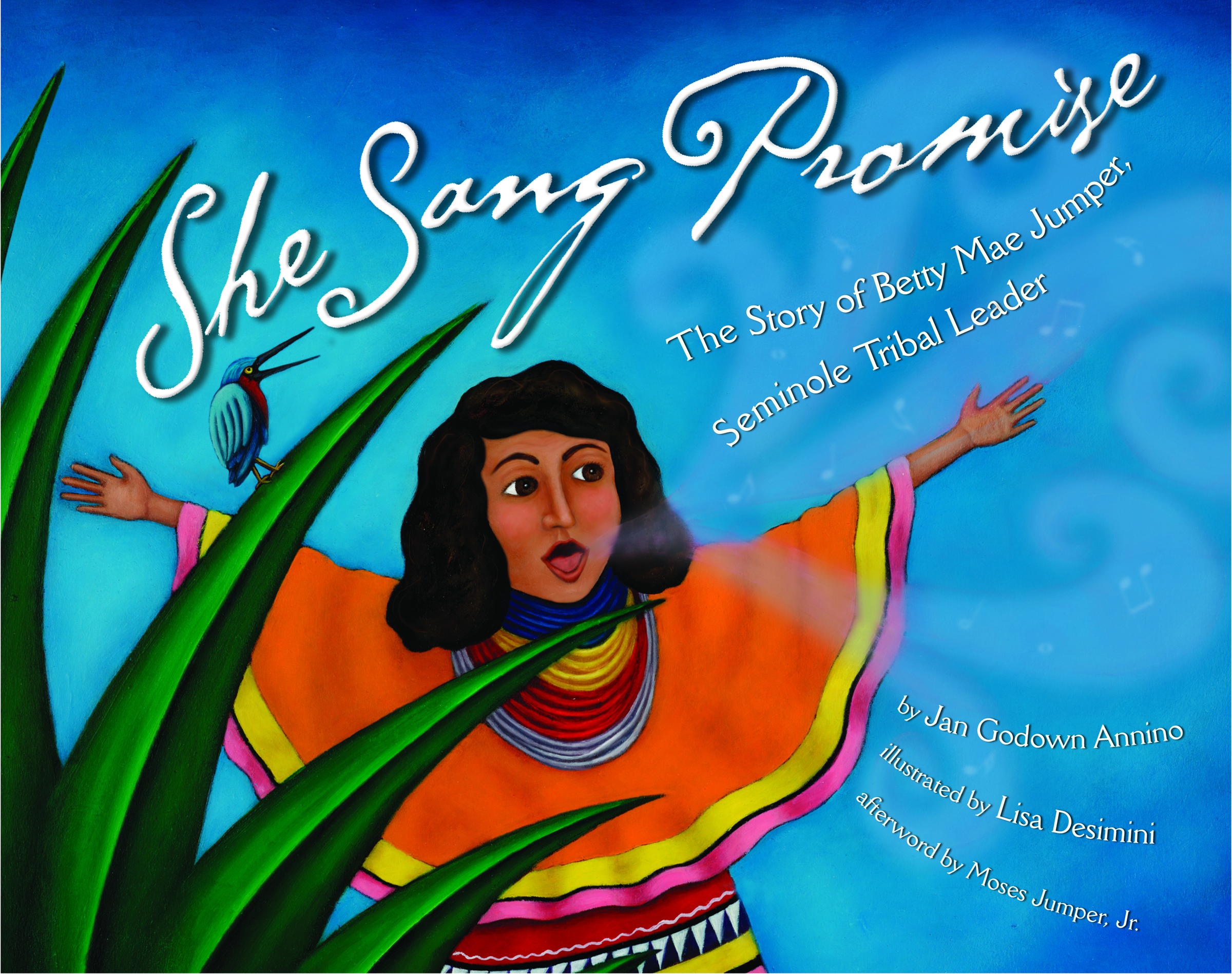
Annino, Jan Godown. 2010. She Sang Promise: The Story of Betty Mae Jumper, Seminole Tribal Leader. Illustrated by Lisa Desimini. Washington D.C.: National Geographic.
Benatar, Raquel. 2004. Isabel Allende: Recuerdos para un cuento/Isabel Allende: Memories for a Story. Illustrated by Fernando Molinari.  Houston, TX: PiƱata Books.
Bolden, Tonya. 2005. Maritcha: A Nineteenth Century American Girl. New York: Harry Abrams.
Bouler, Olivia. 2011. Olivia's Birds: Saving the Gulf.  Sterling.
Brown, Don. 2003. Uncommon Traveler: Mary Kingsley in Africa. New York: Sandpiper.
Brown, Don. 2000. Alice Ramsey’s Grand Adventure. NY: Sandpiper.
Brown, Monica. 2010. Side by Side/Lado a lado: The Story of Dolores Huerta and Cesar Chavez/La historia de Dolores Huerta y Cesar Chavez. Illustrated by Joe Cepeda. New York: HarperCollins/Rayo.
Brown, Monica. 2004. My Name Is Celia! The Life of Celia Cruz/Me llamo Celia: La vida de Celia Cruz. Illustrated by Rafael López. Flagstaff, AZ: Luna Rising.
Bruchac, Joseph. 2004. Rachel Carson: Preserving a Sense of Wonder. Illustrated by Thomas Locker. Golden, CO: Fulcrum Publishing.
Coles, Robert, 20120. The Story of Ruby Bridges. Illustrated by George Ford. New York: Scholastic.
Corey, Shana. 2009. The Spectacular True Story of Annette Kellerman, Who Swam Her Way to Fame Fortune & Swimsuit History! Illustrated by Edwin  Fotheringham. New York: Scholastic Press.
Corey, Shana. 2000. You Forgot Your Skirt, Amelia Bloomer: A Very Improper Story. Illustrated by Chelsey McLaren. New York: Scholastic Press.

Demi. 2012. Joan of Arc. Tarrytown, NY: Marshall Cavendish.

Engle, Margarita. 2010. Summer Birds: The Butterflies of Maria Merian. Illustrated by Julie Paschkis. NY: Henry Holt.


Erdrich, Liselotte (Ojibway). 2003. Sacagawea. Illustrated by Julie Buffalohead (Ponca). Carolrhoda Books.

Fradin, Dennis B and Judith Fradin, 2000.Ida B. Wells: Mother of the Civil Rights Movement. New York: Clarion. (Not a picture book).

Gilliland, Judy Heide. 2000. Steamboat!: The Story of Captain Blanche Leathers. Illustrated by Holly Meade. New York: DK Books.

Giovanni, Nikki. 2005. Rosa. Illustrations by Bryan Collier. New York: Henry Holt.
Gonzalez, Lucia. 2008. The Storyteller’s Candle/La velita de los cuentos. Illustrated by Lulu Delacre. San Francisco, CA: Children’s Book Press.
Greenfield, Eloise. 2010. The Great Migration: Journey to the North. Collage by Jan Spivey Gilchrist. New York: Amistad.
Grimes. Nikki. 2002. Talkin’ About Bessie. Illustrated by E. B Lewis. New York: Orchard.
Hopkinson, Deborah. 2009. Michelle. Illustrated by Ag Ford. New York: Katherine Tegen Books.
Hopkinson, Deborah. 2004. Fannie in the Kitchen. Illustrated by Nancy Carpenter. New York: Aladdin.
Isadora, Rachel. 2000.  Isadora Dances. New York: Puffin.
Krull, Kathleen. Hillary Rodham Clinton: Dreams Taking Flight. Illustrated by Amy June Bates. New York: Simon & Schuster.
Krull, Kathleen. 2000. Wilma Unlimited: How Wilma Rudolph Became the World’s Fastest Woman. Illustrated by David Diaz. New York: Sandpiper.
Lang, Heather. 2012. Queen of the Track: Olympic Champion Alice Coachman. Illustrated by Floyd Cooper. Honesdale, PA: Boyds Mills Press.
Lasky, Kathryn. 2003. Vision of Beauty: The Story of Sarah Breedlove Walker. Illustrated by Nneka Bennett. Cambridge, MA: Candlewick.
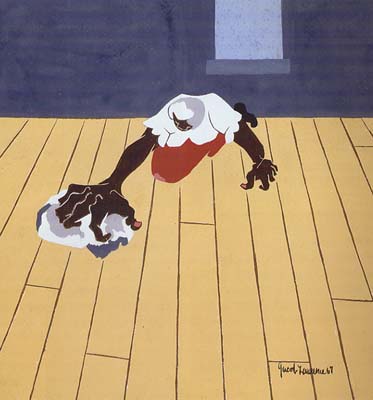
Lawrence, Jacob. 1997. Harriet and the Promised Land. New York: Aladdin.
from Harriet and the Promised Land.Art by Jacob Lawrence
Lee-Tai. Amy. 2006. A Place Where Sunflowers Grow. Illustrated by Felicia Hoshino. San Fransisco, CA: Children’s Book Press.
Lyons, Mary E. and Clementine Hunter.  1998. Talking with Tebe: Clementine Hunter, Memory Artist.  San Diego, CA: Houghton Mifflin.
Menchu, Rigoberta. 2006. The Honey Jar. Illustrated by Domi. Contributed by Dante Liano. Toronto: Groundwood Books.
Miller, William. 1996. Zora Hurston and the Chinaberry Tree. Illustrated by Cornelius Van Wright and Ying-Hwa Hu. New York: Lee & Low.
Mora, Pat. 2002. Maria Paints the Hills. Paintings by Maria Hesch. Albuquerque, NM: Museum of New Mexico Press.
Mora, Pat. 2002. A Library for Juana: The World of Sor Juana Ines. Illustrated by Beatriz Vidal. New York: Knopf Books.
Moss, Marissa. 2011. Nurse, Soldier, Spy: The True Story o Sarah Edmonds, A Civii War Hero.  Illustrated by John Hendrix. New York: Abrams Books.
Add caption
Moss, Marissa. 2004. Mighty Jackie: The Strike Out Queen. Illustrated by C.F. Payne. New York: Simon & Schuster.
Napoli,Donna Jo. 2010. Mama Miti: Wangari Maathai and the Trees..  Illustrated by Kadir Nelson. New York: Simon & Schuster.
Nelson, Marilyn. 2009. Sweethearts of Rhythm. Illustrated by Jerry Pinkney. NY: Dial. 

Nikola-Lisa, W. 2000. The Year with Grandma Moses. New York: Henry Holt.

Nivola, Claire A. 2008. Planting the Trees of Kenya: The Story of Wangari Maathai. NY: Farrar, Strauss and Giroux.

Orgill, Roxanne, 2010. Skit-Scat Raggedy Cat: Ella Fitzgerald. Illustrated by Sean Qualls. Cambridge, MA: Candlewick.

Paul, Ann Whitford. 1999. All By Herself. Illustrated by Michael Sterinagle. Orlando, FL: Harcourt. (14 poems: Amelia Earhart, Mary Jane McLeod, Violet Sheehy, Rachel Carson, Sacajawea, Ida Lewis, Harriet Hanson, Wilma Rudolph, Wanda Gag, Kate Shelley, Pocahontas, Maria Mitchell, Golda Mabovitch (Meir), and Frances Ward.)

Pinkney, Andrea Davis. 2009. Sojourner Truth’s Step-Stomp Stride.  Illustrated by Brian Pinkney. New York: Hyperion.
Pinkney, Andrea Davis. 2000. Let it Shine: Stories of Black Women Freedom Fighters. Illustrated by Stephen Alcorn. Boston, MA: Harcourt.
Ringgold, Faith. 1995 Aunt Harriet’s Underground Railroad in the Sky. New York: Dragonfly Books.
Robinson, Anthony and Annmarie Young. 2010. Gervelie’s Journey: A Refugee Diary. Illustrated by June Allen. London: Frances Lincoln Children’s books.
Ryan, Pam Munoz. 2002. When Marian Snag: The True Recital of Marian Anderson. Illustrated by Brian Selznick. New York: Scholastic.
Sciurba, Katie. 2007. Oye, Celia! A Song for Celia Cruz. Illustrated by Edel Rodriguez. NY: Henry Holt.
Schroder, Alan. 2009. In Her Hands: The Story of Sculptor Augusta Savage. Illustrated by JaeMe Bereal. New York: Lee & Low.
Shange, Ntozake. 2009. Coretta Scott. Illustrated by Kadir Nelson. New York: Katherine Tegen Books.

Stauffacher, Sue. 2007. Nothing but Trouble: The Story of Althea Gibson. Illustrated by Greg Couch. New York: Knopf.

Tallchief, Maria (Osage) with Rosemary Wells. 1999. Tallchief: America’s Prima Ballerina. Illustrated by Gary Kelley. New York: Viking.

Vernick, Audrey. 2010. She Loved Baseball: The Effa Manley Story. Illustrated by Don Tate. New York: HarperCollins.

Wallner, Alexandra. 2012. Susan B. Anthony. New York: Holiday House.

Warren, Sarah E. 2012.Dolores Huerta:  A Hero to Migrant Workers. Illustrated by Robert Casilla. Tarrytown, NY: Marshall Cavnedish.

Weatherford, Carol Boston. 2006. Moses: When Harriet Tubman Led Her People to Freedom. Illustrated by Kadir Nelson. New York: Hyperion.

Winter, Jeanette. 2011. The Watcher: Jane Goodall's Life with Chimps. NY: Schwartz & Wade. 

Winter, Jeanette. 2009. Nasreen’s Secret School: A True Story from Afghanistan. Orlando, FL: Beech Tree Books.

Winter, Jeanette. 2008. Wangari’s Trees of Peace: A True Story from Africa. Orlando, FL: Houghton Mifflin.

Winter, Jeanette. 2005. The Librarian of Basra: A True Story from Iraq. Orlando, FL: Houghton Mifflin.

Winter, Jeanette. 2004. September Roses. New York: Farrar, Straus & Giroux. (True story of 2 sisters from South Africa , the roses they bring  for a show in NY, and 9/11.)
Winter, Jonah. 2009. Sonia Sotomayor: A Judge Grows in the Bronx: La juez que crecio en el Bronx. Illustrated by Edel Rodriguez. NY: Atheneum.
Winter, Jonah. 2002. FridaIllustrated by Ana Juan. New York: Arthur A. Levine Books.
Yoo, Paula. 2009. Shining Star: The Anna May Wong Story. Illustrated by Lin Wang. New York: Lee & Low.

Improv

A brief film I made based on images taken during the last 24 hours with my iPhone.  I used the Hipstamatic app for all images.  The music is by copperhead and the song is Chillin' with Jeris.


Saturday, March 10, 2012

13 Ways of Looking at the Sky: Hipstamatic

I was playing today with my iPhone using the Hipstamatic app. Here are a few images I made while standing in my yard and looking up.

Beginning of Spring  (Hipstamatic, 3.10.12)

Sky (Hipstamatic, 3.10.12)
Clouds Darkening (Hipstamatic, 3.10.12)
Trees and Sky (Hipstamatic, 3.10.12)

Through Trees (Hipstamatic, 3.10.12)
Roof and Sky (Hipstamatic, 3.10.12)
Geometry (Hipstamatic, 3.10.12)
Breezy (Hipstamatic, 3.10.12)
Almost Spring (Hipstamatic, 3.10.12)
Reckless (Hipstamatic, 3.10.12)
A Tangle of Limbs (Hipstamatic, 3.10.12)
Crossed-Wires (Hipstamatic, 3.10.12)
Coming on Night (Hipstamatic, 3.10.12)

Friday, March 9, 2012

Celebrating Women: Literary Works By Women


The Yellow Wallpaper (M.A. Reilly, 2011)
This is not meant as a complete list of literary works by women about women, but rather a handful of books I hope you might enjoy.

Allende, Isabel. 2005. Eva Luna: A Novel. New York: Dial. (Novel).
AnzaldĆŗa, Gloria E.  and Ana Louise Keating. 2002. This Bridge We Call Home: Radical Visions for Transformations. London: Routledge. (Poems, Letters, Stories, Essays).
Erdrich, Louise. 2009. The Plague of Doves. New York: HarperColllins. (Novel).
Fuller, Margaret. 1994. The Portable Margaret Fuller. New York: Viking. (Essay).
Gilman, Charlotte Perkins. 1891/2006.  The Yellow Wallpaper.  Public Domain. (Short Story).
Glancy, Diane. 2011. The Dream of a Broken Field. University of Nebraska Press. (Essay).
Gordimer, Nadine. 2012. No Time Like the Present.  New York; Farrar, Straus & Giroux. (Novel).
Hoffman, Alice. 2012. The Dovekeepers: A Novel. New York: Scribner. (Novel).
hooks, bell. 1997. Bone Black: Memories of Girlhood.  New York: Holt. (Memoir).
Ivins, Molly. 2004. Bushwhacked: Life in George W. Bush's America. New York: Vintage (Essay).
Jewett, Sarah Orne. 1896/2006. Country of the Pointed Firs. Public Domain. (Novel).
Johnson, Josephine. 1934/1992. Now in November. New York: The Feminist Press at CUNY. (Novel).
Kingsolver, Barbara. The Bean Trees. New York: HarperCollins. (Novel).
Lopez-Medina, Sylvia. 1993. Cantora. New York: Ballantine Books. (Novel).
Lorde, Audre. 1986.  Sister Outsider: Essays and Speeches. Crossing Press (Essays, Speeches)
MenchĆŗ, Rigoberta. 2010. I, Rigoberta MenchĆŗ, An Indian Woman in Guatemala. New York: Verso. (Testimony).
Mohr, Nicholas. 1985. Ritual of Survival: A Woman’s Portfolio. Arte Publico Press. (Short stories and novella).
Morrison, Toni. 2005. Love. New York: Vintage. (Novel).
Naylor, Gloria. 1983. The Women of Brewster Place. New York: Penguin. (Novel).
Norris, Kathleeen. 2001. Dakota: A Spiritual Geography. Mariner Books. (Essay).
O'Brien. Edna. 2002. The Country Girls. New York: Plume. (Novel).
Olsen, Tillie. 2003. Silences. New York: The Feminist Press at CUNY.
Parker, Dorothy. 2006. The Portable Dorothy Parker. New York: Penguin. (Short stories, poetry).
Quindlen, Anna. 2006. One True Thing. New York: Random House. (Novel).
Rhys, Jean. 1992. Wide Sargasso Sea. New York: Norton. (Novel).
Smiley, Jane. 1991. A Thousand Acres. New York: Anchor. (Novel).
Tyler, Anne. 1996. Dinner at the Homesick Restaurant. New York: Ballantine. (Novel).
Urquhart, Jane. 2012. Sanctuary Line. Emblem Line. (Novel).
Viramontes, Helena Maria. 1996. Under the Feet of Jesus. New York: Plume. (Novel).
Williams, Terry Tempest. 1995. An Unspoken Hunger: Stories from the Field. New York: Vintage. (Essay).
Wolf, Naomi. 2002. The Beauty Myth: How Image of Beauty are Used Against Women. New York: Harper. (Research, essay, documentary)
Woolf. Virginia. 2005. A Room of One’s Own. Mariner Books. (Essay).
-------------------. 2002. The Common Reader. Mariner Books. (Essay).
Xiao Hong.2006. The Field of Life and Death & Tales of Hulan River. Translated by Howard Goldblatt. Cheng & Tsui.
Yezierska, Anzia. 2003. The Bread Givers: A Novel. New York: Persea. (Novel).
Zitkala- Sa. 1921/2010. American Indian Stories. CreateSpace. (Short stories).

Thursday, March 8, 2012

Stealing Dreams: International Women's Day

Looking Out the School Window (NYC, 2/2012)

I. Girls' Dreams

Today was International Women's Day 2012 and I spent a portion of the day reading young teenage girls' dreams--texts they were authoring that described how they imagined their near futures (early 20s). One girl imagined she would be a part time teacher and have twins. The remainder described their futures in terms of:
  • having two to five children
  • having twins
  • driving a Hummer
  • being married to an attorney, clown, rapper, or current boyfriend
  • getting paid a lot of money
  • living outside of New York City
  • no longer "living horribly"
The girls I spoke with hailed from the south end of the Bronx. Here poverty is persistent.  The public middle school they attend has an "A rating" from NYC DOE.  I have found the school to be an intriguing place, populated with professionals who daily make critical differences in young people's lives.

II. Talking Back to Seth Godin

In section 15 of Stop Stealing Dreams, Seth Godin reports findings from a survey done by Jake Halpern of 750 high school students from the Rochester, NY region. Halpern asked the teens, "When you grow up which of the following jobs would you most like to have?" The choices were limited to:
  • Chief of a major company like General Motors
  • a Navy SEAL
  • a United States Senator
  • the president of a great university like Harvard or Yale
  • the personal assistant to a very famous singer or movie star
Godin reports that the girls surveyed made the following choices: 
  • 9.5% of girls selected: Chief of a major company like General Motors
  • 9.8% of girls selected: a Navy SEAL
  • 13.6% of girls selected: a United States Senator
  • 23.7% of girls selected: the president of a great university like Harvard or Yale
  • 43.4% of girls selected: the personal assistant to a very famous singer or movie star
Role models in our lives matter. What we experience informs our choices and may well limit our choices. With that in mind, I wondered how many women role models are available for the careers Halpern cited as choices.
  • There are currently 12 women who are CEOs of Fortune 500 companies. That represents 2%. (Source)
  • There are 0 women who are Navy Seals as they are prohibited to serve by law. There are between 2000 and 2400 Navy Seals currently. 0%. (Source)
  • There are currently 17 women in the US Senate. 17% (Source)
  • There are currently 3 women who are presidents of Ivy League colleges (Brown, Univ of Penn, Princeton) 37% (Source)
  • There are no conclusive data about the number of women who are personal assistants.
There are currently 2, 576 to 2,976 men working in the positions listed above. In comparison there are 32 women.  Are we really so surprised that girls would gravitate to the one job in the list where women might actually be employed?

III. Snuffing Out Dreams
Godin writes:
Is this the best we can do? Have we created a trillion-dollar, multimillion-student, sixteen-year schooling cycle to take our best and our brightest and snuff out their dreams—sometimes when they’re so nascent that they haven’t even been articulated? Is the product of our massive schooling industry an endless legion of assistants?
The century of dream-snuffing has to end. We’re facing a significant emergency, one that’s not just economic but cultural as well. The time to act is right now, and the person to do it is you. (Section 15)
How many of the few actual female role models do you think live in the South Bronx? How many have ever visited the South Bronx?  I want to say here that it isn't the school or the professional staff who have stolen the girls' dreams of the school I was visiting today.  The assumption that schools are singularly responsible for "dream-snuffing" is faulty and dangerous as it shifts our attention away from other forces that influence girls' dreams.