Sunday, July 10, 2011

Seeing Color

I've been posting a lot of Black and White images lately and thought I'd mix it up a bit, with some color.  Original images I made with a Nikon D80, Nikon D300, or with an iPhone (using Hipstamatic App) and then altered the images using the Instagram App and then Photoshop.

The last image, Summer Fireflies and Moon, I drew using Brushes App and then altered it through Instagram App and then Photoshop.

Hope you enjoy,
Mary Ann

The Neighborhood

Day is Done

Long Beach Island

Sizzle, Bang.

Storm
Lightning

Moon Climbing

Chinatown
Summer Fireflies & the Moon

Doorways through Which We Move: A Response to Gerald, Michael, & Kelly

I've been following a string of blog posts: Gerald Aungst's initial post via Connected Principals site, Why 'I Don't Do Technology' Is Unacceptable,  Michael Doyle's  A response to technophile and Kelly's I Do Technology, but... 

Let me begin by saying all three posts were most compelling, thoughtful in ways one might think of a gift received alongside certain surprise.  As I read (and reread) I imagined Gerald's initial response and Michael & Kelly's responses as collage that together offered insights into how point of view matters and fails to matter.  What we talk about when we talk about tech is more often a discussion about power: who has it and doesn't, how it slips and resettles, and how power obfuscates and reveals what is most desired and elusive.

I was thinking about this:

Wordle based on three posts and then some fooling around...
As I read Gerald's post I was thinking about teachers and administrators I have worked alongside who aren't cognizant that the next Gutenberg has arrived and with it unpredictable social, political, economic, geographic, and environmental changes that will (in)form how we and our children live.  I too have heard educators who almost smugly deride anything we might label "post modern technology" as if the teaching decisions they make were singularly about them, their comfort, and needs.   And boy do I get Gerald's ire, even when I don't agree fully with the hopefulness he sees via technology. 
 
I was wondering about Kelly's conclusion when he wrote: "my experience is that those teachers who connect with their students don’t need to use technology." I wonder if that is and will be true give the way new technologies are altering our human landscape. It seems naive to deny the potential power and responsibility of being connected via tech. I am wondering why any teacher would exclude technologies as a statement of self, given that anything, not human, is a technology. It seems an extreme point of view to maintain and one that might be quite harmful to children who are navigating in a technological world.

As I read Michael's post, I was thinking about my appendix, long gone, and wondering if perhaps some technology instead of a surgeon's bumbling hands might have helped me when I was 15 and sick post-op with peritonitis.   And even when I want this to be true, I simultaneously know everything ultimately rests in human hands.  For is it not our hands, that is the place of intersection among the three posts?

Circa 1967 (Reilly, 2008)
What rests in our hands is what makes us human, fallible, and willing to do good and to harm with the same action.  It seems to me that our capacity and willingness to hear one another, to get past language in order to find intention is what matters most (well at least most often).

So perhaps it is ritual we seek, more so then the presence and absence of that which we label, technology. I am recalling Marge Piercy who told us:

We seek not rest but transformation.
We are dancing through each other as doorways.

Perhaps then it is not technology that rests in our hands, but the grace to know one another as doorways through which we move.

Trying to Find Home (Reilly 2011)

Between the By-Road and the Main Road: Call for Submissions for New Progressive Education...

Between the By-Road and the Main Road: Call for Submissions for New Progressive Education...: "Updated Information I am pleased to announce the arrival of a new progressive education journal, (Re):Mix - A Transnational Journal of Art..."

Thursday, July 7, 2011

#AskObama What If We Have it All Wrong?

I tried writing a question to President Obama and realized that what I needed to ask required more context than 140 characters might offer.  I was wondering if President Obama has the will & the courage to not emphasize standards and testing that his administration has either established or continued from the Bush years? In other words (to borrow from Reagan [clearly a first for me]} -- Can our President JUST SAY NO to standards & testing?

The USDOE and state governments have an unshakable belief in the efficacy and wisdom of national and state standards that outline "the big ideas" and list objectives organized by discrete subjects for teachers to follow. We are told that standards represent the important information to be transferred and that tests designed by companies are the best way to know if the designated information has been learned.  It's all very neat--very logical. But what if the initial assumption is inaccurate?  What if the emphasis on information-based knowledge coupled with a manic desire to test public school students every few weeks in mathematics and English Language Arts (via the PARCC Plan,60 million children ages 8 to 17, would be tested nine times a year) reduces learning, children's desire to learn, and teachers' agency to teach?

In Doug Thomas and John Seely Brown's (2011) A New Culture of Learning they explain that this new culture consists of two elements:
The first is a massive information network that provides almost unlimited access and resources to learn about anything. The second is a bounded and structured environment that allows for unlimited agency to build and experiment with things within these boundaries (Location 63 of 2399).
In contrast to this new culture of learning, we have the mechanistic view of education that President Obama's education policies and practices are maintaining. Thomas and Brown describe the mechanistic approach:
Learning is treated as a series of steps to be mastered, as if students were being taught how to operate a machine or even, in some cases, as if the students themselves were machines being programmed to accomplish tasks. The ultimate endpoint of a mechanistic perspective is efficiency: the goal is to learn as much as you can, as fast as you can (Location 327 of 2399).
In the Obama plan for education, schools are places where students must demonstrate they have received the Common Core Standards and can replicate them on tests given frequently across each school year.  Failure to demonstrate that the standards have been received can lead to retention, failure, cheating, dismissal, and cash bonuses depending on your role and the outcome.  This schema is based on the belief that what we know remains stable.

In contrast in the new culture of learning it is understood that "Making knowledge stable in a changing world is an unwinnable game"(Thomas & Brown, Location 503 of 2399). Instead of valuing only explicit knowledge, we must value tacit knowledge ("We know more than we can tell" (Polanyi as quoted in Thomas & Brown, 957 of 2399).

Like many others, Thomas & Brown conclude that "Students learn best when they are able to follow their passions and operate within the constraints of a bounded environment"(1038 of 2399).  It is challenging, if not impossible, to follow one's passions when federal and state standards outline what matters and in doing so exclude opportunities for the complicated process of a young person coming to know his/her passion(s) to happen.  The very absence of choice is problematic.

Applying the New Culture of Learning: Posing Questions About Things That Matter


As I have indicated in former posts, I have been interested in watching my 12 year old learn.  He is deeply involved in Minecraft and recently learned how to turn the family computer into a Minecraft server.  When I asked him how he had learned this he said that he watched a "ton of YouTube videos" and taught himself about the computer's operating system.

He told me: "It was a lot of trial and error. A lot of experimenting." 

I also wondered what motivated him to create his own server. Why did he do it?

He said he wanted a place where he and his friends and people he hasn't yet met but who also like to play Minecraft could play together and chat. The multi-player aspect of gaming matters to him and motivates him to learn and want to play.  When he first began playing Minecraft he played it as a single player.  He did this for about two months and then decided that he wanted the interaction with others in the world he was designing and building. I'm encouraged that he sees people he has yet to meet as potential friends.  We have discussed safety precautions as well as the more probable scenario that he will meet people who share his interests and who help him to widen and deepen those interests through play and chat. (See Will Richardson's 8 Shifts for Every Classroom: Shift 1: Do Talk to Strangers).

In the world he and others are building, my son made a replica of the Parthenon.  When I asked him how he built it he explained that he had downloaded different images of the Parthenon taken from different angles and then used the images to think about the exterior and interior of the structure as he built his replica. When he had a question, he did an image search.  He also said that he was disappointed as he could not figure out how to build a replica of the statue of Athena.

My son's interest in the Parthenon was tweaked when I told him that two high school students where I work had created a replica of the Palace of Fishbourne in Minecraft.  He figured out how to contact them via their server and was soon interacting with them.  He wanted to do what they had done: build a server and infuse a sense of history into the play.

Again Thomas and Brown discuss the importance and centrality of play, referencing Johan Huizinga (Homo Ludens): "...play is not merely central to the human experience, it is part o f all that is meaningful in human culture. Culture...does not create play; play creates culture" (Location 1359 of 2399).

Central to my son's play in Minecraft, as well as his friends who are often at our home playing or on line playing-- is the sense of agency they possess.  What I find interesting is none of the boys would be considered honor roll students. Some self describe themselves as having reading problems and disliking reading.  Some describe themselves as being "bad in math."  Many have comments on report cards that say: Easily distracted. Not working to potential.  Some have been classified hyperactive. Yet all can design and build intricate worlds with harbors full of ships and various types of homes with rooms serving different purposes, and farms, and self-repairing bridges, and portals to name but a few things. They can do this for hours.

Thomas & Brown discussing agency explain that "unlike traditional notions of learning which position the learner as a passive agent of reception, the aporia/epiphany structure of play makes the player's agency central to the learning process, How one arrives at the epiphany is always a matter of the tacit. The ability to organize, connect, and make sense of things is a skill characteristic of a deep engagement with the tacit and the process of indwelling" (Location 1381 of 2399).

My son built a server as he is in search of a guild: a group of dedicated players who actively participate in the making of the game, framing and posing questions, using answers to generate more questions, and attending to design challenges and other problems as they arise.

So Where To?

The learning world we need to engender looks little like the structure of school we know today. It is not informed by a list of standards, regardless of how clever those standards may or may not seem to be. Learning is not satisfied by having patients receive knowledge and replicate that information on national tests.  Such passivity dulls interest.

Instead, a shift needs to happen. Instead of schools being the locus of learning, we need to be open to seeing learning opportunities beyond the classroom and valuing such experiences instead of situating them as marginal.  This means that we need to be learners as well.  There are educators I have worked with or met via social networking that I would love to have looking in as my son and his friends play.  I imagine teachers like Harry Sugar or David Wees whose keen knowledge of mathematics might shape (bound) occasions based on the game playing that might help the boys to name the mathematics they are using as well as the naive understandings they may well have.

When I think about learning that is needed, I imagine a guild as well: a collection of people who are committed to learning and connected through interests and mediated online and in person. I like the idea of a bounded environment where experimentation happens and agency is privileged. I appreciate the understanding that knowledge is changing at a rate that defies us naming it, teaching it, and regurgitating it on tests. I imagine experiential learning and tacit knowledge coupled with some explicit knowledge mattering. Instead of sitting and watching, learners (students, teachers, mentors, community based experts) would be knowing, making, and playing.

How and what should be locally determined and informed by learners' interests.

Curious as to what you think & I will continue this...

Wednesday, July 6, 2011

Words Have Power

Students in Katie Stritmater's third grade class studied The Declaration of Independence and parts of The Constitution. While this learning was occuring, Katie and her students were also learning about Memorial Day and thinking a lot about the sacrifices US soldiers make.

In order to help students understand the power of words, like those found in these foundational US documents, Katie and her students each selected three word phrases that conveyed a personal message to US soldiers.

Katie and her students then made the film and with parental permission posted it on YouTube in order to celebrate and honor soldiers during Memorial Day.


Tuesday, July 5, 2011

The Rhapsody of Things as They Are

A problem with common core and quite frankly State standards as well is the belief that the direct disciplinary route is not only the "best" way to learn, but the only way to learn. I've been wondering about this for a long time as I know that I weave in and out of disciplinary knowledge, but more times than not,  coming to know (or unknow) is more nomadic than directional. I truly can't trace the way I come to know completely.

For example, I have been thinking about the blue light at the far edges of the horizon for a long time and was especially interested when I read A Field Guide for Getting Lost.  The language Rebecca Solnit used invited me to think, wonder.

Looking East. (M.A. Reilly, 2010)
Solnit opens the second chapter in A Field Guide for Getting Lost by writing:

The world is blue at its edges and in its depths. This blue is the light that got lost. Light at the blue end of the spectrum does not travel the whole distance from the sun to us. It disperses among the molecules of the air, it scatters in water. Water is colorless, shallow water appears to be the color of whatever lies underneath it, but deep water is full of this scattered light, the purer the water the deeper the blue. The sky is blue for the same reason, but the blue at the horizon, the blue of land that seems to be dissolving into the sky, is a deeper, dreamier, melancholy blue, the blue at the farthest reaches of the places where you see for miles, the blue of distance. This light that does not touch us, does not travel the whole distance, the light that gets lost, gives us the beauty of the world, so much of which is in the color blue.

Talking About Malcolm X (M.A. Reilly, 2009)
I wondered about the science of this passage, the intention of light getting lost and such.  I asked Rob as we are sitting outside having breakfast on our deck.  He is my first source for all things science and I read the passage aloud and asked, is this accurate? He insisted, rather emphatically, that light doesn't disperse. Waves don't disperse.  He then explained the loopy look of blue wave lights and the more staccato look of red wave lights using science terms and all I could think about is jazz.

Yesterday we visited friends, Ethel and Mark. Mark is a jazz musician. At one point we discussed the way improvisation happens like a good conversation and I found myself wondering if nature improvises.  Is everything determined? Is nothing determined?

This led me to read a bit more this morning.  Ward Cameron (2005) writes in Colours of the Sky:

When light travels through the atmosphere, it comes into contact with materials that scatter and filter out certain parts of the spectrum. These include atoms of oxygen and nitrogen. As light moves through the atmosphere, the blue end of the spectrum is gradually filtered out leaving a predominance of yellow light. This causes the sun to appear yellow from the earth's surface. As the sun travels greater distances through the atmosphere, more and more of the blue light will be removed...This scattering of blue light also results in another atmospheric phenomenon – a blue sky. When we look upwards, we are actually seeing the scattered blue light – the light that didn't reach the earth's surface.

As I read this I wondered about light as waves, remembering that as Rob spoke I was recalling earlier discussions and reading about waves, light, particles. Louis Bloomfield from Physics Central explains:

To understand why the air redirects primarily blue light, we have to look at the physics of light interacting with matter. Sunlight consists of countless tiny electromagnetic waves, each with an approximate frequency and wavelength, and each with a small amount—a quantum—of energy. Because of the discreteness of their energies, these basic electromagnetic waves have many particle-like properties and are known as photons of light.
The energy of a photon of sunlight determines its color, with higher-energy photons appearing at the blue end of the light spectrum and lower-energy photons appearing at the red end. The bluish photons also have higher frequencies and shorter wavelengths than the reddish photons. These differences in wavelength are responsible for the blueness of the sky.
Electromagnetic waves consist only of electric and magnetic fields, and they interact with matter by exerting forces on the charged particles in that matter. Through these interactions, matter can absorb a light wave and may then reemit it in a new direction, a process known as Rayleigh Scattering. That is just what the air particles do. In effect, the air particles act as antennas for light, absorbing light heading in one direction and reemitting it in another.
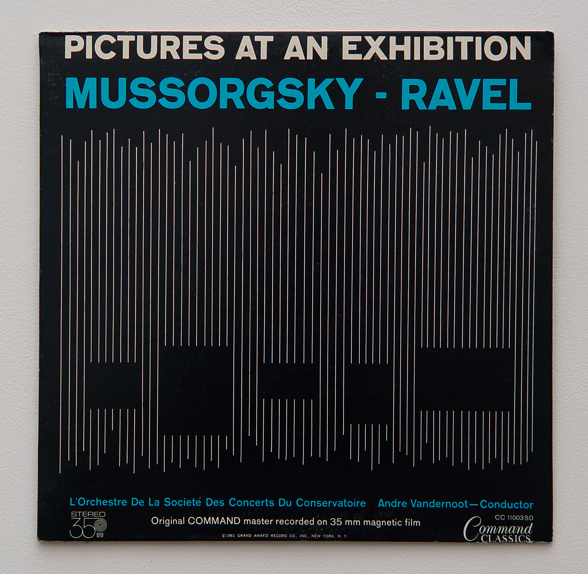
Josef Albers. Image for Command Records. Found Here.
Then I found a wonderful website, Causes of Color, which attempts to marry the aesthetics of color with the science of color. They organize the discussion of color into three causes: Light is made, light is lost, and light is moved. As I read through these pages I was thinking about Josef Albers--returning to subject matter I knew better, felt more comfortable with--something that might anchor the new. Albers's told us that color is understood through experience. He explained, "In visual perception a color is almost never seen as it really is - as it physically is. This fact makes color the most relative medium in art."

Things are not what they are. Tentative perhaps, like this post?

Wallace Stevens's musing about the blue guitar and how things are changed as they are played on that guitar had me quickly leaving Albers and thinking instead about poets,  Picasso, and a lovely book of etchings I have by British painter,  David Hockney --his homage to Stevens an Picasso.  I took a bit of time to reread "The Man with the Blue Guitar" and was stopped by these lines towards the end of the poem:
 
...Morning is not sun,
It is this posture of the nerves,

As if a blunted player clutched
The nuances of the blue guitar.

It must be this rhapsody or none,
The rhapsody of things as they are...

Counting (M.A. Reilly, 2010)
The rhapsody of things as they are is an odd truth we fight bitterly, evidenced by the way our government--both federal and state--organize "content" as deliverable products.  We lack such imagination to imagine things are only as they are and what injustice do we serve to learners when we "train" them to believe solely in such nonsense.

Way always leads on to way.  Frost knew it and so should we.  The direct route may be economical at first blush, but nomadic tendencies are more representative of thinking, of wondering, of coming to know and unknow.