Showing posts with label education. Show all posts

Friday, May 19, 2017

#SOL17: Newark, 20 Years Later

4th graders creating a map


2nd grade teacher reading aloud a novel
20 years ago this month, I accepted the position of the director of literacy for Newark Public Schools in New Jersey. I was in my 30s and had just finished my dissertation and would defend it that next spring. The job was somewhat overwhelming given the academic needs that seemed so prevalent, the pressure heaved upon children and staff to produce academic gains as measured on a state assessment, and the scale.  When I worked there the enrollment was about 50,000 students across 80 schools. Working with staff and students in Newark was  the most important work I would do while employed in public schools.  What I didn't understand well until today is that the years there would fundamentally change me, allow me to see whiteness in ways I simply had not and prepare me to be, perhaps, a better mom to my own son who would be born two years later. What was most important, without question, were the children and teens who populated the schools. 20 years later, I still know that to be true.

Newark was a source of love.

4th graders from NPS reading Hawthorne's The Pomegranate Seeds during a Greek Mythology unit.

Working in Newark allowed me to be a minority--as much as one white woman from Ireland might be. For the first time in my working life there were daily references to music, art, literature, food, dance, and historical and contemporary happenings that I did not understand, and needed to learn. Working in Newark and becoming friends with so many there allowed me to (un)learn some matters of race as I had been taught and to experience from others there the nature and pulse of profound joy and kindness that often were connected to community and faith.

20 years later, the published news out of Newark continues to be more desperate than kind, and often is limited to recounting dangerous situations and terrible deaths. The myriad of caring acts that more typify the different communities there are lost or under-reported. And frankly, we are all the worse for that.

I still work in Newark helping schools there to better ensure the development of fine readers and writers. It is such doable work and some days it feels a bit frustrating to know how important these learning changes could be had and to not be able to influence the public schools who seem bent on chasing academic success with products, not people. If products alone could alter performance trajectories, large scale need would no longer be an issue. In the last two years of Rob's life, before he was diagnosed with cancer, he worked with me in the city. He told me more than once that he understood why I found the place, the people, and the work so compelling.


Thursday, March 3, 2016

GoFundMe: Rob's Wish

You can access the site here.  

Dear friends,

Friends of ours have set up a GoFundMe site to help fulfill Rob's most important wish--Devon's future education. With medical bills wiping out our savings, Rob's care becoming increasingly expensive, and me not working so that I can take care of him at home--any donation you could give would be appreciated. 

Dev and I thank you,
Mary Ann

Wednesday, January 21, 2015

Fixing NCLB

Below is a letter a friend and colleague, Jane M. Gangi, wrote to Senator Alexander in response to a request for suggestions and insights into fixing NCLB. You can write your own letter and send it to: fixingNCLB@help.senate.gov

I have included Jane's letter as I found it to be so informative and helpful.  Thanks Jane for the permission to publish this letter.

You can also read recent commentary by Jane (and a student of hers, Nancy Benfer) that Valerie Strauss published in The Answer Sheet in The Washington Post here: "How Common Core’s recommended books fail children of color" 


Dear Senator Alexander,
I am writing to urge you to repeal the testing requirements of NCLB. We do not need a standardized test for every child in America, nor do we need to throw away billions of tax dollars by funding corporations that make tests and make computers. We have the NAEP, which disaggregates data by ethnicity, income, and so on. The NAEP is given to pockets of children throughout the country, which statisticians say is enough. It is what is done in Finland; Finland does not test every child.
Instead, use the money we can save by stopping the harmful-to children practices of standardized testing to ensure equity in access to the arts, libraries (including lots of multicultural texts), librarians, field trips, school nurses (children have died without them), labs, playgrounds, infrastructure--those things and people that directly impact children. Provide professional learning for teachers to learn how to help children whose culture and socioeconomic status they do not share. Jan Richardson and Mary Ann Reilly have done phenomenal work with children in high poverty areas (and I can make other recommendations of professionals who are succeeding).
We also need to stop VAM, which the American Statistical Academy labels as junk science. We can tell whether teachers are doing their jobs through growth models such as, in literacy, running records. In our work in Newburgh, we expect children to make gains by starting from where they are and continually growing—instead of, as the common core expects, starting from where children aren’t, which only leads to sad consequences.
Please do all you can to stop Race to the Top—as pathetic a metaphor for education as ever there was. Instead, read this post for what education might be--passion-based. . Under President Obama and Secretary Arne Duncan, common core promoters have made money hand-over-fist while children suffer.
There were no early childhood educators who helped develop the common core and they must be brought on board. Please see Defending the Early Years: http://deyproject.org/. There were no special educators, who also must be brought on board.
On math—we have Jason Zimba, “architect” of the math standards on record as stating that these standards will prepare K-12 student only for community college, which means those who can afford private school, like the Obamas and the Gateses, will ensure their children have access to elite colleges.
Neither of the two “architects” of the English Language Arts, David Coleman and Sue Pimental, have ever taught, which leads to these serious errors:
·         of 171 recommended texts in the common core on the elementary level, there are only 18 authors of color (40% of the nation's children are of color). The proficient reader research has shown very clearly that children must make text-to-self connections. Besides proficient reading, having access to texts that represent them is also essential to identity development. Common Core Appendix B recommendations are flying off the shelves in part, possibly, because teachers think their jobs depend on those books.
·         of 171 recommended texts in the common core on the elementary level, less that 7% represent working class or poor children, when 21+ million children in the nation are poor. A recent report shows that 51% of children are poor.
·         of multiple ways to interpret text, children are confined to only "close reading,” which is one of many ways to read text. Missing are transactional reading, critical literacy, and other approaches more likely to help children love reading.
·         of a variety of genres, children must read 50% informational text on the elementary level and 70% informational text on the secondary level. 90% of writers read literary text in their younger days, 75% of genocide and human rights activists read literary text and viewed the arts when they were young (which evoked them to their life's work), and Silicon Valley geniuses read science fiction when they were young (thus America's ingenuity in creating ideas). At the very moment the US disdains fiction, which has been a key to its success, China now emphasizes science fiction--because China learned science fiction is the key to US creativity. China knows it can make things but also knows that it does not have ideas like we do, which we learned from fiction. 
·         that the common core is in no way internationally benchmarked. Finland does not begin to teach reading until children are 7; the common core has turned kindergarten into what used to be second grade. Shenzen, China, has the highest university pass rate in China: They allow free reading and choice and no tests. China is encouraging the rest of the country to follow Shenzen's lead at the very moment we do not.
Please see Lyndsey Layton’s article for an expose on how the scandal of common core occurred:
Please see Superintendent Kenneth Mitchell’s presentation on how much this federal and corporate takeover of education will cost the taxpayer with absolutely no benefit to children:
Thank you for your consideration,
Jane M. Gangi, PhD 

Saturday, January 3, 2015

Teacher Evaluation, Fear, and Certainty

Bearing Witness (M.A. Reilly, Collage. 2012)


I. The State

When I was reading Valerie Strauss's current column, "Teacher evaluation: going from bad to worse?" that Carol Burris authored about proposed changes to NY's teacher evaluation system, I thought about our need for certainty and how this need is directly (in)formed by our national mistrust of other and the fear that this mistrust gives voice to. In a recent letter (linked via the Stauss column) by New York Chancellor Merryl Tisch to a Cuomo aid, the Chancellor writes about changes to the State's evaluation system she would want to see in order to make the system "less complex and more effective in differentiating performance." She proposes that the Governor and Legislature could amend Education Law §3012-c to:

Eliminate the locally selected measures subcomponent, established through local collective bargaining. The data reveal that the locally-negotiated process for assigning points and setting targets in this subcomponent do not differentiate performance in terms of the composite ratings that teachers and principals receive. Instead, assign 40 percentage points to student growth on State assessments and other comparable measures of student growth – including performance-based assessments (like those used in NYC in 2013-14) – determined by districts. 

We shift into another time when certainty becomes an overwhelming need. There is no present here, just reconstructions of the past and/or imaginings of some future. In such schema, we cannot trust our senses as they cannot be engaged when we are not in the present. This is when we our sense of mistrust grows so exponentially that belief in a single measure becomes more trusted than what we know through direct and lived experiences.  This is when the plan to "Eliminate the locally selected measures subcomponent, established through local collective bargaining" and "Establish State-prescribed scoring ranges for the other measures of teacher and principal effectiveness (the observation subcomponent) rather than allowing them to be locally-negotiated" appear to not only be rational, but necessary.

But beneath this rhetoric is a provided truth brought to you by the State. Read closely for it says: the State and its test results know better than you, know better than me, know better than your neighbors, your local teachers who spend most days out of a year with your kids, know better than the local librarian, your family doctor, the plumber you call at 1 a.m. when the hot water heater leaks out, know better than the cashier who chats you up as you bag your groceries, your imam, minister, priest, rabbi or your connection to the divine.  The State knows better than you or your community. The State is Truth and that is what allows Tisch to utter the inane proclamation: A teacher who has received two consecutive Ineffective ratings should not be permitted to return to the classroom.

Really?  This statement tells us that Tisch believes that a determination of worth can be based largely on the outcome of high stakes tests that each and every year seem to have considerable flaws, are designed to measure only what can be tested large-scale and privileged by math and reading standards, and are tests that are kept from public scrutiny. Scrutinize the teachers, but not the tests that measure their worth?

This is a closed system of value, self-informing and it situates humans as dispensable. Surely we can do better.

II. Love

We dismiss the local at our own peril, not because the local is godly or represents some divine Truth, but rather because is its inherently fallible in its humanness and is in sync with the ever emerging present. The local keeps us humble because it carries with it a truth no State can know or promulgate: how we frame and respond to problems are conditional by what we can economically, socially and spiritually afford.  All of the teachers who have taught our son have provided us with important understandings about him that were far, far superior to any state test result we have ever read. Teachers have provided us with doable suggestions, specific supports, and inquiries worth our wonder.

The state test has never cared about my child. It has not offered us insights that we did not already know and it has offered us conflicting information that made us doubt the tests' validity.  It has offered us an expensive summary of his performance across a single week in spring each year that measured a very narrow set of reading and math objectives.  Contrast that with the 40+ teachers he has had who have cared deeply enough to tell us things challenging to hear as well as that which have made us proud, pleased, and purposeful. His teachers have offered guidance, interpretation, and love. Just a week ago an email arrived from a current teacher who queried how to (re)enage our son's creative practice with his work. This is a class where numerically my son performance is at the A+ range because his technical know-how is great.  Additionally, this is a teacher my son respects and dearly loves. Discussing the teacher's concern allowed us to open an important conversation at home about the technical and the creative and how even though these are co-specifying-- they require different vulnerabilities from us.

This teacher's email sent over the holiday opened us to wonder.

These are matters of great importance.  No state test is designed to even inquire about such dispositions, such complications, such vulnerabilities, such wonderings. No state test result could hint at this teacher's intellectual and spiritual influence on my child.

III. Neighborhoods and Subsistence

I think here of  a meaningful essay, The Idea of a Local Economy, that Wendell Berry wrote for Orion.  In it he tells us that local economies rest on two principles: neighborhoods and subsistence. I think we can apply Berry's ideas about the local to school and learning. He writes,
In a viable neighborhood, neighbors ask themselves what they can do or provide for one another, and they find answers that they and their place can afford. This, and nothing else, is the practice of neighborhood. This practice must be, in part, charitable, but it must also be economic, and the economic part must be equitable; there is a significant charity in just prices.
Of course, everything needed locally cannot be produced locally. But a viable neighborhood is a community; and a viable community is made up of neighbors who cherish and protect what they have in common. This is the principle of subsistence. A viable community, like a viable farm, protects its own production capacities. It does not import products that it can produce for itself. And it does not export local products until local needs have been met. (From here)
To desire and practice cherishing and protecting what we have in common cannot be found on state tests, are not communicated in their results,  and may well be in conflict with the ideology that makes such tests overly privileged.  But cherishing and protecting are essential teacher acts--ones that our myopic attention to state test results threaten.

We cannot forget this.

What we have in common is that we are fallible humans. Teachers, like all of us, don't get it consistently 'right' nor do they need to. We need to learn how to love these vulnerabilities, not run from them.

IV. Fear and Wonder

Fear is the rot that undermines community, that allows for States to rise in ways that threaten local liberties, colonize neighborhoods.  If our military and legal responses to 9/11 have taught us nothing, surely they have taught this: Liberties can easily be sold off when fear is manufactured and spreads unchecked. We forget who we are, who our neighbors are and replace self and other with imagined dangers. Similarly, we forget who our local teaches are and replace them with images of the worse of that profession. We begin to doubt in ways that harm us.

Again Berry helps us to understand why shifting to local is important. He says,
...the idea that local needs should be met first and only surpluses exported does not imply any prejudice against charity toward people in other places or trade with them. The principle of neighborhood at home always implies the principle of charity abroad. And the principle of subsistence is in fact the best guarantee of giveable or marketable surpluses. 
In our schools, local child-specific needs are being set aside in order to privilege the chance for better outcomes on state tests. I have seen this firsthand. For example, rather than teach the child who is behind grade level to better read, that child is forced to work with text he or she can not decode, let alone comprehend on a daily basis across the school year. That means the child falls further and further behind because she or he cannot practice reading in meaningful ways, nor can this child accrue knowledge to help with reading.  This steady diet of unattainable reading breeds avoidance to reading. The decisions about that child have been removed from the classroom and the school and are imposed by city and state curriculum mandates. The test outcomes are so important, that curriculum, instruction and professional learning are shaped by test specifications.  Such malpractice is done daily in small and profound ways that over time alter the landscape we call school. This is what the our reliance on single measures procures.

So what is our True North, than?

In Blue Highways, William Least Heat-Moon writes:
Black Elk says it is in the dark world among the many changing shadows that men get lost. Instead of insight, maybe all a man gets is strength to wander for a while. Maybe the only gift is a chance to inquire, to know nothing for certain. An inheritance of wonder and nothing more (p. 240).” 
We think True North is about certainty. It is not. True North is an inheritance of wonder and nothing else. Let's help each other find new roads to walk. Let's trust one another.


Cited

Heat-Moon, William Least (2012-04-03). Blue Highways: A Journey into America. Little, Brown and Company. Kindle Edition. 

Sunday, December 30, 2012

When Excellence is a Single Standardized Measure

from here
When a nation standardizes its tests and then relies on that single measure as its primary definition of excellence, learning is doomed and with it freedom.  At a national level,  the standardized measurement coupled with the weight of its value limits what can be considered as important knowledge regardless of initial intention. To limit what is important knowledge especially at a time when information is no longer considered scarce is of course, ironic. But it is also very misdirected, as it is the suppression of  thought, voice, and agency that is most crippling to individuals and groups and will do the most harm.

Considered what Antoine Mas wrote decades ago about standardization (as quoted by Jacques Ellul in The Technological Society, pp. 11-12, 1954)
"Standardization means resolving in advance all the problems that might possibly impede the functioning of an organization. It is not a matter of leaving it to inspiration, ingenuity, nor even intelligence to find a solution at the moment some difficulty arises; it is rather in some way to anticipate both the difficulty and its resolution. from then on standardization creates impersonality, in the sense that organization relies more on methods and instruction than on individuals."
Is there nothing that lessens desire more than to live in a world that has been scripted?  We have known this for a long time and yet each 'new crisis' allows those with political and economic power to dictate bad practices and impose their will on the masses.


Tuesday, November 13, 2012

Re-imagining Education

from video by Nic Askew
A few films to trigger thinking about what it means to educate and be educated.


RE-IMAGINING THE EXPERIENCE OF EDUCATION AND SCHOOLING


Play 

THE FILM QUESTIONS


One / ‘Might we have underestimated the value of ‘play’?’ Two / ‘How would your life look if seen through a playful state of mind?’ Three / ‘Might confidence sit at the heart of an extraordinary education?’ Four / ‘Might a playful frame of mind stand to transform the experience of education?’ Five / ‘Might a playful state of mind enable the strength of our true human spirit?’


Creative 


THE FILM QUESTIONS 


One / ‘In this rapidly changing world might creativity need to sit at the heart of an education for all?’
Two / ‘Might education now need to embrace these new forms of literacy for all students?’
Three / ‘Might our future call for creative, literate, self expressive and resourceful students?’


Engaged

THE FILM QUESTIONS 


One / ‘What might be the consequence of reframing education around the experience of the student?’
Two / ‘Might curiosity have always sat at the heart of an extraordinary education?’
Three / ‘How might our imagination bring the experience of education to life?’


Mentor

THE FILM QUESTIONS 


One / ‘Might we all have the opportunity to mentor another?’
Two / ‘How powerful is a single moment of validation to a young imagination?’
Three / ‘Might your influence travel further than you might imagine?’
Four / ‘Teacher or not, might you have a part to play in the education of another?’


EVERYONE | MIMI ITO


THE FILM QUESTIONS 


One / ‘Might the information age free us to pursue learning centered on individuals and not institutions?’
Two / ‘Perhaps each of us has a part to play in the possibility of education?’
Three / ‘Might a broader definition and responsibility for education bring us all closer together?’


Tuesday, September 25, 2012

Composing are Acts of Not Knowing & Wanting

Stop Stealing Dreams (2012, M.A. Reilly)


I. Acts of Faith

Fred Leebron closes the essay "Not Knowing," saying this:
Readers suspend disbelief and writers suspend disbelief because writing and reading are acts of faith along the path to knowledge, not just one particular knowledge but any knowledge that is part of the essential truths lurking to be shared by the reader and the writer and all those people in that story, that are coming to not just one conclusion but many conclusions, that follow not one path but many paths, because the writing and the story are not just about one thing but many things, and in this essential multifarious way writing is an embrace of all the complexity of not knowing and wanting to know and all the contradictions that reside therein, and that has been our task, on these paths, all of us--writer, reader, character--to embrace those contradictions (p.56).
His depiction of the tangle we know as reader, writer, and character--provides a stark contrast to how writing and reading are situated at many schools.  One of the terrible by-products of high stakes testing has been the way that certainty is privileged in curriculum, pedagogy, and assessment decisions and enactments.

One might even argue that certainty is the content, regardless of the discipline.

And we are not the better as a result of this.

II. Test Based Writing

If writing is largely a matter of discovery, what do the children who are fed a steady diet of test prompts as a substitute for good writing engagements come to know? What does it mean to be a writer in such rooms? There, knowing is THE given. Writing happens from a stance of already having your three ideas at hand, or plugging into an already scripted response the particulars from the prompt.  Such tasks have little to do with writing and a whole lot more to do with compliance.

Is it any wonder that many of the children in such classrooms fail to write with any agency, power, or faith?


III. A Better Way

Throw out the test prepping that substitutes for engagements.  Build the writing alongside the children, looking for natural places where wondering might be made more concrete through written/visual/auditory text making.  Teach the 'essentials' within such contexts and watch learners bloom.

Annie Dillard said it well in The Writing Life.

Process is nothing. Erase your path. The path is not the work. I hope your tracks have grown over; I hope birds ate the crumbs. I hope you will toss it all, and not look back. 
Let's be bold enough to toss the years of high stakes testing preparation that we have substituted for writing engagements.  It is only then, when there is enough room to not know and still want, that writers might take up the pen without us.

Wednesday, June 6, 2012

A Counting God and Being in the Now

Counting (M.A. Reilly, NYC, 2010)


"...To know certain numbers
would be like standing next to God,
a counting God, too busy
to stop for war or famine.
I'd go out under the night sky
to search for Him up there:
God counting, next to Orion
drawing his bow..."

- Douglas Goetsch, "Counting"

I. Tweeting

Last night I took part in a Twitter chat (#leadfromwithin, Tuesday evenings from 8:00 - 9:00 p.m. EST) and the general topic was about being in the NOW.  John Bernard's, Business at the Speed of Now: Fire Up Your People, Thrill Your Customers, and Crush Your Competitors was referenced. I read the opening chapter on line and marveled at the connections between the business world it describes and the educational world I recently left. Consider this:

A company's failure to solve  the customer's problem now can mean the beginning of the end of a relationship (p. 6).

Certainly, there are key differences between education as civic enterprise and business. Yet, there are similarities as well, especially as affordable education options, such as virtual and blended learning, arise and those with the means to access these alternatives to public schools may well do so.

Last night the chat was largely about the differences between NOW leaders and THEN leaders.  As is the norm for this chat, the questions were thoughtful as were the responses posted by others. There's a lot to borrow from this inquiry as educators.   Years ago a chapter in my dissertation examined epic and novel language in classrooms. I theorized that when first grade teachers spoke using the present tense, the learning opportunities for children increased as both the teacher and the children were operating in the present moment--the now.  The now allows us to be free from operating via our assumptions, misunderstandings, imposed standards.  Rather, the present emerges and alongside it our reading of it--a reading that is jointly constructed.  At such moments, we grapple to make meaning alongside the children.  This energy and purpose is significant and I watched as it signaled Csikszentmihalyi's notion of flow.  In contrast, when teachers' discourse contained lots of past tense markers, the learning opportunities for children narrowed.  At such times, the ever present moment that in fact was emerging was left unattended.  Little children tend to operate in the present--in the now, now, now. When teachers fail to do so, there is a gap that widens.

According to Bernard (as best I can tell by reading one chapter), the world of now has gained prominence, importance, and relativity as the speed of information sharing has increased with the use of stagecoach,  pony, telegraph, railroad, airplane, jet, fax, email, and most recently texting.  Bernard writes:
Now everything anyone needs to know can travel at the speed of light, circling the globe 7.4 times in one second or traveling to the moon or back in 2.6 seconds" (p. 3).
Yes, it is foolish to confuse information with knowledge, however the speed of information does alter possibility in significant ways and does influence knowledge, power, and community. Fast info makes the now, ever nower, and raises alongside it increased potential to connect, collaborate, compose, and contextualize--so long as you have access and choose to use it.

So long as you have the means and method to not only connect, but be connected.


II. Contextualizing

Last week I left a school where I will be working next year and took a tour around the neighborhood. Here poverty has a weight one cannot upend.  Boarded homes are now partially un-boarded and on this warm spring night, many people--all people of color--sat on stoops.  I wondered about connectivity here--in the absence of electricity and water.  Yes, the phone can be a great equalizer, but it loses when shelter, food, safety, and health care are not secured.

This leaves me to think that never has there been a time when public schooling is more important as digital differences increase creating significant challenges for those who cannot connect and for those who can.  This makes me wonder why we continue to invest in the naming of things to know such as that which we find in national and state standards. I wondered if such national investments don't work to oddly maintain income inequality and racism.  It's like the image I made at the top of this post, Counting.  It's folly to count stars with the hope of representing the whole of stars. That which is dynamic cannot be contained with any accuracy inside closed sets.  

The antidote to this great naming of things to know, is being in the now. It's having the courage at local, state, and national levels for us to stand up and say: making knowledge requires a community of learners to operate without the troublesome burden of someone else's 'best' thinking as the only path to follow.  As such, we are rolling up the epic constructs known as standards with their long and tiresome lists and high stakes testing and in their stead we are asking communities to define what  and how learners demonstrate learning--perhaps a few key capacities such as: reason well; compose across symbol systems with accuracy, passion, and sustained interest; communicate effectively; exhibit curiosity; make things; and be kind. 

Alongside such a grand gesture, the housing of teachers and administrators for life must equally end.   Imposed standards and tenure for life represent epic constructs that are potentially harmful to children. Teachers and administrators must be excellent, not even just okay, let alone awful.  The work among learners (including teachers) must be fluid, not static.  To be excellent happens in the company of others and these settled households we know as schools, must be places where knowledge is being made, not simply consumed by both the educator and the pupil. The money being spent on testing in this country could be better used to create such settled households--a reclaiming, if you like, of main street. 

Perhaps then, the enormous attention being paid to public education by presidential hopefuls, like Mitt Romney and other pundits, who describe schooling for some as 'third world conditions' could be spent addressing the economic and social structures that maintain income inequality alongside racism in the United States.  A century ago, W.E.B. Du Bois writing about race and oppression wrote:
This is the problem of to-day, and what is its mighty answer? It is this great word: The cost of liberty is less than the price of repression.
Is such hegemony behind us? The economic, political, educational, judicial, and social structures that represent massive power produce and increase income inequality and they burdens us.


III. Counting

The mindless acts that clutter our day would best be left behind.  A closed set of things to count is best left not started.

Counting is a God-thing, even an indifferent One at that, paring his fingernails...well you know the rest.


Tuesday, October 25, 2011

It's Best Not To Confuse


Ambiguity (2008)
I was recently reminded that when district leadership works feverishly on small, inconsequential control issues it does so in order to avoid having to address systemic issues related to leadership, organization, practices and policy.  This person said, "It gives the illusion of getting tough, when getting smart was actually needed." It made me pause and consider the inherent danger in confusing one thing with another. Then Will Richardson posted, Easier vs Better and again I thought about the dichotomies it might be best to uncouple.

With that in mind, here's a list of things it is best not to confuse:
  1. technician with teacher
  2. standardization with excellence
  3. testing with achievement
  4. manager with principal-teacher
  5. authority with leadership
  6. compliance with agreement
  7. method (any really) with innovation
  8. scripted instruction with teaching
  9. National Standards with individual standards
  10. professional development with professional learning
  11. pacing with depth
  12. assigning with occasioning
  13. measurement with outcome
  14. data with story
  15. technology with technique
  16. attending meetings with distributed leadership
  17. 'best' practices with experience
  18. test preparation with curriculum
  19. efficiency with excellence
  20. explicit content with ways of knowing
  21. mission statement with vision
  22. schooling with learning
  23. being busy with solving problems
  24. production with value
  25. control with self organization
  26. grading with response
  27. mandates with choice
  28. telling & directing with empathy 
  29. content learning with disciplinary knowledge
  30. answering with agency
  31. student with learner
Feel free to add to the list...

Thursday, July 14, 2011

Standing on the Shoulders Requires Agency for All

I would encourage everyone reading this to take some time and read Standing on the Shoulders of Giants: An American Agenda for Education Reform, authored by Marc Tucker, CEO of National Center of Education and the Economy (NCEE) as I imagine it will inform government policies and practices. I am also interested in what others have to say about the text as my impressions are simply a response after a first reading.

I want to begin by saying there was much that I agreed with as I read Tucker's chapter and will take time here to point at several issues and challenges that he addresses.  Similarly there were two major concerns I had after reading the chapter.
  1. Tucker failed to situate education as a complex system that is (in)formed and conditioned by racial, ethnic, geo-political, economic, gendered, and other sociocultural forces--whether that education system is here in the United States or elsewhere.  Education is a human activity and cannot be divorced from where, when and who it involves, marginally involves, and fails to involve. One might expect to find such dynamic renderings in a cross cultural narrative, but in this text, these dynamics are largely missing.
  2. The education system being described as ideal is based on a belief that knowledge is stable and that students are situated as that which is acted upon.  Oddly Tucker has failed to ask the pivotal question that Doug Thomas and John Seely Brown (2011) pose in The New Culture of Learning. They ask: What happens to learning when we move from the stable infrastructure of the twentieth century to the fluid infrastructure of the twenty-first century, where technology is constantly creating and responding to change?  They then add: "The new culture of learning actually comprises two elements. The first is a massive information network that provides almost unlimited access and resources to learn about anything. The second is a bounded and structured environment that allows for unlimited agency to build and experiment with things within those boundaries. The reason we have failed to embrace these notions is that neither one alone makes for effective learning. It is the combination of the two, and the interplay between them, that makes the new culture of learning so powerful" (Kindle Locations 78-81). Acknowledgment of access and agency for both "teacher/mentor" and learner is not articulated as an important truth in this text. Instead of learner agency, the external naming of important things to learn is offered by Tucker via his advocacy of state standards. In contrast, Thomas and Brown state: Instead, the new culture of learning is about the kind of tension that develops when students with an interest or passion that they want to explore are faced with a set of constraints that allow them to act only within given boundaries" (Kindle Locations 1082-1084). Powerful and deep learning requires imagination, possibility, uncertainty, and agency.
A few observations:

1. I applaud Tucker's emphasis on equity. Having spent most of my career in urban centers as a public school educator and as a professor, I appreciate that it is critical to measure a system's excellence by how well all of the children learn. An issue however is what constitutes excellent learning and productivity and how we come to name such things.  Coming to measure such outcomes is trickier than a test can determine, regardless of what country develops it. I want to acknowledge Tucker's statement when he writes:
We hasten to point out that this schema is rather artificial. System features described under any one of these three categories more often than not contribute to outcomes in others. System effects abound (p. 4).
I am disappointed though that he fails to heed his observation and builds his argument on the premise that PISA test results for reading, mathematics, and science (2009) can be used to determine excellence. To be sure, I am not dismissing the results, but I am suggesting that what those results mean is more complex than a schema for ranking countries.

2. I appreciate the strategy of 'benchmarking' other countries' practices  as a way of informing our own work and think a lot could be learned about coding those inquiries from participant observer practices commonly applied in anthropology.  I am reminded that three years ago the Director of Literacy Education from Singapore visited the classroom of a middle school English teacher I had written about: (Reilly, M.A. (2009). Opening spaces of possibility: Teacher as bricoleur. Journal of Adolescent & Adult Literacy 52 (5), 376-384.). The director visited the classroom in order to better understand how creativity was engendered. At the end of the visit, she told the teacher:  "I wish you could come show our teachers how to do that," in response to the multiple passion-based projects she watched students do and discuss.  The story though doesn't end there.  The classroom described in the article and in many ways witnessed by the director has been diminished during the last few years as a result of the teacher having to implement highly prescriptive curriculum in order to ensure compliance with New Jersey's Core Curriculum Content Standards across all classrooms. Invention has been removed from the teacher's hands and in place he has been given commercial units of study (writing & reading), essential questions that were predetermined, formative assessments, and the directive to follow the given plan. Alongside these restrictive practices have been the coming and going of multiple principals and superintendents. Now consider that this teacher works in New Jersey where Governor Christie's unfortunate rhetoric about pubic school educators has added additional burdens this teacher, like others, now carries.

Nothing happens in a vacuum.

3. I fully agree that US schools still run like factories that are designed as hierarchies where teacher and learner agency is restricted. "Providing great discretion to teachers and trusting them to do the right thing, and getting great improvement in student performance in return" is antithetical to the policies espoused by USDOE for more than a decade and embraced by many governors. Public school educators are often not trusted.  What Tucker fails to acknowledge, that is equally important, is that students are also not trusted to learn.  Our government policies and misinformed school-based practices fail to situate the learner as an intelligent being.  Rather learners are acted upon by adults. In Waiting for Superman there is a chilling scene where the top of  students' heads are opened (as if hinged) and "knowledge" is poured in.  Enuf said.

Screen Shot from Waiting for Superman (2010).


4. I wonder about the use of external pressure of tests as an apt "motivator" for learning. Tucker states: "Perhaps the best example is the effect on student motivation of the use of external examination systems as gateways by the best-performing nations. In countries with external examination systems used as gateways, as we noted, students have strong incentives to take tough courses and work hard in school" (p. 32).  In the classroom I wrote about, students were highly motivated because they had legitimate agency and were expected and supported in making decisions about learning. I am hoping that others who read this will weigh in on the issue of test pressure as a motivator for learning.


5. Tucker is simply wrong when he writes: "School people have no incentive to meet the needs of minority and low-income students if their performance improves and the money is taken away" (p. 35). I understand that he isn't an educator and it shows in this statement. I am not suggesting that all educators in the United States (or elsewhere) are intrinsically motivated to to meet the needs of minority and low-income students, but my experience has shown me that the majority are motivated to do so. To suggest less than this is to not understand what it means to teach.


6. When Tucker writes: "Teachers colleges in the best-performing countries are not expected to be “cash cows” for the arts and sciences schools in those countries" (p. 35)--his words resonate. As a professor at a small liberal arts college, the School of Education was expected to "bring in the money."  Numbers were monitored.Students were accepted into programs who should not have been.


7. I think Tucker raises an important issue when he writes about the need for competent work transition planning for learners exiting secondary school.   It is a leap however to state that the absence of such cohesive planning results in "very high youth unemployment rates, a high rate of youth delinquency and crime, and ruined lives" (p. 36). Severe economic inequities, Wall Street greed, and racial strife and segregation in the United States harm our youth and we fail to address these systemic problems intelligently, ethically, and economically.


8. I think it is naive to think educator quality is a matter that can be front-loaded via some formal learning.  We are more than the sum of a college education.  Quality is engendered (or not) in the manner in which we work and how we are afforded to work, as well as how we extend both to students.  Tucker states: "It is essential for a high-performing country to trust its teachers, but it had better have teachers it can trust" (p.39).  In most places where I have worked, excellence as measured by student learning, teacher satisfaction, and the presence of increased innovation has occurred. A high quality staff isn't bought, delivered ready made, or 'incentivized'.  A high quality staff and student learning is composed by the daily decisions we make.

I am leaving the Agenda for American Education section for another post.

Curious as to what you think.


Works Cited
Thomas, Douglas (2011). A New Culture of Learning:  Cultivating the Imagination for a World of Constant Change. CreateSpace. Kindle Edition.

Tuesday, July 5, 2011

The Rhapsody of Things as They Are

A problem with common core and quite frankly State standards as well is the belief that the direct disciplinary route is not only the "best" way to learn, but the only way to learn. I've been wondering about this for a long time as I know that I weave in and out of disciplinary knowledge, but more times than not,  coming to know (or unknow) is more nomadic than directional. I truly can't trace the way I come to know completely.

For example, I have been thinking about the blue light at the far edges of the horizon for a long time and was especially interested when I read A Field Guide for Getting Lost.  The language Rebecca Solnit used invited me to think, wonder.

Looking East. (M.A. Reilly, 2010)
Solnit opens the second chapter in A Field Guide for Getting Lost by writing:

The world is blue at its edges and in its depths. This blue is the light that got lost. Light at the blue end of the spectrum does not travel the whole distance from the sun to us. It disperses among the molecules of the air, it scatters in water. Water is colorless, shallow water appears to be the color of whatever lies underneath it, but deep water is full of this scattered light, the purer the water the deeper the blue. The sky is blue for the same reason, but the blue at the horizon, the blue of land that seems to be dissolving into the sky, is a deeper, dreamier, melancholy blue, the blue at the farthest reaches of the places where you see for miles, the blue of distance. This light that does not touch us, does not travel the whole distance, the light that gets lost, gives us the beauty of the world, so much of which is in the color blue.

Talking About Malcolm X (M.A. Reilly, 2009)
I wondered about the science of this passage, the intention of light getting lost and such.  I asked Rob as we are sitting outside having breakfast on our deck.  He is my first source for all things science and I read the passage aloud and asked, is this accurate? He insisted, rather emphatically, that light doesn't disperse. Waves don't disperse.  He then explained the loopy look of blue wave lights and the more staccato look of red wave lights using science terms and all I could think about is jazz.

Yesterday we visited friends, Ethel and Mark. Mark is a jazz musician. At one point we discussed the way improvisation happens like a good conversation and I found myself wondering if nature improvises.  Is everything determined? Is nothing determined?

This led me to read a bit more this morning.  Ward Cameron (2005) writes in Colours of the Sky:

When light travels through the atmosphere, it comes into contact with materials that scatter and filter out certain parts of the spectrum. These include atoms of oxygen and nitrogen. As light moves through the atmosphere, the blue end of the spectrum is gradually filtered out leaving a predominance of yellow light. This causes the sun to appear yellow from the earth's surface. As the sun travels greater distances through the atmosphere, more and more of the blue light will be removed...This scattering of blue light also results in another atmospheric phenomenon – a blue sky. When we look upwards, we are actually seeing the scattered blue light – the light that didn't reach the earth's surface.

As I read this I wondered about light as waves, remembering that as Rob spoke I was recalling earlier discussions and reading about waves, light, particles. Louis Bloomfield from Physics Central explains:

To understand why the air redirects primarily blue light, we have to look at the physics of light interacting with matter. Sunlight consists of countless tiny electromagnetic waves, each with an approximate frequency and wavelength, and each with a small amount—a quantum—of energy. Because of the discreteness of their energies, these basic electromagnetic waves have many particle-like properties and are known as photons of light.
The energy of a photon of sunlight determines its color, with higher-energy photons appearing at the blue end of the light spectrum and lower-energy photons appearing at the red end. The bluish photons also have higher frequencies and shorter wavelengths than the reddish photons. These differences in wavelength are responsible for the blueness of the sky.
Electromagnetic waves consist only of electric and magnetic fields, and they interact with matter by exerting forces on the charged particles in that matter. Through these interactions, matter can absorb a light wave and may then reemit it in a new direction, a process known as Rayleigh Scattering. That is just what the air particles do. In effect, the air particles act as antennas for light, absorbing light heading in one direction and reemitting it in another.
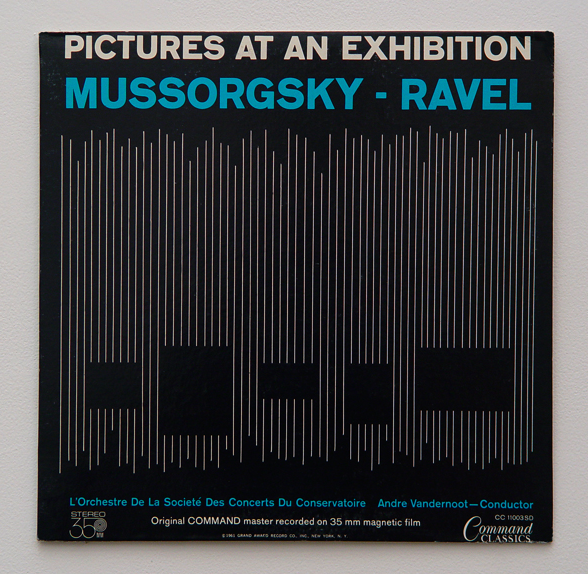
Josef Albers. Image for Command Records. Found Here.
Then I found a wonderful website, Causes of Color, which attempts to marry the aesthetics of color with the science of color. They organize the discussion of color into three causes: Light is made, light is lost, and light is moved. As I read through these pages I was thinking about Josef Albers--returning to subject matter I knew better, felt more comfortable with--something that might anchor the new. Albers's told us that color is understood through experience. He explained, "In visual perception a color is almost never seen as it really is - as it physically is. This fact makes color the most relative medium in art."

Things are not what they are. Tentative perhaps, like this post?

Wallace Stevens's musing about the blue guitar and how things are changed as they are played on that guitar had me quickly leaving Albers and thinking instead about poets,  Picasso, and a lovely book of etchings I have by British painter,  David Hockney --his homage to Stevens an Picasso.  I took a bit of time to reread "The Man with the Blue Guitar" and was stopped by these lines towards the end of the poem:
 
...Morning is not sun,
It is this posture of the nerves,

As if a blunted player clutched
The nuances of the blue guitar.

It must be this rhapsody or none,
The rhapsody of things as they are...

Counting (M.A. Reilly, 2010)
The rhapsody of things as they are is an odd truth we fight bitterly, evidenced by the way our government--both federal and state--organize "content" as deliverable products.  We lack such imagination to imagine things are only as they are and what injustice do we serve to learners when we "train" them to believe solely in such nonsense.

Way always leads on to way.  Frost knew it and so should we.  The direct route may be economical at first blush, but nomadic tendencies are more representative of thinking, of wondering, of coming to know and unknow.  


Thursday, June 16, 2011

What 9 Kids, 4 Teachers & a Supervisor Taught a District

I knew last night would be important, grand, inspiring--so much so that I had trouble sleeping.  I was awake at about 4:30, anxious, and ready to get on with it.  After a significant amount of work, the culmination of an idea that began nearly 20 months earlier, happened. I would like to say I had great clarity about how Classics Academy actually began, but truth be told I have vague recollections of its start.

At that time I shared an office space in the basement of a high school with two colleagues, both of whom worked as coaches.  I had only begun the new job a few weeks earlier and was busy co-teaching with four different English teachers as I began to a get a handle on some redesign possibilities for the high school.  One of the first things the three of us (Celeste Hammell, John Madden and I) decided to do was to find a round table for our office space and "borrow" four chairs as we had hoped it might be a place teachers gathered to talk--figure things out. What I remember most about the start of the Classics Academy was how Harry Sugar, Cynthia Laudadio, Dawn DeMartino and Mark Gutkowski were gathered round that table planning: heads together, the room full of talk, speculation. Scott in and out making suggestions. I knew then what I still believe now: the surest way to redesign a high school is to invest in and support teachers' thinking.  Nothing more.

So these four teachers along with the humanities supervisor, Scott Klepesch, designed a senior experience based on Ancient Greece and Rome, which was a passion the teachers shared.  The plan was for students to enroll in five courses: AP Latin Vergil, AP English - Classics Academy, AP European History and two new courses: Classical History and Mathematics (a team taught class) and The Symposium, a course about creativity. After fairly significant struggles which included addressing many people's doubts, the Academy opened this September with nine students.  In these days of budget conscious communities, the Board and Superintendent showed the necessary backbone in funding this initiative. Our charge though was to grow the program for the next school year. Classics Academy was one of four curriculum/course initiatives, along with American Studies I, American Studies II, and African American Studies at the high school.  This year about 65 students participated in these courses. Next year more than 350 students are enrolled in the same four offerings,  and teachers have also designed additional courses also based on their passions and interests.

Last night these nine students produced individual works for a public exhibition that was well attended. From 7 p.m. to 10 p.m. nine presentations/performances were given, each unique and all in response to a question about how the past informs their individual and societal present.  Kevin Coughlin from Morristown Green.com did a great job of reporting about the exhibition here.  Please take a look before reading on. Truly the performances by the students exceeded anything I have seen in 25+ years of education work. Below is an example from the evening in which senior, Gloria Bangiola conducted an 23-member orchestra of her peers. "Reconciliation" is an original composition Gloria composed based on her reading on the Iliad and her desire to situate the dichotomy between human's brutish expressions and our betters angels.


So if the story ended with a great and inspiring night it would be a success, but this story didn't end there. What is most remarkable, and I want to suggest, even critical, is that these nine students, their four teachers, and a supervisor have helped to change the discourse in the district.  I lost count today of the times students, teachers, directors, and even board of education members discussed the importance of passion based learning, made recommendations for curricular changes based on privileging passion and interests, and suggested that all students had a right to the deep learning witnessed the night before. One junior student told me this morning that he was changing his schedule so that he could be in Classics Academy next year.  He said, "I want to be a scientist who is influenced by the Arts."

24 hours.

Really it's not a lot of time and yet the conversation has changed. Perhaps the event allowed us to hear one another, to dream bigger than we might have felt comfortable to do in front of one another at an earlier time.  Perhaps the nine voices who stunned us while showing us their brilliance also allowed us to understand what Michael Doyle wrote about in a recent post, Arne in June.  Michael said:

The blueberries are still mostly green, just blue enough to remind me of Uranus through our scope.

Raspberries and snow peas and basil and purple beans explode in our mouths, in our brains.

Light, light, and more light floods us daily--anything is possible in June, anything. There's enough energy for all of us who survived the past winter, more than enough.

"Enough" is a wonderful word foreign to many of us. If you know "enough," you know "content."

Less than a week ago, a dolphin eyed me, and I eyed it back. Not much to say, even if we could speak the same language. It's June, and there's more than enough to go around.


Yes, anything is possible in June. The challenge of course is to recall that spirit when less bright times arrive (and we know they will arrive), when doubt and fear fill us and our sense of possibility flickers. Then, I will recall these nine kids, their 4 teachers and a supervisor who helped us to remember that our dreams must be bold.  I will remember the tweet sent to me as I wrote this from another teacher at the high school telling me he's rolling up his sleeves. He has caught the passion bug and spent the day testing out ideas with his students.

I want to be there for this teacher, to use every shred of possible power I have to position him and his ideas for success.  That's the job.

That's the revolution.

It's not in canned programs, regardless of how slick  or pretty they're dressed. It's not in having or not having PLCs or PLNs or strategic plans or vision statements. It's not in the common core.

It's in people.

The power of community can change the direction this country is heading. 


Look, I know that way off in the distance there's Arne Duncan. There's fear. There's the impossibility of PARCC and NCLB and governors who just don't get it and plans to evaluate these fine teachers I've written about here with some awful metric (the new sexy word of the day).  I can hear the drone and for the first time in the 2 years since I took this job, I believe we can get it right for ALL kids, not only nine.  They have showed us the way.  One community in NJ will get this right regardless of what the politicos in Trenton and Washington DC do and don't do. 

Really, it all comes down to this: Last night after the performances as I was getting ready to leave, a father of one of the students said softly and simply: This year has changed my daughter's life. Thank you. 

Quite frankly, that's the only measure I'm paying attention to.