Showing posts with label play. Show all posts

Monday, August 24, 2015

Let Them Play: Thinglink Interactive

I was playing around with Thinglink and decided to make this interactive about play. Just touch the circles to access resources.

Sunday, July 13, 2014

50: Professional Texts & Resources About Play

f
Let 'Em Eat Dirt (Collage, M.A. Reilly, 2014)
In 1981, a typical school-age child in the United States had 40% of her time open for play. By 1997, the time for  play had shrunk to 25%. - Kathy Hirsh-Pasek, from here.

Articles & Chapters
  1. Batt, Tom. (2010). Using Play to Teach WritingAmerican Journal of Play, (1), pp. 63-80.
  2. Bergen, Doris. (2009). Play as the Learning Medium for Future Scientists, Mathematicians and EngineersAmerican Journal of Play, (4), pp. 414-428.
  3. Dougherty, Dale. (2013). The Maker Mindset. In Honey, Margaret & David E. Kanter. (Eds.). (2013). Design, Make, Play: Growing the Next Generation of STEM Innovators. London, UK: Routledge.
  4. Fisher, K., Hirsch-Pasek, K., Newcombe, N. & Golinkoff, R.M. (2011). When playful learning trumps direct instruction: The case of shape learning. In T. R. Westbrook & A. Gopnik (Chairs), Playful learning: Pedagogy and policy. Symposium conducted at 2011 meeting of the Society for Research in Chid Development. Montreal, Canada. (Blog post about the research)
  5. Giddings, Seth and Kennedy, Helen W. (2008). Little jesuses and fuck-off robots: On aesthetics, cybernetics, and not being very good at Lego Star Wars. In Swalwell, M. and Wilson, J., (Eds.). The Pleasures of Computer Gaming: Essays on Cultural History, Theory and Aesthetics. Jefferson: NC: McFarland, pp. 13-32.
  6. Giddings, Seth. (2007). Playing with Nonhumans: Digital Games as Technocultural Form. In deCastell, S. & Jenson J. (Eds.). Worlds in Play: International Perspectives on Digital Games Research. New York: Peter Lang.
  7. MainemelisCharalampos & Sarah Ronson. (2006). Ideas are Born in Fields of Play: Towards a Theory of Play and Creativity in Organizational SettingsResearch in Organizational Behavior: An Annual Series of Analytical Essays and Critical Reviews Research in Organizational Behavior, Volume 27, 81–131.
  8. Marsh, Jackie. (2008). Out-of-School Play in online Virtual world and the Implications for Literacy Learning. Paper presented at Centre for Studies in Literacy, Policy and Learning Cultures, University of South Australia.
  9. Roskos, Kathleen & James Christie. (2013). Gaining Ground in Understanding the Play-Literacy RelationshipAmerican Journal of Play. 6 (1), pp. 82-96. 
  10. Roskos, Kathleen & James Christie. (2011). The Play-Literacy Nexus and the Importance of evidence-Based techniques  in the Classroom. American Journal of Play, 4 (2), pp. 204 - 223.
  11. Vygosky, Lev. (1976). Play and  its Role in the Mental Development of the Child. In Bruner, J., Jolly, A. and Sylva, K. (eds.). Play: Its Role in Development and Evolution. New York: Basic Books.
  12. Weisberg, Deena Skolnick, Hirsh-Pasek, Kathy and Roberta Michnick Golinkoff. (2013). Guided Play: Where Curricular Goals Meet a Playful PedagogyMind, Brain, and Education, 7 (2), pp. 104-112. 
  13. Weisberg, Deena. S., Hirsh-Pasek Kathy., & Golinkoff Roberta. M. (2013).  Embracing complexity: Rethinking the relation between play and learning: Comment on Lillard et al. (2013)Psychological Bulletin. 139, 35-39., Number 1.
  14. Weisberg, Deena. S., Zosh, Jennifer M., Hirsh-Pasek Kathy., & Golinkoff, Roberta. M. (2013). Talking It Up: Play, Language Development, and the Role of the Adult Speaker. American Journal of Play. 6 (1), pp. 39-54. 
  15. Welsch, Jodi G. (2008). Playing Within and Beyond the Story: Encouraging Book-Related Pretend Play. The Reading Teacher, 62, (2), pp. 138-148.
  16. Wohlwend, Karen E. (2008). Play as a Literacy of Possibilities: Expanding Meanings in Practices, Materials, and Spaces. Language Arts, 86 (2), pp. 127-136.
Books 

  1. Ashton-Warner, Sylvia. (1963/1986). Teacher. New York: Simon & Schuster.
  2. Bateson, Patrick & Paul Martin. (2013).  Play, Playfulness, Creativity and Innovation. New York: Cambridge University Press.
  3. Brown, Frase & Chris taylor (Eds.). (2008). Foundations of Playwork. Maidenhead, UK: Open University Press.
  4. Brown, Stuart & Christopher Vaughn. (2009). Play: How it Shapes the Brain, Opens the Imagination, and Invigorates the Soul. New York: Avery.
  5. Cabral, Marta. (2014). Broken Things can Be Beautiful Things: Early Childhood Explorations in Play and Art.  New York: Vast Playground.
  6. Douglas, Katerine M. & Diane B. Jaquith. (2009). Engaging Learners through Artmaking: Choice-based Art Eduction in the Classroom. New York: Teachers College Press.
  7. Duckworth, Eleanor. (2006). "The having of wonderful ideas" and Other Essays on Teaching and Learning.  New York: Teachers College Press.
  8. Dyson, Anne Haas (2013). ReWRITING the Basics: Literacy Learning in Children's Cultures (Language and Literacy Series). New York: Teachers College Press.
  9. Egan, Kieran. (1989). Teaching as Storytelling. Chicago, IL: University of Chicago Press.
  10. Eisner, Elliot W. (2002). The Arts and the Creation of Mind. London: Yale University Press. 
  11. Elkind, David. (2007). The Power of Play: Learning What Comes Naturally. Philadelphia, PA: Da Capo Press.
  12. Frost, Joe L. (2009). A History of Children's Play and Play Environments: Toward a Contemporary Child-Saving Movement. London, UK: Routledge.
  13. Gandini, Lella; Hall, Lynn; Cadwell, Louise, & Charles Schwall. (2005). In the Spirit of the StudioL Learning from the Atelier of Reggio Emilia. New York: Teachers College Press.
  14. Giddings, Seth. (2014). Gameworlds: Virtual Media and Children's Everyday Play. New York: Bloomsbury Academic. (Published on Aug. 28, 2014)
  15. Giddings, Seth. (2006). Walkthrough: Videogames and Technocultural Form. (Dissertation). Bristol, UK: University of the West of England, Bristol.
  16. Gray, Peter. (2013). Free to Learn: Why Unleashing the Instinct to Play Will Make Our Children Happier, Self-Reliant, and Better Students for LifeNew York: Basic Books.
  17. Greene, Maxine. (2000). Releasing the Imagination: Essays on Education, the Arts, and Social Change. San Francisco, CA: Jossey-Bass.
  18. Heath, Shirley Brice. (2012). Words at Work and Play: Three Decades in Family and Community Life. Cambridge, UK: Cambridge University Press.
  19. Honey, Margaret & David E. Kanter. (Eds.). (2013). Design, Make, Play: Growing the Next Generation of STEM Innovators. London, UK: Routledge.
  20. Huizinga, Johan. (1971). Homo Ludens: A Study of the Play-Element in Culture. London, UK: Routledge.
  21. Jones, Elizabeth & Gretchen Reynolds. (2011). The Play's the Thing: Teachers' Roles in Children's Play. New York: Teachers College Press. 
  22. Latta, Margaret Macintyre. (2012). Curricular Conversations: Play is the (Missing) Thing. New York: Routledge.
  23. Learning through Landscapes. (2014). Play Out: How to Develop Your Outside Space for Learning and Play. London, UK: Routledge.
  24. Martinez, Sylva Libow & Gary S. Stager. (2013). Invent to Learn: Making Tinkering and Engineering in the Classroom. Torrance, CA: Constructing Modern Knowledge Press.
  25. Paley, Vivian Gussin. (2014). The Boy on the Beach: Building Community through Play. Chicago, IL: University of Chicago Press.
  26. Paley, Vivian Gussin. (2005). A Child's Work: The Importance of Fantasy Play. Chicago, IL: University of Chicago Press.
  27. Pellegrini, Anthony D. (2009). The Role of Play in Human Development. New York, NY: Oxford University Press.
  28. Schrange, Michael. (1999). Serious Play: How the World's Best Companies Simulate to Innovate. Boston, MA: Harvard Business School Press.
  29. Suits, Bernard. (2005). The Grasshopper: Games, Life and Utopia. Broadview Press.
  30. Sutton-Smith, Brian. (2009). The Ambiguity of Play. Cambridge, MA: Harvard University Press.
  31. Thomas, Douglas & John Seely Brown. (2011). A New Culture of Learning: Cultivating the Imagination for a World of Constant Change. CreateSpace Independent Platform.
  32. Wohlwend, Karen E. (2013). Literacy Playshop: New Literacies, Popular Media, and Play in the Early Childhood Classroom. New York: Teachers College Press.
  33. Wohlwend, Karen E. (2011). Playing their Way into Literacies: Reading, Writing, and Belonging in the Early Childhood Classroom. New York: Teachers College Press.
Websites
  1. Dougherty, Dale. Make  (Archive of magazine). 
  2. The Strong. National Museum of Play. Museum Research and Publications.
  3. This was recommended by Pam Moran.  I remember seeing it a while ago. Thanks Pam:)


Wednesday, July 10, 2013

A Product Worth Buying: Imagination Playground

I so appreciate the thinking that informs Imagination Playground: Provide kids with open space and portable blocks and observe how they make their own play space and what gets enacted and invented within that made space. If I had a school, I'd invest in this type of product along with lots and lots of blocks, sand, water, paints, musical instruments (especially different types of drums and sticks), and other stuff children can find and use to make things.


Saturday, September 8, 2012

Innovation: Play, Passion and Purpose and the Problem with Standards

Today I pulled out some paint, gel medium, gesso, photographs, altered pages from a notebook, and batik paper I had previously made and began to play.  I wasn't sure what I wanted to compose but I did know that I wanted to make use of materials that were new and ones I had previously made. Hours went by and so involved was I that I paid the clock little notice. As I worked a sense of purpose emerged.

Hung the Moon (M.A. Reilly, Mixed Media, 2012)

While I worked, my son two floors above built a replica of the Soviet Typhoon-Class submarine, a few destroyers and battleships in Minecraft that then used them in the course of playing on the server with others.  Like me, he too worked and played and hours passed. We each were fueled by passion and a sense of play, and out of these--purpose emerged.

Screenshot 1(DC, 2012)

Screenshot 2 (DC, 2012)
No one dictated what we should or should not do and this got me thinking about the importance of play, making, and agency--and how these reveal and help to define purpose.  Tony Wagner (2012) in Creating Innovators writes about the relationship among play, passion and purpose. He notes:

In the lives of young innovators whom I interviewed, I discovered a consistent link and developmental arc in their progression from play to passion to purpose. These young people played a great deal—but their play was frequently far less structured than most children’s, and they had opportunities to explore, experiment, and discover through trial and error—to take risks and to fall down. Through this kind of more creative play as children, these young innovators discovered a passion—often as young adolescents. As they pursued their passions, though, their interests changed and took surprising turns. They developed new passions, which, over time, evolved into a deeper and more mature sense of purpose—a kind of shared adult play (p. 30).
I appreciate the idea of the links among play, passion, and purpose--although I would imagine the links are less developmental and more iterative and recursive. Nonetheless that they are co-specifying feels important. Also the need to solve problems seems inherent in all three.

Both my son and I ran into design problems as we played that we each addressed by recalling past work (such as photographing, making things from Legos), leaving the work for a bit of time and returning to it, changing perspective, and trial and error. Creating as we each did today required a large block of time, permission to spend that time as we each wished, and tools necessary to get the work accomplished. It also required not knowing the end when we each started and in fact, not really having a start that was formal.  Rather, the beginning was well over from the point when we might have been able to name it as such. There is an ambiguity here that is rather critical.

All of these ways of composing, coming to know and producing that my son and I each employed are somewhat antithetical to traditional U.S. schooling, especially with its emphasis on external standards. External standards presupposes a neat world--one in which knowledge is defined and the transfer of the defined knowledge is often an end goal. Is it any wonder that so many find school a dead end? My son's interest in the Soviet Union grew out of play, not history class. My interest in textures, mixed media, and photography has grown out of play as well.

On Saturdays like today, I wonder a lot about the spaces of permission necessary for creating to happen and how schools might become such places.


Work Cited


Wagner, Tony (2012-04-17). Creating Innovators. Scribner. Kindle Edition.


Wednesday, April 18, 2012

Imagining A to Z: P Is For Play for Change: World Peace

P is for Play for Change: World Peace

Three at the Beach (M.A. Reilly, 2010)
Yesterday on my way to Plymouth, I was in London at a bus station and met two women who were on their way to a Shaman's collective.  You should know they were joining others from around the world to pray for peace--world peace. I felt better for it.

Play. It is always more fun when you do it with others.
Listen to how people come together across the world to blend their voices. To play for change.
Perhaps you will want to join in.


Imagine and Dream.


Care and Connect.


Be the Change You Want To See in the World.


Look at all we can accomplish by being together, playing together.

Note: In this series of post during the month of April, I am participating in the A to Z blogging challenge, with each day focusing on a letter.  In order to bring some cohesion to this process--releasing the imagination is the focus of each post.

Friday, February 3, 2012

CrowdSourceLove: Day 9 - Be Open to Play

Note: As a lead in to Valentine's Day I will be posting some ways that convey I love you that do not rely on purchasing gifts and am inviting you to do the same where you blog.  If you make a post could you link it to this post?  At the end of two weeks I am curious as to what interconnected posts about love we might make collectively.

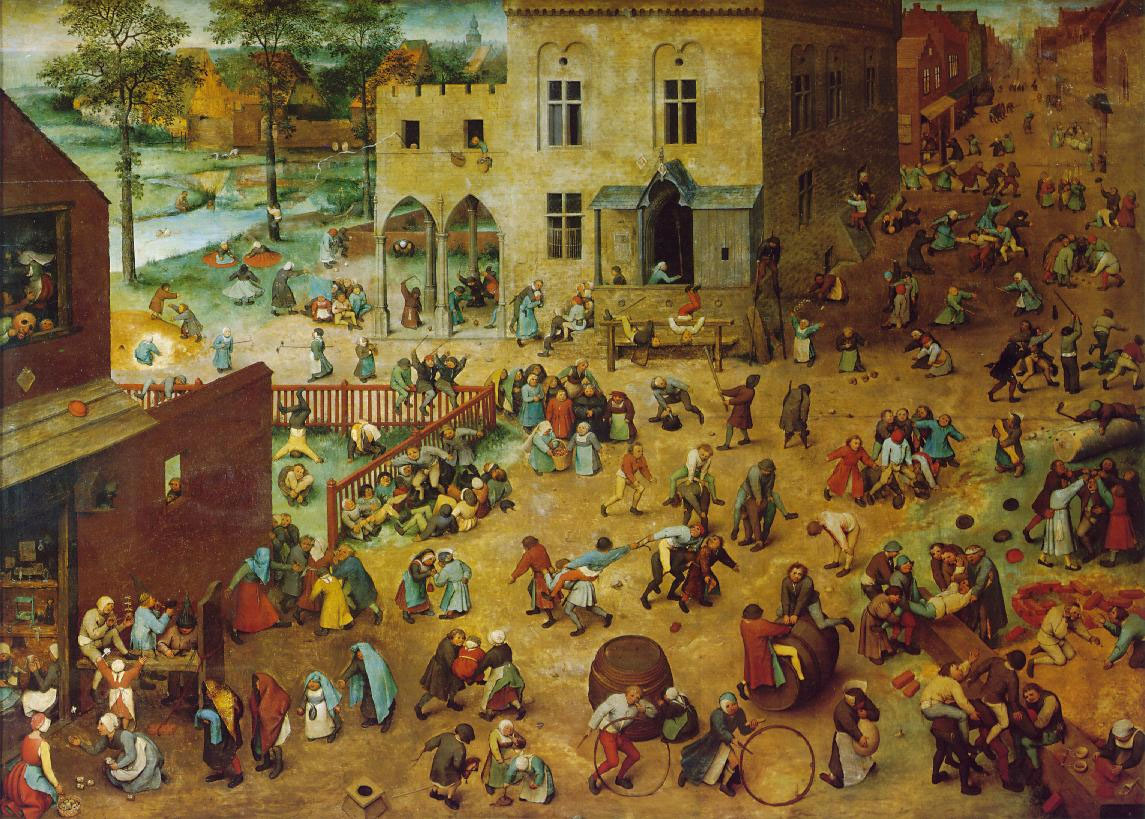
Pieter Bruegel, Young Folks at Play. 1560


However you/s/he/they define it.
Be open to play.
Embrace it.


We need to play.


Tuck away some time to simply play with the person(s) you love, to experience the interconnectedness of you and them and the environment.


Thursday, July 7, 2011

#AskObama What If We Have it All Wrong?

I tried writing a question to President Obama and realized that what I needed to ask required more context than 140 characters might offer.  I was wondering if President Obama has the will & the courage to not emphasize standards and testing that his administration has either established or continued from the Bush years? In other words (to borrow from Reagan [clearly a first for me]} -- Can our President JUST SAY NO to standards & testing?

The USDOE and state governments have an unshakable belief in the efficacy and wisdom of national and state standards that outline "the big ideas" and list objectives organized by discrete subjects for teachers to follow. We are told that standards represent the important information to be transferred and that tests designed by companies are the best way to know if the designated information has been learned.  It's all very neat--very logical. But what if the initial assumption is inaccurate?  What if the emphasis on information-based knowledge coupled with a manic desire to test public school students every few weeks in mathematics and English Language Arts (via the PARCC Plan,60 million children ages 8 to 17, would be tested nine times a year) reduces learning, children's desire to learn, and teachers' agency to teach?

In Doug Thomas and John Seely Brown's (2011) A New Culture of Learning they explain that this new culture consists of two elements:
The first is a massive information network that provides almost unlimited access and resources to learn about anything. The second is a bounded and structured environment that allows for unlimited agency to build and experiment with things within these boundaries (Location 63 of 2399).
In contrast to this new culture of learning, we have the mechanistic view of education that President Obama's education policies and practices are maintaining. Thomas and Brown describe the mechanistic approach:
Learning is treated as a series of steps to be mastered, as if students were being taught how to operate a machine or even, in some cases, as if the students themselves were machines being programmed to accomplish tasks. The ultimate endpoint of a mechanistic perspective is efficiency: the goal is to learn as much as you can, as fast as you can (Location 327 of 2399).
In the Obama plan for education, schools are places where students must demonstrate they have received the Common Core Standards and can replicate them on tests given frequently across each school year.  Failure to demonstrate that the standards have been received can lead to retention, failure, cheating, dismissal, and cash bonuses depending on your role and the outcome.  This schema is based on the belief that what we know remains stable.

In contrast in the new culture of learning it is understood that "Making knowledge stable in a changing world is an unwinnable game"(Thomas & Brown, Location 503 of 2399). Instead of valuing only explicit knowledge, we must value tacit knowledge ("We know more than we can tell" (Polanyi as quoted in Thomas & Brown, 957 of 2399).

Like many others, Thomas & Brown conclude that "Students learn best when they are able to follow their passions and operate within the constraints of a bounded environment"(1038 of 2399).  It is challenging, if not impossible, to follow one's passions when federal and state standards outline what matters and in doing so exclude opportunities for the complicated process of a young person coming to know his/her passion(s) to happen.  The very absence of choice is problematic.

Applying the New Culture of Learning: Posing Questions About Things That Matter


As I have indicated in former posts, I have been interested in watching my 12 year old learn.  He is deeply involved in Minecraft and recently learned how to turn the family computer into a Minecraft server.  When I asked him how he had learned this he said that he watched a "ton of YouTube videos" and taught himself about the computer's operating system.

He told me: "It was a lot of trial and error. A lot of experimenting." 

I also wondered what motivated him to create his own server. Why did he do it?

He said he wanted a place where he and his friends and people he hasn't yet met but who also like to play Minecraft could play together and chat. The multi-player aspect of gaming matters to him and motivates him to learn and want to play.  When he first began playing Minecraft he played it as a single player.  He did this for about two months and then decided that he wanted the interaction with others in the world he was designing and building. I'm encouraged that he sees people he has yet to meet as potential friends.  We have discussed safety precautions as well as the more probable scenario that he will meet people who share his interests and who help him to widen and deepen those interests through play and chat. (See Will Richardson's 8 Shifts for Every Classroom: Shift 1: Do Talk to Strangers).

In the world he and others are building, my son made a replica of the Parthenon.  When I asked him how he built it he explained that he had downloaded different images of the Parthenon taken from different angles and then used the images to think about the exterior and interior of the structure as he built his replica. When he had a question, he did an image search.  He also said that he was disappointed as he could not figure out how to build a replica of the statue of Athena.

My son's interest in the Parthenon was tweaked when I told him that two high school students where I work had created a replica of the Palace of Fishbourne in Minecraft.  He figured out how to contact them via their server and was soon interacting with them.  He wanted to do what they had done: build a server and infuse a sense of history into the play.

Again Thomas and Brown discuss the importance and centrality of play, referencing Johan Huizinga (Homo Ludens): "...play is not merely central to the human experience, it is part o f all that is meaningful in human culture. Culture...does not create play; play creates culture" (Location 1359 of 2399).

Central to my son's play in Minecraft, as well as his friends who are often at our home playing or on line playing-- is the sense of agency they possess.  What I find interesting is none of the boys would be considered honor roll students. Some self describe themselves as having reading problems and disliking reading.  Some describe themselves as being "bad in math."  Many have comments on report cards that say: Easily distracted. Not working to potential.  Some have been classified hyperactive. Yet all can design and build intricate worlds with harbors full of ships and various types of homes with rooms serving different purposes, and farms, and self-repairing bridges, and portals to name but a few things. They can do this for hours.

Thomas & Brown discussing agency explain that "unlike traditional notions of learning which position the learner as a passive agent of reception, the aporia/epiphany structure of play makes the player's agency central to the learning process, How one arrives at the epiphany is always a matter of the tacit. The ability to organize, connect, and make sense of things is a skill characteristic of a deep engagement with the tacit and the process of indwelling" (Location 1381 of 2399).

My son built a server as he is in search of a guild: a group of dedicated players who actively participate in the making of the game, framing and posing questions, using answers to generate more questions, and attending to design challenges and other problems as they arise.

So Where To?

The learning world we need to engender looks little like the structure of school we know today. It is not informed by a list of standards, regardless of how clever those standards may or may not seem to be. Learning is not satisfied by having patients receive knowledge and replicate that information on national tests.  Such passivity dulls interest.

Instead, a shift needs to happen. Instead of schools being the locus of learning, we need to be open to seeing learning opportunities beyond the classroom and valuing such experiences instead of situating them as marginal.  This means that we need to be learners as well.  There are educators I have worked with or met via social networking that I would love to have looking in as my son and his friends play.  I imagine teachers like Harry Sugar or David Wees whose keen knowledge of mathematics might shape (bound) occasions based on the game playing that might help the boys to name the mathematics they are using as well as the naive understandings they may well have.

When I think about learning that is needed, I imagine a guild as well: a collection of people who are committed to learning and connected through interests and mediated online and in person. I like the idea of a bounded environment where experimentation happens and agency is privileged. I appreciate the understanding that knowledge is changing at a rate that defies us naming it, teaching it, and regurgitating it on tests. I imagine experiential learning and tacit knowledge coupled with some explicit knowledge mattering. Instead of sitting and watching, learners (students, teachers, mentors, community based experts) would be knowing, making, and playing.

How and what should be locally determined and informed by learners' interests.

Curious as to what you think & I will continue this...