Showing posts with label Common Core State Standards. Show all posts

Monday, April 14, 2014

Let's Stop (re)Inventing The Committee of Ten: Getting Over School


Committee of Ten History & Government Subcommittee from here.


1. A Story, A Story

What if we have it mostly wrong? 
What if our assumption that school grades and state tests are apt indicators of academic success?  
What if our assumptions that learning discrete subjects as the means for becoming 'college and career ready' are too narrow or misinformed?
What if the goal of becoming 'college and career ready' is narrow, naive, or perhaps inappropriate?

I think about these questions each and every time I read a narrative by someone who 'failed' at school and is now successfully writing for a living.  I wonder about the dissonance between school failure and being a writer.  In the Times there was an interesting essay, The Art of Distraction, by Hanif Kureishi who writes:
As a teenager, in particular, I wanted to be good at things, to shine, but like the Ritalin boy, I fell badly behind at school, finding myself not only unable to learn but at the bottom of my class. I walked out of secondary school, and a semi-skinhead violent street culture, with three “O” levels, feeling as if I’d been badly beaten for five years.
What does it mean to be at the bottom of a class? How is such a position even allowable, let alone the conditions that would give rise to exiting high school feeling as if you had been badly beaten?  What does it mean to succeed at high school?  'School success' as measured by GPAs has a lot to do with compliance: the dutiful student who completes the assignments on time (or ahead of schedule), regurgitates teachers' language for the Friday quizzes and tests, pays attention in class (or at least looks that way), keeps a 'good notebook' filled with the notes the teachers have given, scores well on State assessments, completes test prepping packages, and doesn't cause any trouble or fall asleep in class.  One might argue given the current emphasis on accountability as measured by single tests, that a similar 'compliant' teacher may be more prized than one who 'causes trouble, agitates for a different system.'  Excellence may really be noting more than compliance.

2. Getting over Readiness
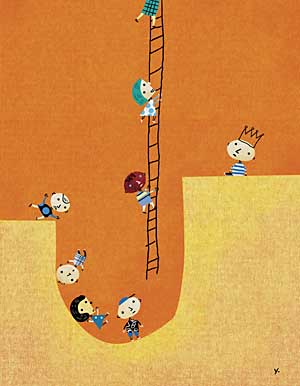
Art By James Yang
I have spent a fair amount of time in K-12 schools and recently I was walking through the hallways of a school I had not been to before.  In room after room the same two scenes were occurring: in some young people sat at single desks and whether they were in rows or small groups--they all were watching the front of the classroom where the teacher talked and talked.  In other rooms, young people sat at single desks and looked busy doing seat work while a teacher sat at his/her desk and did seat work of some sort too. Occasionally the monotony of the scene was broken with a student standing at the teacher's desk or a teacher standing at a student's desk.  In several rooms some students rested their heads on top of folded arms on their desks.  Almost always these were young people seated towards the back of the classroom and usually they were boys.

Room after room.
Floor after floor.
Nary a difference.

In recalling this school and others like it, I think about the irony of readiness, a pernicious concept, if ever there was.  How can we say to parents, "Based on our readiness tests, your child is not ready for school...." Ready for what?  To watch the adult? To fill in endless worksheets and work assignments? To be bored? To fall asleep day after day? To feel as if you had been badly beaten for five years?

3. The Committee of Ten Again, Again 

I know there are aspects of education we are doing wrong, even as I acknowledge that there are wonderful exceptions to the classrooms and school I described above. I have been in schools and classrooms where learning is vibrant, dynamic, thoughtful, edgy.  In conversations with many of these educators though they openly talk about the countless pressures they face to stop the excellence they do with students in order to attend to the given and sanctioned curriculum; the state test content; test prepping and other absurdities.  Excellence cannot be had outside of the now, the ever emerging present.  Excellence does not occur via a sealed past, an epic construct.  It emerges alongside people making and doing, failing and figuring out.  It is inherently idiosyncratic as it is communal.

The standardization of teaching, learning, and measuring that corporations, governments, some school and district leaders, as well as some parents seem to be embracing with increasing interest will only lessen student learning and interest in learning. It will confuse, not illuminate, what excellence looks and sounds like--as we will be in the business of producing a country of Harrison Bergeron's.

In Democracy and Education, John Dewey (1916) wrote:
Schools are, indeed, one important method of the transmission which forms the dispositions of the immature; but it is only one means, and, compared with other agencies, a relatively superficial means. (Kindle Locations 139-140). Public Domain Books. Kindle Edition.
55 years later in Deschooling Society, Ivan Illich (1971) stated:
Most learning is not the result of instruction. It is rather the result of unhampered participation in a meaningful setting (p. 18).
In thinking about Dewey and Illich, I believe that the idea of a place called school as the single method for formal learning may well have outlived its usefulness. Since NCLB & reiteratied through RTTT, the standardization of schools, curriculum, teaching, and learning methods has alarmingly increased and now with the Common Core State Standards, the upcoming Smarter Balanced Assessment Consortium (SBAC) and the Partnership for the Assessment of Readiness for College and Careers (PARCC) testing, and the standardization feels even more exponential. We are now faced with a product that will be the basis of measuring what constitutes privileged academic performance at most schools: a single set of standards, preferred instructional methods (close reading), learning materials, curriculum maps, professional learning modules, and continuous high stakes, national-state testing of children throughout their entire school careers. 

You only have to revisit the assumptions made by the Committee of Ten to understand that inclusiveness in groups who want to standardize, may not be in the best interest of learners or a democracy.

Found on Pearson Website here.
Achieve, Inc. photographs from their Facebook Page
I often wonder how different school might be had the NEA task force, Committee of Ten, (a group of 90 elite men) determined that observation, reasoning, and judgment could be cultivated through multiple methods and studies as opposed to tying each to a discrete subject. I often wonder how different their recommendations might have been had a few women, some newly arrived immigrants, some
people of color, some students,  and representatives who hailed from work other than teaching been part of the committee.  How might the recommendations have been different?  Replacing 90 elite men who served on the Committee of Ten in the 1890s with corporations in the 2010s who are informing the Common Core really isn't much of a change. I think here of Marx who wrote, "...one must become conscious of how an ideology reflects and distorts ... reality ... and what factors ... influence and sustain the false consciousness which it represents -- especially reified powers of domination."


If you take 90 men, hailing from elite schools (college presidents, headmasters, professors) and ask them to name what an excellent education contains--we should not be surprised that their answers (all were in agreement) will reflect their lives, their truths. Habermas told us that without a metalanguage to challenge the given assumption, power tends to  serve up itself as the model of excellence. Today it is Achieve, Inc., Pearson, McGraw Hill, ETS, state DOE, federal DOE who are the new Committee of Ten. Meet the new boss, same as the old boss...

4. Alternatives
  • Imagine if 'school' was organized not solely by discrete subjects, but by people--local, indigenous to a common ground and connected across physical, social, economic, and political geographies. Decisions about learning are made in such places, at such locations. 
  • Imagine a curriculum based on rich conversations engendered within participatory cultures where connecting, collaborating, creating and contextualizing are norm.
  • Imagine if learning was understood as natural, human--that which happens all of the time. As such, learners are by nature and nurture, capable of learning. No one need 'get ready' for learning. Failure is natural and necessary and does not warrant front page reporting, retention.
  • Imagine if learning opportunities and occasions could be curated by learners (students and teachers) for themselves and other learners? That these processes were imbued with choice.
  • Imagine if curriculum was situated as complicated conversation that learners, mentors, teachers, and community members engaged in often, daily even.
  • Imagine if work and learning were not separated so rigidly and apprenticeship was an option for learners based on their interests, needs, economies, passions and communities.
  • Imagine if the learning occurring in passion affinity spaces, in local community-based locales were privileged. Imagine if we leaned in and began to name the thinking that was being done at such 'places' what new importance might emerge.
  • Imagine if readiness was retired. 
  • Imagine if we stopped emphasizing measurement by single high stakes test and end of course grades.
  • Imagine if we did not confuse the well made argument with truth.
  • Imagine if we shifted measurement from being a far-from-student task done by 'others' and instead rested it in the hands of learners as necessary and important learning tasks that a community supported.


Tuesday, August 14, 2012

And the night is enormous: CCSS, Percentages, and Genocide

I. 

 A friend sends a draft chapter from a book she is writing about genocide that Routledge will publish in 2013. The chapter is about the influence of the arts (especially) and literature on those who have become genocide scholars and activist.  Professor Alex Hinton cited the Paz poem, "Hermandad" as influential on his study of genocide. 

Here it is. I find it important to hear this aloud.


Brotherhood

Octavio Paz
Homage to Claudius Ptolemy
I am a man: little do I last
and the night is enormous.
But I look up:
the stars write.
Unknowing I understand:
I too am written,
and at this very moment
someone spells me out.
Translated from the Spanish by Eliot Weinberger


Professor Charli Carpenter cited the 'I, Borg' episode Star Trek: The Next Generation as that which was influential on her work on international laws about war crimes. 


Films such as: Apocalypse Now (Francis Ford Coppola, 1979), Ghosts of Rwanda (Greg Barker, 2004), The Mission (Roland Joffé, 1986), The Shop on Main Street (Ján Kadár and Elmar Klos, 1965), The Killing Fields (Roland Joffé, 1984)--also were cited as influential.

II. 
 
It gives me pause when I survey the list--74% of the influential texts are art, music, and literary works.  The remainder are informational texts--largely autobiographies, biographies, and memoirs. Popular culture, visual and musical arts, photographs, films, literary works--all influenced those who are clearly 'career ready'.  My friend writes that she wonders about the Common Core State Standards and its insistence on percentages of specific text types and I wonder too.   Is there some research apart from David Coleman's remarks that indicates 75% of the high school texts 'should be informational" and 25% narrative? Why?


III.

How foolish to think we can know the proper percentages of anything--let alone that which would make one college and career ready. How many of us simply act on this information via the CCSS as a given truth?

Local matters.  Context (in)forms.  To forget this is to be ignorant.

IV.

And the night is enormous.


Tuesday, July 3, 2012

Crows Talking, Tacit Knowing

Crows Talking (M.A. Reilly, 2011)
I.

I made the image above last summer while out walking.  A cawing, polyphonic nasal sound, caught my ear and had me turning toward it, camera lifting simultaneously, shutter whirling.  Between trees, green with summer, two crows sat on a large branch in the thick of the woods talking.  Between us: an exchange of energy. At that moment, I knew more than I could say.

II.

Later, as I walked on I wondered if perhaps they were mates or neighbors--what they might have been talking about.  Crows, like us, are social beings.

III.

I've always found crows fascinating: these birds whose vocal range is so significant. At 8 I entered a crow calling contest, surprising my family, as we were passing through a town and had stopped for lunch and in the town center there was a small autumn festival happening and on the posted schedule was a crow calling contest and I signed on.  My family cheered me.  I only knew the "caw-caw" of the bird and sounded it loudly--and was even more delighted to hear the other contestants make their varied sounds. They helped me to know that voice of the crow is varied, beautiful.  All the way home I looked for crows and made crow sounds.

IV.

Regardless of living in a city, suburb or rural space--crows have always been a backdrop to wherever I've lived--be it the hooded crow found in Ireland or the black crow I've come to better know here in the States.

V.

Like the humans I joined who imitated the crow, so too have crows been known to imitate human voice. In Gifts of the Crow, John Marzluff (2012) describes a situation in which a crow rounded up local dogs by calling to the dogs in a human sounding voice, "Here, boy. Good dog." The crow lead dogs to a nearby college campus, gathering them beneath a tree. When the students let out of classes, the crow flew low with the dogs following it and their movement disrupted the students as they made their way across a large green, dislodging lunches in the process. The crow returned to eat. A trickster, for sure.

VI.
A Chance of Crows (M.A. Reilly, 2011)

Crows, like many songbirds, sing to define their territories and to attract mates.  But crows also interact with regular neighbors, engaging in sustained social relationships. 

VII.

Like crows, we too seek to make meaning--to frame and figure out problems, to talk our way in and out of ideas, hunches, and relationships.

VIII.

Do birds dream?  Songbirds, like crows, do. They rehearse their songs in sleep.

On birds and dreaming: "During undisturbed sleep...The neurons spontaneously fired the same complex song production patterns in bursts. Interestingly, these activity patterns were at slight variance, as if the bird was rehearsing a variety of slightly different songs, sometimes with slower or faster tempos." (from here).


IX.

Here's an idea: Take one field. Add some children. Add some crows.

There's so much to know and (un)know through observation that I wonder why we don't make it a main activity of school.  Keenly watching and at times using tools to help us notice and understand what we notice is the stuff of conjecture, theory making, composing, experimenting, and insight.  It helps us code and fail to code.

X.

There's so much one can and does learn that expressing the 'totality' of it in neatly and logically written standards is rather foolish and dangerous especially when coupled with a manic desire to test public school children constantly and narrowly.  We need to consider Robert Frost and the advice from the speaker of his poem, "Mending Wall" who has this to say about boundaries:
Before I built a wall I'd ask to know
What I was walling in or walling out,
And to whom I was like to give offence.
The very things that are 'walled in and out' through our understanding of standards, Common or otherwise, may be the necessary keys to learning for some.

XI.

Knowing is embodied in learners, their social networks, and in the processes and things that they create. Tacit knowing is the stuff we cannot list or code.  Much of that uncoded knowledge is systematically being diminished from school experiences, as what counts as content is what can be found on lists of things to know via standards. In our hyper attention to standards and the tests that measure students' acquisition of these coded bits of information, what will become of embodied learning?

XII.

Think about the crows who sat on the limb of the tree, calling.  I didn't know what their calls meant at the time or what that scene remembered might mean again and again or how such knowing might find expression.  I could not have anticipated you, dear reader.  It was a nothing moment, and one that was and is ripe with possibility.

Like learning, lifting the camera to make a moment was part reflex, part faith, part cooperation, and part coding. 

XIII.

Reflex.
Faith.
Cooperation.
Coding.

What might it mean for the generation coming of age if the majority of things we teach them to value are limited to that which can be coded?  What might our children learn about intuition, cooperation, community as knowledge?

Might we be teaching them to turn away from hunches, from self, from other? 


Omen (M.A. Reilly, 2011)


Friday, April 27, 2012

Making Meaning Is Complex: Text Dependency and Feeling

The Reader (M.A. Reilly, 2011)
In the recent issue of Education Week, Catherine Gewertz authors Teachers Embedding Standards in Basal-Reader Questions which chronicles the work of 70 educators who "came together in response to the Common Core State Standards in English/language arts, which demand that students hone their skills at understanding and analyzing a variety of texts." The idea was for educators to rewrite aspects of their basal series which Student Achievement Partners (SAP) and Council for Great City Schools (who sponsored the workshop) say are lacking.  I am not surprised that the basals are less than what is expected via the Common Core or frankly just common sense and think it is important that educators do take a critical look at the materials they are using with children.  The goal of the workshop was for educators to write new questions for their current text series emphasizing queries which would require readers to directly attend to the text. I support that goal as I imagine you do as well.

David Liben, a former principal and a 'senior literacy specialist' with SAP appears to have been a key presenter at this workshop and says that students' experiences 'can play a valuable role in understanding text'.  I was pleased to read that as so much of the rhetoric I have heard  naively dismisses feeling.  Unfortunately Liben is also quoted saying the following:
He (Liben) reminded the participants that the common standards “virtually eliminate text-to-self connections,” meaning they aim to focus students on figuring out what the text means, rather than how they feel about it. This, he said, is a more solid preparation for college and jobs.
“In college and careers, no one cares how you feel,” Mr. Liben said. “Imagine being asked to write a memo on why your company’s stock price has plummeted: ‘Analyze why and tell me how you feel about it,’ ” he said, to the chuckles of workshop participants.
So hold those thoughts and contrast them with what Wendell Berry said last week when he delivered the Jefferson Lecture ( 'It All Turns on Affection'). Berry opens and closes his speech referencing Howards End.  He says:
The argument of Howards End has its beginning in a manifesto against materialism:
It is the vice of a vulgar mind to be thrilled by bigness, to think that a thousand square miles are a thousand times more wonderful than one square mile . . . That is not imagination. No, it kills it. . . . Your universities? Oh, yes, you have learned men who collect . . . facts, and facts, and empires of facts. But which of them will rekindle the light within?14
“The light within,” I think, means affection, affection as motive and guide. Knowledge without affection leads us astray every time. Affection leads, by way of good work, to authentic hope. The factual knowledge, in which we seem more and more to be placing our trust, leads only to hope of the discovery, endlessly deferrable, of an ultimate fact or smallest particle that at last will explain everything.
For a reader, recognizing the light within is what 'gets made' in transaction with texts. These transactions are often (in)formed by how we feel and think about what we are reading.  What is unfortunate with the some of the rhetoric from Liben and others is that in an attempt to situate the importance of attending directly to the text, they find it necessary to debase readers' feelings that arise when they interact with text. I get the interest in ensuring children actually read the text and do so with integrity.  However, it is shortsighted and misinformed to dismiss feeling.  To a large extent it is why we read. Our children need both types of experiences.

I love the idea of text-based inquiry.  As a former English teacher and professor--such methodology is akin to breathing. For example, I still think that meaning rests on Frost's use of the word 'just' in the closing line of 'After Apple-picking' and if asked to support such an assertion could do so with text in hand.  I recall this not only because of the meaning I have made within the text, but also because the text resonates with me as I age.  The meaning does not hold still, but rather re/emerges alongside occasion.  Reading is complex work. A truth is that making meaning of a text doesn't rest in one approach or the other, but rather both aspects can be found, even when naming them may be difficult. They are rather entwined.

Text dependency is of course critical and it does not represent the totality of reading.  Our expectations need to be a bit bigger so that feeling, attention to textual language and detail,  as well as inquiry are represented in our pedagogical approaches to text and in children's engagements and response to text.  I hope educators gently challenge assertions like Liben makes so that our work can be enriched, not narrowed.

Berry would tell us that affection is essential in human activity, --that '[k]nowledge without affection leads us astray every time.'

Wise words from a wise man that we ought to mind.


Tuesday, February 21, 2012

Death, Certainty, and the Common Core

The Cover to a Child's Personal Narrative
1. First a Story

Last week, a ten-year-old boy stopped me while I was visiting his classroom and asked me how I liked the cover to his composition.  He then handed the piece of yellow construction paper to me. At the time he had not added the RIP or the tears.  As I read the title, I stopped unsure if I was reading correctly and reread. It took me a few seconds to find a voice to ask him about his narrative.

He passed two handwritten pages to me and I read them learning that his favorite uncle had died breaking up a mugging, with a bullet to the center of the forehead. He talked to me about how his uncle was his mother's older brother, her favorite too and how he and his uncle use to watch a special TV show together.  I told him that his narrative made me sad and how reading it reminded me that I needed to reach out to both of my brothers, if for no other reason than to say hello.

That's important to do, he told me as he added the tears and the RIP to the cover.

2. Then Another

Beneath the rhetoric of school reform are children's lives--fragile, resilient, and often tragic.  I think about this child and his powerful need to tell this story--a story I imagine he will tell again and again in different ways throughout his life.  Against this, I also think about those who would have us believe that story has limited place at school.  David Coleman, Common Core author joked about personal and persuasive essay when he discussed the Common Core with an audience of educators. Coleman told the audience that narrative and persuasive writing were the two most often prescribed school texts and why that was wrong.  He said:
The only problem with these two forms of writing is they don't get you very far in college and career readiness. Otherwise they're terrific (laughter).  That is it is rare at a job that the boss says, 'Johnson,  I want a market analysis, but before that I want a compelling narrative about your childhood' (again laughter).
An unintended consequence of the Common Core can be found in the certainty that frames so much of Coleman's utterances. He appears to be so sure that his thinking is right--right for an entire country.  With no actual experience against which to measure his remarks, Coleman continues on--perhaps unaware of what his careless rhetoric will displace--a child's powerful need to make sense of a favorite uncle's death through story.  What concerns me more than David Coleman is the audience of administrators and Department of Education folk who sat there and laughed.  Was there no one in that audience brave enough, bold enough to say to Coleman: Wait, you don't know what you're doing.  Let me tell you a story about a child from...?


3. Even in Business, or is it Especially in Business?


Humans, regardless of age, have a powerful need to tell stories.  Stories matter--not only for ten-year- old boys from the Bronx whose favorite uncles die, but also for those earning their keep in various businesses.  Coleman got it wrong in his contrived scenario about market analysis.

Market analysis is informed by story.  One might say it rests on story.

Consider Seth Godin who writes:

Storywork I was brainstorming with my friend Jay today and he put this picture into my head.
Most of the time we do the work. The work is our initiative and our reactions and our responses and our output. The work is the decisions we make and the people we hire.
The work is what people talk about, because it's what we experience. In other words, the work tells a story.
But what if you haven't figured out a story yet?
Then the work is random. Then the story is confused or bland or indifferent and it doesn't spread.
On the other hand, if you decide what the story is, you can do work that matches the story. Your decisions will match the story. The story will become true because you're living it.
Does Starbucks tell a different story from McDonald's? Of course they do. But look how the work they do matches those stories... from the benefits they offer employees to the decisions they make about packaging or locations.
Same is true for that little consulting firm down the street vs. McKinsey. While the advice may end up being similar, each firm lives a story in who they hire, how they present themselves, etc.
The story creates the work and the work creates the story.

 Muriel Rukeyser expressed our need for story, clearly, artfully--years ago when she wrote:
Time comes into it.
Say it.       Say it.

The universe is made of stories,
not of atoms.

We are the stories we tell.  If we fail to tell and receive stories, we fail to be. Ten-year-old children innately know this.  Perhaps, some among us still need to learn it.            

Monday, February 6, 2012

Dr. King and the Problem of Representation

Following a link from Susan Ohanian and one from Grant Wiggins, I came across the same video by Common Core State Standards author David Coleman. Few things have stopped me as this video did. The purpose of the video, 'Text-Dependent Analysis in Action: Examples From Dr. MLK, Jr.'s Letter from a Birmingham Jail,"  is to offer a model to teachers illustrating how to teach critical text analysis to students. Mr. Coleman remarks:
"Many teachers and others have asked us to show them a model of what that (teaching students to read with care, identify textual evidence & represent that learning) might look like...to meet the Standards."
So let me stop here and ask you to take a moment and imagine what Mr. Coleman will next do.  

What do you see? 
What do you imagine?

Below is a screen capture from the video.  Take a careful look at this scene as it is unchanging throughout the 11-minute model teaching video. Mr. Coleman stands in front of a vanilla screen wearing a sports jacket and collared shirt and describes what he does when reading the opening to the letter.  


Screen capture of David Coleman offering a Model Teaching Lesson sans Children

You may ask, "But wait a minute--where are the learners? Are there no children? No students?"  These represent critical questions.  In fact I would ask, Is it even possible to have a model of  student learning that does not have learners represented?  Can we call this a classroom model if the only one present is a man in a suit talking?  


I want to say here that Mr. Coleman's thoughtful inquiry into the opening of the letter is interesting.  I can imagine that we might have a lot to discuss.  But I would be quick to also say that such a discussion about text should not be mistaken for teaching.  There is no teaching when there are no students. Children collectively co-compose the class. They are not vessel upon which we pour 'correct' interpretations. They are the living impulse that along with the teacher make a collection of people into a class.

That's the quiet secret that is missing from so many of these reform efforts and standardization. Teaching and learning are human enterprises. Fallible as they are beautiful. Representation is essential.

Now there is an irony to Mr. Coleman's model lesson without students as he is showing all of us how to critically read Dr. King's impassioned letter from the Birmingham Jail.  What's unfortunate is the significant disconnect between Mr. Coleman's model and his failure to recognize that without students he has no model.  Representation is missing and isn't it ironic given the very text he is critically analyzing?  Dr. King's message is largely about the responsibility we have (especially those sanctioned with power) to ensure the representation of all, especially those who may be cast as 'other'. This important understanding is not lived in the actions of Mr. Coleman.

There are several sections in the letter where Dr. King conveys the importance of representation.  But two sections resonate so loudly.  Dr. King writes:
I guess it is easy for those who have never felt the stinging darts of segregation to say wait. But when you have seen vicious mobs lynch your mothers and fathers at will and drown your sisters and brothers at whim; when you have seen hate filled policemen curse, kick, brutalize, and even kill your black brothers and sisters with impunity; when you see the vast majority of your twenty million Negro brothers smothering in an air-tight cage of poverty in the midst of an affluent society; when you suddenly find your tongue twisted and your speech stammering as you seek to explain to your six-year-old daughter why she can't go to the public amusement park that has just been advertised on television, and see tears welling up in her little eyes when she is told that Funtown is closed to colored children, and see the depressing clouds of inferiority begin to form in her little mental sky, and see her begin to distort her little personality by unconsciously developing a bitterness toward white people; when you have to concoct an answer for a five-year-old son asking in agonizing pathos: "Daddy, why do white people treat colored people so mean?"; when you take a cross-country drive and find it necessary to sleep night after night in the uncomfortable corners of your automobile because no motel will accept you; when you are humiliated day in and day out by nagging signs reading "white" men and "colored"; when your first name becomes "nigger" and your middle name becomes "boy" (however old you are) and your last name becomes "John," and when your wife and mother are never given the respected title "Mrs."; when you are harried by day and haunted by night by the fact that you are a Negro, living constantly at tip-toe stance never quite knowing what to expect next, and plagued with inner fears and outer resentments; when you are forever fighting a degenerating sense of "nobodiness" -- then you will understand why we find it difficult to wait. There comes a time when the cup of endurance runs over, and men are no longer willing to be plunged into an abyss of injustice where they experience the bleakness of corroding despair. I hope, sirs, you can understand our legitimate and unavoidable impatience.
"Nobodiness."  I think here of the absence of actual student bodies in the model Common Core State Standard lesson and want to suggest that this should give us pause. This is not a simple oversight.  This is a philosophical failing--a moral problem that extends well beyond the video lesson. It makes me ask, Would an actual teacher, regardless of competence, actually fail to recognize that one cannot have a class without students?  Is this not the primary understanding that we carry with us when teach? The class cannot exist without the children, the teens, the you, the me.

A bit later in the letter, Dr. King also states: "To use the words of Martin Buber, the great Jewish philosopher, segregation substitutes an "I-it" relationship for an "I-thou" relationship, and ends up relegating persons to the status of things." When I read the Common Core State Standards or watch the Common Core expert modeling lesson, I do not see my son.  That quirky 13-year-old who is flesh and blood, complicated and impassioned is not represented.  Rather my child, like yours, is situated as the 'student'  who is an homogenized, disembodied thing.

Is that the most we can want?

Now Mr. Coleman and I disagree about approaches to reading.  As a coauthor of the Common Core, Mr. Coleman wants us to read like a detective. This insistence on close reading as the singular method is privileged every year in the Standards and yet it is simply one method.  It is an apt method at times, but it fails to represent the whole of reading.  Additionally, I would want my son, a child of color,  to come to know Dr. King's letter through a more embodied experience. I want him to know the issues of representation in his bones, not just in his head. For my son, this isn't simply an academic matter.  The issues of representation and justice may well be matters of life and death.  In such instances, close reading is at best, a weak antiseptic.


Wednesday, September 15, 2010

The Shallow Breath of Standards: Seeing Beyond Things

My friend, Ethel's husband, Mark, loaned me a book today: The Zen of Creativity: Cultivating Your Artistic Life (John Daido Loori).  I started reading it and could not put it down. Early in the text, Loori describes an exercise he did that legendary photographer and teacher Minor White  provided.
Venture into a landscape without expectations. Let your subject find you. When you approach it, you will feel resonance, a sense of recognition. If, when you move away, the resonance fades, or it gets stronger as you approach, you'll know you have found your subject. Sit with your subject and wait for your presence to be acknowledged. Don't try to make a photograph, but let your intuition indicate the right moment to release the shutter. If, after you've made an exposure, you feel a sense of completion, bow and let go of the subject and your connection to it. Otherwise, continue photographing until you feel the process is complete.
Well, now that exercise is pretty clear to me as a photographer and one I anticipate trying this weekend.  I have experienced that odd exchange of energy between myself and my subject when I am in such a zone. It's as if my finger on the shutter and my eye in the viewfinder are no longer limited to my body, but somehow are deeply connected to the subject, located, if you will, outside of time and space.  What is central to these moments out of time, is the state of not knowing that defines how I see.  Certainty has no voice in these dramas. It is pure spirit.

This zen reading and thinking about art, reminds me a lot of what it means to be a teacher and how critical it is to not know, perhaps more so in this time of false certainty. Like my finger on the shutter and eye in the view finder, the space that is made in a classroom with students is not defined by the physical realities of walls, floor, or ceiling.  Something far grander is composed in these learning landscapes--something akin to what Maxine Greene labels as wide-awakeness.

Greene (2008) writes:
To open spaces for learning is to give learners a sense of absence, of open questions lacking answers, of darkness unexplained. If people respond to all of this with a blank disinterest, they are, often without realizing it, acquiescing in the “given,” the fixed, the unchangeable. (LEARNing Landscapes, 1, 3, p. 18).
Formal educational standards are the "given, the fixed, the unchangeable."   I have always been graced with students willing to wander into that unexplained darkness and a deep desire to venture along.  Perhaps that is why I find the standards movement to be at best a shallow breath, and at worse an impediment to all breath.  The use of educational standards assumes a decontextualized world where there is something called "the student" and a separate something called "the teacher".  The sad truth though is that this student can never be your subject, nor one whose presence resonates. Likewise,  "the teacher" can never venture into a landscape without expectations.  Such exercises are folly or in these days, perhaps even seen as sinister.

The given. The fixed. The unchangeable.

My exercise for myself this week is to find some darkness--an absence and reclaim my voice; to be truthful, and to stand against the certainty that is likely to doom us.  

What is Written. Image by M.A. Reilly. Tuscany, 2009.
I wish you, dear reader, an educational landscape sans expectations.

Saturday, August 21, 2010

Waiting for Daedalus: James Joyce in 8th Grade?

Once upon a time and a very good time it was there was...a gigantic mistake.

The Common Core Curriculum Maps.

Yep. I had hope to exhaust what I might have to say about these maps in my last posting, but then I read the middle school maps and found more words to speak. The 8th grade maps, especially the fourth unit, simply defy common sense.   In the "Authors and Artists," a four-week unit,  the "essential" question: How are artists and authors similar is posed.  I'm a bit unclear as to why and for whom that question is essential, but was willing to pretend it could be essential to someone, somewhere.  What baffled me though was the list of 4 stories that were offered as the stories for the unit. They were:

From the Mixed Up Files of Mrs. Basil E. Frankweiler (E.L. Konigsburg)
Leaving Eldorado (Joann Mazzio)
Talking With Tebe: Clementine Hunter, Memory Artist (Mary E. Lyons) (easier)
A Portrait of the Artist as a Young Man (James Joyce) (advanced)

Okay, Mixed Up Files, a story about an 11-year-old girl and her younger brother who run away from home and head to the Met. Perhaps a bit young for 8th grade, but it could fit.  Leaving Eldorado, an epistolary novel features 14 year old Maude who turns down marriage to become an artist. Historical fiction that could be an appealing read for some 8th graders, especially girls. Talking With Tebe: Clementine Hunter, Memory Artist, a picture book biography about an African-American sharecropper who was an artist is intended for younger audience, but certainly might be appealing to 8th graders as a quick read. Three books with three strong female protagonists.  

What about boys? Well, I guess that would leave the last selection. Let's see what was that?  James Joyce's Portrait of the Artist as a Young Man.  It does feature a male protagonist. But wait a minute.  Portrait in middle school? 

Yes, Portrait. 

I had to reread the map a few times to be sure that I hadn't taken a wrong turn.  Perhaps there was in some parallel universe another text by the same name.  But no, it's the moo cow coming down along a very slippery slope.  There was one assignment provided to guide the reading of the text. Yes, just one. I know it's hard to image any one task could sufficiently scaffold a teen's reading of a novel, especially one as complex as Portrait, but just one was provided:


Literary Response
How does James Joyce’s stream-of-consciousness style in A Portrait of the Artist as a Young Man help you understand the character’s motivations? Write responses to these questions in your journal, citing specific examples/page numbers from the text. 


Okay, so I'm a slow study, but at 51, I am still trying to understand Stephen's motivation and that's after reading and teaching Portrait, Dubliners and reading Ulysses as an adult.  I can't imagine why a 13-year-old would care to read Portrait, nor why educators would offer it as one of four choices for a unit about artists and authors. Surely there must be other texts more worthy, more appealing to young teens; one's teens might offer.  

This brings me back to the point I raised in the post prior to this: who did these educators have in mind when they wrote these maps?  Did they imagine that at the end of reading Portrait (if some student actually got that far) that the student(s), like Stephen, would declare: 
Welcome, O life, I go to encounter for the millionth time the reality
of experience and to forge in the smithy of my soul the uncreated
conscience of my race...Old father, old artificer, stand me now and ever in good stead.

This is the problem with epic constructs, such as curriculum maps, made by others and offered as national models--they are without location--without voice and context.  Rather, these maps privilege paper and pencil tasks that find their expression mostly in the completion of essayist compositions.  In crafting these units, the educators seem to have confused rigor with difficulty and relevance with elitism.  Offering Joyce to 13 years old will do nothing more than frustrate them and their teachers.  


Finally, how does reading these texts or any of the ones offered or writing the essays assigned actually help a student to answer the "essential" question: How are artists and authors similar?  I always thought authors were artist. Isn't that what Stephen is declaring?


Sunday, August 8, 2010

Nomadic Reading in a Standards-Based World

I have never really given much thought about how I get ready to read, but tonight as I went in search of a copy of David Foster Wallace's, Everything and More: A Short History of Infinity and failed to secure a copy, I realized that in lieu of the real deal, I am reading and talking about the book.

I first became interested this afternoon as I listened to my husband read aloud sections of the text from a copy of the book he is reading. It caught me ear. Then we talked about what he had read aloud and ideas we each had about mathematics. We talked a lot through the next few hours, off and on. Then I read a few reviews on line, abandoning some as I read and rereading others. Next, we went off in search of the book at two book stores and came up empty. I returned to the Internet found the opening of the text on Google books and read it and then read blogs that mentioned the text and I found myself cycling back to read more reviews. In one blog, I found a photograph of  David Foster Wallace reading, an image I had seen before, and this time I wondered what his voice might have sounded like. This stilled me and I wondered why he took his life.

All of these musings will (in)form how I read, stirring my imagination and readying me (perhaps) for when the book arrives on Tuesday and I open it. I imagine/anticipate that time when I come home from work to find the book has arrived and think about how I will spend that first night reading and writing in the margins, as this is a text where I most likely will want to write--will have something to say and to question.

So thinking about how I am approaching this text nudges me to consider how reading is situated in high school and wondering if room can be made so that possibilitites of reading stances are afforded to learners. It seems important to recognize that there are times when we ready ourselves to read and certainly times when we do not. Reading actions can be informed via an infinite number of possibilities and conditions and it is just staggering that any group could somehow contain such openness within a set of common core state standards that describe the conditions and outcomes of reading for all learners across 13 years. How could any group anticipate such vastness? How could anyone define, univocally, literate behavior?

The opening statement of the Common Core State Standards' mission says: "The Common Core State Standards provide a consistent, clear understanding of what students are expected to learn, so teachers and parents know what they need to do to help them." Oddly, when I read these standards, there was no mention I could find that suggests that pre-reading exists, let alone is desirable.

Tonight I wonder how any group can purport to know so much, when the possibilities of action/inaction that precede the arrival of the next book I plan to read are infinite? The path before me is largely nomadic; one that I am claiming and making simultaneously, and consider that I haven't even gotten to hold the book in my hands. What might happen to learners if instead of constructing epic certainties as a positive and sought outcome, we conceptualized curriculum as a road to make, not a determined path all must follow? Consider the possibilities that would immediately be opened.