Showing posts with label Maxine Greene. Show all posts

Saturday, June 21, 2014

Being (Other)Wise: If Not Now, Then When?


I knew of MACOS as I have read some of the history of the course's development and a bit of the response.  After watching the 55-minute film, I too am sad like Roberto. We never seem to move pass our fear of other and this is to our detriment and because of our immense military power and or willingness to use it, it is often to the detriment of others, too.

I hope you will make 55 minutes to watch the film below. 
It is so relevant.

One only has to think of Maxine Greene who stated so clearly:


“To be sunk in habitual routines, to be merely passive is…to miss an opportunity for awakening. But we as teachers take the chances the young do when we try to enable them to defamiliarize their familiar situation…to reflect on things as if they could be otherwise” (p. 98).


An American elementary school program from the 1970s, Man: A Course of Study (MACOS), looked to the Inuit of the Canadian Arctic to help students see their own society in a new way. At its core was The Netsilik Film Series, an acclaimed benchmark of visual anthropology from the National Film Board that captured a year in the life of an Inuit family, reconstructing an ancient culture on the cusp of contact with the outside world. But the graphic images of the Netsilik people created a clash of values that tore rifts in communities across the U.S. and revealed a fragile relationship between politics and education. A fiery national debate ensued between academic and conservative forces. 

Through These Eyes looks back at the high stakes of this controversial curriculum. Decades later, as American influence continues to affect cultures worldwide, the story of MACOS resonates strongly.

Saturday, March 22, 2014

A Passion for Possibility

Want (M.A Reilly, 2009)
“A meaning only reveals its depths once it has encountered and come into contact with another, foreign meaning: they engage in a kind of dialogue, which surmounts the closedness and one-sidedness of these particular meanings, these cultures. We raise new questions for a foreign culture, ones that it does not raise itself; we seek answers to our own questions in it; and the foreign culture responds to us by revealing to us new aspects and new semantic depths” (Bakhtin, 1986, p. 7).
Tonight I was listening to Beethoven's 9th. It is such an expansive and emotional work.  One that never fails to move me--largely because it opens me to possibility.  There's something untamed about listening to the 9th.  

When I think about listening I wonder about about learning--how learning ought to open us--ought to be largely a matter of possibility, not certainty.  And yet, the desire to be certain when confronting an unknown and have it named often determines us and what we value--be it in our homes, our hearts, or our schools.  Consider Maxine Greene who tells us:
We are not the first to feel a slippage under our feet, to grope for a “point d’appui,” something to stand on, a platform, a ground. Like so many of our predecessors, many of us grope wildly for security. We seek a certainty of protection, of salvation.  (from here)
But what is the price we pay for security?  I can't help but think of the cool comfort standards and high stakes testing have offered--twin methods we have been embracing since we were told we were a nation at risk.  Frightened of our limitations, we wondered who might we trust? And in the ensuing years we have learned most not to trust ourselves, our very eyes and ears. We substitute certainty and completeness that wrap itself around national standards and national tests for the slippages we feel when we stand on our own feet atop a world that is always in motion. 

When I think about the CCSS and other educational certainties it is the sameness--the way the language parses itself so neatly, so predictably that most confounds me as it concerns me. Consider how likely it is that David Coleman and company, could name for millions of children (at least those enrolled in public US schools) what they most need to learn and when. Standards are a closed system. And yet, if meaning is most revealed as Bakhtin says when it comes in contact with other, then what might we make of this rather closed movement of educational standards--self-referential, monologic?  Hegemonic?

Again, Greene offers us a way of framing this conundrum when she writes:
As John Dewey reminded us, facts are mean and repellent things until we use imagination to open intellectual possibilities. Imagination may be viewed as a passion for possibility...this is where the effort to achieve freedom begins—freedom as the opening of spaces in which choices can be made and action undertaken. Thoughtfulness, imagination, encounters with the arts and sciences from the grounds of lived life: this is the beginning and the opening to what might be.
It is from the grounds of lived life, where we most need to dwell--the spaces that open and close causing gaps to appear. Nothing living is ever finished.  It is in the lived life where we can best "anticipate and accept incompleteness" (Greene again).   And perhaps that--incompleteness--is what we might value most at school. 

Saturday, April 21, 2012

Imagining A to Z: S is for See/Sea, Again

The Constancy of Waves (M.A. Reilly, 2010)

S if for See/Sea, Again

In James Joyce's Dubliners, there's that lovely line in "Eveline" when the narrator speaking of Eveline tells us: "All the seas of the world tumbled about her heart."  For me the sea has a powerful allure. I cannot recall a time when I have not wanted to visit the sea, to linger there, to dwell.  It draws me to it.  A few years ago I visited where I was born, having no memory of the place, the land. Stamullen, about 40 kilometers north of Dublin is a stone's throw from the Irish Sea.

What is it about the sea that calls us? Maxine Greene in "Imagination, Oppression and Culture/Creating Authentic Openings" writes:
At the very beginning of Moby Dick Melville describes people who all year are trapped in
their desks, who can’t move in their desk, and how on Sundays they run to see the water,
they run to see the ocean. It’s a way of breaking free. And a way, again, of somehow
being liberated by a loop of the imagination, but by realizing there is another way of
being. There is another way of being in the world.
Here's Melville, at the opening of Moby Dick. Best to have someone read this to you and to listen, let your mind wander, much like rivers do to the sea:
Circumambulate the city of a dreamy Sabbath afternoon. Go from Corlears Hook to Coenties Slip, and from thence, by Whitehall, northward. What do you see?- Posted like silent sentinels all around the town, stand thousands upon thousands of mortal men fixed in ocean reveries. Some leaning against the spiles; some seated upon the pier-heads; some looking over the bulwarks of ships from China; some high aloft in the rigging, as if striving to get a still better seaward peep. But these are all landsmen; of week days pent up in lath and plaster- tied to counters, nailed to benches, clinched to desks. How then is this? Are the green fields gone? What do they here?
But look! here come more crowds, pacing straight for the water, and seemingly bound for a dive. Strange! Nothing will content them but the extremest limit of the land; loitering under the shady lee of yonder warehouses will not suffice. No. They must get just as nigh the water as they possibly can without falling And there they stand- miles of them- leagues. Inlanders all, they come from lanes and alleys, streets avenues- north, east, south, and west. Yet here they all unite. Tell me, does the magnetic virtue of the needles of the compasses of all those ships attract them thither?
Once more. Say you are in the country; in some high land of lakes. Take almost any path you please, and ten to one it carries you down in a dale, and leaves you there by a pool in the stream. There is magic in it. Let the most absent-minded of men be plunged in his deepest reveries- stand that man on his legs, set his feet a-going, and he will infallibly lead you to water, if water there be in all that region. Should you ever be athirst in the great American desert, try this experiment, if your caravan happen to be supplied with a metaphysical professor. Yes, as every one knows, meditation and water are wedded for ever.
But here is an artist. He desires to paint you the dreamiest, shadiest, quietest, most enchanting bit of romantic landscape in all the valley of the Saco. What is the chief element he employs? There stand his trees, each with a hollow trunk, as if a hermit and a crucifix were within; and here sleeps his meadow, and there sleep his cattle; and up from yonder cottage goes a sleepy smoke. Deep into distant woodlands winds a mazy way, reaching to overlapping spurs of mountains bathed in their hill-side blue. But though the picture lies thus tranced, and though this pine-tree shakes down its sighs like leaves upon this shepherd's head, yet all were vain, unless the shepherd's eye were fixed upon the magic stream before him. Go visit the Prairies in June, when for scores on scores of miles you wade knee-deep among Tiger-lilies- what is the one charm wanting?- Water- there is not a drop of water there! Were Niagara but a cataract of sand, would you travel your thousand miles to see it? Why did the poor poet of Tennessee, upon suddenly receiving two handfuls of silver, deliberate whether to buy him a coat, which he sadly needed, or invest his money in a pedestrian trip to Rockaway Beach? Why is almost every robust healthy boy with a robust healthy soul in him, at some time or other crazy to go to sea? Why upon your first voyage as a passenger, did you yourself feel such a mystical vibration, when first told that you and your ship were now out of sight of land? Why did the old Persians hold the sea holy? Why did the Greeks give it a separate deity, and own brother of Jove? Surely all this is not without meaning. And still deeper the meaning of that story of Narcissus, who because he could not grasp the tormenting, mild image he saw in the fountain, plunged into it and was drowned. But that same image, we ourselves see in all rivers and oceans. It is the image of the ungraspable phantom of life; and this is the key to it all.
 And here is how Melville closes the same text:
Now small fowls flew screaming over the yet yawning gulf; a sullen white surf beat against its steep sides; then all collapsed, and the great shroud of the sea rolled on as it rolled five thousand years ago.
Seeing the sea allows me to feel the ungraspable, and understand it as ancient.

Literature offers lines of flight.
We need only grasp and ride.


Note: In this series of post during the month of April, I am participating in the A to Z blogging challenge, with each day focusing on a letter.  In order to bring some cohesion to this process--releasing the imagination is the focus of each post.

Wednesday, September 15, 2010

The Shallow Breath of Standards: Seeing Beyond Things

My friend, Ethel's husband, Mark, loaned me a book today: The Zen of Creativity: Cultivating Your Artistic Life (John Daido Loori).  I started reading it and could not put it down. Early in the text, Loori describes an exercise he did that legendary photographer and teacher Minor White  provided.
Venture into a landscape without expectations. Let your subject find you. When you approach it, you will feel resonance, a sense of recognition. If, when you move away, the resonance fades, or it gets stronger as you approach, you'll know you have found your subject. Sit with your subject and wait for your presence to be acknowledged. Don't try to make a photograph, but let your intuition indicate the right moment to release the shutter. If, after you've made an exposure, you feel a sense of completion, bow and let go of the subject and your connection to it. Otherwise, continue photographing until you feel the process is complete.
Well, now that exercise is pretty clear to me as a photographer and one I anticipate trying this weekend.  I have experienced that odd exchange of energy between myself and my subject when I am in such a zone. It's as if my finger on the shutter and my eye in the viewfinder are no longer limited to my body, but somehow are deeply connected to the subject, located, if you will, outside of time and space.  What is central to these moments out of time, is the state of not knowing that defines how I see.  Certainty has no voice in these dramas. It is pure spirit.

This zen reading and thinking about art, reminds me a lot of what it means to be a teacher and how critical it is to not know, perhaps more so in this time of false certainty. Like my finger on the shutter and eye in the view finder, the space that is made in a classroom with students is not defined by the physical realities of walls, floor, or ceiling.  Something far grander is composed in these learning landscapes--something akin to what Maxine Greene labels as wide-awakeness.

Greene (2008) writes:
To open spaces for learning is to give learners a sense of absence, of open questions lacking answers, of darkness unexplained. If people respond to all of this with a blank disinterest, they are, often without realizing it, acquiescing in the “given,” the fixed, the unchangeable. (LEARNing Landscapes, 1, 3, p. 18).
Formal educational standards are the "given, the fixed, the unchangeable."   I have always been graced with students willing to wander into that unexplained darkness and a deep desire to venture along.  Perhaps that is why I find the standards movement to be at best a shallow breath, and at worse an impediment to all breath.  The use of educational standards assumes a decontextualized world where there is something called "the student" and a separate something called "the teacher".  The sad truth though is that this student can never be your subject, nor one whose presence resonates. Likewise,  "the teacher" can never venture into a landscape without expectations.  Such exercises are folly or in these days, perhaps even seen as sinister.

The given. The fixed. The unchangeable.

My exercise for myself this week is to find some darkness--an absence and reclaim my voice; to be truthful, and to stand against the certainty that is likely to doom us.  

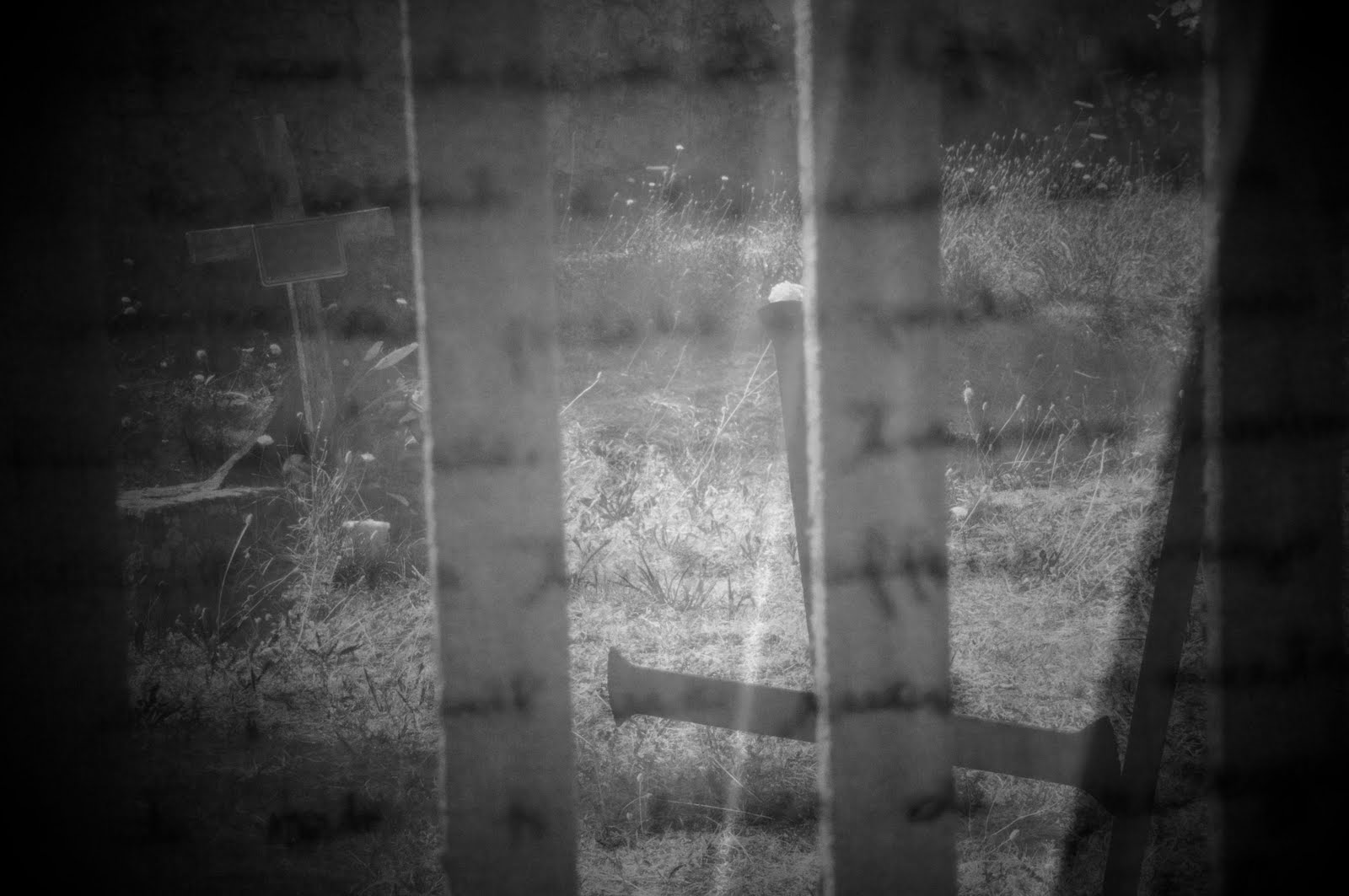
What is Written. Image by M.A. Reilly. Tuscany, 2009.
I wish you, dear reader, an educational landscape sans expectations.