Wednesday, October 12, 2011

'A Link in the Chain of Speech Communion'

Yesterday, my rather humble blog passed the mark of 20,000 visitors from 123 countries. A year ago I began the blog and truth be told, I am a bit amazed at the numbers as it had not occurred to me that a blog could or would attract such 'global' readership. 

Depending on your experience with social media, the power of blogging may be difficult to know, appreciate, and value.  I've noticed a lot of posts with titles such as: Why I Blog, Why Blogging Matters, Why Teachers Should Blog and so on and decided to weigh in on the matter.  I began blogging in earnest a couple months after meeting Will Richardson. I had started the blog in December of 2009 and made just one post which was generated in response to an assignment--something I would not recommend be done.  In 2009, the idea of blogging didn't mean anything to me, as I was uninitiated. I was taught the technical aspects of establishing a blog which were nothing more then point and click. Whereas I knew a fair amount about writing in a 1.0 world, what I knew did not necessarily help me to understand some key attributes of blogging: largely that it is social and rhizomatic.  The assignment once done only served to undermine my confidence.  I had nothing to say and I was saying it (not as eloquently as John Cage) and felt I had 'failed' blogging.  So when Will showed a screen shot of his blog to a group of us, I was pretty intrigued by a graphic displayed on it that showed the globe filled with lots and lots of red dots. Each dot indicated a visitor to the blog and frankly Will's globe was mostly red. 

I connected that day to a shift in understanding about how communication happens via blogs.  Although I had written a fair amount prior to blogging, my writing tended to be academic and published rather exclusively in professional journals that were juried. Some of those journals enjoyed significant readership.  In many ways though the academic writing world seemed based on a communication model much like Saussure theorized at the turn of the last century.  It was a linear transmission model. I wrote a text, some peers reviewed the text, the text was accepted for publication (with or without revision), a final version was submitted, the text was published and made available for others to read.  A concern with Saussure's communication model is that it assumed that a listener's comprehension mirrored the speaker's and so given that belief, the unidirectional representation seemed complete. Oddly, many academic journals seem built upon a similar mindset as dialogue is not facilitated. 

Blogging assumes a rather different model of communication: more akin to Mikhail Bakhtin's (1986) notion of dialogue as a "link in the chain of speech communion" (76) rather than an encoder-decoder model. A year later, I am understanding that blog posts are rhizomatic in ways print publication simply cannot be.  After meeting Will, I began to 'follow' him on Twitter, to read his posts, and to follow the hyperlinks within those posts to other posts. It was dizzying. In doing so I found other blogs I enjoyed reading, agreed and/or quarreled with, and after a bit of time found myself responding in print. Even when I did not post a response, I often followed the 'conversation'. At the same time, in part because of what I was reading, I became aware of a need to communicate my understanding of and concerns with the Common Core Standards. In many ways I had been entering that dialogue without writing and so in late August I found I had a lot to say and began doing so via the blog, beginning with the post, Nomadic Reading in a Standards-Based World.

Blogging is not simply about 'writing' and to think of it as a writing task is to make a mistake. Rather, blogging is about entering into a chain of speech communion, of which you are a link.  Depending on how you enter and re-enter, the chain often appears quite different and what you link/unlink shifts.  It would have been difficult, if not impossible for me to understand this without blogging and as I write this I am confident that there is much more that I don't realize from the place I am standing.

The only advice I offer today is to not assign blogging as a task for students to complete. Initiate learners by reading, listening and viewing blogs and leave the choice to commit to writing a blog to the individual. 


Monday, October 10, 2011

Poetry Books for Grades 3 - 5

from Gathering the Sun. Illustrated by Simon Silva.
Ada, Alma Flor. 1994.  Gathering the Sun: An Alphabet in Spanish and English. Illustrated by Simon Silva. NY: HarperTrophy.      
Adedjouma, Davida, (Ed.). 1996. The Palm of My Heart: Poetry by African American Children. Illustrated by Gregory Christie. New York: Lee & Low.    
Adoff, Arnold. 2000. Touch the Poem. Illustrated by Lisa Desimini. NY The Blue Sky Press.  
Alarcón, Francisco X. 2005. Laughing Tomatoes: And Other Spring Poems/Jitomates risuenos: y otros poemas de primavera. Illustrated by Maya Christina Gonzalez. San Francisco: Children's Book Press.  
  -----------------------. 2005. From the Bellybutton of the Moon and Other Summer Poems / Del Ombligo de la Luna: Y Otros Poemas de Verano. Illustrated by Maya Christina Gonzalez. San Francisco: Children's Book Press.      
-----------------------. 2005. Angels Ride Bikes: And Other Fall Poems / Los Angeles Andan en bicicleta: Y Otros Poemas de Otoño. Illustrated by Maya Christina Gonzalez. San Francisco: Children's Book Press.      
-----------------------. 2005. Iguanas in the Snow: And Other Winter Poems / Iguanas en la Nieve Y Otros Poemas de Invierno. Illustrated by Maya Christina Gonzalez. San Francisco: Children's Book Press.       
-----------------------. 2005. Poems to Dream Together/Poemas para soñar juntos. Illustrated by Paula Barragan. NY: Lee & Low.    
Argueta, Jorge. 2010. Arroz con leche/Rice Pudding: In poema para cocinar/A Cooking Poem. Illustrated by Fernando Vilela. Toronto: Groundwood.    
------------------. 2006. Talking with Mother Earth/ Hablando con Madre Tierra: Poems/poemas. Illustrated by Lucia Angela Perez. Toronto: Groundwood.   
------------------. 2003. Trees are Hanging from the Sky. Illustrated by Rafael Yockteng. Toronto: Groundwood.      
-----------------. 2001. A Movie in My Pillow/Una película en mi almohada. Illustrated by Elizabeth Gómez. San Francisco: Children’s Book Press.
Belting, Natalie. 2006. Spirit Dancing: Poems Based on Traditional American Indian Songs and Stories. Illustrated by Leo and Diane Dillon. NY: Milk & Cookie Press.   
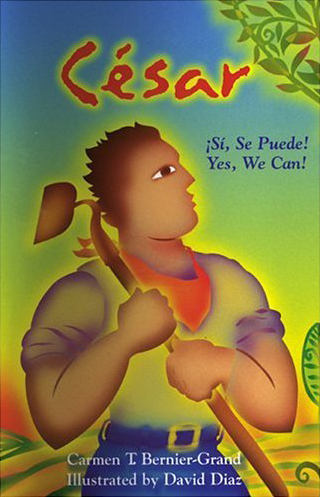
Bernier-Grand, Carmen T. 2004. César: !Si, Se Puede! Yes, We Can! Illustrated by David Diaz. Tarrytown, NY: Marshall Cavendish.      
Bierhorst, John (Translator). 1994. On the Road of Stars: Native American Night Poems and Sleep Charms. Illustrated by Judy Pedersen. NY: Macmillan.    
Bouchard, David. 2003. The Elders are Watching. Paintings by Roy Henry Vickers (First Nations). Vancouver, BC: Raincoast Books.  
Brand, Dionne. 2006. Earth Magic. Illustrated by Eugenue Fernandes.  NY: Kids Can Press.  
Brenner, Barbara. 1994. The Earth is Painted Green: A Garden of Poems About Our Planet. Illustrated by S.D. Schindler. New York: Scholastic.   
Brooks, Gwendolyn. 2007. Bronzeville Boys and Girls. Illustrated by Faith Ringgold. NY: Amistad.    
Bruchac, Joseph (Abenaki). 1998. The Earth Under Sky Bear’s Feet. Illustrated by Thomas Locker. NY: Putnam Juvenile.    
Carroll, Lewis. 2007. Jabberwocky. Illustrated by Christopher Myers. NY: Hyperion.   
Cline-Ransome, Lisa. 2001. Quilt Alphabet. Illustrated by James Ransome. NY: Holiday House.    
Clinton, Catherine (Ed.).1998.  I, Too, Sing America: Three Centuries of African American Poetry. Illustrated by Stephen Alcorn. Boston MA: Houghton Mifflin.    
Cole, William. 1981. Poem Stew. Illustrated by Karen Ann Weinhaus. NY: HarperTrophy.      
Dotlich, Rebecca Kai. 1998. Lemonade Sun and Other Summer Poems. Illustrated by Jan Spivey Gilchrist. Honesdale, PA: Boyds Mills Press.  
Esbensen, Barbara Juster. 2003. Swing Around the Sun. Illustrated by Cheng-Khee Chee, Janice Lee Porter, Mary GrandPre, and Stephen Grammell. Minneapolis, MN: Carolrhoda Books/Lerner.    
Fletcher, Ralph. 2007. Moving Day. Illustrated by Jennifer Emery. Honesdale, PA: Wordsong.   
Florian, Doug. 2007. Comet, Stars, the Moon, and Mars: Space Poems and Paintings. San Diego, CA: Harcourt.
from Dear Hot Dog by Mordicai Gerstein.
Gerstein, Mordicai. 2011. Dear Hot Dog. NY: Abrams Books for Young Readers.  
Giovanni, Nikki. 2008. Hip Hop Speaks to Children with CD: A Celebration of Poetry with a Beat. Illustrated by Alicia Vergel de Dios, Damian Ward, Kristen Balouch, Jeremy Tugeau, Michele Noiset. Naperville,IL: Sourcebook.  
Graves, Donald. 1996. Baseball, Snakes and Summer Squash: Poems About Growing Up. Illustrated by Paul Birling. Honesdale, PA: Boyds Mills Press.    
Gray, Rita (Compiler). 2010. One Big Rain: Poems for a Rainy Day. Illustrated by Ryan O'Rourke. Cambridge, MA: Charlesbridge.    
Greenfield, Eloise. 2006. When The Horses Ride By: Children in the Time of War. Illustrated by Jan Spivey Gilchrist. NY: Lee & Low.   
--------------------. 1993. Nathaniel Talking. Illustrated by Jan Spivey Gilchrist. NY: Writers & Readers.   
--------------------. 1991. Under the Sunday Tree. Illustrated by Jan Spivey Gilchrist. NY: HarperCollins.  
from When Horses Ride By: Children in the Time of War. Illustrations by Jan Gilchrist.
Grimes, Nikki. 2006. Thanks a Million. Illustrated by Cozbi A. Cabrera. NY: Greenwillow.      
---------------. 2001. Danitra Brown Leaves Town. Illustrated by Floyd Cooper. NY: Amistad.     
---------------. 1998. A Dime a Dozen. Illustrated by Angelo. NY: Dell.    
Gunning, Monica. 2004. America, My New Home: Poems. Honesdale, PA: Boyds Mills Press.    
---------------------.1999. Not a Copper Penny in Me House: Poems from the Caribbean. Illustrated by  Frané Lessac. Honesdale, PA: Boyds Mills Press.         
Hallworth, Grace. 2011. Down by the River: Afro-Caribbean Rhymes, Games and Songs for Children. Illustrated by Caroline Binch. London: Frances Lincoln Books.     
Heard, Georgia (Ed.). 2009. Falling Down the Page: A Book of List Poems. NY: Roaring Brook Press.    
-----------------. 1997. Creatures of Earth, Sea, and Sky: Poems. Illustrated by Jennifer Owings Dewey. Honesdale, PA: Boyds Mills Press.    
Herrera, Juan Felipe. 1998. Laughing Out Loud, Fly: Poems in English and Spanish. Illustrated by Karen Barbour. NY: Joana Colter Books.         
High, Linda Oatman. 2001. A Humble Life: Plain Poems. Illustrated by Bill Farnsworth. NY: Candlewick.    
Ho, Minfong.1996. Maples in the Mist: Children’s Poems from the Tang Dynasty. Illustrated by Jean & Mou-sien Tseng. NY: Lothrop, Lee & Shepard.    
hooks, bell. 2004. Skin Again. Illustrated by Chris Raschka. NY: Jump at the Sun.       
Hopkins, Lee Bennett (Ed.). 2007. Behind the Museum Door: Poems to Celebrate the Wonders of Museums. Illustrated by Stacey Dressen McQueen. NY: Harry N. Abrams Books.   
Issa. 2007. today and today: haiku by Issa. Illustrated by G. Brian Karas. NY: Scholastic.      
Iyengar, Malathi Michelle. 2009. Tan to Tamarind. Illustrated by Jamel Akib. San Francisco, CA: Children's Book Press.   
From Tan to Tamarind. Illustration by Jamel Akib.
Jones, Lessie Little. 2000. Children of Long Ago. Illustrations by Jan Spivey Gilchrist. NY: Lee & Low.    
Lee, Claudia M. (Ed.). 2002. Messengers of Rain and Other Poems from Latin America. Illustrated by Tafael Yockteng Toronto, Groundwood Books.     
Maher, Ramona. 2004. Alice Yazzie's Year. Illustrated by Shonto Begay (Diné). San Francisco, CA: Tricycle Press. 
Mak, Kim. 2001. My Chinatown: One Year in Poems. NY: Harper’s.       
Medina, Jane. 1999. My Name is Jorge On Both Sides of the the River. Illustrated by Fabrico Vanden Broeck. Honesdale, PA: Boyds Mills Press.     
Medina, Tony. 2002. Love to Lanston. Illustrated by R Gregory Christie. NY: Lee & Low.       
Miller, Kate. 2007. Poems in Black and White. Honesdale, PA: Wordsong.   
Mora, Pat. 2006. Confetti: Poemas para ninos/Poems for Children. Illustrated by Enrique O. Sanchez. NY: Lee & Low.    
-----------. 2004. Love to Mama: A Tribute to Mothers. Illustrated by Paula S. Barragan. NY: Lee & Low.  
----------------. 2001. Listen to the Desert/Oye al desierto. Illustrated by Francisco X. Mora. New York: Clarion.   
from Blues Journey. Illustrated by Christopher Myers
 Myers, Walter Dean. 2009. Looking Like Me. Illustrated by Christopher Myers. NY: Egmont.  
----------------------. 2008. Jazz. Illustrated by Christopher Myers. NY: Holiday House.  
----------------------. 2003. Blues Journey. Illustrated by Christopher Myers. NY: Holiday House.  
----------------------. 1997. Harlem. Illustrated by Christopher Myers. NY: Scholastic. 
Nishimoto, Keisuke. 1998. Haiku Picturebook for Children. Illustrated by Kozo Shimizu. Heian International.   
Nelson, Marilyn. 2009. Sweethearts of Rhythm. Illustrated by Jerry Pinkney. NY: Dial.   
Norman, Lissette. 2006. My Feet are Laughing. Illustrated by Frank Morrison. NY: Farrar, Straus & Giroux.    
Nye, Naomi Shihab. 2000. Come with Me: Poems for a Journey. Illustrated by Dan Yaccarino. New York: Greenwillow.    
Olaleye, Isaac. 1995. The Distant Talking Drum: Poems from Nigeria. Illustrated by Frané Lessac. Honesdale, PA: Wordsong. 
From Red Sings from the Rooftop. Illustrated by Pamela Zagaremski
 Rochelle, Belinda. 2000. Words with Wings: A Treasury of African-American Poetry and Art.  NY: Amistad.   
Rosen, Michael J. 2009. The Cuckoo's Haiku and Other Birding Poems. Illustrated by Stan Fellows. Cambridge, MA Candlewick. 
Schaefer, Lola M. 2006. An Island Grows. Illustrated by Cathie Felstead. NY: Greenwillow Books. 
Shange, Ntozake. 2009. We Troubled the Water. Illustrated by Rod Brown. NY: Amistad.    
Sidman, Joyce. 2011. Swirl by Swirl: Spirals in Nature. Illustrated by Beth Krommes. Boston: Houghton Mifflin.       
-----------------. 2009. Red Sings from Treetops: A Year in Colors. Illustrated by Pamela Zagarenski. Boston: Houghton Mifflin.   
-----------------. 2007. This Is Just to Say: Poems of Apology and Forgiveness. Illustrated by Pamela Zagarenski. Boston: Houghton Mifflin. 
-----------------.2006. Butterfly Eyes and Other Secrets of the Meadow. Illustrated by Beth Krommes. Boston: Houghton Mifflin.  
-----------------. 2005. Song of the Waterboatman and Other Pond Poems. Illustrated by Beckie Prange. San Diego, CA: Houghton Mifflin.   
 Siebert, Diane. 2006. Tour America: Through Poems and Art. Illustrated by Stephen T. Johnson. Gosau, Switzerland: Seastar.      
Singer, Marilyn. 2002. Footprints on the Roof: Poems about the Earth. Illustrated by Meilo So. Borzoi Books. 
 Smith, Charles R. Jr. 2002. Perfect Harmony: A Musical Journey with The Boys Choir of Harlem. NY: Jump at the Sun.   
-----------------------. 2000. Rimshots: Basketball Pix, Shots and Rhythms. NY: Puffin.    
Soto, Gary. 2003. Neighborhood Odes. Illustrated by David Diaz. NY: Sandpiper.    
Tadjo, Veronique, (ed.). 2004. Talking Drums: A Selection of Poems from Africa south of the Sahara. NY: Bloomsbury.      
Thomas, Joyce Carol. 2008. The Blacker the Berry. Illustrated by Floyd Cooper. NY: Amistad.     
-------------------------. 1998. I Have Heard of a Land. Illustrated by Floyd Cooper. NY: Joanna Cotler Books.    
------------------------. 1993. Brown Honey in Broomwheat Tea. Illustrated by Floyd Cooper. NY: HarperCollins.      
Updike, John. 1999. A Child's Calendar. Illustrated by Trina Schart Hyman. NY: Holiday House.
From Animal Poems. Illustrated by Steve Jenkins.
Walker, Alice, 2007. Why War is Never a Good Idea. Illustrated by Stefano Vitale. NY: HarperCollins.  Weatherford, Carole Boston. 2006. Dear Mr. Rosenwald. Illustrated by R. Gregory Christie. NY: Scholastic.   
 ---------------------------------. 2001. Sidewalk Chalk: Poems of the City. Illustrated by Dimitrea Tokumbo. Honesdale, PA: Boyds Mills Press.       
Winnick, Karen B. 2011. A Year Goes Round: Poems for Twelve Months. Honesdale, PA: Wordson/Boyds Mills Press.    
Wong, Janet, S. 2007. Yoga Poems. Illustrated by Julie Paschkis. NY: Margaret E. McElkderry Books.   -----------------. 2000. Night Garden: Poems from the World of Dreams. Illustrated by Julie Paschkis. NY: Margaret E. McElkderry Books.     
Woodson, Jacqueline. 2003. Locomotion. NY: Speak.   
Worth, Valerie. 2007. Animal Poems. Illustrated by Steve Jenkins. NY: Farrar, Straus & Giroux.     
Yolen, J. (ed.). 1997. Once Upon Ice and Other Frozen Poems. Photographs by Jason Stemple. Honesdale, PA: Boyds Mills Press.   
Zimmer, Tracie Vaughn. 2009. Steady Hands: Poems About Work. Illustrated by Megan Halsey and Sean Addy. NY: Clarion Books.

Sunday, October 9, 2011

To Err is Human, Yet at Schools...

An expert is a man who has made all the mistakes which can be made in a very narrow field.  ~Niels Bohr
On Gaming and Errors

Yesterday while driving in the car my son explained that he is improving at writing code:
Invention. (Reilly, 2008)
When I first started last summer I would get about 800 error messages and I got that down to 60 by the end of summer. The other day I got it down to 5 error messages.
My husband, Rob, quickly added that this is a gaming mentality.
Ask any gamer and he'll tell you that you learn through trial and error.
This struck me as significant.  Each week, either Rob or I have to sign a paper acknowledging each quiz and test grade my son received/earned during that week.  Next to each number, one of us signs his or her name. Some weeks Rob does this, other weeks I do it.  But it never stops or changes.  The numbers are final and we must acknowledge with ink, each performance and each "counts" towards a final marking period grade. Tests count x percentage points and quiz grades and homework count as well. 

It's all quite logical and explained at back to school night. Yet, it seems to me as if the logic is really faulty if the outcome is learning. For there are no second chances or even the understanding of how any one performance may be viewed in light of any other performance.

Eggs in a carton. Each separate, never mixed for fear of cracking.

There is no learning along the way. There are starts and stops and even these don't seem to be connected.

On Schooling

from this website
Last year, my son arrived at a new school in March and took a mathematics test three days after arriving. He failed the test, earning less than half of the available points.  A week of so later the mathematics teacher phoned to tell me she thought my son should be moved from the advanced math class as he was not doing well.  I inquired why and she mentioned the test score.  As we talked a bit it became evident that he was tested on material he simply had not been present to learn.  There was an assumption that "he should have known" the material. The test score would count toward his final average, I was warned. This seemed like misinformed mathematics to me.  I suggested as much and although the teacher agreed, the test score remained an indicator of his knowledge and performance.

But what did it actually mean?  How was it received? What did my son learn about his potential as a mathematician?  This is a child who at 21 months took the condiments from the refrigerator and organized them into two groups in an attempt to balance the lot. 11 years later he would confide to me that he just isn't' good in math, as in the class.  This is what he has learned at school. He has confused mathematics know-how with mathematics performance at school.

I never hear my son say, I am not a good gamer.  800 error messages and he sees these as an indicator of what he will learn, not as an indicator of how 'smart' he is.   School is something quite different.  In September, a friend told me about a virtual Java course at Stanford and I mentioned it to my son.  At first he seemed interested in attending. Yesterday he announced he had decided against this.
It's school.  I'd rather figure out Java like I do everything else. On line and figuring it out with friends and YouTtube.
Occupy Your Classroom

Circa 1967 (M.A. Reilly, 2009)
We make much of NCLB, its restrictive and onerous assessment practices, and we are right to do so.  I often wish though that the same educators who are vocal about state assessments might deeply inquire about their own assessment practices.  Now, I realize that there are many who do.  There are many who have more informed practices.  And there are many who simply issue grades based on some simple algorithm.

How is it that in a gaming culture, error is a way of learning and yet at schools, error is a form of damnation?  How many children sit in classrooms where they are terrorized by failing?  How many hear their teachers say to them or someone else in the class that if you fail you will be left back?  How many parents use their children's performances via grades at school as bragging rights, as bumper stickers? What is a way out of this mindless entrapment?

Karl Fisch (@karlfisch), Jose Vilson (@TheJLV) and Chad Sansing (@chadsansing) recently blogged about educators occupying their own classrooms.

Jose offered five ways for educators to occupy their classrooms.  He closed by writing:

We ought to rebel. Our best rebellion must come in the form of assuring our students do as well as possible. Outside politics have deteriorated, not elevated, the classroom experience for far too long. Before we can truly have a revolution of any nature, we must first shore up the parts of our job we can immediately control. It starts with the 30 / 60 / 90 / 150 students we have under our care.
Shore up the parts of the job we have immediate control over.

In a post dated October 7, 2011, Karl wrote:
That instead of blaming “the system,” we should realize that we are the system, and we should advocate for our students when we see things that we don’t believe are in their best interests. And that we, just like the protesters in the middle east, and just like the #occupywallstreet folks, have access to tools that Clay Shirky has shown us make it much easier to not only organize, but to actually effect change. That, really, this thing we call school doesn’t happen without us.
Be responsible as we are the system.

Chad closed his post by suggesting five proactive actions.  The last one, Build communities instead of reinforcing expectations, seems to be at the heart of what I am attempting to convey here.

Want to occupy your classroom?

Begin by asking yourself: Do the practices I espouse help to build a culture where to err is not only human, but necessary? As James Joyce penned in Ulysses,  "A man of genius makes no mistakes.  His errors are volitional and are the portals of discovery"

What portals will you afford your students?

Saturday, October 8, 2011

Fieldwork


Birds Lifting (M.A. Reilly, 2011)


SONG

A rowan like a lipsticked girl
Between the by-road and the main road
Alder trees at a wet and dripping distance
Stand off among the rushes.

There are the mud-flowers of dialect
And the immortelles of perfect pitch
And that moment when the bird sings very close
To the music of what happens.

-Seamus Heaney, 1979

Man Watching (M.A. Reilly, 2011)

A DRINK OF WATER

She came every morning to draw water
Like an old bat staggering up the field:
The pump's whooping cough, the bucket's clatter
And slow dimineundo as it filled,
Announced her. I recall
Her grey apron, the pocked white enamel
Of the brimming bucket, and the treble
Creak of her voice like the pump's handle.
Nights when a full moon lifted past her gable
It fell back through her window and would lie
Into the water set out on the table.
Where I have dipped to drink again, to be
Faithful to the admonishment on her cup,
"Remember the Giver," fading off the lip.

                                                        -- Seamus Heaney

Fog Lifting (M.A. Reilly, 2011)

Autumn Festivals: Book Recommendations for Grades 3-8+


1. Day of the Dead
Ancona, George. 1993. Pablo Remembers: The Fiesta of the Day of the Dead. NY: HarperCollins.
Amado, Elisa. 1999. Barrilete: A Kite for the Day of the Dead. Illustrated by Joya Hairs. Toronto: Groundwood Books.
Goldman, Judy. 2008. Uncle Monarch and the Day of the Dead. Illustrated by Rene King Moreno. Honesdale, PA: Boyds Mills Press.
Johnston, Tony. 2000. Day of the Dead. Illustrated by Jeanette Winter. NY: Sandpiper.
Keep, Richard. 2008. Clatter Bash! A Day of the Dead Celebration. Atlanta, GA: Peachtree Publishers.
Krull, Kathleen. 1994. Maria Molina and the Days of the Dead. Illustrated by Enrique O. Sanchez. NY: Simon & Schuster.
Vicente, Luis San. 2002. Festival of Bones/El Festival de las Calaveras:  The Little-Bitty Book for the Day of the Dead. El Paso. TX: Cinco Puntos Press.
Winter, Jeanette. 2004. Calavera Abecedario: A Day of the Dead Alphabet. Cambridge, MA: North-South Book.

2. Halloween
Behn, Harry. 2003. Halloween. Illustrated by Greg Couch. NY: North-South Books.
Bowers, Sharon. 2009. Ghoulish Goodies. Storey Books. http://www.youtube.com/watch?v=_aGMe1VwBbA
Choi, Yangsook. 2006. Behind the Mask. NY: Farrar, Straus, & Giroux.
Hamilton, Virginia. 2004. Wee Winnie Witch’s Skinny. Illustrated by Barry Moser. NY: Blue Sky Press.
Heiligman, Deborah. 2009. Holidays Around the World: Celebrate Halloween. Washington D.C.: National Geographic.
from The Three Witches
Hurston, Zora Neale. 2006. The Three Witches. Adapted by Joyce Carol Thomas. Illustrated by Faith Ringgold. NY: HarperCollins.
Merrian, Eve. 1987. Halloween ABC. NY: Simon & Schuster.
http://blaine.org/jules/gatos_werewolf.jpg
From Los Gatos Black on Halloween
Montes, Marisa. 2006. Los Gatos Black on Halloween. Illustrated by Yuyi Morales. NY: Henry Holt.
Nikola-Lisa, W. 1997. Shake Dem Halloween Bones. Illustrated by Mike Reed. NY: Houghton Mifflin.
RavenWolf, Silver. 1999. Halloween: Customs, Recipes & Spells. St. Paul, MN: Llewellyn Worldwide.
 
3. Harvest Festivals/Autumn
Bruchac, Joseph (Abenaki). 2007. Squanto’s Journey: The Story of the First Thanksgiving. Illustrated by Greg Shed. NY: Sandpiper.
Jackson, Ellen.  2003. The Autumn Equinox: Celebrating the Harvest. Illustrated by Jan Davey Ellis. Brookfield, CT: Millbrook Press.
Lee, Uk-Bae. 1999. Sori’s Harvest Moon Day: A Story of Korea. Norwalk, CT: Soundprints.
Leslie, Clare Walker and Frank E. Gerace. 2000. The Ancient Celtic Festivals: And How We Celebrate Them Today. Rochester, VT: Inner Traditions International.
Levenson, George. 2002. Pumpkin Circle. Photographs by Shmuel Thaler. San Francisco, CA: Tricycle.
Lin, Grace. 2010. Thanking the Moon: Celebrating the Mid-Autumn Moon Festival. NY: Knopf.
O’Neill, Catherine. 2004. 1621: A New Look at Thanksgiving. Washington D.C.: National Geographic.
Pfeffer, Wendy. 2006. We Gather Together. Illustrated by Linda Bleck. NY: Dutton Juvenile.
Russell, Ching Yeung. 1997. Moon Festival. Illustrated by Christopher Zhong-Yuan-Zhang. Honesdale, PA: Boyds Mills Press.
Tan, Amy 1995. The Moon Lady. Illustrated by Gretchen Shields. NY: Aladdin.
Tang, Sanmu. 2008. Celebrating the Mid-Autumn Festival. Translated by Mina Tenison. Better Link Press.
Williams, Brenda. 2009. Lin Yi’s Lantern: A Moon Festival Tale. Illustrated by Benjamin Lacombe. Cambridge, MA: Barefoot Books.

4. Scary Stories (Grades 3 – 8+)
From Coraline
Bellairs, John. 2004. The House with a Clock in Its Walls. Illustrated by Edward Gorey. NY: Puffin.
Gaiman, Neil. 2009. Coraline: The Graphic Novel. Illustrated by P. Craig Russell. NY: Harper Collins.
----------------. The Graveyard Book. Illustrated by Dave McKean. NY: HarperCollins.
Gidwitz, Adam. 2011. A Dark Tale and Grimm. NY: Puffin.
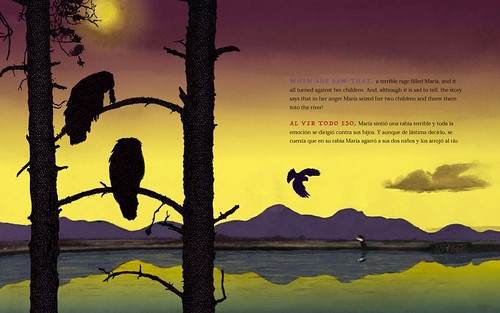
From La Llorna/The Weeping Woman
Priestly, Chris. 2007. Uncle Montague’s Tales of Terror. Illustrated by David Roberts. NY: Bloomsbury.
Hayes, Joe. 2006. La Llorna/The Weeping Woman. Illustrated by Mona Pennypacker. Translated by Bicki Trego Hill. El Paso, TX: Cinco Puntos Press.
-------------. 2003. El Cucuy: A Bogeyman Cuento. Illustrated by Honorio Robeledo. El Paso, TX: Cinco Puntos Press.
Riggs, Ransom. 2011. Miss Peregrine’s Home for Peculiar Children. Philadelphia, PA: Quirk Books.
SanSouci, Robert D. 2010. Haunted Houses (Are You Scared Yet?). Illustrated by Kelly Murphy and Antoine Revoy. NY: Henry Holt.


Thursday, October 6, 2011

On Teaching Writing, Not!

A People Do Not Forget their Geniuses (Reilly, 2009)
Last weekend Maureen Devlin (@lookforsun) asked me if I had written or would write a post about teaching writing. I found one post, actually taken from part of a chapter from a book I wrote. But other than that, I have been pretty quiet about teaching writing and I think there are some reasons for that silence.

I'm not sure teaching teachers about writing is helpful to them or their students, especially if the instruction is in place of teachers actually learning to teach writing by being authors and studying their own processes.  I almost want to suggest that on the many books and posts about teaching writing that there needs to be a sign that reads: Don't try this without actually having written and thought a bit about how you write!


Wild Nights! Wild Nights! (Reilly, 2009)
Now to be clear, the challenge isn't that there are lots of text about teaching writing, some that have informed my own work.  The issue, rather, is that such information will not and cannot take the place of being a writer.  Being a writer allows me to understand what actually happens while writing, thinking about writing, avoiding writing, etc.  From within the context of doing and thinking, texts about writing may be helpful.  I am wondering though how many teachers think they can read about teaching writing and then apply those lessons to their classrooms, in lieu of actually being a writer.  I want to say here, that such practices may well  result in lessons that lack accuracy, depth, and appropriate or meaningful response.  The reasons for this are three-fold:
  1. Without actually writing it is impossible to understand that what you recommend or insist learners do which may appear logical , may in fact be problematic or simply, wrong. You may be telling students to do things that will limit their expression, cause them to doubt their capacity to write, confuse them, or cause them to dislike writing.
  2. Not everyone who authors books about teaching writing, actually has experience teaching. Whereas the recommendations made may make sense to the author and perhaps other adults, some of the practices may not translate well or be appropriate for children. 
  3. Not all recommended practices work well with youngsters depending on their age, their histories, their idiosyncratic practices as writers.
Some writing advice/directions or writing instruction I have heard told to students that would not help me as a writer, well at least not always:
A Pocket Full of Stones (Reilly, 2009)
  1. You must begin your composition with a topic sentence. Underline it.
  2. Never use first person in your essay.
  3. You must keep a writer's notebook. I will show you the format you will use.
  4. Each paragraph must have a topic sentence, supporting details, and clincher sentence. The paragraphs must contain between 5 and 8 sentences and you must include at least five paragraphs.
  5. Correcting verb tense on a first draft. (I am almost always shifting tense as I am unsure of where I am situating the text).
  6. Make an outline of your story before you begin writing.
  7. Once you decide your topic, you must stick to it throughout the writing. It cannot be changed.
  8. Begin your writing by making a web of ideas.
  9. Shh. You're writing, not talking.
  10. Add adjectives to spruce up your work.
  11. Put away those books, you're writing.
  12. You must write the first draft and then can use the computer for the final copy.
  13. Finish every piece.
  14. You have five days to write....
  15. Show, don't tell.
  16. Only write with complete sentences.
  17. You  must write in x number of different genres each year.
  18. This is a non-fiction piece. There should be no fiction in it.
  19. You must prewrite and it should be attached to your final draft.
  20. Invert the question into a statement and use that as your opening. 
  21. Make a list of topics you want to write about this year and put them in the front of your notebook.
  22. You must write everyday for at least 15 minutes.
  23. Draw a picture before you write.
  24. Use metaphors in your writing.
  25. Never mimic other people's writing. This is stealing.
  26. Do not use "you" anywhere in your work.
  27. Talk about what you want to write with your neighbor before you write.
  28. Don't edit until the end.
  29. You will lose 10 points for each day your writing is late.
  30. I can't give you a topic. You must find one for yourself.
  31. Don't use slang.
  32. Write only in Standard English.
So what teaching writing advice I would offer?
  • Write.
  • See what you learn about writing from your own writing, writing habits, and dispositions across time.
  • Join or don't join a writing group. Truly this is a personal decision.
  • Read often.
  • Forget my advice and invent it for yourself.

Nausicaa (Reilly, 2009)
On a lighter note, here's some feedback for James Joyce upon submission of Ulysses to his creative writing workshop. 


    Monday, October 3, 2011

    Authority, Meaning Making, and Information Literacy

    Warning: Very emergent thinking on my part!!!

    It was with great interest that I read and reread Thomas Mackey and Trudi E. Jackobson's (2011) Reframing Information Literacy as a Metaliteracy and would recommend the text to you. The authors provide a critique of several frameworks for literacy (information literacy, media literacy, digital literacy, visual literacy, cyberliteracy) and suggest that a metaliteracy framework is necessary as these former definitions of literacy/ies are challenged "based on the emergence of new social technologies" (p. 69).

    The authors contend that:
    Metaliteracy reinforces stronger connections between information literacy and other literacy frameworks. This approach looks at the foundation principles that unite information and technology, rather than focusing on differences based on discrete skills, distant technologies, or media formats (p. 70).
    The authors wish to ensure that a broader definition than information skills be employed.

    As I read, I wondered: What do we mean when we characterize something as information?  Do we carry with us an understanding that information is stable? Static? Singularly authored? Is information limited to what we explicitly know? In Mackey and Jacobson's critique, they write about the need to think:
    beyond information as a commodity, and instead (focus) on the production of knowledge in collaboration with others (p.68).
    Screen shot from Minecraft.
    Yet when offering examples of metaliteracy, they situate "information" as a bounded entity; that which can be found and retrieved. And certainly there is information that fits that definition--information based on explicit knowledge.  Yet, what happens if instead of thinking of information as a bounded matter, we situate information along a knowledge continuum that stretches from bounded (a thing you could hold in you hand such as a bus schedule) to unbounded (that which cannot be contained nor is complete, such as an emerging idea)?  Perhaps it is the practice of referring to all of those possibilities as information that is so thorny, especially when we may well think of information as that which is bounded.  In some ways the tensions remind of Louise Rosenblatt's transactional theory in which efferent and aesthetic ways of reading represent a continuum of responses to text.

    I wonder if the tensions the authors describe might also be influenced by how knowledge is (in)formed: explicitly and tacitly.  It is easy to identify explicit knowledge. It is external and codified and schools of the last century (and many would argue this century) have build curricula on explicitly known information. Explicit knowing is something I can hand to you using a single symbol system.  Tacit knowing is inherently different and less likely to be seen at school. Tacit knowing is bodily-known, experiential, and not yet codified. Additionally, tacit knowing, cannot be represented via a single symbol system.  In fact I would suggest that it is through transmediated representations (multiple symbol systems) that tacit knowledge begins to be codified.

    Tacit knowledge is about knowing and at the same time not being able to clearly explain how and at times what one knows. Earlier today I was reading Roger Martin's essay, How To Make Companies Think Long-Term and stopped when I read:
    Eliminating stock-based compensation would help reduce the incentive for executive leadership to focus on the short term. But there is a residual problem which has long frustrated me. The answer finally popped into my brain (funny how that works).
    Martin's characterization of knowing as the answer popping into his brain suggests a possible bridge between tacit and explicit knowing that occurs when that which you have known but could not name begins to be codified. I wonder if codification of tacit knowledge isn't heightened via the connectivity to and collaboration with so many potential others through social media and online communities.

    This idea feels important. How? I'm not sure I can name it as of yet.  But here's my first go at it.

    Perhaps the emphasis in redefining information literacy as metaliteracy and expanding the definition to include the participatory nature of producing and consuming information is secondary to understanding the emerging importance of tacit knowledge and how such knowledge becomes codified.  I am not suggesting metaliteracy isn't important.  I think the authors do a fine job at exploring the differences and arguing well for the expanded framework. But I think the tensions the authors describe are more a symptom of the need in social institutions to shift from privileging explicit ways of knowing to privileging tacit ways of knowing.

    Here's my working thesis: Through participation and collaboration with others via social media and online communities as well as the development of transmediated (multiple symbol systems) representations, learners' feelings, intuitions, and impressions emerge rhizomatically and collectively. These tacit ways of knowing among people disrupt what it has meant to know, to author, and to consume.  It is these disruptions that signal tension, disequilibrium and creation.