Showing posts with label primary grades. Show all posts

Monday, December 28, 2015

75+ Read Aloud Books to Help Celebrate February Holidays

Children's Books to Help Celebrate February Holidays 
from Groundhog's Dilemma
Groundhog Day (Feb. 2, 2016)
  1. Cox, Judy. (2004). Go To Sleep, Groundhog! Illustrated by Paul Meisel. New York: Holiday House. 
  2. Freeman, Don. (2002). Gregory's Shadow. New York: Puffin Books.
  3. Gregory's shadow.Gibbons, Gail. (2007). Groundhog Day! New York: Holiday House. (900L)
  4. Hill, Susanna Leonard. (2005). Punxsutawney Phyllis. Illustrated by Jeffrey Ebbeler. New York: Holiday House. (590L)
  5. Lewin, Betsy. (2014). Groundhog Day. New York: Scholastic.
  6. Miller, Pat. (2010). Substitute Groundhog. Illustrated by Kathi Ember. Park Ridge, IL: Albert Whitman & Company. 
  7. Pallotta, Jerry. (2013). Who Will See Their Shadows This Year? Illustrated by David Biedrzycki. Cartwheel Books. 
  8. Pearlman, Robb. (2015). Groundhog's Day Off. Illustrated by Brett Helquist. New York: Bloomsbury USA Childrens. 
  9. Pickford Susan T. (1993). It's Up to You Griffin! Illustrated by Marcy Dunn Ramsey. Atglen, PA: Schiffer Publishing
  10. Remenar, Kristen. (2015). Groundhog's Dilemma.  Illustrated by Matt Faulkner. Watertown, MA: Charlesbridge.
  11. Roberts, Bethany. (2008). Double Trouble Groundhog Day. Illustrated by Lorinda Bryan Cauley. New York: Henry Holt. (440L)
Rosa Parks Day (Feb. 4, 2016)


from Rosa
  1. Adler, David. A. (1995). A Picture Book of Rosa Parks. Illustrated by Robert Casilla. New York: Holiday House.
  2. Giovanni, Nikki. (2007). Rosa. Illustrated by Bryan Collier. New York: Square Fish.
  3. Kittinger, Jo S. (2010). Rosa's Bus: The Ride to Civil Rights. Illustrated by Steven Walker. Honesdale, PA: Calkins Creek.
  4. McDonough, Yona Zeldis.  (2010). Who Was Rosa Parks? Illustrated by Nancy Harrison and Stephen Marchesi. New York: Grosset & Dunlap.
  5. Miller, William. (2001). The Bus Ride. Illustrated by John Ward. New York: Lee & Low Books.
  6. Parks, Rosa & Jim Haskins. (1999). I am Rosa Parks. Illustrated by Wil Clay. New York: Penguin.
  7. Pingry, Partick A. (2007). The Story of Rosa Parks. Illustrated by Steven Walker. Candy Cane Press. (Board Book)
  8. Pinkney, Andrea Davis. (2008). Boycott Blues: How Rosa Parks Inspired a Nation. Illustrated by Brian Pinkney.  New York: Greenwillow Books.  
  9. Reynold, Aaron. (2013). Back of the Bus. Illustrated by Floyd Cooper. New York: Puffin.
  10. Ringgold, Faith. (2003).  If a Bus Could Talk: The Story of Rosa Parks. New York: Aladdin.
  11. Ringgold, Faith. (1993). Dinner at Aunt Connie's House. New York: Hyperion.
Chinese New Year (Feb. 6, 2016)


from Sam and the Lucky Money
    1. Chinn, Karen. (2003). Sam and the Lucky Money. Illustrated by Cornelius Van Wright. New York: Lee & Low Books. (660L)
    2. Demi. (2003).  Happy, Happy Chinese New Year! New York: Knopf Books for Young Readers. 
    3. Gower, Catherine. (2005). Long-Long's New Year: A Story About the Chinese Spring Festival. Illustrated by He Zhihong. Boston, MA: Tuttle.
    4. Katz, Karen. (2012). My First Chinese New Year. New York: Square Fish.
    5. Lin, Grace. (2010). Bringing in the New Year.  New York: Dragonfly Books. (250L)
    6. Li-Qiong, Yu.  (2011). A New Year's Reunion: A Chinese Story.  Illustrated by Zhu Cheng-Liang. Somerville MA: Candlewick Press. (560L)
    7. Otto, Carolyn. (2015). Holidays Around the World: Celebrate Chinese New Year: With Fireworks, Dragons, and Lanterns. Washington, DC: National Geographic Books.
    8. Simonds Nina. (2002). Moonbeams, Dumplings & Dragon Boats: A Treasury of Chinese Holiday Tales, Activities & Recipes. Illustrated by Leslie Swartz. Boston, MA: HMH Books for Young Readers.
    9. Sing, Rachel. (1994). Chinese New Year's Dragon. Illustrated by Shao Wei Liu. New york: Aladdin.
    10. Waters, Kate. (1991). Lion Dancer: Ernie Wan's Chinese New Year.  Illustrated by Martha Cooper. New York: Scholastic.
    11. Wong, Janet S.  (2014). This Next New Year. Illustrated by Yangsook Choi. Princeton, NJ: Pomelo Books. 
    12. Zucker, Jonny. (2014). Lanterns and Firecrackers: A Chinese New Year Story. Illustrated by Jan Cohen. London, UK:  Frances Lincoln Children's Books.
     Valentine's Day (Feb. 14, 2016)

    1. Bond, Felicia. (2006). Day It Rained Hearts. New York: HarperCollins.
    2. Bunting, Eve. (2016). Mr. Goat's Valentine. Illustrated by Kevin Zimmer. Sleeping Bear Press.
    3. Carle, Eric. (2015). Love from The Very Hungry Caterpillar. New York: Grosset & Dunlap.
    4. Choldenko, Gennifer. (2011). A Giant Crush. Illustrated by Melissa Sweet. New York: G.P. Putnam's Sons Books for Young Readers.
    5. deGroat, Diane. (1997). Roses Are Pink, Your Feet Really Stink. New York: HarperCollins.
    6. Dunrea, Olivier. (2015). Ollie's Valentine. New York: HMH Books for Young Readers. 
    7. Gibbons, Gail. (2006). Valentine's Day Is. New York: Holiday House.
    8. Hall, Kat and Lisa Eisenberg. (2000). Olive You!: And Other Valentine Knock-Knock Jokes You'll A-Door. Illustrated by Stephen Carpenter. New York: HarperFestival. 
    9. Henkes, Kevin. (2003). Lilly's Chocolate Heart. New York: Greenwillow Books. 
    10. Katz, Karen. (2003). Counting Kisses: A Kiss & Read Book. New York: Little Simon.
    11. Marley, Cedella. (2014). One Love. Illustrated by Vanessa Brantley-Newton. San Francisco, CA: Chronicle Books. 
    12. McBratney, Sam. (2011). Guess How Much I Love You? Illustrated by Anita Jeram. Somerville, MA: Candlewick. (690L)
    13. Petersen, David. (2011). Snowy Valentine. New York: HarperCollins.
    14. Preultsky, Jack. (2013). It's Valentine's Day. Illustrated by  Marylin Hafner. New York: Greenwillow Books.
    15. Schertle, Alice. (2004). 1, 2, I Love You. Illustrated by Emily Arnold McCully. San Francisco, CA: Chronicle Books. 
    16. Spinelli, Eileen. (1996). Somebody Loves You, Mr. Hatch. Illustrated by Paul Yalowitz. New York: Simon & Schuster Books for Young Readers.
    17. Yolen, Jane. (2009). How Do Dinosaurs Say I Love You? Illustrated by Mark Teague. New York: The Blue Sky Press.
    Lincoln's Birthday (February 12, 2016) & President's Day (February 15, 2016)
      from Looking at Lincoln
    1. Borden, Louise W. (2001). A. Lincoln and Me. Illustrated by Ted Lewin. New York: Scholastic.
    2. Brown, Don. (2015). Dolley Madison Saves George Washington. New York: HMH Books for Young Readers. 
    3. Burleigh, Robert. (2014). Abraham Lincoln Comes Home. Illustrated by Wendell Minor.
    4. Castrovilla, Selene. (2013). Revolutionary Friends: General George Washington and the Marquis de Lafayette.  Illustrated by Drazen Kazjan. Honesdale, PA: Calkins Creek. (620L)
    5. Ganeshram, Ramin. (2016). A Birthday Cake for George Washington.  Illustrated by Vanessa Brantley-Newton. New York: Scholastic Press.
    6. Giovanni, Nikki. (2013). Lincoln and Douglass: An American Friendship. Illustrated by Bryan Collier. New York: Square Fish. 
    7. Kalman, Maira. (2012). Looking at Lincoln. New York: Nancy Paulsen Books. (480L)
    8. Katz, Susan. (2012). The President's Stuck in the Bathtub: Poems About the Presidents. Illustrated by Robert Neubecker. New York: Clarion Books. (1070L)
    9. Krull, Kathleen. (2016). Lincoln Tells a Joke: How Laughter Saved the President (and the Country). Illustrated by Paul Brewer. New York: HMH Books for Young Readers. 
    10. McNamara, Margaret. (2010). Presidents' Day. Illustrated by Mike Gordon. New York: Simon Spotlight. (430L)
    11. McNamara, Margaret. (2012). George Washington's Birthday: A Mostly True Tale. Illustrated by Barry Blitt. New York: Schwartz & Wade. 
    12. Polacco, Patricia. (2011). Just in Time, Abraham Lincoln. New York: Penguin,
    13. Rappaport Doreen. (2008). Abe's Honest Words: The Life of Abraham Lincoln.  Illustrated by Kadir Nelson. New York: Disney-Hyperion. (820L)
    14. Rockwell, Anne. (2015). Big George: How a Shy Boy Became President Washington. Illustrated by Matt Phelan. New York: HMH Books for Young Readers. 
    15. Rockwell, Anne. (2009). Presidents' Day. Illustrated by Lizzy Rockwell. New York: HarperCollins.
    16. Schanzer, Rosalyn. (2007). George vs. George: The American Revolution As Seen from Both Sides. Washington D.C.: National Geographic Children's Books.  

    17. Singer, Marilyn. (2013). Rutherford B., Who Was He?: Poems About Our Presidents. Illustrated by John Hendrix. New York: Disney-Hyperion. 
    18. Slade, Suzanne. (2015). The House That George Built.  Illustrated by Rebecca Bond. Watertown, MA: Charlesbridge. (890L)
    19. Small, David. (1997). George Washington's Cows. New York: Farrar, Straus and Giroux. 
    20. Smith, Lane. (2012). Abe Lincoln's Dream. New York: Roaring Brook Press.
    21. Smith, Lane. (2006). John, Paul, George & Ben. New York:  Disney-Hyperion. (660L)
    22. Stier, Catherine. (2007). If I Ran for President. Illustrated by Lynne Avril. Morton Grove, IL: Albert Whitman & Company. 
    23. Stier, Catherine. (1999). If I Were President. Illustrated by Diane DiSalvo-Ryan. Morton Grove, IL: Albert Whitman & Company. 
    24. Turner, Ann. (2003). Abe Lincoln Remembers. Illustrated by Wendell Minor. New York: HarperCollins. 
    25. Wells, Rosemary. (2011). Lincoln and His Boys. Illustrated by P.J. Lynch. Somerville, MA: Candlewick.
    26. Winters, Kay. (2006). Abe Lincoln: The Boy Who Loved Books. New York: Aladdin.

    Thursday, April 3, 2014

    Visual Evidence of K- 2 Student Thinking: A Pictorial


    2nd graders' explanation of the water cycle. (2014)


    1st grader's explanation about a share text.

    1st graders' vocabulary knowledge rating chart for science-based read aloud


    Kindergarten children's thinking in response to Stealing Home.

    2nd grades Frayer Model vocabulary wall chart

    1st grader's journal entry.


    2nd grader's independent project (self designed)
    created in response to poetry book about Gee's Bend women quilters.
    Kindergarten children work together to complete a concept sort.

    Kindergarten children's mental images created in response to a heard poem.

    Two 2nd graders' collaborative research report.


    Word solving anchor cart from 2nd grade.

    Kindergarten child's journal page.

    2nd grader's response during read aloud.

    Example of daily quote and students' interpretation from grade 2.
    Close up of a 2nd grader's response to a posted quote.


    Quote and interpretations from grade 2.

    Two 2nd graders collaborating on a visualization and explanation task.


    Two 2nd graders' initial noticing and wonderings as they preview a text.

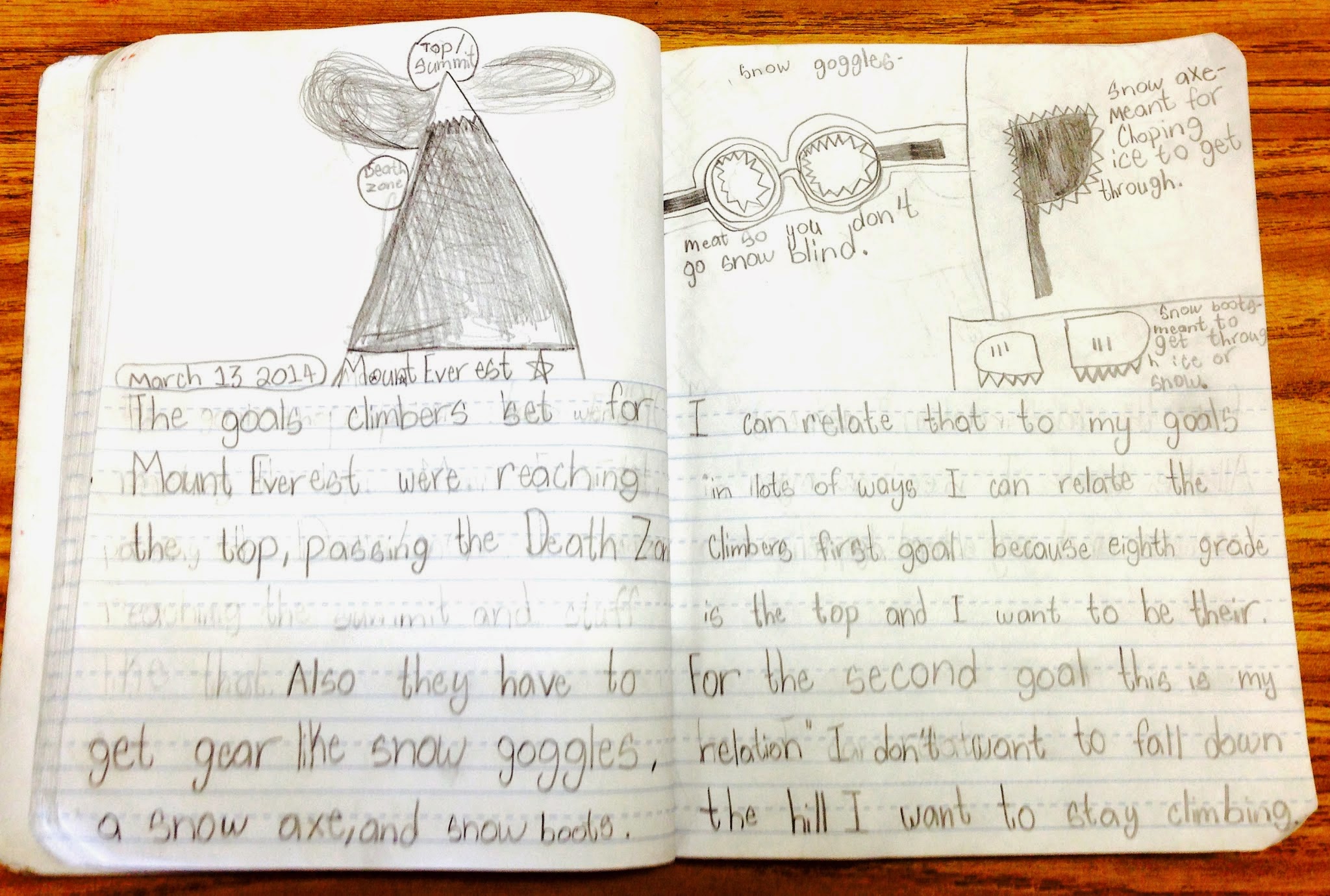
    2nd grader's explanation about goals related to read aloud book and then connected to his life.


    2nd grader's explanation about a text.

    Primary grade student's imitation of a Rothko painting.

    1st grader's journal entry.

    Kindergarten child's drawing and fact based on the read aloud book, Weird Friends.

    Comparative chart made in kindergarten focusing on animal partnerships.

    Kindergarten child's letter sorting.

    Flip book illustrated by kindergarten child.

    2nd grader's 4 square facts.

    Interactive writing from 1st graders.

    2nd grader sketching what he sees as he listens to the opening of a text.

    1st graders determining their knowledge of ket vocabulary.
    Art Conversation and poem created by 1st graders.

    1st grader drawing before writing.  He is writing a before and after text.

    1st grader composing in journal.

    Kindergarten child's science observation.


    1st grader checking a favorite book (North) to help him with his own composing.


    Thursday, August 9, 2012

    Recommended Apps to Develop Children's Foundational Reading Skills

    I used my iPad/iPhone the past five weeks teaching young children how to read. In this post, I highlight a few specific apps I used with children to help them acquire and/or strengthen foundational skills for reading. It is important to note that I did not need to do much (if any) direct instruction related to how to use these apps even though none of the children had ever seen an iPad before. 

    Oral Language/Story Development


    iTalk Recorder Premium: I used this app with children to record stories they spontaneously told in order to help them to develop their oral language. The finished products also served as an important informal assessment. Working alone and in self-formed groups, children told stories and then listened to their story. I also had students retell read aloud texts they had heard their teachers read using the text to help them retell the story. It was fascinating to hear what children had to say.  The audio file can be emailed.  ($1.99)


    Doodlecast for Kids: Children used Doodlecast to tell stories or explain a process as they drew using the prompts at times. This app records the children's voices as they draw. The finished drawing and recording can be shared and/or published. Again I used this for oral language development and students drew and told stories with and without the prompts provided by Doodlecast. ($1.99)

    Letter Formation, Letter and Sound

    IntroToLetters: Children learn to trace (will not let the child trace the letter incorrectly), read, write and record letter sounds, names, and phonograms.  Nicely done. ($4.99)

    AlphabetTracing: Children follow a train, worm, or truck in order to trace upper, lowercase letters and numbers.  A potential limitation with the app is that a child may trace the letter incorrectly. In some ways this may be important in that it allows approximation that can be corrected. What I noticed was that the children I worked with began to copy the train and form the letters correctly after they had an understanding of the app.  This is a good intro to letter formation.  There is also a picture provided for each symbol. (Free)

    Sight Words

    Sight Words:  The children loved using this Teacher Created Materials app. I have the full version (300 words) and it allowed me to select a range of words to fit each specific child.  Each word can be heard and is written by the child and then the child also records his/her voice reading the word.  After five words there is a review practice via a game (tic-tac-toe, concentration, hangman, sentence writing, etc.). I watched children acquire sight word knowledge and retain it and do so with joy.  ($9.99)


    Interactive Books

    Using some very easy interactive books (those children selected), students learned about one-to-one matching, return sweep, sight words, while adding schema.
    Some favorite books included:

    Boats  - Byron Barton ($1.99)
    Planes - Byron Barton ($1.99)
    It's Tyrannosaurus Rex - Smithsonian Institute ($2.99)
    Three Little Pigs - Nosy Crow version ($5.99)
    Five Little Monkeys Jumping on the Bed - Produced by Oceanhouse Media ($2.99)


    Saturday, July 14, 2012

    Interactive Read Aloud: Dwelling, Talking, Feeling & Thinking


    When I designed the Newark Public Schools' summer school literacy project for children in primary grades, I gave a lot of thought about how to infuse high quality text into that experience and decided to emphasize the daily interactive read aloud as one important component of the daily learning.  Because I am also teaching and coaching in the project, I have the satisfaction of not only designing, but also seeing that work interpreted and enacted with children.  I knew without a doubt that I would learn so much and that this partnership would give rise to questions, wonderings, and theories about teaching and learning. I have not been disappointed as I have seen super work being done with regard to vocabulary and text response and this work has prompted my thinking.

    Because most of the read aloud texts are meant to be read across multiple days as well as reread, I imagined that teachers might chart the wonderings of students as they talked and might let sit a question of two across several days:  a question that the teacher and students would revisit as they reread a given text.  Unfortunately, I failed to make that clear in the guide I wrote and so I might be most responsible for what I perceive as an absence.  It is the dwelling in ideas that matter so.

    Child's response to what happens at the beginning of The Firekeeper's Son.
    In correspondence with coaches who are supporting teachers and students in the project, I asked them to be mindful of the presence of student talk and to support teachers in ensuring that children have lots of opportunities to talk about what they are hearing, seeing, feeling and thinking.  Whereas there is a good deal of turning and talking among the youngest children, there seems to be less of this being done with the older children.  Alongside this emphasis of student talk, I also wanted to convey to coaches and teachers that interpreting and evaluating text often requires enough space for learners to dwell, not to simply respond.   In many ways that space is a placeholder for Louise Rosenblatt's concept of poem: the transaction a reader and text create.  A challenge with text-dependent questions is that they are often efferent and can be 'answered' definitively.  Whereas understanding literal details is important, so too are interpretive and evaluative queries and certainly text dependent questions can also lead to interpretation and evaluation.  It is these latter ways of thinking about text that I want to suggest make for good potential places for dwelling. When I rehearse teaching in my mind,  I imagine saying to children: "This is a question we may not answer and one that we will need to think about across the next few days. I'm going to leave it printed here on our chart so that we can think about it when we're not reading the book. Then when we revisit the question we can see if we have any new ideas and questions." 

    I am going to be paying attention to dwelling in text as I make my way through the next week with the teachers and children.  I hope to post another blog in which I follow children's lines of thought that happen apart from the read aloud text and yet is connected to it.

    Thinking beyond the read aloud time about the text is an important goal.

    Here are some of the texts children are hearing and interacting with this summer.

    Kindergarten

    First Grade
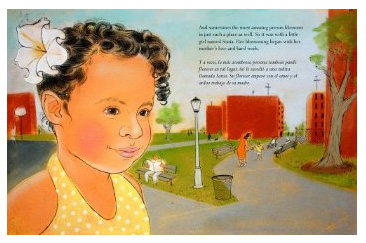
    Illustration by Edel Rodriguez from Sonia Sotomayor: A Judge Grows in the Bronx.

    Second Grade
    Claire Nivola's illustration from Life in the Ocean.
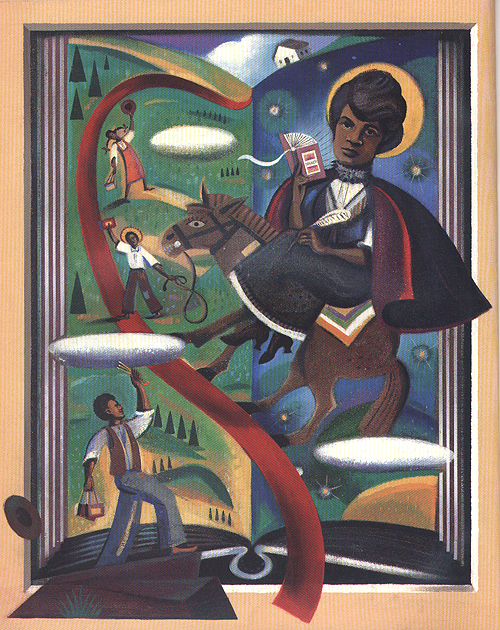
    Ida B. Wells by Stephen Alcorn from Let It Shine.


    Third Grade