This is the sixth of seven posts about early literacy.
 |
| Guided Reading in Kindergarten |
Teaching Sight Words
- Provide students with a classroom word wall so that they have a mental anchor to sight words.
- Add several sight words a week to the wall and regularly interact with the wall. I found Pat Cunningham's Phonics They Use to be a great resource in how to make sure the wall remains interactive. Also this ppt is helpful.
- Encourage students to find word wall words in the text during small and whole group lessons.
- Explain that sight words help make reading easier because we can use them.
- Use an individual-size and/or full-size word wall to help build a sight word vocabulary or provide students with a portable word wall the children can use when they are writing as Lenore Furman, a kindergarten teacher at Abington School in Newark designed. See video below.
6. Look at the books you'll be using for guided reading during Levels A through C and make sure that you have all of the sights words identified for teaching. I do this rather than rely on a list from a program. Individual Word Wall Template.
7. If an unknown word is on the word wall, refer to it as a student comes to a sight word she does not recall. Say, That word is on the word wall, can you find it? What is that word? Okay, reread the sentence now that you remember the word. If the word is not on the word wall, use context clues to help the child figure it out (skip it and reread, look at the letters) and add it to the wall.
 |
| 1st grader using the app, Sight Words. |
8. My favorite app for teaching sight words is Sight Words by Teacher Created Materials.
 |
| A small group interactive writing lesson with kindergarten children. They were writing in response to a read aloud. |
9. Make sure to include taught sight words during interactive writing. As one students is writing the whole sight word in text, the other students can write the word on the carpet or on individual whiteboards.
 |
| The cut apart sentence, focusing on specific letter and word learning in grade 1. |
10. Cut apart a sentence into individual words and have students reassemble it.
11. Use highlighter tape and highlight sight words (you are studying) in shared reading texts. Wide tape.
12. Build the words with letter tiles or magnetic letters.
13. Stamp the words using alphabet rubber stamps.
14. Use alphabet cookie cutters or play dough letter stamps to stamp the words into play dough.
15. Determine a procedure to teach sight words and stick to it. I like Jan Richardson's 4-part process. (What's Missing? Mix and Fix. Finger Spell. Table Writing)
 |
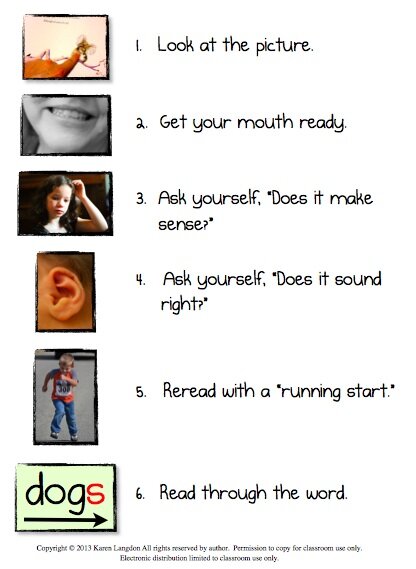
What Do I Do When I Come to A Word I Don't Know: Word Solving
1. Use prompts to cue student to use first sounds as she solves for unknown words, such as, What sound does that word start with? |
2. Prompt students by saying, Get your mouth ready for the first sound.
3. Prompt students to Look at the beginning of the word.
 |
5. Encourage cross-checking and self-correcting behaviors by prompting student to look at pictures and words as she solves for the unknown.
6. Also, prompt student to reread and fix miscues when her reading doesn't make sense, sound right, or look right (words and pictures don't match).
7. Instruct student that reading always makes sense, sounds right, and looks right. If reading does not make sense, sound right, or look right, she needs to reread and make changes.
8. After child reads through a miscue, guide him back to the point of miscue and ask, Did that make sense? or Did that sound right? or Does that look like what you read? Ask child to reread and fix error.
6. Also, prompt student to reread and fix miscues when her reading doesn't make sense, sound right, or look right (words and pictures don't match).
7. Instruct student that reading always makes sense, sounds right, and looks right. If reading does not make sense, sound right, or look right, she needs to reread and make changes.
8. After child reads through a miscue, guide him back to the point of miscue and ask, Did that make sense? or Did that sound right? or Does that look like what you read? Ask child to reread and fix error.
 |
| from http://www.teachingace.com/reading-strategies-anchor-chart/ |
9 While reading with a student in instructional text, prompt student at the point of word-solving to, Look for parts you know. Do you know a word like that? Do you know any other word that has the same letters at the end/beginning?
10. Add one word from each word family/rime to the word wall. Use that word to help write and read other words.
11. Indicate the special word family words/rimes by placing a star next to them on the word wall.
12. Prompt child to use the word wall as a resource for these words: That word looks like one of our word wall helper words. Can you find the one it looks like? What is the word wall word? If that's____, what is the word in the book?
10. Add one word from each word family/rime to the word wall. Use that word to help write and read other words.
11. Indicate the special word family words/rimes by placing a star next to them on the word wall.
12. Prompt child to use the word wall as a resource for these words: That word looks like one of our word wall helper words. Can you find the one it looks like? What is the word wall word? If that's____, what is the word in the book?
13. Capture strategies on an anchor chart the children can use.
Early Literacy Series #1: Shared Reading & Writing and CAP
Early Literacy Series #2: Shared Reading Resources for Preschool and Kindergarten
Early Literacy Series #3: Teaching Rhyming and Initial Sound Instruction
Early Literacy Series #4: Teaching Sound and Letter Identification in Kindergarten
Early Literacy Series #5: Teaching Blending & Segmenting through Books and Poetry
Books to Teach the 37 Most Common Rimes: The Rime Poetry Book.
Early Literacy Series #7: Teaching Comprehension & Fluency
Early Literacy Series #2: Shared Reading Resources for Preschool and Kindergarten
Early Literacy Series #3: Teaching Rhyming and Initial Sound Instruction
Early Literacy Series #4: Teaching Sound and Letter Identification in Kindergarten
Early Literacy Series #5: Teaching Blending & Segmenting through Books and Poetry
Books to Teach the 37 Most Common Rimes: The Rime Poetry Book.
Early Literacy Series #7: Teaching Comprehension & Fluency