Showing posts with label professional texts. Show all posts

Tuesday, June 24, 2014

Professional Texts about Reading, Reading Workshop, Conferring, Assessment, and Reading 2.0

Print Resources for K-6


Teachers engaging (Reilly, Newark, NJ 2014)


I.               Texts About Comprehension & Literacy

Allington, Richard L. (Ed.). (2010). Essential Readings on Struggling  Learners.  Newark, DE: IRA.
Barnhouse, Dorothy & Vicki Vinton. (2012). What Readers Really Do: Teaching the Process of Meaning Making. Portsmouth, NH: Heinemann.
Campano, Gerald. (2007).  Immigrant Students and Literacy: Reading, Writing, and Remembering . New York: Teachers College Press.
Dorn, Linda & Carla Soffos. (2005). Teaching for Deep Comprehension. Portland, ME: Stenhouse Publishers.
Fountas, Irene  & Gay Su Pinnell (2006). Teaching for Comprehending and Fluency: Thinking, Talking, and Writing About Reading, K-8. Portsmouth, NH: Heinemann.
Miller, Debbie. (2013). Reading with Meaning: Teaching Comprehension in the Primary Grades. Portland, ME: Stenhouse Publishers.
Serafini, Frank (2004). Lessons in Comprehension: Explicit Instruction in the Reading Workshop. Portsmouth, NH: Heinemann.
Strickland, Dorothy, (Ed.). (2010). Essential Readings in Early Literacy. Newark, DE: IRA.

II.              Texts about Reading Workshop

Barnhouse, Dorothy. (2014). Readers Front and Center. Portland, ME: Stenhouse Publishers.
Collins, Kathy. (2008). Reading for Real: Teach Students to Read with Power, Intention, and Joy in K-3 Classrooms. Portland, ME: Stenhouse Publishers.
Collins, Kathy. (2004). Growing Readers: Units of Study in the Primary Classroom. Portland, ME: Stenhouse Publishers.
Hahn, Mary Lee. (2002). Reconsidering Read-Aloud. Portland, ME: Stenhouse Publishers.
Heard, Georgia & Jennifer McDonough. (2009). A Place for Wonder: Reading and Writing Nonfiction in the Primary Grades. Portland, ME: Stenhouse Publishers.
Parsons, Stephanie. (2010). First Grade Readers: Units of Study to Help Children See Themselves as Meaning Makers. Portsmouth, NH: Heinemann.
Reif, Linda. (2014). Read Write Teach: Choice and Challenge in the Reading-Writin​g Workshop. Portsmouth, NH: Heinemann.
Serafini, Frank (2001). The Reading Workshop: Creating Space for Readers. Portsmouth, NH: Heinemann.
Serafini, Frank & Suzette Serafini-Youngs. (2006). Around the Reading Workshop in 180 Days: A Month-by-Month Guide to Effective Instruction. Portsmouth, NH: Heinemann.
Sibberson, Franki. (2012). The Joy of Planning: Designing Minilesson Cycles in Grades 3-6. Holden, ME: Choice Literacy.
Sibberson, Franki & Karen Szymusiak. (2003). Still Learning to Read: Teaching Students in Grades 3-6. Portland, ME: Stenhouse Publishers.

III. Texts about Teacher Language & Student Talk & Conferring

Allen, Patrick A. (2009). Conferring: The Keystone of Reader's Workshop. Portland, ME: Stenhouse Publishers.
Genishi, Ceila & Anne Haas Dyson. (2009). Children Language & Literacy. New York: Teachers College Press.
Johnston, Peter H. (2012). Opening Minds: Using Language to Change Lives. Portland, ME: Stenhouse Publishers.
Johnston, Peter H.  (2004). Choice Words. Portland, ME: Stenhouse Publishers.
Lindsfor, Judith Wells. (2008). Children's Language: Connecting Reading, Writing, and Talk. New York: Teachers College Press.
Nichols, Maria. (2008). Talking About Text: Guiding Students to Increase Comprehension Through Purposeful Talk . Huntington Beach, CA: Shell Education.
Serravallo, Jennifer  & Gravity Goldberg (2007). Conferring with Readers: Supporting Each Student's Growth and Independence. Portsmouth, NH: Heinemann.
Zwiers, Jeff & Marie Crawford. (2012). Academic Conversations: Classroom Talk that Fosters Critical Thinking and Content Understandings. Portland, ME: Stenhouse Publishers.

III. Texts About Assessment

Sibberson, Franki & Karen Szymusiak. (2008). Day-to-Day Assessment in the Reading Workshop: Making Informed Instructional Decisions in Grades 3-6. New York: Scholastic.
Yetta Goodman, Yetta  Gretchen Owocki. (2002). Kidwatching: Documenting Children's Literacy Development. Portsmouth, NH: Heinemann.

IV. Texts about Reading & Technology
Hyler, Jeremy & Troy Hicks. (2014). Create, Compose, Connect!: Reading, Writing, and Learning with Digital Tools. New York: Routledge. 
Miller, Suzanne M. & Mary B. McVee (Eds.) (2012). Multimodal Composing in Classrooms: Learning and Teaching for the Digital World. New York: Routledge. 
Serafini, Frank (2015). Reading Workshop 2.0. Portsmouth, NH: Heinemann. (To be published. Info here).
Vasquez, Vivian Maria  & Carol Branigan Felderman. (2012). Technology and Critical Literacy in Early Childhood. New York: Routledge.


Tuesday, December 4, 2012

Professional Books for Teaching K-2 Literacy: An Annotated List

As promised to the K-2 teachers at Robert Treat Academy in Newark--here are a few recommendations of professional books related to K-2 literacy, with an emphasis on teaching writing.


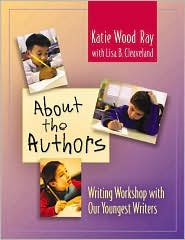
Cleveland, Lisa and Katie Wood Ray. (2003). About the Authors: Writing Workshop with Our Youngest Writers. Portsmouth, NH: Heinemann.
An inside look at the ways that first grade teacher, Lisa Cleveland teaches her students to write well and assisted by consultant Katie Wood Ray. Includes an overview of units of study that Lisa taught and samples of student work. I also think the DVD, The Teaching Behind the Authors, is excellent, especially as it chronicles teaching writing the very first day in first grade.

Cowhey, Mary. (2006). Black Ants and Buddhists: Thinking Critically and Teaching Differently in the Primary Grades. Portland, ME: Stenhouse.
This is one of my favorite teaching books as the author, Mary Cowhey is a fine storyteller and the stories she tells about the teaching she did with her first and second graders at a public school in Massachusetts are critical ones that illustrate social justice and literacies in action.  Highly recommend this book.

Dorn, Laura J. & Tammy Jones. (2012). Apprenticeship in Literacy: Transitions Across Reading and Writing K-4. (2nd Edition)  Portland, ME: Stenhouse.
I purchased this book as soon as it was available having read and reread the first edition. I believe deeply in cognitive apprenticeship and Dorn and Jones based their book on this theory. This text is thorough and contains significant classroom based examples that illustrate what it means to apprentice a child.  The keen insights into the use of teacher language makes this a critical text to read/reread. You might also find the intervention model Dorn and Schubert developed of great interest. Here is a link to A Comprehensive Intervention Model for Preventing Reading Failure: A Response to Intervention Process by Linda Dorn and Barbara Schubert (from Journal of Reading Recovery, 2008)

Heard, Georgia & Jennifer McDonough. (2009). A Place for Wonder: Reading and WritingNonfiction in the Primary Grades.  Portland, ME: Stenhouse.
I just recently read this title and was found it to be filled with specific practices that a kindergarten-first grade teacher, Jennifer McDonough along with parent and poet Georgia Heard employed while helping young children to read and write nonfiction.  The writing is lovely and the ideas are sound.  I read it in a gulp.

Miller, Debbie. (2002). Reading with Meaning. Portland, ME: Stenhouse.
If you are questioning how to teach comprehension, or struggling to do so, I would recommend Debbie's book.  Clearly written, this text outlines the work she did with primary grade students and includes samples of student work.  The quality is very high.  This book inspires me to teach better.

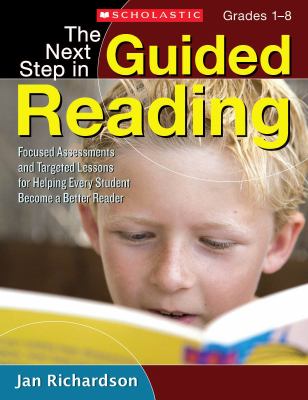
Richardson, Jan. (2009). The Next Steps in Guided Reading: Focused Assessments and Targeted Lesson for Helping Every Student Become a Better Reader. New York: Scholastic.
I love this book by Jan.  Many years ago when I was the Literacy Director for Newark Public Schools, I hired Jan to do some work modeling instruction with K-2 children.  Her work resonated with all of us.  This book outlines much of what Jan modeled.  What I appreciate about this text is that it is evident that the ideas and practices are based on the on work Jan has done in the area of preventing reading difficulties, especially with the "hard to teach" child. I highly recommend it for teachers who want specific ideas and practices for preventing reading difficulties. Jan's practices far surpass the more traditional guided reading lessons.  The content mix of guided reading, phonics, and writing provides a nexus of support for learners.

Ruzzo, Karen and Mary Ann Sacco. (2003). Significant Studies for Second Grade: Reading and Writing Investigations for Children. Portsmouth, NH: Heinemann.
Karen and Mary Ann highlight several different reading and writing units of study (dialogue, setting, nonfiction, and content area research) conducted with second grade children across a school year.  This book has been a favorite of countless graduate students I've taught. Why?  They often commented that the book provided an array of materials that are specific to each unit and helped them to envision how they might craft their own units and/or make use of these units when teaching.

Vasquez, Vivian M. and Carol Branigan Felderman. (2012). Technology and Critical Literacy in Early Childhood. New York: Routledge.
In this work, Vivian and Carol explore the intersections between new technologies and critical literacies through case studies of early childhood classrooms (PK - 2). Technologies that are highlighted include VoiceThread, podcasting, world mapper, clustr maps, wordle, tagxedo, bit strips for schools (comics), literacy through photography [blog], odosketch, storybird, kerpoof, photopeach .

Friday, November 23, 2012

50 Professional Texts that Influence My Thinking: An Eclectic Set


Dreaming of Kurt Schwitters (M.A. Reilly, 2011)

An eclectic set of professional texts  that I have read that influence my thinking. Curious as to which books you would include in a list. 

  1. Albers, Joseph. (2006). Interaction of Color. New haven, CT: Yale University Press.
  2. Alexander, Christopher; Sara Ishikawa, and Murray Silverstein. (1977). A Pattern Language: Towns, Buildings, Construction.  London: Oxford University Press.
  3. Arnheim, Rudolf. (2004). Visual Thinking: Thirty-fifth Anniversary. Berkeley, CA: University of California Press. 
  4. Bachelard, Gaston. (1958/1994). The Poetics of Space. Maria Jolas, translator. Boston: Beacon Press.
  5. Bakhtin, M.M. (1981). The Dialogic Imagination: Four Essays. Michael Holquist, editor. Vadim Liapunov, translator. Austin, TX: University of Texas Press.
  6. Bakhtin, M.M. (1986). Speech Genres and Other Late Essays. Caryl Emerson & Michael Holquist, editors. Vern W. McGee, translator. Austin, TX: University of Texas Press.
  7. Bang, Molly. (2000). Picture This: How Pictures Work. San Francisco, CA: Chronicle Books.
  8. Barthes, Roland. (2010). Camera Lucida: Reflections on Photography. New York: Hill and Wang.
  9. Bateson, Mary Catherine. (1995). Peripheral Visions: Learning Along the Way. New York: HarperCollins.
  10. Benjamin, Walter. (1969).  Illuminations: Essays and Reflections. Schocken.
  11. Berger, John. (1995). Another Way of Telling. New York: Vintage.
  12. Berger, Ron. (2003). The Ethics of Excellence: Building a Culture of Craftsmanship with Students. Portsmouth, NH: Heinemann.
  13. Bhabha, Homi K. (2004). The Location of Culture. London: Routledge.
  14. Brookfield, Stephen & Steven Presskill. (2005). Discussion as a Way of Teaching: Tools and Techniques for Democratic Classrooms, 2nd Ed. San Francisco, CA: Jossey Bass.
  15. Bruner, Jerome. (1986). Actual Minds: Possible Worlds. Cambridge, MA: Harvard University Press.
  16. Butler, Judith. (2005). Giving an Account of Oneself. New York: Fordham University Press.
  17. Deleuze, Gilles & Felox Guattari. (1987). A Thousand Plateaus: Capitalism and Schizophrenia. Minneapolis, MN: University of Minnesota Press.
  18. Deleuze, Gilles & Claire Parnet. (2002).  Dialogues, Second Ed. New York: Columbia University Press.
  19. Dewey, John. (2005). Art as Experience. New York: Perigee Trade.
  20. Eisner, Elliott. (2004). The Arts and the Creation of Mind. New Haven, CT: Yale University Press.
  21. Elbow, Peter. (1973/1998). Writing without Teachers: 25th Anniversary Edition. New York: Oxford University Press.
  22. Freire, Paulo. (2000). Pedagogy of the Oppressed. 30th Anniversary Edition. Myra Bergman Ramos, translator. New York: Continuum.
  23. Gee, James. (2011). Social Linguistics and Literacies: Ideology in Discourse. London: Routledge.
  24. Gonzalez, Norma, Luis Moll, and Cathy Amanti (Eds).(2005).  Funds of Knowledge: Theorizing Practices in Households and Classrooms. Mahwah, NJ: Lawrence Erlbaum.
  25. Greene, Maxine. (2000). Releasing the Imagination: Essays on Education, the Arts, and Social Change. San Francisco: Jossey Bass.
  26. Greene, Maxine. (1988). The Dialectic of Freedom. New York: Teachers College Press.
  27. Grumet, Madeleine. (1988). Bitter Milk: Women and Teaching. Amherst, MA: The University of Massachusetts Press.
  28. Hayles, N. Catherine, (2012). How We Think: Digital Media and Contemporary Technogenesis. Chicago, IL: University of Chicago Press. 
  29. Heath, Shirley Brice. (1983). Ways with Words: Language, Life and Work in Communities and Classrooms. Cambridge, MA: Cambridge University Press.
  30. Henry Jenkins, Henry, Ravi Purushotma, Margaret Weigel, Katie Clinton, Alice J. Robison (2009). Confronting the Challenges of Participatory Culture: Media Education for the 21st Century (The John D. and Catherine T. MacArthur Foundation Reports on Digital Media and Learning).  Cambridge MA: MIT Press.
  31. hooks, bell. (2003). Teaching Community: A Pedagogy of Hope. London: Routledge.
  32. Huizinga, Johan. (1971). Homo Ludens: A Study of the Play-Element in Culture. Boston, MA Beacon Press.
  33. Iser, W. (1974). The implied reader: Patterns of communication in prose fiction from Bunyan to Beckett. Baltimore: Johns Hopkins University Press.
  34. Ito, Mizuko, Heather A. Horst, Megan Finn, Arthur Law, Annie Manion, Sarai Mitnick, David Schlossberg and Sarita Yardi. (2009). Hanging Out, Messing Around and Geeking Out: Kids Living and Learning with New Media. Cambridge, MA: MIT Press. 
  35. Latour, Bruno. (2007). Reassembling the Social: An Introduction to Actor-Netwok-Theory. Oxford.
  36. Lefebvre, Henri. (19920. The Production of Space. London: Wiley-Blackwell.
  37. Newkirk, Thomas, (2011). The Art of Slow Reading: Six Time Honored Practices for Engagement. Portsmouth, NH: Heinemann.
  38. Pinar, William. (2011). What is Curriculum Theory? 2nd Edition. London: Routledge.
  39. Rogoff, Barbara. (1991). Apprenticeship in Thinking: Cognitive Development in Social Context. London: Oxford University Press.
  40. Rosenblatt, Louise.  (1978/1994). The Reader, The Text, and the Poem: Transactional Theory of the Literary Work. Carbondale, IL: Southern Illinois University Press.
  41. Soja, Edward. (1997/2011). Postmodern geographies: The reassertion of space in critical social theory. New York: Verso.
  42. Sumara, Dennis. (1996). Private Readings in Public: Schooling the Literary Imagination. New York: Peter Lang.
  43. Sutton-Smith, Brian. (2001). The Ambiguity of Play. Cambridge, MA Harvard University Press.
  44. Tharp, Roland & Rolland Gallimore. (1988). Rousing Minds to Life: Teaching, Learning & Schooling in Social Context. Cambridge University Press
  45. Thomas, Doug  & John Seely Brown. (2011). A New Culture of Learning: Cultivating the imagination for a World of Constant Change. CreateSpace.
  46. Vinz, Ruth. (1996). Composing a Teaching Life. Portsmouth, NH: Heinemann.
  47. Vygotsky, Lev. (1986). Thought and Language. Cambridge, MA: MIT Press.
  48. Weinberger, David. (2012). Too Big To Know: Rethinking Knowledge Now That Facts Aren't the Facts, Experts are Everywhere, and The Smartest Person in the Room is the Room. New York: Basic Books.
  49. Weschler, Lawrence. (2009). Seeing is Forgetting the Name of the Thing One Sees. University of California Press.
  50. Wheatley, Margaret J. (2002). Turning to One Another: Simple Conversations to Restore Hope. San Francisco, CA: Berrett-Kohler.