Showing posts with label professional learning. Show all posts

Tuesday, February 3, 2015

Spilled Paint Story

Night Falling in the Woods
In a few days I will be introducing fourth graders and their teachers to a storytelling technique that uses spilled paint, conversation, and story making. The slide share below chronicles the process I used to create a Spilled Paint Story. It is always fascinating to see what happens when children spill paint, fold paper and unfold stories.


Saturday, January 24, 2015

On Learning: Twitter, College, Frames, and the Accidental

A Certain Stillness (M.A. Reilly, Wales, 2014)
I. 

Occasionally, I read tweets that argue how Twitter can be a source for professional learning.  I too have found tweets that lead to interesting learning. Most often these are to blogs or particular sites. Rarely, though do chats on Twitter require me to think deeply, differently, or to work arduously. When a chat does lead to an A-ha moment, I find these insights fade, quickly forgotten against the rush of the day. Twitter chats are more about being in the moment and there's a beauty to that.  

There are different types of learning with different intensities. 

Sometimes I'll read tweets that accompany these 'chats about PD that state rather emphatically how Twitter is the superior method for learning in comparison to college courses/programs, reading/viewing, and outside-provider professional 'development'. These tweets are often met with a round of retweets--a Twitter form of marginalia that affirms, says, "Yes!" At these times, I wonder about the Twitter-Tops-All sentiment.  What rests beneath these assertions? What assumptions are being made/unmade?  Is the subtext here more about asserting one's agency, rather than quality? When it comes to learning, can there be a single method that is somehow superior to other methods?  Does that even make sense? Are those who send such tweets telling us a truth, a type of truth? 


II.

A few days ago, Rob shared an email from a former student that mentioned an interest in a course being taught at the University of Rochester. After reading the course description, I contacted Professor Paul Duro and requested permission to post the description here. He agreed and sent me an updated version for the course, Rhetoric of the Frame, which appears below: 
The task of any discussion of frames and framing in literature and the visual arts is first and foremost to counter the tendency of borders, boundaries and frames to invisibility with respect to the work they contain. We see the work, but we do not see the frame. It is against this tendency to overlook the paregonal aspects of the work that this seminar is directed. Starting from a close reading of the foundational texts of frame theory in Immanuel Kant’s Critique of the Power of Judgment and Jacques Derrida’s celebrated study The Truth in Painting, we will explore the boundaries of the artwork from the point of view of its material, discursive, and metaphorical borders. Topics to be considered range from Edgar Allen Poe’s short story ‘The Purloined Letter’ to Martin Heidegger’s essay ‘The Origin of the Work of Art,’ and from Nicolas Poussin’s comments on the role of painting to Gotthold Ephraim Lessing’s meditation on the limits of painting and poetry to the textual frame of literature in the work of Gerard Genette. 

After reading the description, Rob and I agreed that this was a course we would enjoy taking.  We each lamented the distance from home to Rochester.  I've long been interested in what we (un)frame and fail to frame and how frames alter how we see. Shift the frame and the artwork contained alters too. The uncertainty and ambiguity of it all intrigues me as does the way we see when peering through frames and how we see in their absence. A week ago, I bought a used copy of Derrida's The Truth in Painting and plan to crack it open during the weekend and see what sense (if any) I make of it. This may not be a book I can initially read well on my own as I find Derrida's work dense and sometimes obscure. Sometimes, I enjoy a more knowledgeable other to help me get anchored in a text. This may be one.

III.

I've been fortunate having learned with and from teachers, professors, and fellow students--in and out of school.  As an undergraduate and while earning a doctorate, I was encouraged by teachers and family to learn, not for a specific utilitarian purpose, but more often for the art of it. I can recall my doctoral adviser saying to me to slow down, take my time. "When will you have the time to learn this way again?"  When indeed?


Take courses that interest you was a mantra I lived by and one I could live by as the college degrees I earned were paid for through generous scholarships. The most memorable of these programs were ones where I was able to select the majority of courses and design independent studies as opposed to following an pre-established curriculum. I didn't recognize then how significant such freedom could be. Learning at college has afforded me the opportunity to ponder deeply--to struggle with complex ideas and to compose theory that was most often connected to my work as a teacher, artist, and professor. It has afforded me the interest and opportunities to set into words what these theories mean/fail to mean and to then publish these works. Such study has helped me to coauthor written and visual texts.  Frankly, it's hard for me to imagine learning such depth, such contradictions in an hour-long chat regardless of the participants. The preparation for such study required a very different use of time and resources. I think of this now as I am working with two friends who are each completing their dissertation and I am serving on their respective committees. The work and curve of learning these women do is so significant, challenging, and brave. It is these experiences that make me question the belief that Twitter represents the apex of professional learning.  It so often feels so fleeting.

IV.

Perhaps what I am struggling to articulate here is the idea that a multiplicity of ways to learn may be superior to a single method, and may be more truthful of how we compose ourselves professionally. I think that different types of learning require different degrees of responsibility from us and perhaps we are the better for such differences. What may be more important than method is the privilege of saying yes and/or no to what is being learned.   

I credit a blend of accidental and planned learning for much of the professional knowledge I've composed and forgotten and am grateful for professors, colleagues, teachers, fellow students, friends and family who have taught me and learned alongside. 

I'll let you know how the Derrida book goes.  

Sunday, March 30, 2014

How Making Art (In)Forms My Work as a Teacher


Today I have been looking at images I made in classrooms and workshops where I am teaching/co-teaching, largely in Newark, NJ.   The images illustrate work done with principals, teachers, and children.

I have been sharing these images and insights via Twitter today. Here are a few of the tweets.


In doing this work today, I realize how influenced I am as a teacher by the art I make. I uploaded this portfolio of black and white images I made during a four year period to slideshare.  (See below) This got me thinking about how observing and seeing though various lenses influences the multiple perspectives I bring to my work as an educator.


All of this is to say that when we think about professional learning, the quiet out of school learning we do ought to matter. 

Tuesday, December 4, 2012

Professional Books for Teaching K-2 Literacy: An Annotated List

As promised to the K-2 teachers at Robert Treat Academy in Newark--here are a few recommendations of professional books related to K-2 literacy, with an emphasis on teaching writing.


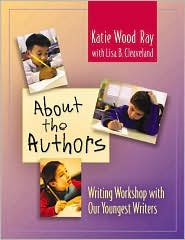
Cleveland, Lisa and Katie Wood Ray. (2003). About the Authors: Writing Workshop with Our Youngest Writers. Portsmouth, NH: Heinemann.
An inside look at the ways that first grade teacher, Lisa Cleveland teaches her students to write well and assisted by consultant Katie Wood Ray. Includes an overview of units of study that Lisa taught and samples of student work. I also think the DVD, The Teaching Behind the Authors, is excellent, especially as it chronicles teaching writing the very first day in first grade.

Cowhey, Mary. (2006). Black Ants and Buddhists: Thinking Critically and Teaching Differently in the Primary Grades. Portland, ME: Stenhouse.
This is one of my favorite teaching books as the author, Mary Cowhey is a fine storyteller and the stories she tells about the teaching she did with her first and second graders at a public school in Massachusetts are critical ones that illustrate social justice and literacies in action.  Highly recommend this book.
Dorn, Laura J. & Tammy Jones. (2012). Apprenticeship in Literacy: Transitions Across Reading and Writing K-4. (2nd Edition)  Portland, ME: Stenhouse.
I purchased this book as soon as it was available having read and reread the first edition. I believe deeply in cognitive apprenticeship and Dorn and Jones based their book on this theory. This text is thorough and contains significant classroom based examples that illustrate what it means to apprentice a child.  The keen insights into the use of teacher language makes this a critical text to read/reread. You might also find the intervention model Dorn and Schubert developed of great interest. Here is a link to A Comprehensive Intervention Model for Preventing Reading Failure: A Response to Intervention Process by Linda Dorn and Barbara Schubert (from Journal of Reading Recovery, 2008)

Heard, Georgia & Jennifer McDonough. (2009). A Place for Wonder: Reading and WritingNonfiction in the Primary Grades.  Portland, ME: Stenhouse.
I just recently read this title and was found it to be filled with specific practices that a kindergarten-first grade teacher, Jennifer McDonough along with parent and poet Georgia Heard employed while helping young children to read and write nonfiction.  The writing is lovely and the ideas are sound.  I read it in a gulp.

Miller, Debbie. (2002). Reading with Meaning. Portland, ME: Stenhouse.
If you are questioning how to teach comprehension, or struggling to do so, I would recommend Debbie's book.  Clearly written, this text outlines the work she did with primary grade students and includes samples of student work.  The quality is very high.  This book inspires me to teach better.
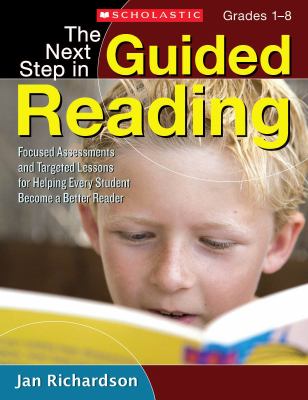
Richardson, Jan. (2009). The Next Steps in Guided Reading: Focused Assessments and Targeted Lesson for Helping Every Student Become a Better Reader. New York: Scholastic.
I love this book by Jan.  Many years ago when I was the Literacy Director for Newark Public Schools, I hired Jan to do some work modeling instruction with K-2 children.  Her work resonated with all of us.  This book outlines much of what Jan modeled.  What I appreciate about this text is that it is evident that the ideas and practices are based on the on work Jan has done in the area of preventing reading difficulties, especially with the "hard to teach" child. I highly recommend it for teachers who want specific ideas and practices for preventing reading difficulties. Jan's practices far surpass the more traditional guided reading lessons.  The content mix of guided reading, phonics, and writing provides a nexus of support for learners.

Ruzzo, Karen and Mary Ann Sacco. (2003). Significant Studies for Second Grade: Reading and Writing Investigations for Children. Portsmouth, NH: Heinemann.
Karen and Mary Ann highlight several different reading and writing units of study (dialogue, setting, nonfiction, and content area research) conducted with second grade children across a school year.  This book has been a favorite of countless graduate students I've taught. Why?  They often commented that the book provided an array of materials that are specific to each unit and helped them to envision how they might craft their own units and/or make use of these units when teaching.

Vasquez, Vivian M. and Carol Branigan Felderman. (2012). Technology and Critical Literacy in Early Childhood. New York: Routledge.
In this work, Vivian and Carol explore the intersections between new technologies and critical literacies through case studies of early childhood classrooms (PK - 2). Technologies that are highlighted include VoiceThread, podcasting, world mapper, clustr maps, wordle, tagxedo, bit strips for schools (comics), literacy through photography [blog], odosketch, storybird, kerpoof, photopeach .

Sunday, September 23, 2012

How to Be an Explorer, Elaboration 1

From here.

I had gotten this book (How to Be an Explorer of the World) a few months ago, tucked it away for a better day and found it again (on what must be that better day).

Ten things about where I'm sitting right now that I hadn't noticed when I sat down.


  1. The speckled brown and yellow leaf on the tree outside, dead.
  2. The sound and feel of air moving through the house with all its windows open is soothing, almost impossibly too beautiful.
  3. The sound of water running in the sink.
  4. How anticipation feels like wind through the trees.
  5. Late day light and the pattern it makes of the window pane on the shade.
  6. A cricket sounding, an insistent repetition running beneath these thoughts.
  7. The smoothness of the round oak table where I am sitting.
  8. The sound of keys pressing on a laptop and the hardness of the chair beneath me.
  9. The comfort of repetition: ice cubes being dropped, as if they were on a conveyor belt, one after another after another.
  10. The inevitable whining drone of a weekend warrior bringing tameness to a lawn.