Showing posts with label Curriculum. Show all posts

Saturday, February 15, 2025

Cohesive Teaching and Learning

Grade 2 Student’s Written Response to a Daily Instructional Task


Teaching young children, in this case second graders, to define the key term they are writing about allows them to better select evidence to support an assertion. I have embedded this kind of structure into primary and intermediate grade curriculum. In the example below, I modeled composition instruction in response to a text from a Cinderella unit. Children, through the routine of text talk, learned the word, crafty the previous day with their teachers (this is an inclusion class). I followed by using the the Single Paragraph Outline (SPO) designed by the Writing Revolution, with one key change. After Topic Sentence, I added a space for the explanation of the key term. The remainder is as TWR designed with details and the closing sentence. 

In the student writing example below, it is clear that the evidence selected (details) clearly supports the writer’s assertion that Yeh-Shen’s stepmother is crafty. She tricks her step daughter. 

In contrast to writing process reminders like, RACE, this approach actually focuses and scaffolds children’s thinking, producing far better outcomes.  What’s equally critical is the lesson the previous day built vocabulary knowledge. The next day’s lesson develops essayist writing. This happens because the curriculum is coherent. 

In grade 2, children need to build stamina, reading and writing fluency, and learn how to write convincing compositions with accurate evidence and paragraph structure. This technique of defining the key term allows students to stay focused, recall the critical parts of the text rather than try to retell all of it, and conclude well. 

The classroom teacher, principal, and I will be presenting on the the impact of teaching robust vocabulary and composition structure in primary grades at the 31st Annual Conference on Literacy, “Exploring Literacy and the Arts in Pursuit of a Socially Just World,” on  April 5, 2025 at Mount Saint Mary College in Newburgh,NY. 

Hope you can join us.

Saturday, March 28, 2015

Beginnings: Doorways We Walk Through (#SOL15, Day 28)

House by the Tracks (M.A. Reilly, 2009)

I.

Edward Said wrote that “a beginning is accepted as a beginning after we are long past beginning and after our apprenticeship is over” (1975, Beginnings: Intention and Method, p.76). Being beyond a moment often helps us to reframe it.

Tonight, I am wondering about the partial beginnings I have known.

In writing about the partially unknown beginning, Said explains “that we make and accept it at the same time that we realize that we are ‘wrong’” ( p. 78).  In reading Said's words, I think about the messiness of school.  We have accepted schools as they have been made.  Fictions and realities are co-constructed on a page, as well as in a classroom--in the school house. These fictions, these realities serve us little.

There are new doorways, we need to walk through if we can find the courage to do so. 

II.

In the current push for the Common Core State Standards and “tougher” normed assessments that dedicate weeks out of the school year for preparation and testing the folly of our ways is more and more obvious. Our need for certainty obscures that learning has always been a human enterprise, temporally located, fictitious and real.  

Yes, fictitious and real. 

Schooling though is not the same as learning. It never has been--even when we needed it to be so. The schools we have known--the ones we have made are ending. And tonight I know that another generation will not sit tight for the dusting off of something old, something too blue, something they no longer need. The signs are everywhere. 

Identity is composed in the joining of fictions and realities—be it on paper or in the lived-curriculum of a classroom.  Said explains that this composition holds constant “so long as we have language to help us and hinder us in finding it, and so long as language provides us with a word whose meaning must be made certain if it is not to be wholly obscure” (p.78). The meaning of school can no longer be made certain. 

What gets made in its stead, interests me, even though I know what we make can't help but be wrong.

Saturday, May 24, 2014

Expeditionary Learning ELA Modules: A Critique

Grade 3 students answering questions posed by Expeditionary Learning.
I've spent the last year working with teachers in grades 3 through 8 who are using the ELA modules created by Expeditionary Learning. I've appreciated much of the design of the modules, the thinking behind some of the lessons, and the attempt to ensure active learning through the use of collaborative techniques such as jigsaw; Praise, Question, Suggest; interactive word wall and others.

But if asked to recommend these to clients after spending a year with the materials, I would not do so. The modules are flawed in ways that must be corrected, especially as these modules have been situated as being a model curriculum that is CCSS-aligned.  Keep in mind that NYCDOE endorsed these modules for their schools in February 2013 before writing had been completed.

EL states:
EL is at the forefront of creating classroom-ready Common Core curricular materials. New York State chose EL to create Common Core-aligned English language arts and literacy curriculum for grades 3-5 and deliver Common Core professional development to representatives from districts across the state. EL is also working with the authors of the Common Core State Standards to develop model secondary curriculum aligned to the standards. (from here)
Although there are several concerns I have with the EL curriculum, two represent the greatest concerns:
  1. The absence of instruction that scaffolds and requires students to generate and frame questions of inquiry to answer.
  2. No one present in the classroom authors the work at hand.
Additional Concerns:
  • The absence of comprehensive writing instruction that moves beyond writing in response to text.
  • The absence of  systematic vocabulary instruction that doesn't rely on directing students to "use context clues" (which aren't always present) or guess.  
  • The amount of time allotted for students to respond to tasks is woefully underestimated.
  • Situating literary texts as something to be used is problematic. There is an absence of an aesthetic appreciation of literary works. Rather literature is situated as efferent (Rosenblatt, 1978).
  • Wait, where's the expedition? The translation of these modules, sans expedition, is simply wrong.  The experiential opportunities are missing.
In this post I want to focus on the first two concerns as these speak to issues of servitude and colonialism.

1. What Career Is EL Getting Your Children Ready To Do?
3rd grader answering a question.

A main challenge I see with  EL's 'model' curriculum is that it undervalues students being active problem framers and instead locates them as responders to already determined questions. Throughout thousands and thousands of pages of curriculum, students are situated in the role of responders to already determined questions and their teachers are located as mimers whose main task is to parrot those already determined questions. Learners are not asked to generate and then frame their own questions to solve. Rather, they are asked repeatedly to merely pen responses to questions that the EL curriculum writers have written, including essay questions.  

Now slide under that instruction for a minute and ask yourself what that set of practices might be developing.  Remember the CCSS is all about making sure our children are college and career ready.

As a former college professor I can assure you that not developing children's capacity to generate and then frame questions of worth is a method to ensure that students are not college ready. College ready at least ought to include students who have done the challenging work of framing problems, not merely answering an authority's questions. Questioning involves speculating about possibilities.
K Mart Greeter.  Image from here
But what about career ready?  What is the career trajectory for people who have been trained to answer questions, rather than generate and frame questions?

Yes, it isn't a pretty outcome for millions of children.

Recently when I asked a group of teachers this question we came up with the following jobs: phone operator, K-Mart greeter, customer service representative.  The absence of question generation and framing leaves the EL curriculum to be more a model of servitude than a model curriculum.

2. Authoring.

“Every empire, however, tells itself and the world that it is unlike all other empires, that its mission is not to plunder and control but to educate and liberate."  (Los Angeles Times, July 20, 2003)”  ― Edward W. Said

The EL curriculum is scripted. No one in the actual classroom gets to author--neither teacher nor student.  The curriculum is written to direct teachers to the specific materials to gather (including independent books for student reading), what to say, what to write, what to show, and allocates the number of minutes that each task needs to be completed.  It also includes anecdotes teachers can say (I guess in case teachers have none of their own?) when teaching vocabulary for example.  The curriculum is so bloated with commentary and directions that it is not unusual for each module to be comprised of 500+ pages.

With all of those pages there is little room for anyone actually present in the classroom to create curriculum: authentic and complicated conversations between students and teachers. The construct is epic, not novel.

Russian thinker Mikhail Bakhtin (1984) described epic as “ a poem about the past” (p.13), “an utterly finished thing” (p. 17) and novel as being unfinalizable and speculative about the unknown.  A similar difference can be said to exist between the institutionally controlled structures such as curriculum, and teachers' more idiosyncratic pedagogical and content practices. The epic world of Expeditionary Learning curriculum is unified, completed, “beyond the sphere of possible contact with the developing, incomplete, and therefore re-thinking and revaluating present” (p.17).  One can think of this epic world as being unalterable. The EL curriculum is an epic construct. It is untouchable. Dead. Beyond the influence of now.

Further, EL situates teaching as being complicated, not complex. Brent Davies' and Dennis Sumara's observe that “teaching has been cast as a complicated rather than a complex phenomenon—one that can be understood by analyzing its component parts and one that, for all intents and purposes, does not vary across time, setting, and persons” (“Cognition, Complexity, and Teacher Education,” 1997, p. 121, emphasis in original).   It doesn't matter who you are and are not. Who the children are and are not. Teaching and learning does not vary across time, setting, and persons. At 10:05 on Tuesday, all 3rd grade teachers should...

Such a belief sucks the energy and creativity from people: teachers and children alike.

In The Dialectic of Freedom, Maxine Greene writes about the difficulty teachers face with burgeoning demands and bureaucratic prescriptions that the public at large demands from educators. She writes:
“We do not know how many educators see present demands and prescriptions as obstacles to their own development, or how many find it difficult to breathe. There may be thousands who, in the absence of support systems, have elected to be silent. Thousands of others (sometimes without explanation) are leaving the schools” (p. 14). 
I've witnessed this leaving--the exiting of excellent teachers who simply can no longer allow themselves to be puppets of corporate enactments of learning. The struggle to continue to teach in light of model curriculum like EL is a formidable task as the mandated use of such curriculum restricts what is allowed to be taught and whose voice, value, and ideas are honored, ignored, and discouraged. 

Saturday, May 10, 2014

Looking Along and At: Ways of Knowing

Tide's Out (Bae Caenarfon, Wales. M.A. Reilly)

I've been thinking about the many ways of (un)knowing and how, as educators, we respond to efforts like the Common Core and other attempts (national and otherwise) to categorize explicit knowledge as if it was a given Truth.  David Kettel in Cartesian Habits and the 'Radical Line' of Inquiry says that in thinking about Cartesian thinking:
a particular spatial image rules our imagination. This is the image of ourselves as looking on at the knowing subject as in every instance a determinate reality set among the realities of the world. This image offers a picture of the act of knowing, of the knowing subject, and of what is known, as such. Our habitual reliance on this image lies at the heart of Cartesian thinking.
Cartesian thought is what gets privileged when we codify, such as the 'content' of standards--making the knowing explicit.  Explicit or formal knowledge is rationalized, organized, and codified--usually outside of our everyday experiences. But there are more ways of knowing and things to know than just what people with power tend to codify (school-based reading, writing, and math and the associated products, such as teacher evaluation and high stake tests). In addition to knowing explicitly, we also tacitly know.  Doug Thomas and John Seely Brown (2011) contrast explicit and tacit dimensions of knowing as follows:
The Painted Essay for CCSS writing
Painted Essay Method from Vermont Writing Collaborative.
An example of codified method. 
Explicit knowledge, as we have seen, lends itself well to the process of teaching—that is, transferring knowledge from one person to another. You teach and I learn. But tacit knowledge, which grows through personal experience and experimentation, is not transferrable—you can’t teach it to me, though I can still learn it. The reason for the difference is that learning tacit knowledge happens not only in the brain, but also in the body, through all our senses (Kindle Locations 1012-1015).
What we call tacit knowledge, Keats called 'taking part in the existence of things'.  In Roger Deakin's, Wildwood: A Journey through Trees, I learned that there are woodland people who can "tell the species of tree from the sound it makes in the wind" (pp. IX-X). This way of knowing is not written down (codified) and taught, but rather is learned through experience often alongside a more experienced other. 

C.S. Lewis, in "Meditation in a Toolshed," describes two ways of knowing. He writes, 
"You get one experience of a thing when you look along it and another when you look at it" (emphasis added).  
The woodland people look along trees. They are immersed in the woods and what is important to know is contextual. Knowing about trees is not something they learn by only looking at trees.  Lewis notes, "...you can step outside one experience only by stepping inside another."  It is this communion of ways of knowing (looking along and looking at) that is most important--not a single way.  And it this communion that is largely absent from the efforts that arise alongside national standards. (Yes, I know the CCSS Is a 'state' effort, but it feels national, doesn't it?)  

And this is what gets missed when knowledge is codified and handed out like after dinner mints for the masses to digest. The messy thinking that happened to first codify gets left off the translation--as it must. Experience cannot be handed out. It must be embodied.  So there is often little experiential learning that gets occasioned when standards are to be 'mastered' especially when the standards are tied to high stakes testing or as José Luis Vilson suggests are part of a package deal. Vilson writes (from here): 

"The CCSS came as a package deal with the new teacher evaluations, higher stakes testing, and austerity measures including mass school closings."

So the authority that accompanies codification of knowledge, the looking at stance, becomes even thornier when multiple agendas converge and are packaged as being truer than our experience. Just think about how irrational it is when people who rarely (if ever) step foot in classrooms are creating and/or are implementing the codification of the 'true' pedagogy, alongside the 'true' content as measured by the 'true' tests. 
This is the true way teach. This is the true content to learn. This is the true way to know if students have learned the true content.  
With all this Truthiness, it gets a bit crowded. So many have game.  

And yet, in determining such Truths, you may find yourself largely missing.  
You are not an actor. 
You are the one being acted upon.  

A by-product that gets fed and populated alongside codification is the belief that the knowledge codified for us is somehow truer than what we experience.  This is the stuff C.S. Lewis told us was the rot.
"...we must never allow the rot to begin. We must, on pain of idiocy, deny from the very outset the idea that looking at is, by its own nature, intrinsically truer or better than looking along. One must look both along and at everything."

Monday, July 9, 2012

Thinking about Spaces of Permission as Curriculum

Milton Glaser says that the "most significant work comes out of misunderstanding."  Is Glaser correct?  If so, how do you grant yourself permission to dwell in problem framing and solving so that your misunderstandings can surface and be explored?  What does it mean to understand a misunderstanding?

If understanding one's misunderstandings are important, then how do you grant permission for learners you teach to do likewise?

What do these spaces of permission look and sound like?  Are spaces of permission a form of curriculum? How might you reconcile, if you can,  spaces of permission as curriculum with the CCSS?  Perhaps considering spaces of permission as descriptive curriculum and CCSS as prescriptive curriculum might be a starting point.


Wednesday, February 22, 2012

Mining Educational Thought through Photographs of Street Play


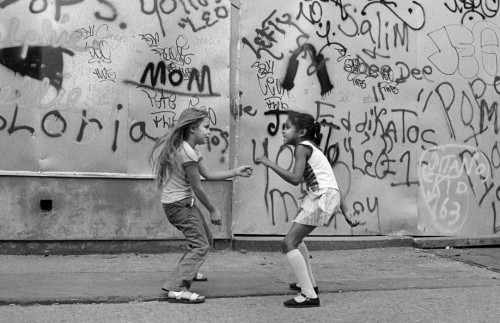
Image by Martha Cooper from here.
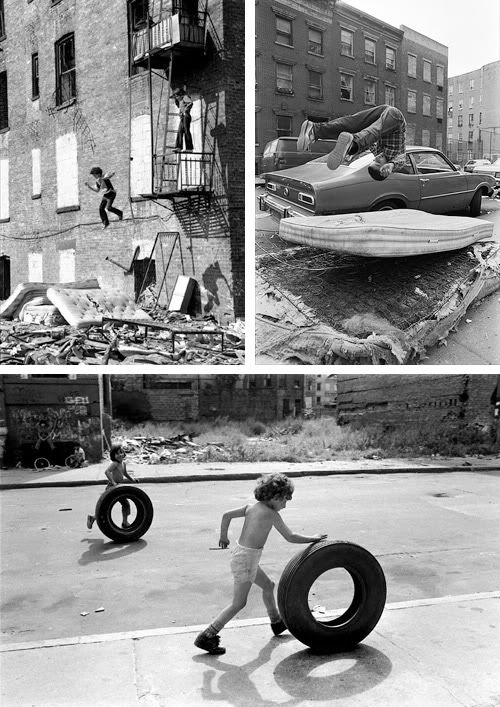
While Martha Cooper was a staff photographer for the New York Post (1977 - 1980) she learned that "The city's poorer neighborhoods had the richest street life." She left her job at the Post and began documenting across the world, children's street play.  In thinking about what she had learned while in New York, she writes:

Children often played for hours without adult supervision and frequently supervised younger siblings themselves.  As I photographed these kids, I came to admire their creativity, energy, humor and willingness to share. I marveled at the simplicity of their homemade toys and at their imagination in playing with them.
Images by Martha Cooper from here.

Maxine Greene (2007) tells us that imagination is "the capacity to break with the ordinary, the given, the taken-for-granted and open doors to possibility." She tells us that a way to describe imagination is as a "passion for possibility." 

A passion for possibility can be seen in the images Cooper makes of children at play.  In contrast to Cooper's images made in the streets, I wonder about the images we make at school.  Is there enough room in the lived curriculum for the unexpected? Is there enough room for children to imagine in ways we cannot and will not predict?

I think about the images Cooper made of children at play and how these images illustrate the power of a child's imagination alongside Greene's definition of learning as imaginative play.  This thinking makes me wonder how often we explore imagination inside of school and just how natural it is for children to employ their imaginations when they are beyond the school door.

Agency seems to matter.

All of this gives me pause and makes me wonder how we might invite the world that children compose outside of school inside our classrooms.  Imagine what we might learn if there was enough space for play that we did not orchestrate.

Works Cited
Cooper, Martha. (2006). Street Play. Berlin, Germany: From Here to Fame Publishing.
Greene, Maxine. (2007).  Imagination and the Healing Arts.

Thursday, January 26, 2012

Part III: Bold Schools - Community as Knowledge

Community is Infinite (January 2012, by M.A. Reilly)

This is the third post in a series where I explore bold schools. In the first post I examined the learner as knowledge worker--a knowmad. In the second post I situated the teacher as time traveler. In this post I deconstruct the idea of content and connect it to community, rhizome, and complicated conversations. These posts were composed in response to Will Richardson's query about bold schools.

1.  What Is Content?
from here.

In bold schools, 'content' is situated and experienced as stable and unstable, bound and unbound.  In this manner, tensions are often present and we may characterized these tensions as rhizomatic.  Although Deleuze and Guattari (1987) tell us: “A rhizome has no beginning or end; it is always in the middle, between things, interbeing, intermezzo” (p. 25), they also remind us that "there exists tree or root structures in rhizomes; conversely, a tree branch or root division may begin to burgeon into a rhizome”(p. 15).  At bold schools, what becomes important content is conditioned by lines of flight, stratification and context. Nothing is primary.

In traditional schools, content remains mostly a matter of stratification and is hopelessly decontextualized. Content is often seen as autonomous--something that can be listed and transferred to another to enact, to know, such as a list of standards and learning objectives that have been developed elsewhere and handed down to the teacher to enact. In such schemata, the most we can hope for is mediocrity.  The 'stuff' we learn has always been a movable force, incapable of being fully contained.  Learning is non-orientable and each time we position it in a limited space we kill a little bit of hope, narrow the range of what might be learned, while guiding learners to reach the unfortunate conclusion that x represents the whole of some matter.

In situating content as rhizomatic, it allows for possibility, not certainty; context, not decontexualzation. Experiential ways of coming to know, gain a foothold in such schools--a requisite for lines of flight.  In an earlier post, I wrote:
Lines of flight represent the creative impulses we compose while thinking and doing that offer a seemingly novel way to disrupt concepts cast as dualities. In fact, one might argue that it is the duality that may at first spark the line of flight: a way of moving beyond what is given to explore what might be. 
In bold schools--neither the State, the institution, the teacher, or the student own the curriculum.  It is a shared matter that is made and remade based on emerging intention by learners, regardless of their role. You can't place it in a binder. You can't post it on the Internet and say it is our Common Core. This is a model for a past century. It cannot hold us in good stead now.  Bold schools understand that curriculum--the content that is learned-- is a made thing that happens inside a context and is impervious to prior mapping.  This is not to say that such curriculum isn't informed by State, institutional, teacher, or student resources.  It surely can be.  What is essential though is that it does not exist as a closed system. 

2. Social Participation and Community as Sources of Knowledge

In bold schools, learning is recognized, even celebrated as being social, experimental, and experiential.  Bold schools make use of digital and non-digital technologies in order for learners to connect, collaborate, contextualize, and create knowledge with others. Doug Thomas and John Seely Brown (2011) explain:
The learning that happens through blogs, social networks, and other new media may be deeply grounded in experience and personal expression, but it also arises from the contributions of multiple people and voices. Expertise and authority are dispersed rather than centralized, and once a digital space hits a point of critical mass, it is very likely that some member of the community will have valuable expertise to share about a given topic (Kindle Locations 924-927).
Thomas and Brown point at the role of community in content knowledge. A second shift in understanding how content is situated then, is to recognize the role of the community as knowledge maker.  In "Community as Curriculum" Dave Cormier (2008) writes:
In the rhizomatic model of learning, curriculum is not driven by predefined inputs from experts; it is constructed and negotiated in real time by the contributions of those engaged in the learning process. This community acts as the curriculum.
 A few years later (2010) he adds:
We need to return to community as a valid repository for knowledge, and away from a packaged view of knowledge and expertise. Knowledge can be fluid; it can be in transition, and we can still use it. We need to tap into the strength provided by communities and see the various forms of community literacy as the skills we need to acquire in order to be effective members of those communities.
Bold schools tap into and contribute to local and extended communities of practice. Neither the teachers, nor the students are contained by the school.  They are mobile learners, who have presences beyond the institution, and in fact many who play a role in student learning will not be officially employed by the school. Networks abound.  In bold schools the conversation is not about whether the students will have an Internet presence and will collaborate with 'strangers', but rather how such presence is mediated, conducted, and (re)presented.

The curriculum composed is generated in the lived moments of learning.  As such, the rhizomatic possibilities become quite pronounced. In these schools there are bold teachers and learners who understand, even celebrate, that such curriculum is complicated conversation (Pinar, 2008) that occurs among the teachers, students, and extended community. In an earlier post, I defined complicated conversation, quoting William Pinar:

William Pinar tells us that curriculum is a “complicated conversation.” He suggests curriculum is situated in space and time where teacher, student, and text meet to co-produce self, other, and culture. The curriculum documents that are produced in schools and standards that are produced by states and nations offer possible curricula, but not the lived one. To mistake one for the other often leads to reenactment or miming and divorces "school curriculum from public life and school curriculum from students' self-formation" (Pinar, p. 186).  Pinar writes:
Instead of employing school knowledge to complicate our understanding of ourselves and the society in which we live, teachers are forced to "instruct" students to mime others' (i.e., textbook authors') conversations, ensuring that countless classrooms are filled with forms of ventriloquism rather than intellectual exploration, wonder, and awe (p. 186).
Intellectual exploration, wonder, and awe cannot occur if learners are thought of as receivers of curriculum, be it the teacher who is handed the curriculum to deliver or the student who receives "the content".  Intellectual exploration, wonder, and awe require an organicism that is not relevant, nor possible, when the task at hand is mere mimicry or translation.
The community, both local and extended, represent a new culture of learning that Thomas and Brown (2011) contrast with teaching-based education:
...the primary difference between the teaching-based approach to education and the learning–based approach is that in the first case the culture is the environment, while in the second case, the culture emerges from the environment—and grows along with it. In the new culture of learning, the classroom as a model is replaced by learning environments in which digital media provide access to a rich source of information and play, and the processes that occur within those environments are integral to the results. A second difference is that the teaching-based approach focuses on teaching us about the world, while the new culture of learning focuses on learning through engagement within the world. Finally, in the teaching-based approach, students must prove that they have received the information transferred to them—that they quite literally “get it.” As we will see, however, in the new culture of learning the point is to embrace what we don’t know, come up with better questions about it, and continue asking those questions in order to learn more and more, both incrementally and exponentially. The goal is for each of us to take the world in and make it part of ourselves. In doing so, it turns out, we can re-create it (Kindle Locations 374-387).
We cannot conceive of bold schools and do so in the former guise of the teacher-based (or I tend to think of this as State-imposed) approach to education.  We need to stop asking, did the student learn X, and instead ask what did the students create and how and why did they do so?

In bold schools there is an understanding of, appreciation in, and a felt necessity to recognize teachers as caring intellects who know how to teach well and place responsibility for curriculum into their capable hands--a responsibility they share with learners and the larger community beyond the school.  These are teachers who connect with the world beyond the school. They live wide-awake lives (Greene, 1988). Bold schools don't simply mouth platitudes about valuing teachers--they live it.  In 2010, I had the pleasure of visiting High Tech High in San Diego. While there I spent part of a morning talking one-to-one with Larry Rosenstock. We talked about a lot of things, and one topic that resonates still was a discussion about a teacher who Larry described with great affection as being avant-garde and utterly essential to the school. He recognized that the teacher makes the school, as does the student and the community.

Bold schools are places where the critical role and brilliance of teachers are recognized and this knowledge informs how curriculum is understood. What this means in practical terms is that the teacher and his/her students are expected to make decisions about learning.  This would not seem so amazing if not for the times in which we live. We have recast the role of many a teacher from decision maker to mime.  Mimes cannot exist for any length of time at bold schools as they are sorely out of place. The culture does not support mimicking. 

3. We Have What We Need


Bold schools may feel unfathomable--impossible. You might be tempted to begin to list all of the difficulties you might face in composing bold schools.  You may begin to list the specific teachers you would need. The specific type of student you would want to enroll; the type of community where such boldness might best occur. You might begin to think about budgets, policy, boards, facilities and come to a halting stop, well before you have even gotten started.

You will need to resist these impulses as they allow for standardization to be used as an antidote to complexity.  Resist.  This has never been about you or me.  Rather it is about us. There must be an us for bold schools to come of age.

Monika Hardy recently reminded me that we have what we need, with an emphasis on the we.  I think about that for a while and recall having what we need is one of the 8 principles in Walk Out Walk On.   I am reminded of South African community leader, Dorah Lebelo, who explains that leadership happens in concert with one's community.
I don’t exist outside my community; they create me. And I in turn create them by believing in their leadership, by trusting that we have everything we need to create the world we wish for (Walk Out, Walk On, p. 95).
Being bold requires the understanding that it carries with it an uneasiness. Deborah Freize, one of the authors of Walk Out Walk On explains that she helped to create the Berkana Exchange as she needed "a community of fellow pioneers, people willing to experiment with groundbreaking work, people willing to fail over and over again and yet to persevere in their yearning to create a new future" (p.233).

When I think of bold schools, I think of Michael McCabe ,who along with others, is composing The Kornerstone School in Wisconsin.  This is a new venture, a public school serving students in grades 8 through 12.  The Kornerstone School's Mission is:
Provide a learning environment where students’ passions direct the day-to-day learning. Students create projects and become active citizens in their community. Kornerstone School will provide students with the foundation to get into their profession of choice and make a significant impact on their community.  
Passion matters. I think of the work I did with Scott Klepesch, Mark Gutkowski and others from Morristown High Schools when we began a Classics Academy. The Academy was begun as the result of four teachers' collective passion about classical times. The Academy which operates within a traditional public high school, includes student-selected mentors who are often external from the school. Although I have left the school system, I will have the pleasure this year of mentoring a student in the Academy, a talented photographer, Jon Stone, as he composes a final work for  public exhibition in June. What connects Wisconsin and NJ is the idea of community as an evolving entity, privileging the passion of all learners, and the understanding that failure will accompany success. In our situation in NJ, we also made good use of visiting bold schools that were established. Specifically some of us went to Science Leadership Academy in Philadelphia and High Tech High in San Diego, as well as visiting smaller, but nonetheless powerful innovations happening within schools such as Hunterdon Central Regional High School in Flemington, NJ. I hope this year to make it out to Loveland, CO to visit Monika and The Innovation Lab, another bold project.


This rests in our hands. Boldness has always been ours to compose and to come to know. It may mean that for some of us, we will need to walk out from the way--and perhaps even the place where--we currently work.  Without question, boldness will require us to walk on.
Walk Ons find each other and connect. Together, they learn quickly, take greater risks, and support one another to continue their pioneering work. A new system is born from their efforts (Wheatley & Frieze, p.12).

Community is infinite.
Are you willing to chance?
To join?
To commit and walk on?


Works Cited

Cormier, D. (2008). Rhizomatic education: Community as curriculum. Innovate, 4 (5). Retrieved from http://www.innovateonline.info/index.php?view=article&id=550
Cormier, Dave. (2010). Community as curriculum: Vol. 2. The guild/distributed continuum. Retrieved on 1.25.12 from here. Dave's Educational Blog: January 27, 2010.
Deleuze, Gilles and Guattari, Félix. (1987). A thousand plateaus: Capitalism and schizophrenia. London: Continuum. 
Greene, Maxine. (1988). The dialectic of freedom. New york, NY: Teachers College Press.
Pinar, William F. (2008). What is curriculum theory? Taylor & Francis e-Library.
Thomas, Douglas; Seely Brown, John (2011-03-12). A New Culture of Learning: Cultivating the Imagination for a World of Constant Change. CreateSpace. Kindle Edition.
Wheatley, Margaret and Frieze, Deborah (2011-04-11). Walk Out Walk On: A Learning Journey into Communities Daring to Live the Future Now. Berrett-Koehler Publishers. Kindle Edition.