Saturday, July 18, 2015

Naming Tone Visually in Number the Stars & Sharing Work through VoiceThread & Flipsnack

In the grade 5 e-book I am completing, one of the invitational tasks students might opt to compose after reading Number the Stars is as follows: 

Using page 75 (Chapter 9). (Reilly, 2015)
  1. Invite student to skim Number the Stars for passages that display obvious tones. Have students identify the tone, and then  identify words (explicit details) on the page that could be used to create the tone. 
  2. Have students select one page from the text to work with.  This page should be photocopied. 
  3. Students should circle the words that suggest tone and then use art (markers, paint, charcoal, gesso) to edit out all the other words on the page, creating a new composition that matches the tone of the text selected. 
  4. Students can then write an explanation of their work (if needed) and further examine the topic of tone.
  5. An example of a finished work is published here. I took the text from Lois Lowry's Number the Stars, Chapter 9, page 75.
  6. After students (who had an interest in this project) complete their work, they might organize their images (perhaps chronologically by page number or perhaps by tone) and publish their images using Voicethread and/or Flipsnack.  This would allow for a larger audience to view the work and offer commentary.


Work Cited
Lowry, Lois. (1989). Number the Stars. New York: HMH Books.

Friday, July 17, 2015

Engaging Students in a Visual Reading of Chapter 14 in Number the Stars


Papercuts from Schenker's Little Red Riding Hood
In a fifth grade e-book I am completing there is a unit focusing on analyzing historical fiction. One of the texts is Lois Lowry's Number the Stars (1989).  I want students to see chapter 14 of the text--to feel Annemarie's desperation and uncertainty. You may recall that this is the chapter where Lowry tells the parallel story of Red Riding Hood as the main character, Annemarie, negotiates the woods while attempting to avoid Nazi soldiers. There's great tension here--at the climax of the novel. Annemarie will never be the same innocent she was before this trip through the woods.

I want to slow down students' reading at this point. I want them to dwell in the text as they grapple to see-feel the metaphor.  So after various readings of the chapter, I will engage them with Sybille Schenker's visually stunning version of the Brother Grimm's Little Red Riding Hood (Thank you Tom V. for showing me this book!)

Schenker's laser die-cuts create partial views of the world and in doing so heightens suspense. We are never really grounded anywhere. Secrets are hidden and revealed through the lacy work of die-cuts as we turn the pages. In some ways, this parallels what Lowry did with words.  By having the main character, Annemarie remember variations of the Red Riding Hood story as she makes her way through the still darkened woods, the reader experiences the unsettled environment where nothing is familiar even though the woods and the path through them should be familiar to Annemarie. 

I want the readers--the students--to be unsettled.


from Schenker's Little Red Riding Hood
After the read aloud, students will have the opportunity to engage in art conversations (nonverbal discussion using drawing) through flockdraw (allows you to draw in real time with others). I then plan to invite students to work through Molly Bang's ideas about aesthetics that she outlines in Picture This: How Pictures Work.  Students will learn 10 of Bang's principles and then apply them to creating an image that is made in response to the phrase, Wolf Waiting. I want them to feel the presence of the four Nazi soldiers with their dogs that we meet at the close of the chapter and to feel this within the context of the Red Riding Hood story. 

Wolf waiting. 

Bang asked this provocative question: “How does the structure of a picture affect our emotional response?" It is this that I want students to experience as they compose. To that end, students will be issued four pieces of construction paper (black, white, red, and purple), white glue, and scissors. They then apply some of Bang's principles as they create a visual response to the phrase, Wolf Waiting.

My paper response using Bang's Visual Grammar to the phrase, Wolf Waiting.  (Reilly, 2015)

After this visual work is completed, I'm wondering what transformations students might make of the work. For example, what might happen if some students took all or some of the images and then used these with an online tool such as Animoto to juxtapose and share the work against some music?  The randomness via Animoto might make for some interesting surprises.  Or perhaps other students might like to create a text set using flickr.  I also wonder what might happen if the paper images we made were juxtaposed alongside WWII or Holocaust images.  What stories might such juxtaposition tell?  What would happen if we borrowed Schenker's methods and created die-cuts using historical images and our work? What metaphors might such work reveal?

Endless possibilities. 

A goal here is to mimic the climax of the novel: the point at which the main character's fall from innocence cannot be undone. How might this work we engage in alter us? What transformations might we bear?


Works Cited:

Bang, Molly. (2000).Picture This: How Pictures Work. San Francisco, CA: Chronicle Books. 
The Brothers Grimm. (2014). Little Red Riding Hood. Illustrated by Sybille Schenker.  Translated by Anthea Bell. London, UK: Michael Neugebauer Publishing, Ltd. 

Thursday, July 16, 2015

Stop & Jot with Padlet: Turning on Digital Tools to Make Meaning Emerge Across People, Places

In a grade 5 e-book I am writing, I've integrated a few key digital response tools throughout the 6 units of study. One of those tools is Padlet. Padlet is a virtual wall that you and others can write on. What I like about this tool is its capacity to visually juxtapose ideas. I deeply believe in the practice of building community knowledge and Padlet is a tool that facilitates such composition.

One of the units of study in the e-book focuses on launching book clubs in grade 5.  To demonstrate a series of possible response tools that students might opt to use when they run their own book clubs, I model several tools using Paul Fleischman's novel, Seedfolks.  I show students how to use Stop & Jot while reading (based on Kyleen Beers & Robert Probst's notion of textual signposts). This tool could be limited to paper and pencil and there are of course times when such solitary thinking may well be important.  In the e-book I show how to make that tool digital by using Padlet. This allows for the process of attentive reading to happen across students and classrooms and time.  The tool then isn't just about what you as a reader have determined, but opens the door to seeing what others have named too and posting (if desired) responses to peers' work.  Through Padlet, something dialogic may well emerge.

And it is this sense of emergence that I am most after here.  That's the bigger content.

Below is a screenshot of a wall I made that contains a few responses that I wrote. All that is waiting now are other readers and their ideas. That's where the power of response becomes more attuned. Padlet allows us to name and highlight the spaces where textual intersections occur among and between people.


From M.A. Reilly's Padlet: Stop and Jot


Wednesday, July 15, 2015

Mapping Relationships with Popplet

Seedfolks Map (Reilly, 2015)
I am working on a unit of study that uses the text, Seedfolks and I have been thinking about ways to visualize text structure.  The tool, Popplet, works well for this purpose as it allows you to map associations and this brief novel is all about associations.

Here's the map I created:


The map really helps to quickly show the structure of the text--which in turn amplifies a possible theme of inter-connectedness.

If I was teaching this text, I would love to see what students created as they mapped relationships.  It would be interesting to then connect the maps.

Saturday, July 4, 2015

love what it loves

Towards Home (M.A. Reilly, Warwick NY.2010)

Wild Geese

 by Mary Oliver

You do not have to be good.
You do not have to walk on your knees
for a hundred miles through the desert repenting.
You only have to let the soft animal of your body
love what it loves.
Tell me about despair, yours, and I will tell you mine.
Meanwhile the world goes on.
Meanwhile the sun and the clear pebbles of the rain
are moving across the landscapes,
over the prairies and the deep trees,
the mountains and the rivers.
Meanwhile the wild geese, high in the clean blue air,
are heading home again.
Whoever you are, no matter how lonely,
the world offers itself to your imagination,
calls to you like the wild geese, harsh and exciting -
over and over announcing your place
in the family of things.


Thursday, July 2, 2015

Building Community in Primary Grades: 15 New Must Have Books for this Fall

from  Salsa: Un poema para cocinar / A Cooking Poem (Bilingual Cooking Poems). 

Argueta, Jorge. (2015). Salsa: Un poema para cocinar / A Cooking Poem (Bilingual Cooking Poems). Illustrated by Duncan Tonatiuh. Translated by Elisa Amado. Toronto, ON: Groundwood Books.

I love this series of books that Jorge Argueta has created. This is sure to be a favorite with the children. An ultimate how-to book. You and your students will love making this salsa recipe.

from Sometimes I Feel Like a Fox.
Daniel, Danielle. (Metis)  (2015). Sometimes I Feel Like a Fox. Toronto, ON: Groundwood Books.
Time to make masks and emulate the text! An introduction to the Anishinaabe tradition of totem animals, told through 12 brief speakers who explain their chosen mask, such as deer, moose, beaver. 

from How the Sun Got to Coco's House
Graham, Bob. (2015). How the Sun Got to Coco's House. Somerville, MA: Candlewick Press. 
A book to read aloud to start the day.

from The Little Gardner
Hughes, Emily. (2015). The Little Gardner. London, UK: Flying Eye Books.
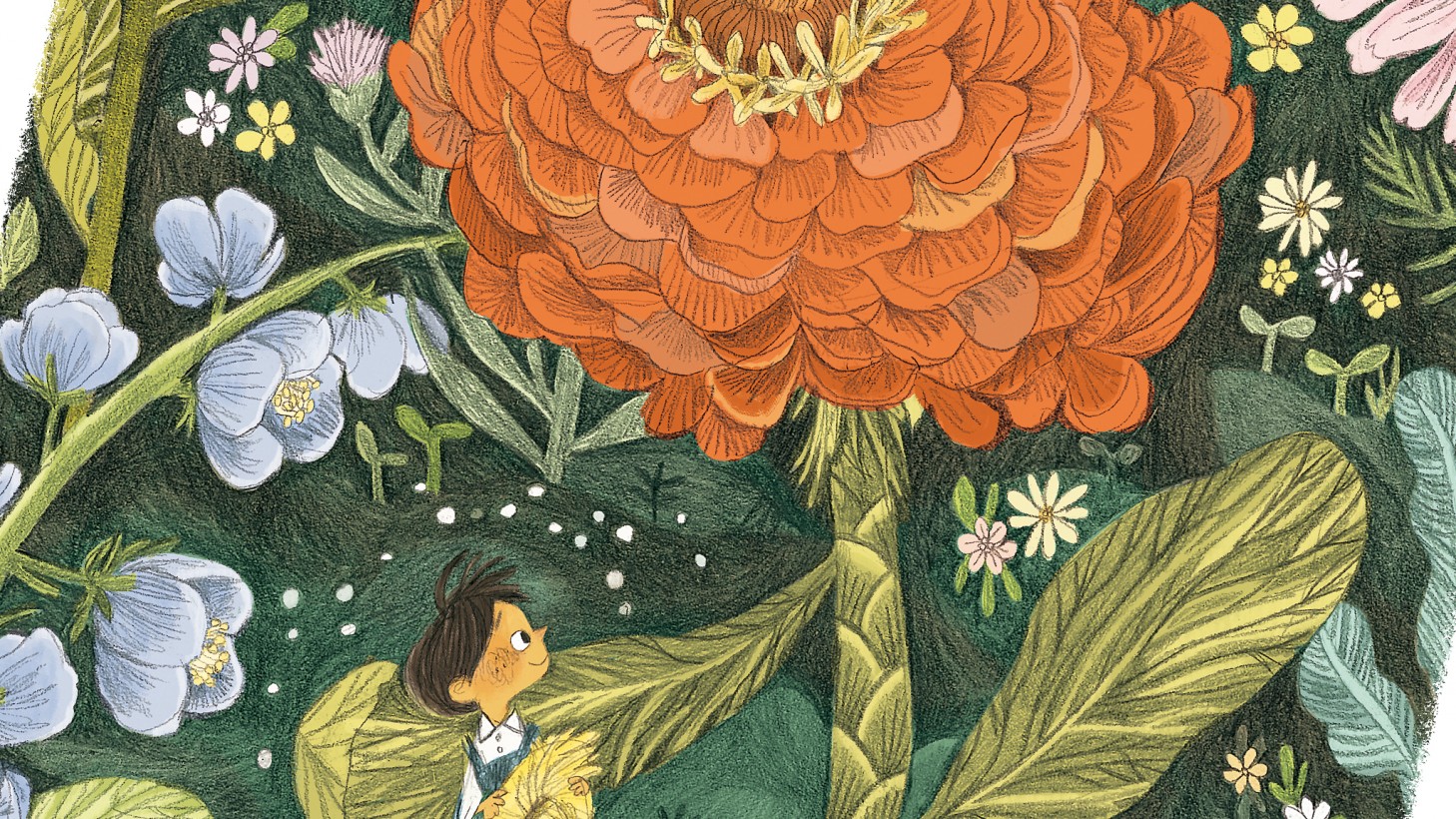
An original tale to delight over and images to savor.  After reading this, make art with the kids. Bold colors.

from A Fine Desert Four Centuries, Four Families, One Delicious Treat.

Jenkins, Emily. (2015). A Fine Desert Four Centuries, Four Families, One Delicious Treat. Illustrated by Sophie Blackall. New York: Schwartz & Wade.
Now this is a history book children will beg to hear again and again.  Make the recipe that traveled across four centuries.

from Bright Sky, Starry City


Krishnaswami, Uma. (2015). Bright Sky, Starry City.  Illustrated by Aimee Sicuro. Toronto, ON: Groundwood Books.
What I love about this book is the mixture of story (a little girl and her dad want to see the night sky in the city) and science (afterwards) wrapped up in child-like illustrations.


Kulling, Monica. (2015). Grant and Tillie Go Walking. Illustrated by Sydney Smith. Toronto, ON: Groundwood Books.
Based in part on the life of artist, Grant Wood, mixed with a bit of fiction.  Grant and his cow go for a walk.

from Sidewalk Flowers

Lawson, JonArno. (2015). Sidewalk Flowers.  Illustrated by Sydney Smith. Toronto, ON: Groundwood Books.
A wordless book to dwell on. Small things, small gestures often yield big feelings. A treasure.


Messner, Kate. (2015). How to Read a Story. Illustrated by Mark Siegel. San Francisco, CA: Chronicle Books.
10 easy steps.  Step 1: Find a story. Step 2: Find a reading buddy and so on...A delightful romp through reading.  You'll read this one over and over again.

from Water is Water: A Book About the Water Cycle
Paul, Miranda. (2015). Water is Water: A Book About the Water Cycle. Illustrated by Jason Chin. New York: Roaring Brook Press.
A book to wonder about, together. Told through poetry. Oh my. Jason Chin's art is lush.


from The Tea Party in the Woods

Miyakshi, Akiko. (2015). The Tea Party in the Woods. Tonawanda, NY: Kids Can Press.
An original fairy tale to read aloud. A study in minimal color.


from What James Saw

Rosenberg, Liz. (2015). What James Saw. Illustrated by Matthew Myers. New York: Roaring Brook Press.
A book about misunderstandings, art, and friendship.

from Beautiful Birds.
Roussen, Jean. (2015). Beautiful Birds. Illustrated by Emmanuelle Walker. London, UK: Flying Eye Books.
An ABC book to read and reread.


Seeger, Laura Vaccaro. (2015). I Used to Be Afraid. New York: Roaring Brook Press.
Another book for students to emulate. I can imagine a wall story being made by young children borrowing the structure of this text.


from How Jelly Roll Morton Invented Jazz.

Winter, Jonah. (2015). How Jelly Roll Morton Invented Jazz. Illustrated by Keith Mallett. New York: Roaring Brook Press.
This demands to be read out loud!  Introduce the children to language that riffs and Jelly Roll Morton.


Shadow Worlds

House by the Tracks (M.A. Reilly, 2009)

I.

I've spent the last few months mucking about in myths. Knee deep you might say. Some believe in religion. In science.  I believe in mythologies. In stories. In the sacredness of breath. Nothing less. No matter the myth or its place of origin, myths are energies that speak so directly that words are a type of sound and meaning gets (un)made through the repetition of sound.

We feel it, bone deep.

II.

And here, I want to tell you--everything is connected.

We story ourselves, feel
story as verb, not merely noun.

III.

There are no true meanings. There's just now.
Put aside your interpretations for they'll block your weariness.
They'll justify the content of war, greed, malnourished selves too over indulged
or sciences divorced from the very earth you and I will return to
regardless of the subterfuge of caskets and prayers.

Susan Sontag writes:
To interpret is to impoverish, to deplete the world— in order to set up a shadow world of “meanings" (p. 7). 
She's writing, in part, about art interpretation, but she could be writing about the limitations of learning at school, or the slow touch known so infrequently in less-awake lives.

We are buried beneath interpretation.

IV.

At schools, the powers insist upon close reading. An interpretive move that is to be applied against all that is read across all 13 years of school. Close reading is singularly about interpretation, about right readings of text--and this, alone, should give us pause.

Again, Sontag tells us:
For decades now, literary critics have understood it to be their task to translate the elements of the poem or play or novel or story into something else (p.8).

Yet, she tells us that the most alive art is the one with mistakes.
Perhaps the way one tells how alive a particular art form is, is by the latitude it gives for making mistakes in it, and still being good.

V.

Art need not be about particular things--nor learning.
That was the first myth we forgot.


.