Showing posts with label K-2. Show all posts

Sunday, September 6, 2015

Here Comes Autumn: New K-2 Books To Read Aloud

Autumn

Bell, Lisa. (2015). Autumn: Leaves Fall from the Trees! (My First Science Songs). Illustrated by Emily Brooks. North Mankato, MN: Cantata Learning.
This is both an informational text and a song book. A song book with music included.

Chernesky, Felicia Sanzari. (2015). From Apple Trees to Cider, Please! Illustrated by Julia Patton. Morton Grove, IL: Albert Whitman & Company.
A frolicking rhyme explains how apple cider is made.


Detlefsen, Lisl H. (2015). Time for Cranberries. Illustrated by Jed Henry. New York: Roaring Brook Press.
Harvest time! A boy, Sam, is finally old enough to help his parents harvest cranberries.  Explains the process. Recipes included.

Duval, Kathy. (2015). A Bear's Year. Illustrated by Gerry Turley. New York:  Schwartz & Wade.
A book about the changing seasons.

Hayes, Karel. (2015). The Autumn Visitors. Lanham, MD: Down East Books.
A bear family enjoys a New England autumn. The fourth in a series of books about the bears.

Miller, Pat Zietlow. (2015). Sharing the Bread: An Old-Fashioned Thanksgiving Story. Illustrated by Jill McElmurry. New York: Schwartz & Wade.
Told through rhythmic and rhyming text, this story chronicles the making of a Thanksgiving feast by an extended family.
from Ask Me

Waber, Bernard. (2015). Ask Me. Illustrated by Suzy Lee. Boston, MA: HMH Books.
A young girl and her father talk as they go for a walk in fall.

Yee, Wong Herert. (2015). My Autumn Book. New York: Henry Holt.
A little girl creates an autumn book so she can remember the changes come winter. Rhyme. Figurative Language. 

Thursday, July 2, 2015

Building Community in Primary Grades: 15 New Must Have Books for this Fall

from  Salsa: Un poema para cocinar / A Cooking Poem (Bilingual Cooking Poems). 

Argueta, Jorge. (2015). Salsa: Un poema para cocinar / A Cooking Poem (Bilingual Cooking Poems). Illustrated by Duncan Tonatiuh. Translated by Elisa Amado. Toronto, ON: Groundwood Books.

I love this series of books that Jorge Argueta has created. This is sure to be a favorite with the children. An ultimate how-to book. You and your students will love making this salsa recipe.

from Sometimes I Feel Like a Fox.
Daniel, Danielle. (Metis)  (2015). Sometimes I Feel Like a Fox. Toronto, ON: Groundwood Books.
Time to make masks and emulate the text! An introduction to the Anishinaabe tradition of totem animals, told through 12 brief speakers who explain their chosen mask, such as deer, moose, beaver. 

from How the Sun Got to Coco's House
Graham, Bob. (2015). How the Sun Got to Coco's House. Somerville, MA: Candlewick Press. 
A book to read aloud to start the day.

from The Little Gardner
Hughes, Emily. (2015). The Little Gardner. London, UK: Flying Eye Books.
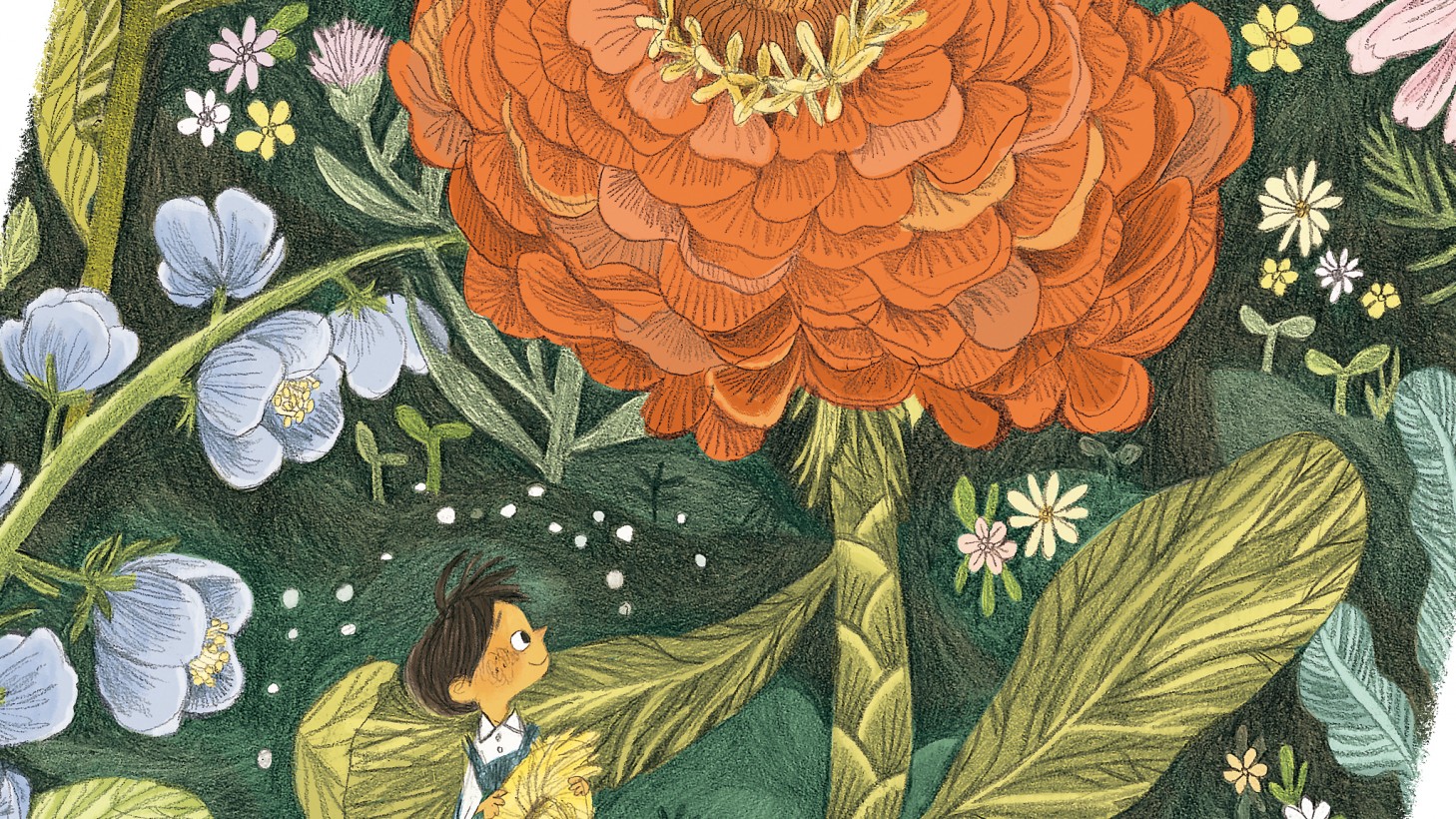
An original tale to delight over and images to savor.  After reading this, make art with the kids. Bold colors.

from A Fine Desert Four Centuries, Four Families, One Delicious Treat.

Jenkins, Emily. (2015). A Fine Desert Four Centuries, Four Families, One Delicious Treat. Illustrated by Sophie Blackall. New York: Schwartz & Wade.
Now this is a history book children will beg to hear again and again.  Make the recipe that traveled across four centuries.

from Bright Sky, Starry City


Krishnaswami, Uma. (2015). Bright Sky, Starry City.  Illustrated by Aimee Sicuro. Toronto, ON: Groundwood Books.
What I love about this book is the mixture of story (a little girl and her dad want to see the night sky in the city) and science (afterwards) wrapped up in child-like illustrations.


Kulling, Monica. (2015). Grant and Tillie Go Walking. Illustrated by Sydney Smith. Toronto, ON: Groundwood Books.
Based in part on the life of artist, Grant Wood, mixed with a bit of fiction.  Grant and his cow go for a walk.

from Sidewalk Flowers

Lawson, JonArno. (2015). Sidewalk Flowers.  Illustrated by Sydney Smith. Toronto, ON: Groundwood Books.
A wordless book to dwell on. Small things, small gestures often yield big feelings. A treasure.


Messner, Kate. (2015). How to Read a Story. Illustrated by Mark Siegel. San Francisco, CA: Chronicle Books.
10 easy steps.  Step 1: Find a story. Step 2: Find a reading buddy and so on...A delightful romp through reading.  You'll read this one over and over again.

from Water is Water: A Book About the Water Cycle
Paul, Miranda. (2015). Water is Water: A Book About the Water Cycle. Illustrated by Jason Chin. New York: Roaring Brook Press.
A book to wonder about, together. Told through poetry. Oh my. Jason Chin's art is lush.


from The Tea Party in the Woods

Miyakshi, Akiko. (2015). The Tea Party in the Woods. Tonawanda, NY: Kids Can Press.
An original fairy tale to read aloud. A study in minimal color.


from What James Saw

Rosenberg, Liz. (2015). What James Saw. Illustrated by Matthew Myers. New York: Roaring Brook Press.
A book about misunderstandings, art, and friendship.

from Beautiful Birds.
Roussen, Jean. (2015). Beautiful Birds. Illustrated by Emmanuelle Walker. London, UK: Flying Eye Books.
An ABC book to read and reread.


Seeger, Laura Vaccaro. (2015). I Used to Be Afraid. New York: Roaring Brook Press.
Another book for students to emulate. I can imagine a wall story being made by young children borrowing the structure of this text.


from How Jelly Roll Morton Invented Jazz.

Winter, Jonah. (2015). How Jelly Roll Morton Invented Jazz. Illustrated by Keith Mallett. New York: Roaring Brook Press.
This demands to be read out loud!  Introduce the children to language that riffs and Jelly Roll Morton.


Saturday, March 23, 2013

Preventing Reading Difficulties: First Steps Taken at Urban School

1st grader teaches a younger peer to use the iPad.

I. Preventing Reading Difficulties

As many of you know, through my company--Blueprints for Learning, I have been involved in designing and now implementing along with consultants, teachers, and administrators a set of key strategies for preventing reading difficulties with K-2 children who are learning in classrooms in a northeast city in the United States. This past week I took at look at interim assessments for one of the schools in order to gauge how the work is going, and to be able to shift and intensify resources for children who may not meet the district's literacy benchmarks given their current performance.

To contextualize the work, a review of recent demographics of the school population provides this information:

  • School Size: about 900
  • School Type: PK - 8
  • Poverty % Based on Free & Reduced Lunch: 88%
  • Racial & Ethnicity Make-up:  Asian: 1%, Black: 42%, Hispanic: 56%, White: 1%
  • Gender: 55% boys, 45% girls
  • In 2011, 84% of the 3rd graders tested via the state ELA assessment were not proficient and 16% of the 3rd graders tested via the state ELA assessment were proficient. None were advanced proficient.

Of the K-2 children at this school site, 12% of them need additional support given their current performance as measured by text level reading, alphabetic knowledge identification, and other literacy tasks. All but three of these students are making progress, but the progress has been slow. The remainder of the K-2 children have either met or surpassed the district benchmarks (55%), or appear very likely to meet the benchmarks by June. In some significant ways, the data shows almost a reversal of performance that has typified the school in recent years. I want to caution that preventing reading difficulties is not the same thing as performing well on state literacy tests.  There are many differences between these outcomes.

What I can say though, is that failure to prevent reading difficulties in the primary grades best ensures low performance on any state ELA assessment.

At this site there are several Blueprints' consultants working with staff at the Pre K-2 level. Additionally we are also working with the 3-8 staff too. In total, there are 7 of us working at this site.

II.  Practices

A teacher conducting small group reading lesson.

Six consistent practices have most influenced the literacy outcomes for the K-2 children at this site:

1. Teachers, Blueprints' consultants, and administrators willingly participate in constant dialogue about teaching, learning, and the prevention of reading difficulties. The energy this produces fuels reform. Everyone is a risk taker.

2. Key literacy practices have been taught, modeled, retaught and coached. These include:
  • interactive read aloud with embedded vocabulary, comprehension, art-based practices [drawing, choral reading, narrative pantomime, reader's theater], and text dependent questions and tasks and an accompanying e-book guide 
  • interactive writing lessons and sustained independent reading and the use of individualized book boxes
  • high intensity guided literacy instruction that combines guided reading, guided phonics, and guided writing.

3. There is an ongoing shift among teachers, who have amazed all of us at Blueprints, from situating reading as a memorizing activity to resituating it as a problem-solving practice. They are tenacious in their desire to learn and refine their work.

4. Several literacy practices have been amended or eliminated such as: a form of shared and modeled writing, round robin reading, whole group basal reading as shared reading, and independent reading conducted without managed text selection (i.e., book boxes).

5. At this school, leadership is distributed:
  • teachers model newly learned instruction for colleagues and then engage in spirited dialogue about their observations
  • teachers actively observe excellent classroom instruction elsewhere in the school district accompanied by Blueprints' consultants and then plan for implementation of refined practices based on observation, making critical decisions about their teaching and learning
  • Some of the Read Aloud books
  • administrators attend all professional development sessions/PLCs, actively participating by sharing their knowledge, (mis)understandings and revisions as they actively learn alongside staff.

6. The principal and assistant principal ensure that teachers understand the shared goals and importance of this literacy project, and that they have all of the materials necessary to do the work, including a significant addition of culturally relevant texts, blocks and dramatic play materials in kindergarten, art and classroom supplies in K-2 (i.e., paints, different types of paper, magnetic letters, magnetic lap boards, markers, crayons, pencils, notebooks, etc.), and iPads with specified apps (about 5 per classroom).


7. Teachers’ understanding and use of assessments is shifting from a compliance model to a users model as they make better use of text level records, sight word notations, and other just-in-time assessments to guide their thinking when working with children and planning.


III. Next Steps

Having identified each child at risk for reading difficulties, individualized plans have been generated and will be refined as we work with the children. Their progress will be closely attended to during the next three months.


Thursday, March 14, 2013

When Joy, Play & Learning are Deliberate: Learning in K-2

This is such an inspiring look at literacy that is intentional, play-based, and artful.  From the UK.

Reading, Writing and Drama Playing


Lesson Plans Related to the Video:

Reception – The Gruffalo
Introducing the new story


Learning Objective:  To listen and respond to a story.

Context of Learning:  Linked to our context of Monsters and Dinosaurs we will be using the book The Gruffalo by Julia Donaldson and Axel Scheffler.  The children will be developing their ability to listen and respond to the story, the sequence of the story and explore the setting, characters and theme of the story.   
Success Criteria: All children to be able to talk about what they can see in the pictures.  All children to be able to say if they liked the story and why.
Key Questions:  Where is this story set?  What is it like in the woods?  What is a Gruffalo?  What does the word gruffalo make you think of?  What does the gruffalo look like?  Did you like the story?  What was your favourite part?  What did you notice about the story?
Whole Class teaching
Explain we are going to be reading a new book and finding out about new characters.  Show the title page of the woods, where is this story set?  What is it like in the woods?  Discuss with talk partner what they can see and record comments around the picture.

Introduce the character of the mouse and read the blurb.  What is a gruffalo? What does the word gruffalo make you think of?  Discuss children’s thoughts and feelings.  Show the children a picture of the gruffalo.  What does the Gruffalo look like?  Tell your partner.

Read the story - Stop at varies intervals ask questions Why do the animals think the mouse looks good?  Look at the animals faces and discuss feelings, How is the animal feeling now they have seen the gruffalo?

Booktalk – Ask children to share their thoughts about the story - Did you like the story and why? What was your favourite part and why?  What did you notice about the story? (rhyming words etc)  Was their a pattern?  How did the mouse describe the gruffalo?

Independent learning activities:
Painting the gruffalo.
Retelling the story using a variety of props in a large builders tray.


Reception – The Gruffalo 

Exploring Characters

Learning objective: 
To talk about the main characters in the story and how they are feeling.
To think, say and write simple sentences for a thought bubble.
Context of Learning:  Linked to our context of Monsters and Dinosaurs we will be using the book The Gruffalo by Julia Donaldson and Axel Scheffler.  The children will be developing their ability to listen and respond to the story, the sequence of the story and explore the setting, characters and theme of the story.   
Success Criteria:  Children will be able to explore the different feelings of the characters by using their facial expressions and words.  
Key Questions:  How is the … feeling?  How do you know?  Why is the … feeling like that?  What is the mouse thinking?  How many words in out sentence?  What is the first word?  What does it begin with?  What do we put at the end of our sentence?
Whole Class teaching
Show pages from the story and discuss how the characters are feelings and why.  Can you use your face to show that feeling? 

Explain that they are going to help to retell the story and that they must become the different characters using their bodies and faces to show how they are feeling.
Retell the story with the children joining in using a drum to indicate when to freeze frame.  Use a microphone to interview the children in role about how they are feeling and why.

Model writing 
Now we have thought about how the characters are feeling we are going to write a thought bubble.  Show the last page of the mouse eating a nut, what is the mouse thinking?  Share with your talk partner, ask children to share their ideas to the class.  Choose a sentence to write, say the sentence, count how many words.  What is the first word?  What sounds can we hear in it?  When we have written the sentence count the words has it got the correct number of words? Reread does it say what we wanted it to say? 

Independent learning activities:
With teacher children to write their own thought bubbles – think, say, write a sentence.
Using their own puppets and the theatre to retell the story.


Planned activities to support learning
Of the Gruffalo

Throughout the week planned activities both adult led and independent for the children to develop their knowledge and understanding of the story further.

  • Drawing other characters using pastels
  • Props to retell the story
  • Puppets and a theatre to retell the story
  • Puppet making
  • Book making
  • Using computer programs to draw the Gruffalo and parts of the story
  • www.gruffalo.com
  • Collage a gruffalo
  • Label body parts
  • Created storymaps and used them to retell the story in their own words
  • Using instruments to add sound effects
  • Writing speech bubble for what the characters say throughout the story
  • Learn the Gruffalo song and actions
  • Pairs/snap game using character pictures also children can describe or say a sentence about that character
  • Sand tray – props to retell story
  • Reading The gruffalo’s Child

Whole class teaching sessions –

·      The children listened for the repeated phrases and joined in.
·      Shared writing – labeling around the gruffalo how the mouse describes him.  Comparing the mouse and gruffalo. 
·      Explored the theme of who was the scariest creature?  Was the mouse clever?
·      Split into groups, each groups was a different character and we retold the story and the children acted out their part.
·      Learnt The Gruffalo song and made up actions.


II. Guided Writing: Experienced-based


Guided Writing Strategy Guide


Recommended Professional Resources

Corbett, Pie & Julia Strong. (2011). Talk for Writing Across the Curriculum. London: Open University Press.
Corbett, Pie. (2008). Storyteller. London: Scholastic.
Heard, Georgia & Jennifer McDonough. (2009). A Place for Wonder: Reading and Writing Nonfiction in the Primary Grades. Portland, ME: Stenhouse.