Showing posts with label perseverance. Show all posts

Saturday, March 17, 2018

20 Latinas Who Persevered: Picture Books for Grade 2


Image result for the flying girl margarita
from The Flying Girl

-->
1.    Benatar, Raquel. (2004). Isabel Allende: Recuerdos para un cuento/Isabel Allende: Memories for a Story. Illustrated by Fernando Molinari.  Houston, TX: Piñata Books.
2.    Brown, Monica. (2017). Frida Kahlo and Her Animalitos. Illustrated by John Parra. New York: NorthSouth Books.
3.    Brown, Monica. (2010). Side by Side/Lado a lado: The Story of Dolores Huerta and Cesar Chavez/La historia de Dolores Huerta y Cesar Chavez. Illustrated by Joe Cepeda. New York: HarperCollins/Rayo.
4.    Brown, Monica. (2004). My Name is Celia/Me llamo Celia: The Life of Celia Cruz/la vida de Celia Cruz.  Illustrated by Rafael López. Cooper Square Publishing.
5.    Chambers, Veronica. (2005). Celia Cruz: Queen of SalsaIllustrated by Julie Maren. New York: Dial.
6.    Cohn, Diana. (2005). ¡Si, Se Puede! / Yes, We Can!: Janitor Strike in L.A. (English and Spanish Edition). Illustrated by Francisco Delgado. El Paso, TX: Cinco Puntos Press.
7.    Engle, Margarita. (2018). The Flying Girl: How Aida de Acosta Learned to Soar. Illustrated by Sara Palacios. New York: Atheneum Books for Young Readers.
8.    Engle, Margarita. (2017). Bravo!: Poems About Amazing Hispanics. Illustrated by Rafael López . New York: Henry Holt and Co.
9.    Gonzalez, Lucia. (2008). The Storyteller’s Candle/La velita de los cuentos. Illustrated by Lulu Delacre. San Francisco, CA: Children’s Book Press.
10.Herrera, Juan Felipe. (2014). Portraits of Hispanic American Heroes. Illustrated by Raul Colón. New York: Penguin Books.
11.Mora, Pat. (2002). Maria Paints the Hills. Paintings by Maria Hesch. Albuquerque, NM: Museum of New Mexico Press.
12.Mora, Pat. (2002). A Library for Juana: The World of Sor Juana Ines. Illustrated by Beatriz Vidal. New York: Knopf Books.
13.Mora, Pat. (2005). Dona Flor: A Tall Tale About a Giant Woman with a Great Big Heart. Illustrated by Raul Colón. New York: Knopf Books.
14.Morales, Yuyi. (2014). Viva Frida. Illustrated by Tim O'Meara. New York: A Neal Porter Book.
15.Tafolla, Carmen and Sharyll Teneyuca. (2008). That's Not Fair! / ¡No Es Justo!: Emma Tenayuca's Struggle for Justice/La lucha de Emma Tenayuca por la justicia.  Illustrated by Terry Ybáñez. San Antonio, TX: Wings Press.
16.Tonatiuh, Duncan. (2017). Danza!: Amalia Hernández and El Ballet Folklórico de México. New York: Abrams Books for Young Readers.
17.Tonatiuh, Duncan. (2014). Separate Is Never Equal: Sylvia Mendez and Her Family’s Fight for Desegregation. New York: Harry N. Abrams. 
18. Warren, Sarah. (2012). Dolores Huerta: A Hero to MIgrant WorkersIllustrated by Robert Casilla. New York: Two Lions.
19.Winter, Jonah. (2009). Sonia Sotomayor: A Judge Grows in the Bronx: La juez que crecio en el Bronx. Illustrated by Edel Rodriguez. New York: Atheneum.
20.Winter, Jonah. (2002). FridaIllustrated by Ana Juan. New York: Arthur A. Levine Books.

Thursday, February 8, 2018

Teaching about Perseverance, Invention, and History

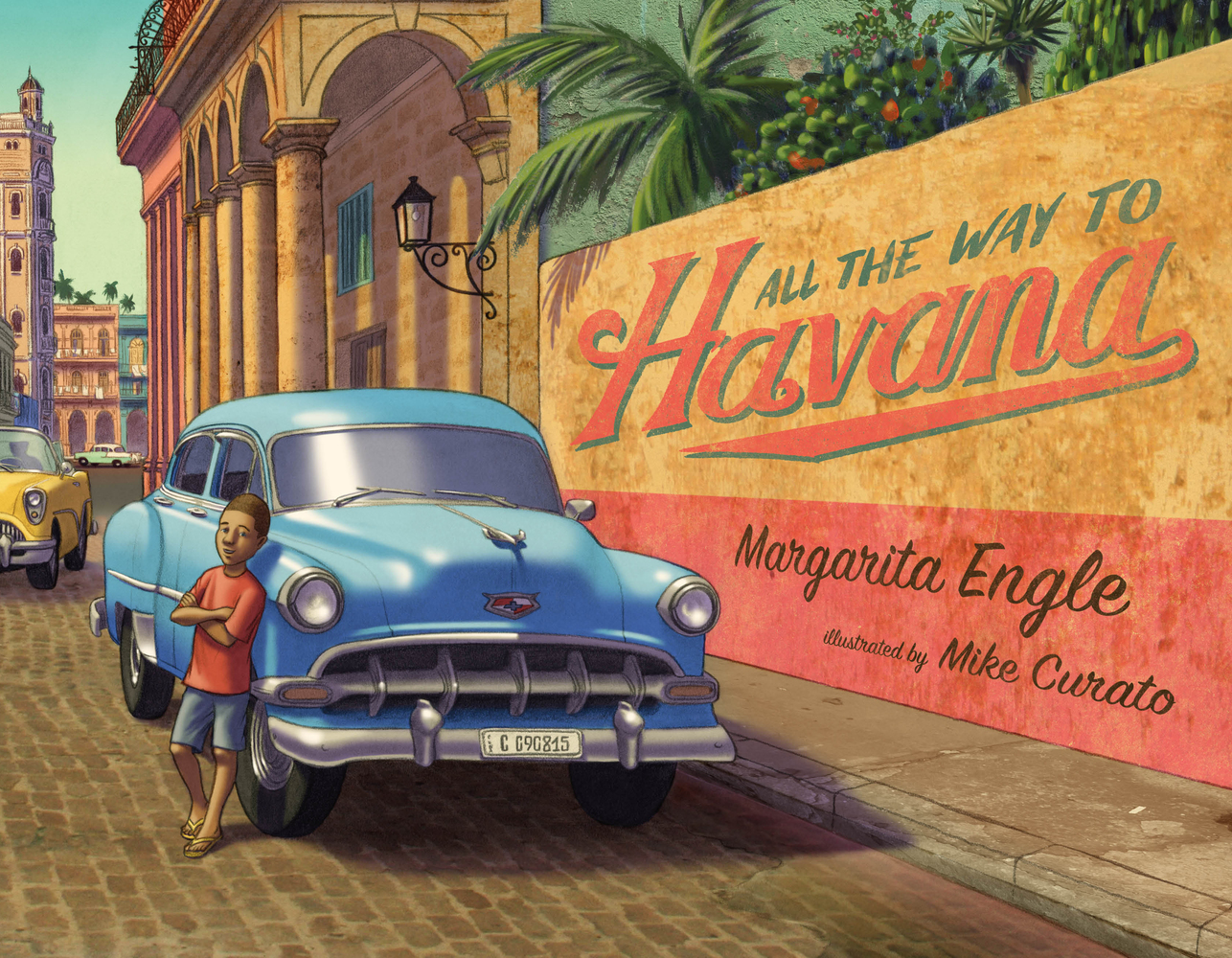
Image result for All the Way to Havana


I.

Margarita Engle's All the Way to Havana, illustrated by Mike Curato, is a celebration of perseverance and ingenuity. The story told is simple. A family sets out across the countryside heading to Havana, Cuba in order to visit a newborn relative bearing gifts and cake in their very old 1954 blue Cara Cara Chevy.  Before they can get on the road though the car needs to be fixed. We learn that it simply isn't making the right noise as today it sounds like a tiny baby chick.


The narrator, a young boy, helps his dad figure out what's making the wrong sound and together they fix the car after several wrong tries.

Are they discouraged?

The narrator tells us:

"We don't give up.
We experiment.
We invent."

As I read this I thought about American poet, William Carlos Williams and imagined how he would have been proud to hear this young boy speaking. Williams told us long ago in the poem,  Deep Religious Faith, that the job of the poet was invention.  In this story, everyday people are poet inventors. This simple picture book tells us what invention sounds like, looks like, and the taste of its sweat.

We
are
chin
deep
in
invention.

The family finally gets into the car and they are joined by neighbors who need to travel too. The car quickly fills up and the narrator says that he felt "like we're traveling in a barrel of elbows and knees." I love the playfulness of that and how it sounds like something a child might say.  As the family travels across the countryside, we hear the various sounds the car makes and encounter lots of other vintage American cars when the Chevy rides along "the curved road by the seawall" that leads into the city of Havana.

"...Mama points out noiosy old cars of every color--yellow, pink, purple, green, orange, and even a bright red car with huge fins like a lurking shark."


As the setting shifts from country to city, the beat of the lines change too--becoming more syncopated. The narrator tells us that some of the cars have "torn seats, shattered windows, and cracked mirrors." Cars "roar, growl, whine, or putt putt but most just honk, honk, honk as they glide, bumpety bump on potholed city streets."

After getting to Tia's home and meeting his newborn baby cousin, eating cake and opening presents, the narrator falls asleep and is awakened to learn it is time to start driving home. The next two-page spread is bathed in blue night as the car makes it way back across the rolling hills, under a waxing moon.

Engle closes the story the next morning when the narrator and his dad work "under the hood" again, never giving up, never losing hope..." The car which was Abuelo's as a young man will someday be his.

II.

At the end of the book, Engle includes an author's note explaining that American cars stopped being imported to Cuba after 1959. We know that is because of the embargos enacted by the United States in the late 50s and again in the early 60s.  As such, Cubans had to remain "creative" in order "to keep machines of all sorts running long past the age wealthier people would discard them."


The book closes with an illustrator's note. Mike Curato outlines the process he went through in order to create the lush paintings.  He writes, "I created the illustrations by combining pencil drawings, paintings, and textures from the  photographs I took while in Cuba." Fascinating end pages invite readers to study the variety of classic cars that populate Cuba. As Curato notes, the cars may not always look as they were first intended because the Cuban "people have to work with what they have, so some car have parts that use to belong to completely different cars."

Bricoleurs.

What I especially like about the picture book is how the subject of cars can help to tell the bigger story about the "everyday ingenuity of poor people everywhere who have to struggle, persevere, create, and invent on a daily basis."

I plan to read the story aloud to a group of first graders and their teachers in a few weeks at a public school in the Bronx. It's a book I'll leave with them as I am certain the children will want to revisit the text again and again.  Depending on how things go, perhaps we'll talk a little bit about ingenuity and maybe we'll do some drawing and writing too. I hope as we grope towards some kind of meaning, that the boy's insights will be ours too:

"We don't give up.
We experiment.
We invent."