 |
| Screenshot from video. |
Showing posts with label informational texts. Show all posts
Showing posts with label informational texts. Show all posts
Thursday, June 19, 2014
Reading and Writing Research in 1st Grade


Sunday, May 11, 2014
Why Literary Texts Matter
 |
| Along the Way (Snowdonia Mountains, Wales. M.A. Reilly. May 2014) |
Today on a train from Caernarfon to Porthmadog (Wales) we were joined by an Anglican priest and his companion. It was apparent that the priest was a regular traveler as Steve, the train conductor, knew him and the companion and began talking with them about the very legend he had just told to Jane and me. Prior to the priest boarding, Steve had been telling us all about Gerlet's grave as we made our way through the Snowdonia Mountains. We were just arriving at Beddgelert where the legend of the hound (Gelert) originated.
Here's the legend (from here):
"In the 13th century Llewelyn, prince of North Wales, had a palace at Beddgelert. One day he went hunting without Gelert, ‘The Faithful Hound’, who was unaccountably absent.
On Llewelyn's return the truant, stained and smeared with blood, joyfully sprang to meet his master. The prince alarmed hastened to find his son, and saw the infant's cot empty, the bedclothes and floor covered with blood.
The frantic father plunged his sword into the hound's side, thinking it had killed his heir. The dog's dying yell was answered by a child's cry.
Llewelyn searched and discovered his boy unharmed, but nearby lay the body of a mighty wolf which Gelert had slain. The prince filled with remorse is said never to have smiled again. He buried Gelert here".Of course, imbued with local knowledge, Steve was able to embellish the legend with a bit of local history. It seems that there was not an actual dog that had killed a wolf in order to protect the Prince's child. In fact, there may never have been a faithful hound--although that is still disputed. According to Steve, a local bard told to drum up business for the town fashioned the tale in order to lure visitors to Gelert's grave. The story was told and retold until it became the stuff of legend.
Now interestingly, as the priest and his companion bordered the train, they too began to discuss Gelert as Steve mentioned us and the legend. Immediately, the priest had some words to impart about the legend--although his words were a bit different from Steve's. As I listened I thought about how telling legends may well bridge the span of uncomfortableness that accompanies awkward beginnings. You see, the priest had just finished saying mass at Beddgelert. As the legend conversation wore itself out, Steve uttered a confession (repeatedly). It seems that now he works most every Sunday on the train and as a result he is absent from church services. He mentioned three ( perhaps even four) times how he regretted his absence from church and made plans (loose ones at that) to attend the priest's mass on a not-too-distant Sunday (9:35 a.m. or so depending on how quickly the priest could travel from Porthmadog) in Beddgelert.
As I listened, I thought about how story organizes us. How it is human and essential. I wondered about the decision in the US to limit students' access to literary works in favor of balancing informational texts with literary ones. I'm fairly confident that the use of percentages to force adherence to the CCSS is a mistake. Perhaps, a costly one at that.
Sharing literary works has the potential to bridge differences and in doing so create more empathetic people who via shared literary experiences can become (other)wise. Bakhtin described this process by explaining how our utterances are dependent. He explained:
“Any concrete utterance is a link in the chain of speech communication of a particular sphere. The very boundaries of the utterance are determined by a change of speech subjects. Utterances are not indifferent to one another, and are not self-sufficient; they are aware of and mutually reflect one another..." (Bakhtin, 1986, p.91).
 |
| At the Sea (Bae Caernarfon,Wales. May 2014. M. A. Reilly) |
 |
| Birds in Flight (Snowdonia Mountains, Wales. M.A. Reilly. May 2014) |
That is what literary texts do. They make us after years long gone recall not only a bit of meaning, but, perhaps more important the rhythm and sounds--the way the language forms and reforms in our very mouths. These are the texts we wear.
We embody the literary. Yes, we may pay some attention to the informational--less perhaps as most of what we might glean can be forgotten and recalled with the simple voice command, "Siri find..."
And I think that, perhaps, is why the literary text matters so. It is potentially transforming in ways that informational text simply cannot be. I think about this after a two hour trip on a train and how it was story that built a bridge between a lapse church goer and an Anglican priest. It was story that opened enough space for the conductor to confess to the priest his sorrow--and for the priest to listen not only to the story but its feelings and re-welcome the man.
I so wonder about the reduction of literary works in place of this odd and to me arbitrary 50-50/30-70 split that David Coleman and the rest of the CCSS crew have insisted upon. I do not think this 'shift' is wise.
Thinking about the conductor and the priest gives me pause--gives me human hope.
We might want to ask what we are leaving behind as we adhere to the text 'shift' via the Common Core. There's only so much time to teach and less time to learn at school. What memorable language will your students be able to recall twenty years from now?
Cited
Bakhtin, M. M. (1986). Speech Genres and Other Late Essays. Trans. by Vern W. McGee. Austin, TX: University of Texas Press.
Tuesday, May 6, 2014
Children's Books about the Middle East
Abouraya, Karen Leggett. (2012). Hands Around the Library: Protecting Egypt's Treasured Books. Illustrated by Susan L. Roth. New York: Dial.
Aliki. (1985). Mummies Made in Egypt. New York: HarperCollins.
Khan, Hena. (2012). Golden Domes and Silver Lanterns: A Muslim Book of Colors. Illustrated by Mehrdokht Amini. San Francisco, CA: Chronicle Books.
Demi. (2013). Tutankhamen. Tarrytown, NY: Two Lions.
Milton, Joyce. (2000). Hieroglyphs. Illustrated by Charles Micucci. New York: Grosset & Dunlap.
Navarro, Dominique & Richard Hoath. (2013). Egypt's Flora and Fauna: An AUC Press Nature Foldout. Cairo: American University in Cairo.
Navarro, Dominique & Matthew Lammana. (2013). Egypt's Prehistoric Fauna: An AUC Press Nature Foldout. Cairo: American University in Cairo.
Navarro, Dominique &John Wyatt. (2013). Birds of the Nile Valley: An AUC Press Nature Foldout. Cairo: American University in Cairo.
Navarro, Dominique & Salima Ikram. (2013). Ancient Egypt's Wildlife: An AUC Press Nature Foldout. Cairo: American University in Cairo.
Sabuda, Robert (1997). Tutankhamen's Gift. New York: Aladdin.
Winter, Jeanette. (2005). The Librarian of Basra. Orlando, FL: Harcourt.
Biography & Informational Grade 4+
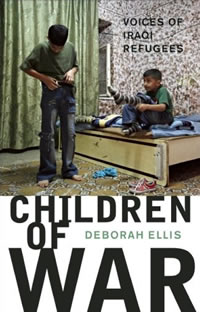
Ellis, Deborah. (2010). Children of War: Voices of Iraqi Refugees. Toronto, ON: Groundwood Books.
Ellis, Deborah. (2006). Three Wishes: Palestinian and Israeli Children Speak. Toronto, ON: Groundwood Books.
Filipovic, Zlata. (2006). Stolen Voices: Young People's War Diaries, from World War I to Iraq. New York: Penguin Books.
Hart, Georgia. (2008). DK: Eyewitness Books: Ancient Egypt. New York: DK Publishing.
Maydell, Natalie and Sep Riahi. (2007). Extraordinary Women from the Muslim World. Paintings by Heba Amin. Lancaster, PA: Global Content Ventures.
Macaulay, David. (1982). Pyramid. New York: HMH Books for Young Readers.
Stanley, Diane. (2002). Saladin: Noble Prince of Islam. New York: HarperCollins.
Stanley, Diane. (1997). Cleopatra. Illustrated by Peter Vennema. New York: HarperCollins.
Steele, Philip. (2007). DK: Eyewitness Books: Mesopotamia. New York: DK Publishing.
Wilkes, Sybella. (2010). Out of Iraq: Refugees' Stories in Words, Paintings and Music. Foreword by Angelina Jolie. London, UK: Evans Brothers.
Myths, Traditional Tales, Poetry, and Stories: K-6
Akbarpor, Ahmad. (2005). Good Night, Commander. Illustrated by Morteza Zahedi. Toronto, ON: Groundwood. (Although a picture book, I would recommend it for older children & teens.)
Alrawi, Karim. (2000). The Girl Who Lost Her Smile. Illustrated by Stefan Czernecki. Vancouver, BC: Tradewinds.
Azzoubi, Rana. (2007). Through a Mud Wall. Rana Azzoubi
Climo, Shirley. (1992). The Egyptian Cinderella. Illustrated by Ruth Heller. New York: HarperCollins.
Foster, Karen. (1999). City of Rainbows: A Tale from Ancient Sumer. Philadelphia, PA: University of Pennsylvania Museum.
Heide, Florence Parry and Judith Heide Gilliland. (1995). Day of Ahmed's Secret. Illustrated by Ted Lewin. New York: HarperCollins.
Heide, Florence Parry and Judith Heide Gilliland. (1992). Sami and the Time of the Troubles. Illustrated by Ted Lewin. New York: Clarion.
Henderson, Kathy. (2006). Lugalbanda: The Boy Who Got Caught Up in a War: An Epic Tale From Ancient Iraq. Illustrated byJane Ray. Somerville, MA: Candlewick.
Hickox, Rebecca. (1998). The Golden Sandal: A Middle Eastern Cinderella Story. New York: Greenwillow.
Hughes, Vi. (2001). Aziz the Storyteller. Illustrated by Stefan Czernecki. Vancouver, BC: Tradewinds.
Khan, Hena. (2008). Night of the Moon: A Muslim Holiday Story. Illustrated by Julie Paschkis. San Francisco, CA: Chronicle Books.
Khan, Rukhsana. (2001). Muslim Child. Illustrated by Patty Gallagher. Toronto, ON: Napoleon Publishing.
Laird, Elizabeth. (2014). Shahnameh. Illustrated by Shrin Adl. London, UK: Frances Lincoln. (Stories and myths from Iran).
Laird, Elizabeth. (2008). A Fistful of Pearls and Other Tales from Iraq (Folktales from Around the World). Illustrated by Shelley Fowles. London, UK: Frances Lincoln.
Laird, Elizabeth. (2008). Kiss the Dust. New York: MacMillan.
Logan, Claudia. (2002). The 5,000-Year-Old Puzzle: Solving a Mystery of Ancient Egypt. Illustrated by Melissa Sweet. New York: Farrar, Straus and Giroux.
Lumbard, Alexis York. (2012). The Conference of the Birds. Illustrated by Demi. Bloomington, IN: Wisdom Tales.
McCaughrean, Geraldine. (2003). Gilgamesh, The Hero. Illustrated by David Parkins. Grand Rapids, MN: Eerdmans.
Poetry/Memoir/Novels (Grades 7-12)
Abdel-fattah, Randa. (2010). Where The Streets Had A Name. New York: Scholastic.
Alareer, Refaat (ed). (2014). Gaza Writes Back: Short Stories from Young Writers in Gaza, Palestine. Charlottesville, VA: Just World Books. (Teens/Adults)
Barakat, Ibtisam. (2007). Tasting the Sky: A Palestinian Childhood. New York: Farrar, Straus and Giroux.
Carmi, Daniella. (2000). Samir and Yonatan. Translated by Yael Lotan. New York: Arthur A. Levine.
Clinton, Cathryn. (2010). A Stone in My Hand. Somerville, MA: Candlewick.
Hicyilmaz, Gaye. (1992). Against the Storm. New York: Little, Brown.
Laird, Elizabeth. (2008). Oranges in No Man's Land. London, UK: Haymarket Books.
Laird, Elizabeth. (2006). A Little Piece of Ground. London, UK: Haymarket Books.
Levine, Ana. (2009). Freefall. New York: Greenwillow.
Marsden, Carolyn. (2012). The White Zone. Minneapolis, MN: Carolrhoda Books
Nye, Naomi Shihab. (2008). Habibi. New York: Simon Pulse.
Nye, Naomi Shihab. (2002). 19 Varieties of Gazelle: Poems of the Middle East. New York: Greenwillow.
Nye, Naomi Shihab. (1998). The Space Between Our Footsteps: Poems and Paintings from the Middle East. New York: Simon & Schuster.
Powers, Kevin. (2012). The Yellow Birds: A Novel. New York: Little, Brown and Company.
Satrapi, Marjane. (2007). The Complete Persepolis. New York: Parthenon.
Stamaty, Mark Alan. (2012). Alia's Mission. New York: Dragonfly Books.
Zenatti, Valerie. (2008). A Bottle in the Gaza Sea. New York: Bloomsbury.
Zenatti, Valerie. (2007). When I was a Soldier. New York: Bloomsbury.
Graphic Novels/Texts (Late High School/Adult)
Delise, Guy. (2012). Jerusalem: Chronicles from the Holy City. Translated by Helge Dascher. Montreal, QC: Drawn and Quarterly.
Guibert, Emmanuel. The Photographer: Into War-torn Afghanistan with Doctors Without Borders. New York: First Second.
Pekar,Harvey. (2012). Not the Israel My Parents Promised Me. Illustrated by J.T. Waldman. Epilogue by Joyce Brabner. New York: Hill and Wang.
Sacco, Joe. (2010). Footnotes in Gaza: A Graphic Novel. New York: Metropolitan.
Sacco, Joe. (2001). Palestine. Introduction by Edward Said. Seattle, WA: Fantagraphics.
Winter, Jeanette. (2005). The Librarian of Basra. Orlando, FL: Harcourt.
 |
Biography & Informational Grade 4+
Ellis, Deborah. (2010). Children of War: Voices of Iraqi Refugees. Toronto, ON: Groundwood Books.
Ellis, Deborah. (2006). Three Wishes: Palestinian and Israeli Children Speak. Toronto, ON: Groundwood Books.
Filipovic, Zlata. (2006). Stolen Voices: Young People's War Diaries, from World War I to Iraq. New York: Penguin Books.
Hart, Georgia. (2008). DK: Eyewitness Books: Ancient Egypt. New York: DK Publishing.
Maydell, Natalie and Sep Riahi. (2007). Extraordinary Women from the Muslim World. Paintings by Heba Amin. Lancaster, PA: Global Content Ventures.
Macaulay, David. (1982). Pyramid. New York: HMH Books for Young Readers.
Stanley, Diane. (2002). Saladin: Noble Prince of Islam. New York: HarperCollins.
Stanley, Diane. (1997). Cleopatra. Illustrated by Peter Vennema. New York: HarperCollins.
Steele, Philip. (2007). DK: Eyewitness Books: Mesopotamia. New York: DK Publishing.
Wilkes, Sybella. (2010). Out of Iraq: Refugees' Stories in Words, Paintings and Music. Foreword by Angelina Jolie. London, UK: Evans Brothers.
 |
| Morteza Zahedi's illustration from Good Night, Commander |
Akbarpor, Ahmad. (2005). Good Night, Commander. Illustrated by Morteza Zahedi. Toronto, ON: Groundwood. (Although a picture book, I would recommend it for older children & teens.)
Alrawi, Karim. (2000). The Girl Who Lost Her Smile. Illustrated by Stefan Czernecki. Vancouver, BC: Tradewinds.
Azzoubi, Rana. (2007). Through a Mud Wall. Rana Azzoubi
Climo, Shirley. (1992). The Egyptian Cinderella. Illustrated by Ruth Heller. New York: HarperCollins.
Foster, Karen. (1999). City of Rainbows: A Tale from Ancient Sumer. Philadelphia, PA: University of Pennsylvania Museum.
Heide, Florence Parry and Judith Heide Gilliland. (1995). Day of Ahmed's Secret. Illustrated by Ted Lewin. New York: HarperCollins.
Heide, Florence Parry and Judith Heide Gilliland. (1992). Sami and the Time of the Troubles. Illustrated by Ted Lewin. New York: Clarion.
Henderson, Kathy. (2006). Lugalbanda: The Boy Who Got Caught Up in a War: An Epic Tale From Ancient Iraq. Illustrated byJane Ray. Somerville, MA: Candlewick.
Hickox, Rebecca. (1998). The Golden Sandal: A Middle Eastern Cinderella Story. New York: Greenwillow.
Hughes, Vi. (2001). Aziz the Storyteller. Illustrated by Stefan Czernecki. Vancouver, BC: Tradewinds.
Khan, Hena. (2008). Night of the Moon: A Muslim Holiday Story. Illustrated by Julie Paschkis. San Francisco, CA: Chronicle Books.
Khan, Rukhsana. (2001). Muslim Child. Illustrated by Patty Gallagher. Toronto, ON: Napoleon Publishing.
 |
| from Shahnameh. |
Laird, Elizabeth. (2008). A Fistful of Pearls and Other Tales from Iraq (Folktales from Around the World). Illustrated by Shelley Fowles. London, UK: Frances Lincoln.
Laird, Elizabeth. (2008). Kiss the Dust. New York: MacMillan.
Logan, Claudia. (2002). The 5,000-Year-Old Puzzle: Solving a Mystery of Ancient Egypt. Illustrated by Melissa Sweet. New York: Farrar, Straus and Giroux.
Lumbard, Alexis York. (2012). The Conference of the Birds. Illustrated by Demi. Bloomington, IN: Wisdom Tales.
MacDonald, Read.(2012). Tunjur! Tunjur! Tunjur!: A Palestinian Tale. Illustrated by Alik Arzoumanian. Las Vegas, NV: Two Lions.
 |
McDermont, Mustafa Yusuf. (2009). Muslim Nursery Rhymes. Leicestershire, UK: The Islamic Foundation.
Robert, Na'ima. (2009). Ramadan Moon. Illustrated by Shirin Adl. London: Frances Lincoln.
Rumford, James. (2004). Traveling Man: The Journey of Ibn Battuta 1325-1354. New York: HMH Books.
Rumford, James. (2003). Seeker of Knowledge: The Man Who Deciphered Egyptian Hieroglyphics. New York: HMH Books.
Sands, Emily & Duglad Steer. (2004). Egyptology: Search for the Tomb of Osiris. Illustrated by Nijk Harris and Helen Ward. Somerville, MA: Candlewick Press.
Tarnowska, Wafa’. (2000). The Seven Wise Princesses: A Medieval Persian Epic. Illustrated by Nilesh Mistry. Barefoot.
Wharnsby, Dawud. (2014). A Whisper of Peace. Illustrated by Shireen Adams. Leicestershire, UK: The Islamic Foundation.
Wharnsby, Dawud. (2013). Colours of Islam. Illustrated by Shireen Adams. Leicestershire, UK: The Islamic Foundation.
Wharnsby, Dawud. (2011). A Picnic of Poems: In Allah's Green Garden. Illustrated by Shireen Adams. Leicestershire, UK: The Islamic Foundation.Williams, Marcia. (2013). Ancient Egypt: Tales of Gods and Pharaohs. Somerville, MA: Candlewick.
Zeman, Ludmila. (1998). Gilgamesh the King (The Gilgamesh Trilogy). Toronto, ON: Tundra Books.
Zeman, Ludmila. (1998). The Revenge of Ishtar (The Gilgamesh Trilogy). Toronto, ON: Tundra Books.
Zeman, Ludmila. (1998). The Last Quest of Gilgamesh (The Gilgamesh Trilogy). Toronto, ON: Tundra Books.
Zeman, Ludmila. (1998). The Last Quest of Gilgamesh (The Gilgamesh Trilogy). Toronto, ON: Tundra Books.
Abdel-fattah, Randa. (2010). Where The Streets Had A Name. New York: Scholastic.
Alareer, Refaat (ed). (2014). Gaza Writes Back: Short Stories from Young Writers in Gaza, Palestine. Charlottesville, VA: Just World Books. (Teens/Adults)
 |
Carmi, Daniella. (2000). Samir and Yonatan. Translated by Yael Lotan. New York: Arthur A. Levine.
Clinton, Cathryn. (2010). A Stone in My Hand. Somerville, MA: Candlewick.
Hicyilmaz, Gaye. (1992). Against the Storm. New York: Little, Brown.
Laird, Elizabeth. (2008). Oranges in No Man's Land. London, UK: Haymarket Books.
Laird, Elizabeth. (2006). A Little Piece of Ground. London, UK: Haymarket Books.
Levine, Ana. (2009). Freefall. New York: Greenwillow.
Marsden, Carolyn. (2012). The White Zone. Minneapolis, MN: Carolrhoda Books
Nye, Naomi Shihab. (2008). Habibi. New York: Simon Pulse.
Nye, Naomi Shihab. (2002). 19 Varieties of Gazelle: Poems of the Middle East. New York: Greenwillow.
Nye, Naomi Shihab. (1998). The Space Between Our Footsteps: Poems and Paintings from the Middle East. New York: Simon & Schuster.
Powers, Kevin. (2012). The Yellow Birds: A Novel. New York: Little, Brown and Company.
Satrapi, Marjane. (2007). The Complete Persepolis. New York: Parthenon.
Stamaty, Mark Alan. (2012). Alia's Mission. New York: Dragonfly Books.
Zenatti, Valerie. (2008). A Bottle in the Gaza Sea. New York: Bloomsbury.
Zenatti, Valerie. (2007). When I was a Soldier. New York: Bloomsbury.
Graphic Novels/Texts (Late High School/Adult)
Delise, Guy. (2012). Jerusalem: Chronicles from the Holy City. Translated by Helge Dascher. Montreal, QC: Drawn and Quarterly.
Guibert, Emmanuel. The Photographer: Into War-torn Afghanistan with Doctors Without Borders. New York: First Second.
Pekar,Harvey. (2012). Not the Israel My Parents Promised Me. Illustrated by J.T. Waldman. Epilogue by Joyce Brabner. New York: Hill and Wang.
Sacco, Joe. (2010). Footnotes in Gaza: A Graphic Novel. New York: Metropolitan.
Sacco, Joe. (2001). Palestine. Introduction by Edward Said. Seattle, WA: Fantagraphics.
Sunday, July 8, 2012
Video: Previewing Informational Text with Grade 2 Guided Reading Group
I was a guest for a school system in New York and I was working with second graders as their teachers watched. In this video, I introduce students to the idea of previewing text and text features (table of contents, photo) . The texts are leveled at 16 and include fiction and informational texts. The idea of choice is important and I wanted to demonstrate that providing students with managed choice (teacher selects a range of texts and students preview texts and select one to read) enhances reading. This video was filmed in November. This is the students first encounter with informational text.
\\
\\
Saturday, May 5, 2012
Barefoot Knowledge and a Few Birds
Freedom (Mixed Media. 2009, M.A. Reilly) As early as I could remember it was the habit of the men folks particularly to gather on the store porch of evenings and swap stories. Even the women folks would stop and break a breath with them at times. As a child when I was sent down to Joe Clarke's store, I'd drag out my leaving as long as possible in order to hear more. Zora Neale Hurston, Mules and Men, Introduction.

I.
I like to be reminded that that there are all kinds of knowing and unknowing in the world.
II.
I have been immersed these last few weeks in studying the Common Core (ELA) and am deeply appreciative of its insistence that knowledge be an important outcome, especially in primary grade education. We often have emphasized the code aspects of reading acquisition (not saying code isn't important) and in doing so inadvertently devalued factual knowledge. Susan Neuman
(2010) writes:
the true path to literacy is not the procedural skills
that stand out in the crowd, but the knowledge of content and concept that
underlie its foundation (p. 301).
It is in naming the
knowledge and context, which under girds the development of procedural skills
such as code-focus learning (alphabetic knowledge, phonological awareness,
phonological memory, rapid naming of letters, print concepts , and writing one’
own name) that is challenging and critical to do. Again Neuman (2010)
concludes:
Code-related skills, the essential alphabetic principles
that make up our language, are a critical component in learning to read. But
while these skills are necessary, they are certainly not sufficient. At the
same time, these skills must be accompanied by a massive and in-depth
foundation of factual knowledge (p. 304).
I think that is an outcome that is sought via the explicit inclusion of informational text and the practice of text-dependent reading, alongside foundational reading skills. What I want to caution about though is the means by which knowledge is composed and the confusion between information and knowledge.
III.
Reading informational text is certainly one way to nudge open a door to
learning about the world. But we should not mistake that for dwelling in
a world of ideas. George Siemens (2006) states it nicely: "All knowledge is information, but NOT all information is knowledge" (vi). If we think that adding informational texts to the classroom, so that they represent 50% of the library and taught texts, will lead to knowledge--we are surely mistaken. I want to believe that the intent of the Common Core is much larger than the percentage of books that are taught. We have before us an opportunity to reclaim the arts, literature, natural sciences, history, geography, anthropology--many of which have ceased to be potential lines of inquiry as school time has been doled out to studying for tests in mathematics and reading. We have before us the occasion to privilege embodied ways of knowing.
 |
| The Weight of Living (Mixed Media, 2009, M.A Reilly) |
IV.
Beneath the window where I am writing this I have been stopping, called away you might say, and am listening to and watching birds. So insistent are some as they use their beaks to move the very leaves that my family and I have neglected to rake from last fall. They are I suspect in search of worms, insects, food that rests beneath. They work with an intensity few would not appreciate. There is a kind of knowing, an indwelling here that needs to be learned, embodied, surrendered to.
V.
In Michael Polanyi's Personal Knowledge he explains the need to surrender to what you study. How possible is that in school when there's so much declared stuff to know?
Polanyi writes:
A true understanding of science and mathematics includes the capacity for a contemplative experience of them, and the teaching of these sciences must aim for imparting this capacity to the pupil. The task of inducing an intelligent contemplation of music and dramatic art aims likewise at enabling a person to surrender himself to works of art. This is neither to observe nor to handle them, but to live them. This the satisfaction of gaining intellectual control over the external world is linked to a satisfaction of gaining control over ourselves (pp. 195-196).
We create environments by the decisions we make--be it in a schoolroom, a boardroom, or a bedroom. Hauling in a different collection of books will hardly matter if language has been stripped from meaning, replaced with the pre-made 'thought'.
Contemplative experiences require agency and error.
Room and breath.
VI.
The birds are insistent. I wish I understood what their varied cries and calls meant. It's a sound-alphabet I cannot decipher, cannot hear well to mimic. I can't seem to ease the birds from my mind. It's like that moment in Hitchcock's masterpiece when you begin to really see the birds because they block the sunlight.
The world cools.
VII.
This morning I am thinking how the birds are always
before me so often in fact that I hardly stop to notice. This
indwelling, perhaps, comes with a cost and so I try to distract myself from the ways the birds seem to part the air by turning to Annie Dillard. I read a bit and it worries me that even as I write this someone else somewhere is penning a quiz or a test based on Dillard's "Living Like a Weasel," as it is now a Common Core exemplar. I hope they will resist the urge to test. As Dillard says in The Writing Life, I hope the birds eat your crumbs.
I have lived a half-century and have read and reread "Living Like a Weasel" and perhaps the greatest thing I can say is that meaning still is slippery. With each age, I read it differently, understand aspects less.
Is there a quiz in which knowing less is an A?
 |
| I Found Words (Mixed Media, 2009, M.A. Reilly) |
VIII.
A task we might try on is one that invites children to name their world--through embodied experiences and text-based experiences. I know that is hardly the stuff we think about when think about curriculum, but it gives me pause--especially when I think of my own child. Using what we know to name the world opens us to recast what we first know as simple with increasing complexity, with increasing simplicity.
This is a kind of knowing we cannot codify for another.
IX.
In 'Total Eclipse' Dillard first mentions a child's bucket and shovel as noticed when passing through a hotel lobby:
On the broad lobby desk, lighted and bubbling, was a ten-gallon aquarium containing one large fish; the fish tilted up and down in its water. Against the long opposite wall sang a live canary in its cage. Beneath the cage, among spilled millet seeds on the carpet, were a decorated child’s sand bucket and matching sand shovel (pp. 11-12).
Later in the essay, when she and her husband have gone to witness a full eclipse, she tugs on that simple mention of the bucket and shovel.
All those things for which we have no words are lost. The mind—the culture—has two little tools, grammar and lexicon: a decorated sand bucket and a matching shovel. With these we bluster about the continents and do all the world’s work. With these we try to save our very lives (p.24).
She will return to the bucket and shovel again in this and other essays. It is not that she is tossing facts at us, as much as it is that she understands common objects in multiple and contrasting ways. It is in the space between the mentioning and my recognizing the mentioning that I reach to make sense--there, beneath the codification, is a restlessness that suggests a way of knowing that cannot be taught.
 |
| Barefoot (Mixed Media, 2009, M.A. Reilly) |
X.
Dennis Sumara observes: "Curriculum is a normalizing experience...Teachers become tour guides, showing students which sites must be noticed...As a daily performance, teaching becomes a pointing ritual that seldom pierces underneath the skin of the everyday" (p. 233).
Paying attention to the everyday is a call to the sensual. See how Luis Moll and his colleagues frame this:
The primary purpose of the work is to develop innovations in teaching that draw on the knowledge and skills found in local households...We use the term funds of knowledge to refer to these historically accumulated and culturally developed bodies of knowledge and skills essential for household or individual function and well-being. Luis Moll, Cathy Amanti, Norma González, 2005. "Funds of Knowledge for Teaching: Using a Qualitative Approach to connects Homes and Classrooms"
For Dillard, like Moll and his colleagues, funds of knowledge are in everyday objects.
XI.
There are all kinds of things purported as knowledge. I wonder if knowledge can exist outside a body?
 |
The birds have quit their rooting with the onslaught of Saturday lawn mowers and blowers. But they remain. In trees, between trees, on the deck railing across the street, on the wires that cross, I spot them. Their tweets and calls rise above from time to time the insistent motoring of mowers. I wish I knew more about birds, their songs and such.
 |
| Pages (Mixed Media, 2009, M.A. Reilly) |
There is much to learn in simply being present.
XII.
In
a few weeks a friend and I will be presenting at a conference. At that
time we will engage participants in the closest of readings: the
kind you embody. Through choral reading and dramatic tableaux we will
step in and out of text.
I hope they leave unsettled.
XIII.
As
I am not beholden to a system of learning, I daily grant myself permission
to blindly follow
lines of flight
that may and may
not lead to
ideas
insights
blind alleys
buckets shovels
bits of sand
 |
| Bloomed Ink and Birds (Mixed Media. 2009, M.A. Reilly) |
and
birds
Works Cited
Dillard, A. (2009). Teaching a stone to talk. NY: HarperCollins - Kindle Edition.
Neuman, S.B.
(2010). Lessons from my mother: Response to the National Early
Literacy Panel. Educational
Researcher, 39, 301-305.
Polanyi, M. 19581962. Personal knowledge: Towards a post-critical philosophy. Chicago, IL: University of Chicago Press.
Siemens, G. (2006). Knowing Knowledge.
Sumara, D. (1996). Private readings in public: Schooling the literary imagination. New York: Peter Lang.
Subscribe to:
Posts (Atom)