Showing posts with label characterization. Show all posts

Saturday, January 31, 2015

Writing Well Begins With Critical Reading: Talking Back to Scripted Programs


Pandora Story Map Based on Kimmell Version of the Myth
I. Greek Mythology Unit Designed by Teachers

For the last few weeks I have been working with a group of fourth grade teachers.  We co-designed a unit of study focusing on Greek Mythology that embedded reading, writing, speaking-listening, and language standards throughout the unit. Students had the opportunity and responsibility to listen to, read and view Greek myths--and to respond to those texts through discussion and writing. 

Through interactive read aloud with an emphasis on critically retelling and vocabulary development, and through guided reading that privileged comprehension conversations students read deeply.  They also engaged in shared, guided, and independent writing. Students were able to demonstrate a keen understanding of what they heard, read, and viewed through their whole class, small group and partner discussions and their writings.  Students heard, read and viewed multiple versions of each myth (print, visual arts, and video). This allowed them to compare versions and to complicate their understanding. This critical reading work represented the foundation that students' writings rested upon.


II. Anchoring What Is Heard/Viewed/Read

In order to anchor what was heard, viewed, and read--students created different types of story maps in response to the read aloud texts, such as the two Pandora story maps pictured here.  To analyze the myths, students first needed to be able to retell the story accurately.  It is impossible to analyze a text well if literal understanding is absent or faulty. Therefore, students with the help of their teachers, created a story map for each text. Teachers began this process by having students retell the myth. A deep retelling included:
Pandora Story Map Based on Burleigh/Colon Version of the Myth

  1. Retell what happened.
  2. Why it happened
  3. The effect on the characters’ mental state
  4. Be able to emphasize connections between earlier and later parts in the story.
  5. Retell with emphasis on character insight, touching on genre-specific elements and attempting to use the vocabulary or figurative language used in the text.


They also created character analysis anchor charts focusing on explicating indirect methods of characterization by naming and then analyzing what a character does, thinks, and says and then asking what might be inferred.  For example, when studying the Pandora myth, the class created an anchor chart. They named Pandora's actions, thoughts and speech and then analyzed what might be inferred. What did Pandora's actions, thoughts, and speech reveal about her character? This work allowed them to later step into the character in response to a writing task (see below).

III. Writing Rests on Reading

After studying two or more versions of the Pandora story (read aloud and guided reading), students responded to the prompt pictured below by writing a narrative that continues the story.
First major writing task in the mythology unit.


Attempting to enter into the myth at the point depicted in the visual art required students to read the painting, to consider the two or more versions of the story they had read, and to think about the inferences they had made in order to craft a believable text. I want to emphasize that no graphic organizers were used or needed during the writing because students deeply understood the myth.  Instead of some formula to guide their writing, students rested their work on what they had read and analyzed. By critically reading, discussing and writing they had already walked in Pandora's shoes. Because students had so closely studied different versions of the myth and had analyzed the characters--their responses were well grounded.

Standard W.4.9a asks students "to draw evidence from literary texts to support analysis, reflection, and research." Specifically, students are asked to "[a]pply grade 4 Reading standards to literature (e.g., “Describe in depth a character, setting, or event in a story or drama, drawing on specific details in the text [e.g., a character’s thoughts, words, or actions].”).  To do this well, students needed to use their knowledge of Pandora through the analyses they had done, drawing on specific details from one or more versions of the myth in order to extend the story.  Let's look closely at how one student did this.

IV. Studying One Student's Writing

Below is an example of one student's response (Catherine Esteves) from Jacqueline Peguero's fourth grade classroom in Newark, NJ.   Notice how the details Catherine crafts fits with the tone of the myth and re-establishes a credible setting ("Darkness circled around me..."). Notice how Catherine uses story language ("Then I sank into a deep sleep.") to forward the narrative. Notice her diction ("bat-like creatures hurrying," "ropes loosened") and the blend of narration and dialogue to forward the plot.  In Catherine's guided reading work she read Nathaniel Hawthorne's story, The Paradise of Children, and we can see how she borrows from Hawthorne's retelling of Pandora by having Epimetheus assume some of the blame for releasing evil into the world, as well. She also draws from the painting by Gerhartz by referencing the flowers. Yet she doesn't merely mimic what she has read or viewed for in Catherine's version she couples together the goodness of the world by having Love, Kindness, Grace and Caring (to name but a few) join Hope--thereby resettling the world. As Catherine has learned through reading, she closes her version of the myth with a statement to her reader: Remember, good will always be stronger and have more power than bad. We sense the author behind the work.

Page 1 from Catherine's writing.

Page 2 from Catherine's writing.


Through diction and character action, Catherine crafts a believable and controlled piece of writing that helps us to understand the painting and the written myths more fully. 


V. When Teachers Author

I have had the pleasure of working as an external consultant with Jackie and her colleagues (Waleska Burgos and John Feinstein) for the last few years.  In a conversation with Jackie a week ago she mentioned that her students' parents were commenting on how much their children were enjoying the mythology unit.  Jackie said that what surprised her the most was that parents had nothing to say during the Expeditionary Learning module they had done earlier in the year and that made her wonder how well that work had been received. 

When teachers author academic studies they can better respond to what emerges as well as build from one portion of the year to the next and from year to year. We had decided to write our own unit in order to replace an Expeditionary Learning (EL) module as the teachers and I thought that the EL work was not sturdy enough academically (especially with regard to writing and deep analysis), nor could a unit made by another in an earlier time and place be responsive to emerging academic and social needs and strengths we saw occurring with the children. We also wanted to ensure that students continued to explore mythology. 

Kindergarten children at these schools are listening to folk tales through read alouds and beginning in first grade students begin reading traditional literature in guided reading. These reading efforts are supported through read aloud units in grades 1, 2, and 3. In first grade, children are introduced to cautionary tales (Red Riding Hood versions), fables and tall tales in grade 2, and in grade 3 they study mythology generated by indigenous people. These earlier works set the stage for the work being conducted in grade 4. Alongside this work, teachers in earlier grades are able to help students respond to text through whole class shared writing and through guided practice during guided reading.  For example, in Suzanne Capuano's second grade I taught a small group of struggling reader last week. I taught the group in response to a concern Suzanne raised about the children's reading. She said that she noticed that the children were having difficulty remembering what they were reading during retelling. By identifying a learning challenge, Suzanne set the stage for us to problem solve.

During guided reading, I asked the students to respond to a Red Riding Hood story by charting the actions of the wolf or Red Riding Hood. The children read the text first and then during a rereading of the text, they partnered and completed the chart with guidance (see below). 


One of the teachers (grades 1, 2 an 3 teachers viewed) observing the lesson said that what was most notable was that the children's confidence increased  as did the lateral discussion that happened as the children worked through the text. The children knew they were successful, no gold star was necessary. 

Children in this class learned to think about what a character does and says during earlier read aloud units when their teacher created anchor charts that helped students to think about what a character says and does and what we infer based on those actions and speech. I built on that knowledge. Students also have daily opportunities to interpret what characters say as is evidence below in a second grader's response to a read aloud about Sonia Sotomayor.


Christopher's response to a quote from Jonah Winter's book about Sonia Sotomayor.
Christopher interprets through writing and drawing the quote: "Success comes to those who make the most of the chances they are offered in life."   He wisely tells us: "When you get chances that can change your life take risks. If you can't take (a) chance you might not succeed."

VI. Risk Taking

The weave among read aloud, guided and independent reading, and writing is critical and needs to be designed and organized by teachers who are working with children in the here and now--not by corporations who mass produce units of study and distributed them like cheap pens. We all ought to worry when we see teachers being confined to enacting scripted programs, not simply because the programs may or may not be lacking, but more importantly authoring is a critical and necessary practice for teaching and learning. At the schools where Jackie, Waleska, John and Suzanne work they are provided with the professional respect by their leadership to think, design, and redesign. Excellence does not come by handing teachers already completed units of study and limiting them to merely enacting them. This is a grave error.  We need to follow Christopher's advice and take risks.  'Fool' proofing curriculum is an epic failure. 


Monday, December 22, 2014

Teaching Plot, Subplot and Characterization in Grade 2 through Read Aloud and Writing


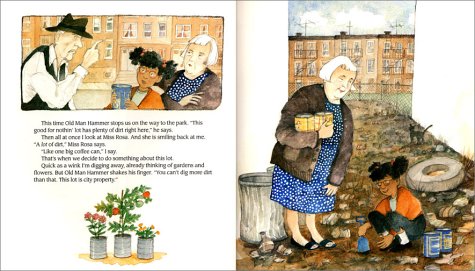
In this post I show how to teach plot, subplot and characterization through a multi-day read aloud, using the picture book, City Green. For additional books you can use to teach subplot, see this post: Teaching Multiple Plot Lines with Picture Books.


Text: DiSalvo-Ryan, DyAnne. (1994). City Green. New York: HarperCollins. 


Note: Book Introduction: Instead of introducing the book, begin by sharing a think aloud that you do showing students how you ask questions while reading a text.

Conduct a think aloud in order to demonstrate how to ask questions about a text while reading. Tell the students that their job is to watch and notice what you do and the questions you ask. (Below are example questions. You should pose your own actual questions.As you read, Create a Question Web, so that you model for students what you will be asking them to do independently.

Focusing on RL.2.1: Asking Questions while Reading
  1. “While I read today I’m going to share my questions about City Green, but later I’m going to ask you to share your questions. So listen carefully to how I ask questions and later it will be your turn to pose questions.”
  2. “I’m also thinking that this story is fiction because there are pictures, and it is told like a story. Can someone remind us of the difference between fiction and non-fiction books?”
1. After reading the title:
Question 1: I wonder, who is this little girl?
Question 2: Why does she have so many plants around her?
Question 3: I notice the buildings behind her and the title and think this story takes place in a city.  Could this be a garden in the city? Does she eat the foods we see?

2. After reading page 1:
Question 4: Why isn’t this building standing anymore?
Question 5: Why is Old Man Hammer so mean to the little girl?
Question 6: What city does this girl live in?


Can you turn and tell your partner what you watched me do? What did you notice about the questions I asked?

3. After reading page 6:
Question 7:  Will Old Man Hammer try to stop Marcy from planting her garden?  Might the garden change him?
Question 8: Can Marcy plant a whole garden by herself?
Question 9: Who is going to help her pick up all of the trash?

4. After reading page 9:
Question 10: What is a petition and what is it used for?
Question 11:  Why did Old Man Hammer refuses to sign it and help? What stops him?

5.  After reading page 12:
Question 12: How can Marcy rent a lot of land for only one dollar?
Question 13: What will the garden look like at the end?
  1. Now that I’ve shown you how I ask questions during the story, I’m going to let you all share your questions with me as we finish the book. 
  2. After I read a page I’ll stop and invite you to ask your questions and I’ll record them on our chart. 
(Continue through the book, and allow students to ask questions that are relevant to the story)

Question 14: I asked you when we started the story what the title might mean. [Show cover of book]. Think about the title and the events in the story and then turn and tell your partner what you think this story is mostly about? [RL.2.2; RL.2.7]

Applying What We Have Learned About Asking Questions to Independent Reading
  1. Now that you have generated questions I want you to go back to select a independent reading book that you would like to reread. 
  2. This time, though, I want you to generate questions while you read. Try to think of and record at least 5 questions that you are wondering about while reading. 
  3. To begin, write the title of your book in a circle, and then write the questions that you’re wondering about that relate  to your book. 
  4. Remember to ask questions at the beginning, middle and end of your book. 
  5. After independent reading time, we will share how well we were able to generate questions by showing our question webs to a partner.

2nd Reading/Writing: Writing in Response to Text

from City Green

Show students the story map (on the next page) and ask them to think about the characters, setting, events, problem and solution as you reread, City Green by DyAnne DiSalvo-Ryan. Explain to the students that there is the main plot and a subplot.  The main plot focuses on Marcy, while the subplot focuses on Old Man hammer and how he changes.

After reading, have partners complete two story maps for City Green: one for the main plot and one for the subplot. (W.2.2)

Main Plot
  1. Have students retell the main plot in a single paragraph.
  2. You may want to provide some of the students with a scaffolded paragraph in order to help them understand what information would be include.
Retell the main plot in a paragraph.


The story City Green is about _____________________________________________. When the city workers ___________________________________________________. Marcy and her neighbors _____________________________________________. Then they___________________________________. Next __________________________. Now _________________________________________.

Sample Paragraph: 
The story City Green is about working together to clean up a messy lot. When the city workers tore down a building it left a lot of rubble. Marcy and her neighbors went to  City Hall to rent the lot for one dollar. Then they cleaned the lot up. Next they planted a garden. Now the people go to the garden to relax and look at the flowers.

Sub Plot (W.2.2)
  1. Invite students retell the subplot in a single paragraph.
  2. You may want to provide some of the students with a scaffolded paragraph in order to help them understand what information would be include.


In the story City Green, Old Man Hammer changes from ____________________ into ________________________.  Old Man Hammer is sad because __________ ___________________________________________________. Next, ____________________________________________. Then, ____________________. _________________________.   Old Man Hammer is happy at the end because __________________________________________________________________.

SAMPLE  PARAGRAPH 
In the story City Green, Old Man Hammer changes from a grumpy man into a delightful person. Old Man Hammer is sad because his old home was torn down and the lot is grimy.  The neighbors clean the lot up.  Next, Old Man Hammer plants seeds in the garden. Then, Old Man Hammer’s seeds grow. Marcy goes and gets Old Man Hammer and shows him the sunflowers. Old Man Hammer is happy at the end because the lot is clean and pretty. Old Man Hammer comes back every day to relax.

Day 3: Reread Text/Opinion Writing (W.2.1)

Create a character analysis of Marcy with the students using three charts that are similar to the ones below through shared writing.


Step One
  1. Ask students to focus on the character of Marcy.  What is she like (think about her actions)? Unlike Old Man Hammer, Marcy doesn’t undergo change.  She is consistent throughout the story.
  2. Show students the first chart (not with it filled in) and ask them to put their heads together with their partner and to name traits that represent Marcy based on her actions.  Discuss and then list these traits in the column marked, Traits.
  3. Next, tell the students that as you reread the story, they should raise a hand when they hear evidence that supports a trait. Stop reading when students raise their hands indicating evidence. Discuss the evidence so students can explicitly share their opinions.
Step Two
  1. Review the completed first chart with students and then show them the second chart (also undone). Ask students which of the traits is Marcy’s most important trait. Then provide evidence (Sequence of events that prove Marcy is _______.) List these.
Step Three:
  1. Invite students to compose a paragraph that explains which trait they think was Marcy’s most important. They should state their opinion, supply reasons that support their opinion, use linking words (e.g., because, and, also) to connect opinion and reasons, and provide a concluding statement or section.

Saturday, December 20, 2014

Multi-Day Read Aloud Lessons to Teach Characterization in Primary Grades

This is a multi-day lesson designed to introduce second grade children to methods of characterization by inferring about a character's actions. This is the last book read in a unit about the Himalayan Mountains. Students have heard and interacted with the following texts:

  1. Martin, Jacqueline Briggs. (2010). The Chiru of High Tibet: A True Story. Illustrated byLinda Wingerter. Boston, MA: Houghton Mifflin Books.
  2. Jenkins, Steve. (2002). The Top of the World: Climbing Mount Everest. New York: Sandpiper.
  3. Reynolds, Jan. (2007). Himalaya: Vanishing Cultures. New York: Lee & Low Books.


Text: Soros, Barbara. (2003). Tenzin’s Deer. Illustrated by Danuta Mayer. Cambridge, MA: Barefoot Books.

Day One/1st Reading
Book Introduction: This is a story about a Tibetan boy named, Tenzin, who finds an injured musk deer and cares for her. Eventually the deer heals and Tenzin is faced with making an important choice. Let’s read in order to find out what challenge Tenzin faces and what choice he makes.
Vocabulary: poached, extinction

Note: It is recommended that you read this book through once stopping only briefly to respond to children’s questions/wonderings. During subsequent re-readings, the following questions can be explored.
After 1st reading: Have students create a story map with you. 

When retelling the children should be able to:
  1. Retell what happened
  2. Why it happened
  3. The effect on Tenzin's mental state
  4. Be able to emphasize connections between earlier and later parts in the story. 


Day Two/Second Reading

Question 1: Listen as I reread the opening to the story (this should be written on chart paper so that students can use the written text to help them answer the question) and ask yourself: ‘What similarities are there between this story and The Chiru of High Tibet (Note: Place copy of the book on easel so students can see it):
The musk deer is a small, shy, solitary animal found throughout the forested regions of Asia and Russia. Musk, the oil base used in a number of perfumes, is one of the world’s most expensive natural products; up to five times more expensive than gold. The musk deer is widely poached for its precious scent gland and, as a result, this beautiful creature is facing extinction.
Turn and tell your partner one similarity between this book and The Chiru of High Tibet. (RL.2.9)

Question 2: Listen as I reread the first page and study the illustrations carefully. Roughly-hewn stones are stones that have been shaped with hard blows from a cutting instrument like an ax. 
What can you infer about Tenzin and the characters in this story based on what I have read and the other books we have read together?  Turn and tell your partner what you are thinking. (RL.2.3, RL.2.9)
Allow children to discuss their inferences and then show the chart below and model one inference you made and how you supported your inference with reasons from the text. Invite students to offer their inferences and then reread the passage and have students listen for and identify reasons that support their inferences. (RL.2.7, RL.3.5)


Question 3: What happened to the deer when Tenzin first finds her? Which words in the passage directly tell you? Reread page that begins: “Help me I am in pain...but he did not know what would happen now.” (RL.2.1)


Question 4: Tenzin’s first dream leads him to treat the deer. How does his dream connect with the actions he took to remove the arrow? (Reread the dream and the action. ) Turn and tell your partner. (RL.2.1)

Day 3/Third Reading

Question 5: Let’s recount each dream Tenzin has and explain how the dream leads him to care for Jampa. (RL.2.1) 


Question 6: How are Tenzin and Jampa similar? (RL.2.3)

Question 7: How did Tenzin use the myrobalan flower to heal Jampa? Explain this to your partner.(RL.2.1)

Question 8: Why does Tenzin decide to release Jampa so she can return to the wild? Turn and tell your partner. Why is this difficult for him to do?   Turn and tell your partner what he learns as a result of releasing Jampa. (RL.2.1, RL.2.2)

Question 9: How does Tenzin’s earlier years and experiences caring for Jampa prepare him to be a fine doctor?  Discuss with your partner and then write an explanation in your notebook. (RL.2.1)

Day 4 /Fourth Reading

Listen as I reread. Let’s think about specific times when we wonder while reading this story.   Use this frame: 
The moment I heard...I wondered. 


Day 5/Fifth Reading

Task 1: This time when I reread the story, let’s think about the actions that Tenzin takes in the story and what those actions suggest about the person he is. To help us keep track of our thinking we will record the actions Tenzin takes in the left column and we will record what we think motivated him in the right column. 

When you hear or think of something we should record, please raise your thumb and I will stop reading. (RL.2.3)


Task 2: We can learn a lot about a character from his actions and what we think motivates those actions. Let’s reread our chart, think about the Tenzin's actions and motivations, and then name some character traits that fit Tenzin. (Reread chart and then flip page to show Character Traits. ) To get us started I recorded some character traits on this chart. Let’s read through them chorally and as we read let’s think about which ones best describe Tenzin.


Turn and tell your partner which traits best describe Tenzin. Then in your notebook record the trait and explain why. (RL.2.3)

Task 3: Now that we have discussed traits, let’s think about the story and find evidence that supports our thinking. For example, if I think that Tenzin was dependable what evidence from the story can I find to support that idea? Who can help me complete this statement?

Tenzin shows he is dependable by taking care of Jumpa until she is healed.

Continue this chart by recording the first portion of the sentence and having students name the trait and evidence. (RL.2.3)

Tenzin shows he is ________________ by ___________________________________ . 

Task 4: Now that we have described Tenzin, have thought about his actions, and have connected those actions with our description of him--let’s write a paragraph to explain what Tenzin is like and support our ideas with evidence from the story. Note: You may want to differentiate this task by having students do as much of this work independently as possible. (RL.2.3)

Task 5: Most stories have a message, moral, or lesson about life. Let’s think about the ways Tenzin was courageous in the story.  Courageous means to be brave and not to be stopped by pain. (RL.2.2)
  • What did Tenzin do that caused him pain?  
  • What does he learn from this experience? 
  • What do we learn from Tenzin? 
Record a written response to these questions in your notebook.