Showing posts with label art journal. Show all posts

Friday, July 2, 2021

A Look into an Art Journal: Using journal pages to experiment and try out motifs, colors, marks

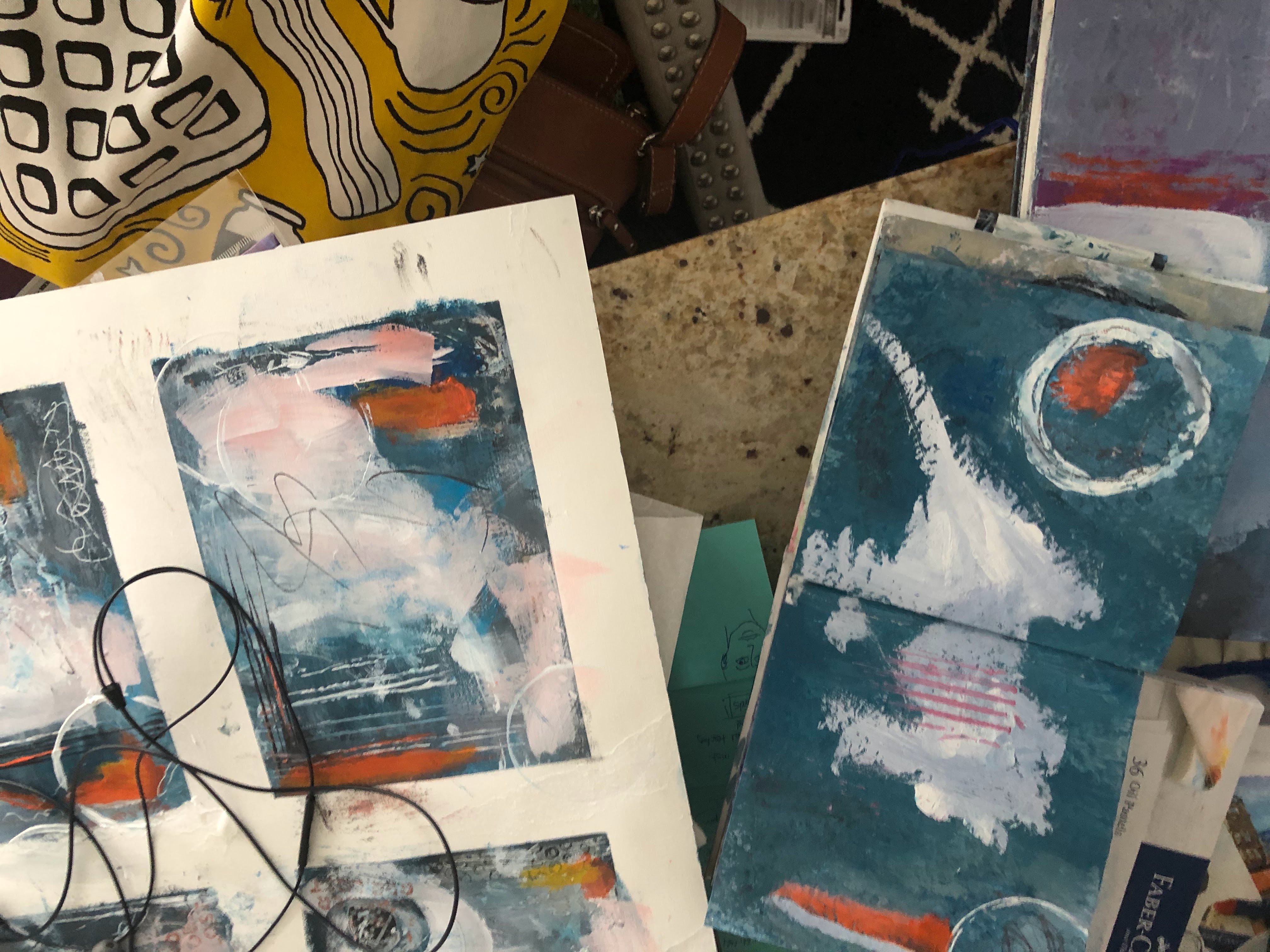
I thought in this post I would show a few pages of current art journals where I try out ideas, colors, shapes, movement, collage, brush marks, companion pages, rough painting, mark makings, mixed colors, abstracts, and the use of mixed media.  What these pages have in common is that they are unfinished and did inform more finished works.

I plan to begin working in a concertina journal tomorrow to explore how ideas cross pages. 


Two journals I am working I often at the same time. The larger journal shows a 2-page spread (you can see earlier work on the pages below) and a smaller square watercolor journal with very heavy paper.  Working back and forth across the two pages and in another journal helps me to be patient. 


A page in a 8 1/2 x 11”  watercolor journal. This is the facing page to the page below. 


Facing page to the one above. I like the blocks of color on this page.


2-page spread: limited palette with collage papers. These pages are too light. Hard to know where to look. I am drawn to the the block of dark blue on the bottom left page.


A large watercolor sheet and a smaller watercolor journal. In both I play with a similar color palette. 


These are two pages page where I got lost and could not find cohesion. I do wonder if sections of these two pages might work better.  I do like small sections, like the horizontal white lines. 


A journal page where the color mixing got away from me. Way too busy.  I have let this sit. This started loose and then got very, very tight.  I do like the black mark making on the upper left side.


Trying out dominant, vertical orange mark with very limited palette and lines. This is a motif I keep returning to. Experimented here with making marks into the wet paint. 


Collage page on a paper with found papers including dress pattern, tissue paper, primary yellow, primary magenta, white and black. Not my usual colors. I love the little block of pink. 


Thursday, January 23, 2020

Constant State of Change

From one of my art journals from 2016. I created the journal by gessoing an old atlas that had been Rob’s. 


“...[E]very aspect of life is in a constant state of change” (p. 1). I reread this from the opening of The Art of Resilience: One Hundred Paths to Wisdom and Strength in an Uncertain World by Carol Orsborn. I read this book off and on in the weeks following Rob’s death. Someone, and I am embarrassed to say I could not remember who, sent this to me and then I noticed the taped paper in the inside cover. Two women I work with. 

Rereading the book Nearly four years after Rob’s death finds me in a different place. It’s as if I am reading the book for the first time as I have forgotten most of it, if not all. What I have mostly learned from being reflective is that grief and shock are entwined. Without this written record, I would remember little in the way of detail. 

Tuesday, August 22, 2017

#SOL17: Transforming Heart Ache through Art: 18 Months of Journaling with Paint

Dreaming. (watercolor, digital remix, August 18, 2017, about 3 a.m., Molskine journal)

For the last 18 months I have been painting in art journals--some purchased, some made by hand. It hasn't exactly been practice, as practice connotes an end game and somehow the drawing and painting I have been doing was more elemental, more necessary. There was no prescribed end in mind. It began simply because I needed to expend energy after Rob died. Lifting my camera was a too familiar weight. Making a photographic image felt too passive and perhaps more so reminded me of Rob and all the times I had photographed during our nearly thirty years together.

In the time since his death, painting in my journals (and perhaps painting on a large sheet of watercolor--I actually took out a sheet in anticipation) has become essential.  I dream of painting, rehearsing in my mind what I will do. I can feel my hand holding the brush, moving paint with my fingers.  I don't remember many dreams upon waking, but I do remember my painting dreams.  Most mornings when I am not at work I paint. When I can I paint in the evenings too, especially late evening.  I paint, let dry what needs to dry and come back. I also work across numerous journals now using a lot of different media. Some days I sketch in different journals. These may be people I have been observing in public spaces, like at a Starbucks or photographs or images from magazines that I use as references. On other days I may spend hours just painting backgrounds on journal pages with little anticipation of what I might end up creating on the page. Now and then I will just sketch what I imagine or paint without any guide.

Oddly, it was without any reference that I began painting. Below is the first painting I made after Rob died. It is non-representational and I thought it nothing more than a sloppy mess. I titled it, "Let Her Paint" and posted it on my blog nonetheless. Beneath all of that grief, I think I knew that physical act of painting would be necessary. I needed it so much and how grateful I am that painting was possible.

from an art journal (March 18, 2016)
Two months later I began to keep an art journal in earnest. I selected an old atlas that had been Rob's and gessoed several pages.  It was an oversized book and allowed me a lot of space to work. I painted the image below using a stencil and also free hand. Even now, looking at it, I still enjoy the image--mostly because of the way I used space across two pages. This morning when I reread the image, knowing I made it two months after Rob died,  I notice how life percolates beneath the ground unseen--like the will to live remained within me.

Page from art journal, May 18, 2016

After Father's Day I made  the two images below, using newspaper, ink, gesso, Stabilo pencil, and acrylic paint. As I look at these paintings, I notice the empty spaces surrounding each and how the the grief image (6.19.16) seems to float without an anchor, whereas the other image of sadness is anchored to the bottom of the page. Each new holiday, like Father's Day, was mostly a terror that first year. Less so the second year.

(stabilo pencil, gesso, acrylic paint, ink, newspaper, 6.20.16)
(stabilo pencil, gesso, acrylic paint, newspaper, 6.19.16)

The image of two women I made four months later crossed two large journal pages. I think about how I was seeing and not seeing at the time. Grief and loneliness alter reality.  The arrangement here of images and collage elements felt new to me.  Uncharted territory. What to do with empty space is a question I worked out on this page--much like I was working out in my life. After the death of a husband, large blocks of what felt like empty space become more noticeable. Understanding that I had choices and perhaps, more importantly, needed to see my own hand in my life, I began slowly to accept that the life I was making was my own.  I had been waiting for life to be given to me, not made. In the fall of last year I was learning that if I waited for something external to show me all there was to see, I would be waiting for a long time. Most days now, I accept that living is always about partial sight. We never really know where we are walking and what we will see.


from my art journal, 10.22.16 (gesso, found papers, acrylic paint, Tombow markers, tissue paper, ink)

Five months later in mid-March of 2017 I was thinking a lot about the burden of grief and that lovely poem by Molly Peacock, "Putting a Burden Down."  Many years ago I took a class at the 92nd Street Y with Molly and after the class ended she became a private teacher for me for the remainder of the year. I was writing a final project for a graduate degree--a collection of poems. I painted the image below in my journal. It was a week after the anniversary of Rob's death and I began to think that putting down grief is a decision not a divine directive. What rested in my hands was mine for the making. As Rob told me so many times, the only way out is through. After a year of grieving I came to understand that defining myself through grief and grieving was a choice. So too was putting it all down. And if only it was that simple.


(watercolor, pencil, acrylic paint, ink, March 2017)

A month later, I decided to spend the next 100 days painting, drawing and on occasion photographing faces.  I wanted to represent faces better.  This led me to painting most days and learning how to first try to control the paint brush and paint and paint representationally. Later I experimented with leaning into the work and seeing where it led. Below is one of my more expressive pieces. The painting happened across a month.  It was a painting I started and abandoned, returning to again and again. Finally, I just painted and scribbled with much abandon. Just as grief was loosening its grip from my heart and life, my hand was learning how to hold the top of of the paint brush looser, to trust mark making both literally and figuratively.

acrylic paint, crayon, early July 2017)


12 paintings with blackbirds (July - August, 2017)

In the last month, flocks of blackbirds have found their way into what I am painting. A friend suggested the old Beatles' song, "Blackbird," as an apt metaphor. And perhaps it is new wings I am trying out. Painting offers a language that is complementary and different than the words I use to speak and write. Painting reveals truths I might not know or could not say. Below is a detail from a painting I completed in my art journal on August 19th. I wonder about the partiality of it and also the sensuousness of the image. It is more blended, less precise. More heart than mind. What might suggestion have to do with healing?  I suspect as I paint more, I will learn.

Suggestion (August 19, 2017)

Next spring I will be taking an acrylic collage workshop with abstract painter, Jane Davies. Lately the call of the non-representational is loud.  I want to explore it in large ways, using big spaces to paint. I have been drawn to abstract expressionist art for decades, but have never tried my hand at it. These days find me bolder, more willing to risk.

After the death of a husband, little seems undoable.

Saturday, March 25, 2017

#SOL17: Making a Gelli Print Art Journal

Cover to Birgit's handmade art journal

Cover to Birgit's handmade art journal


inside Birgit's journal


I.

Last weekend I took an art class with Birgit Koopsen from the Netherlands and she had with her several gelli-printed art journals she had made. Although our work during the weekend did not involve making printed art journals, I found her work compelling and beautiful and knew I would want to make my own journal after seeing hers.

Below is a quick look through one of her journals.


She outlines the process in this blog post.


gelli print plate with paint on it

II.

papers I have made
So this week I decided to start making my own art journal by making a series of printed papers. I used a 12 x 12 gelli plate, fluid acrylic paints, Canson Watercolor sheets 9"X12" (90 lb), brayers, and different objects I had on hand to make marks on the plate, such as the rim of a glass, a corn holder, a foam stamp.

I had never used a gelli plate before last Saturday and I am finding it an incredibly useful tool for printing. Right now I am creating pages for the journal. Once I create enough pages, fold and glue them (back to back), and then assemble folios--I will move on to binding the journal.

Birgit creates a heavier cover using cardboard and
folded folios
paper. And then she just binds the pages using heavy-duty tape. I plan to do so as well.


III.

After all that work, I will then have a journal ready to work in. Then I will create different art on top of the painted sheets of paper in the journal. One type of art I will be creating are image transfers from original photographs. Below is a brief video that shows one way of transferring laser printed images.


I found that using Liquitex Pouring Medium helps me to achieve even transfers. Also, printing black and white images with high resolution offers the blackest image for transfer. Some of these images I will hand paint and then transfer, others I plan to leave as black images that contrast with the paint already on the page.

Below is an example of a painted image I transferred to a journal based on a black and white photograph I made some years ago.

Two-page spread in one of my journals.
I hand painted the back and white photograph and then transferred it to a journal.


I love the collection of art journals I have created during the last year. I have posted images from the last year of hand made work, here. Most of the books I have used have been purchased, although I have altered two books: an old atlas that was Rob's and a book on color.

There's something special when the entire journal is made by your own hands.

Sunday, October 9, 2016

Art Journaling Resources

from my art journal, 10.8.16 (Gesso, ink, acrylic paint, tombow markers, stabilo pencil, pan pastel)


As some of you already know, I began art journaling shortly after my husband died last March.  I have made digital images and photographs for years, but felt the need to immerse myself in something more physical. Frankly, I had so much nervous energy that I needed full immersion in the work. Art journaling meets that need as it allows me to paint, draw, collage, and write. During these last seven months I have been following a few blogs, read some books, viewed online some work by other artists and thought that in this post I would share a bit of what I have been learning by listing some resources.

I recently started a meet-up for those interested in art journaling in northern NJ.  We will have our first meeting soon. This January I will be participating in Life Book 2017, an online art workshop that last the full year. I'm super excited about this.

Here are just a few resources I use or have used when art journaling.

Blogs

The Altered Page (Seth Apter)
Art Journal Everyday (Julie Fei-Fan Balzer)
The Common Denominator (Marybeth Shaw)
Creative Art Journal (Emily T)
Creativity Unleashed (Traci Bautista)
Journal Girl (Samantha Kira Harding)
Michelle Ward
Misty Mawn
Mixed Media Journal with Judy Wise
My Art Journal (Diane Salter)
Ponderings (Dina Wakely)
Serena Barton's Blog
Studio 274 Design
An Uninterrupted View (Louise Nelson)
Willowing Arts (Tamara Laporte)

Blog Post: Packing Tape Transfers

Books

page from A world of Artist Journal Pages...
Barton, Serena. (2013). Wabi-Sabi Art Workshop: Mixed Media Techniques for Embracing Imperfection and Celebrating Happy Accidents. North Light Books.
Carriker, Pam. (2015). Mixed Media Portraits with Pam Carriker: Techniques for Drawing and Painting Faces. North Light Books.
Carriker, Pam. (2013). Creating Art at the Speed of Life: 30 Days of Mixed-Media Exploration. Interweave.
Mawn, Misty. (2011). Unfurling, A Mixed-Media Workshop with Misty Mawn: Inspiration and Techniques for Self-Expression through Art. Quarry Books.
Sokol, Dawn DeVries. (2015). A World of Artist Journal Pages: 1000+ Artworks - 230 Artists - 30 Countries. New York: Stewart, Tabori and Chang - An Imprint of Abrams.
Sokol, Dawn DeVries. (2013). Art Doodle Love: A Journal of Self-Discovery.  New York: Stewart, Tabori and Chang - An Imprint of Abrams.
Wakely, Dina. (2014). Art Journal Courage: Fearless Mixed Media Techniques for Journaling Bravely. North Light Books.
Wakely, Dina. (2013). Art Journal Freedom: How to Journal Creatively With Color & Composition. North Light Books.


Digital

Art Journaling blog
Art Journaling on Pininterest
Beginning Art Journaling on Pininterest
21 Secrets Tools and Techniques

How To's
How 2 Art Journal
How to create and keep an art journal: Aisling's How-To Page

Magazine

Art Journaling Magazine
Art Journal No. 2 Zine

Video

Pam Carriker video page


See more here.

Tuesday, June 14, 2016

#SOL16: Tell Them We Ate Love

from my art journal 6.14.16 We Ate Love (gesso, acrylic, collage papers, archival ink, pan pastel)


This morning I had to turn off the radio.  I had to.  I also skipped the Facebook posts that focused on the dead in Orlando--that identified those beautiful dead boys and girls, men and women.  Some just 19 years old.  Some just 20 years old.  Just a few years older than my own son.  Having lost Rob recently, my ears are tuned to hear and record the shocked-voice of the family members who were interviewed on NPR.  Months from now someone will tell them what they said for they will have no memory of it.

None.

Shock insulates and that is perhaps a small mercy.

Instead, this afternoon I painted in my art journal. I thought about those who survived--about their luck, their courage, their will.  I wanted to celebrate those who live.  I kept thinking about a few lines from a poem by Shokry Eldaly, "A History That Has Not Yet Come to Pass."  The opening lines resonated and allowed me to make a small tribute to the survivors.


Sunday, June 12, 2016

#SOL16: Restless

Two pages from my art journal, 6.9.16: She Had a Lot On Her Mind 
(acrylic paint, gouache paints, archival ink, pencil, gesso)


I.

There's a restlessness that comes with grief. Suddenly I become aware that my foot is tapping, or I'm walking about the house without intention. Grief is unspent energy. Some days I find it hard to concentrate and to attend to matters. Concentration happens best when I am working with children or teachers, walking/hiking, working in my art journal, or cooking. Intensity matters.  In a letter to his niece, Henriette Lund in 1847, Søren Kierkegaard advised,

Above all, do not lose your desire to walk. Every day I walk myself into a state of well-being, and walk away from every illness. I have walked myself into my best thoughts, and I know of no thought so burdensome that one cannot walk away from it (p. 412).
Since Rob died I have walked each day.  This past week I got caught a mile or so from my car in a rain storm. I had forgotten how private it is to walk in rain. At first loneliness permeated my days. Now I find loneliness is yielding.  In Perseverance,  Margaret Wheatley writes how loneliness can transform into a willingness to be alone.  Two separate feelings. She explains,

Loneliness eventually transforms into a willingness to be alone, even a desire for the space and peace available when nobody else is there. But to get to this lovely place, we first have to let loneliness be there, wait for it to pass through, and then notice that it’s gone, that we quite like the space we’re in. 
It reminds me so much of Kathleen Norris's advice in Dakota: A Spiritual Geography about letting a place happen to you. Walking anchors me to the earth and soothes the loneliness by allowing me each day to commune with nature at the moment.

II.

It was just an old, oversized atlas that I found on a bookshelf at home when I was packing up a collection of books for teachers at a school. The atlas was Rob's and now it has become one of my art journals. I find working in multiple journals at the same time to be more productive. I can prep a two-page spread in one book and as those pages dry, I can work in a different journal.

I enjoy working on paper that Rob had handled. I notice how the maps and print bleed through the thin layer of gesso I apply and this often adds to the design and the ideas that emerge as I work.  I almost never know what I will be creating and the blank page is sometimes difficult.  Now and then I just go ahead and mark a few pages and this allows me to begin to see a potential narrative I night want to follow.

The journal is a place for self expressions and discovery. After Rob died, I needed to work with my hands.  The painting and collage making provide a means to ease the restlessness while focusing my attention. I often get lost in art making for hours.

My art journal is place for experimentation--a place where I can try out new techniques I am learning, invent methods, make lots and lots of errors, cover up mistakes (thank goodness for gesso) and start over again.  The work I am making is amateurish and there's a frustration to that and yet, there is also an odd satisfaction. The art journal also is a place where I work out things I may be feeling, but not naming.  It is sort of like my life after Rob. In many ways these last few months have been largely about practice, about acting as if.

At first, the weeks following Rob's death found me partially paralyzed with fear.  I seemed unable to make even the simplest of decisions.  In the time that has past though I am feeling braver, more willing to cultivate new interests.  I wonder if in seeing Rob die it hasn't liberated me from fearing my own death.  Rather than guard against death, I know that at some point I will die.  In some ways this liberates me to live more fully.


Work Cited
Kierkegaard, S. (1978). Søren Kierkegaard's Journals and Papers: Autobiographical, 1829-1848. Howard V. Tong and Edna H. Hong, Translators. Indiana University Press.


Saturday, May 28, 2016

#SOL16: Grief - Nothing Stays Put


from my art journal - "For in Grief, nothing stays put" - 5.28.16
(gesso, acrylic paints, newspaper, white marker, pan pastel, watercolor pencils)


One of the hardest things to come to terms with, if coming to terms is even possible, is the way grief with all of its power re-emerges so unexpectedly. In A Grief Observed, C.S. Lewis writes about this. He says,

Tonight all the hells of young grief have opened again; the mad words, the bitter resentment, the fluttering in the stomach, the nightmare unreality, the wallowed-in tears. For in grief nothing ‘stays put.’ One keeps on emerging from a phase, but it always recurs. Round and round. Everything repeats. Am I going in circles, or dare I hope I am on a spiral? 
But if a spiral, am I going up or down it? (p. 56)


His account rings true. Out of nothing discernible, grief rises like a rogue wave, appearing suddenly, unexpectedly. Such grief submerges. And though you don't die, it just feels that way.  It is a paralysis that widows learn to stand inside, even as it unbalances the heart.

Sometimes the wait for a return to balance is long.
Sometimes a rebalancing happens quickly.
The only constant is the not knowing.
This is the way of grief.


Friday, May 27, 2016

#SOL16: Resettling

from Art Journal. May 27, 2016 (gesso, watercolor, newspaper, acrylic)


I. 

This past week I gathered Rob's remaining clothes--the shirts and sweaters, pants and jackets, suits and coats and donated 20 bags of clothing to the Lupus Foundation. It pained me to gather his remaining clothing and so I tucked away two flannel shirts, a maroon sweater, and a few things for Devon if he so wishes. Against the pain, it also pleased me to think that others will be wearing the well-tended clothes of my husband as I know Rob would want that. 

It took a considerable amount of time to gather from four different closets on three different levels all of Rob's remaining clothes. I lived with the bags lining the upper hallway for more than two weeks. I just couldn't make the phone call no matter how often I thought to do so.  On Tuesday, I received a card in the mail asking for a donation from the very agency I was going to phone. I took this as a sure sign and made the call.

II. 

There's an elegance that accompanies small steps. Outside on the front stoop are pots of geraniums. On the side porch are potted herbs. Each action need not be elaborate, nor even complete.  

Each bag of clothing I gathered and donated left a vacancy, amplified losses I don't care to calculate. For now, my home is filled with pockets of movement and of stillness. These are placeholders for the love that feels misplaced. 

I have worked these last few months to resettle the house.  The heart will keep for another day.

Wednesday, May 18, 2016

#SOL16: Invincible Summer


From my art journal, May 18, 2016 (gesso, gouache paints, pan pastel, graphite pencil)


I.

Sometimes grief feels invincible, as if the body you have known all these years is no longer yours. It has been let out, given over, occupied. And the best you can do is surrender. And after so many attempts at standing, this sitting down feels right.


II.

This means something--something I don't know.


III.

In the late night when the whole world holds its breath and the quiet that surrounds is a sleepy lullaby no day could sing, I whisper, Take from the day what you can. Leave what you cannot bare to carry. 

I whisper so I might remember these words tomorrow.