This is the fifth of seven posts about early literacy.
Blending (Onset and Rime)
- Blending becomes crucial when children are decoding printed words from their spellings. One way to break down the syllable is into onset (everything before the vowel) and rime (the vowel and everything after it).
- Play blending riddle games with children. "I'm thinking of an animal that goes quack and is a /d/ /uck/.
- The following 37 rimes are listed in Sharon Ruth Gill’s “Teaching Rimes With Shared Reading” (The Reading Teacher, 60, 191–193) and are mentioned in the podcast based on the article. As described by Wylie and Durrell in their 1970 article “Teaching Vowels Through Phonograms” (Elementary English, 47, 787–791), these rimes can be found in 500 words commonly used in primary-level texts. This is a link to teaching each of the rimes using nursery rhymes. For example, for -ack the nursery rhyme is Jack and Jill. This is a link to all of the materials.
- -ack, -ail, -ain, -ake, -ale, -ame, -an, -ank, -ap, -ash, -at, -ate, -aw, -ay
- -eat, -ell, -est
- -ice, -ick, -ide, -ight, -ill, -in, -ine, -ing, -ink, -ip, -it
- -ock, -oke, -op, -ore, -ot
- -uck, -ug, -ump, -unk
 |
| from Phonics They Use (Pay Cunningham) |
5. Pat Cunningham's Rounding Up the Rhymes is another blending game. See directions below:
6. Pat Cunningham's Reading/Writing Rhymes (pp.145-146) is another activity that helps students learn to use patterns to decode and spell hundreds of words. "In addition, all beginning letters (onsets) are reviewed every time you do a Reading/Writing Rhymes lesson. Once all the rhyming words are generated on a chart, students write rhymes using these words and then read each other’s rhymes. Because writing and reading are connected to every lesson, students learn how to use these
patterns as they actually read and write. Here is how to do Reading/Writing Rhymes lessons.
❉The Onset Deck
You will need an onset deck containing cards for all the beginning sounds. The cards, 3 × 5 index cards, are laminated and have the single‐letter consonants written in blue, the blends in red, and the digraphs and other two‐letter combinations in green. On one side of each card, the first letter of
the onset is a capital letter. The onset deck contains 50 beginning letter cards including:
To begin the lesson, distribute all the onset cards to your students. Depending on how many students you have, each student will have two or three cards.
❉Making the Chart of Rhyming Words
Once all the onset cards are distributed, write the spelling pattern you are working with 10 to 12 times on a piece of chart paper or a smart board. As you write it each time, have the children help spell it and pronounce it (“a‐d, ad”).
ad
___ ad ___ ad
___ ad ___ ad
___ ad ___ ad
___ ad ___ ad
___ ad ___ ad
___ ad ___ ad
Next, invite all the children who think they have a card that makes a real word to line up next to the chart or overhead board. As each child shows his or her card, blend the onset and the rhyming pattern together to decide if the word is a real word. If the word is indeed a real word, use the word in a sentence and write that word on the chart. If the word is not a real word, explain why you cannot write it on the chart. (If a word is a real word and does rhyme but has a different spelling pattern, such as plaid to rhyme with ad, explain that it rhymes but has a different pattern and include it on the bottom of the chart with an asterisk next to it.) Write names with capital letters and, if a word can be
a name and not a name, such as tad and Tad, write it both ways. When all the children who think they can spell words with their beginning letters and the spelling pattern have come up, call children up to make the words not yet there by saying something like,
Try to include all the words that any of the children would have in their listening vocabulary, but avoid obscure words. If the pattern you wrote to begin your chart gets made into complete words, add as many more as needed. Finally, if you can think of some good longer words that rhyme and have that spelling pattern, add them to the list. (Spell and write the whole word here since children
do not have the extra letters needed to spell it.)
ad
b ad Ch ad
s ad Br ad
m ad d ad
p ad t ad
gl ad T ad
h ad f ad
grandd ad undergr ad"
from: Cunningham, Patricia M. (2012-07-12). Phonics They Use: Words for Reading and Writing (6th Edition) (Making Words Series) (Page 145-146). Pearson HE, Inc.
 |
| from Phonics They Use |
6. Pat Cunningham's Reading/Writing Rhymes (pp.145-146) is another activity that helps students learn to use patterns to decode and spell hundreds of words. "In addition, all beginning letters (onsets) are reviewed every time you do a Reading/Writing Rhymes lesson. Once all the rhyming words are generated on a chart, students write rhymes using these words and then read each other’s rhymes. Because writing and reading are connected to every lesson, students learn how to use these
patterns as they actually read and write. Here is how to do Reading/Writing Rhymes lessons.
❉The Onset Deck
You will need an onset deck containing cards for all the beginning sounds. The cards, 3 × 5 index cards, are laminated and have the single‐letter consonants written in blue, the blends in red, and the digraphs and other two‐letter combinations in green. On one side of each card, the first letter of
the onset is a capital letter. The onset deck contains 50 beginning letter cards including:
- Single consonants: b c d f g h j k l m n p r s t v w y z
- Digraphs (two letters, one sound): sh ch wh th
- Other two‐letter, one‐sound combinations: kn qu
- Blends (beginning letters blended together, sometimes called clusters):
- bl br cl cr dr flfr gl gr pl pr sc scr sk sl sm sn sp spl spr st str sw tr tw
To begin the lesson, distribute all the onset cards to your students. Depending on how many students you have, each student will have two or three cards.
❉Making the Chart of Rhyming Words
Once all the onset cards are distributed, write the spelling pattern you are working with 10 to 12 times on a piece of chart paper or a smart board. As you write it each time, have the children help spell it and pronounce it (“a‐d, ad”).
ad
___ ad ___ ad
___ ad ___ ad
___ ad ___ ad
___ ad ___ ad
___ ad ___ ad
___ ad ___ ad
Next, invite all the children who think they have a card that makes a real word to line up next to the chart or overhead board. As each child shows his or her card, blend the onset and the rhyming pattern together to decide if the word is a real word. If the word is indeed a real word, use the word in a sentence and write that word on the chart. If the word is not a real word, explain why you cannot write it on the chart. (If a word is a real word and does rhyme but has a different spelling pattern, such as plaid to rhyme with ad, explain that it rhymes but has a different pattern and include it on the bottom of the chart with an asterisk next to it.) Write names with capital letters and, if a word can be
a name and not a name, such as tad and Tad, write it both ways. When all the children who think they can spell words with their beginning letters and the spelling pattern have come up, call children up to make the words not yet there by saying something like,
“I think the person with the f card could come up here and add f to ad to
make a word we know.”
do not have the extra letters needed to spell it.)
ad
b ad Ch ad
s ad Br ad
m ad d ad
p ad t ad
gl ad T ad
h ad f ad
grandd ad undergr ad"
from: Cunningham, Patricia M. (2012-07-12). Phonics They Use: Words for Reading and Writing (6th Edition) (Making Words Series) (Page 145-146). Pearson HE, Inc.
For a few books to teach rimes see this post: Books to Teach the 37 Most Common Rimes: The Rime Poetry Book.
Sound Substitution
Using a poem, ask students to listen to how the first letter(s), or onset, changes. For example, in the Lewis Carroll poem below, students might substitute /n/ sound in night, making other words like bright and might, which are in the poem. Then ask them to change the onset and make words not in the poem like fight, light, right, sight and tight.
Sound Segmentation
Using a poem, ask students to listen to how the first letter(s), or onset, changes. For example, in the Lewis Carroll poem below, students might substitute /n/ sound in night, making other words like bright and might, which are in the poem. Then ask them to change the onset and make words not in the poem like fight, light, right, sight and tight.
The sun was shining on the sea,
Shining with all his might:
He did his very best to make
The billows smooth and bright
And this was odd, because it was
The middle of the night.Record the new words on chart paper so students can see the pattern. The rime, -ight, remains the same.
Sound Segmentation
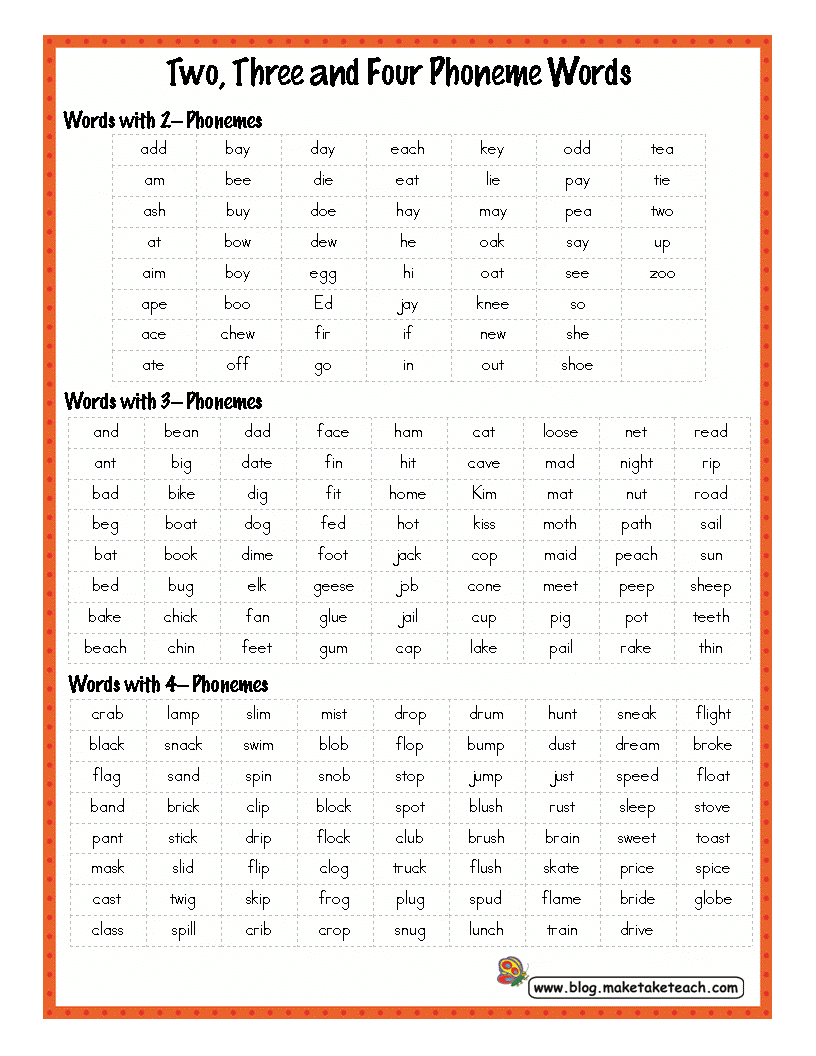
- Create a list of two, three, four letter words to separate into sounds to use for segmentation modeling and practice. Explain that words can be separated into letter sounds.
- Model the behavior many times first. For visual cue, provide three blocks to indicate that the words have three sounds. Instruct student to point to one block as she says each sound in the word.
- Use Elkonin Boxes. (from Reading Rockets. Everything your ever wanted to know about using Elkonin Boxes...)
- Use list of three letter words to work with student. Explain that words can also be divided by onset (beginning sound) and rime (ending chunk).
- Model behavior and have student echo you until he is able to do it with minimal support. Use a series of words with the same onset/rime (all -at words, all -an words) and then change to a new word family. Eventually mix up rimes as student becomes more proficient.
Early Literacy Series #1: Shared Reading & Writing and CAP
Early Literacy Series #2: Shared Reading Resources for Preschool and Kindergarten
Early Literacy Series #3: Teaching Rhyming and Initial Sound Instruction
Early Literacy Series #4: Teaching Sound and Letter Identification in Kindergarten
Early Literacy Series #6: Teaching Word Solving through Shared & Guided Reading
Early Literacy Series #7: Teaching Comprehension & Fluency
Early Literacy Series #2: Shared Reading Resources for Preschool and Kindergarten
Early Literacy Series #3: Teaching Rhyming and Initial Sound Instruction
Early Literacy Series #4: Teaching Sound and Letter Identification in Kindergarten
Early Literacy Series #6: Teaching Word Solving through Shared & Guided Reading
Early Literacy Series #7: Teaching Comprehension & Fluency