Showing posts with label common core standards. Show all posts

Monday, December 26, 2011

Curriculum as Local Landscape

I like to think of curriculum as local landscape: one that moves, refuses to be fixed by the easy map, one you know because you walk it.  Curriculum cannot actually be mapped as it is a path unwinding before your feet--one that is altered by experience and changed by light and dark, fog and mist, intention and action, student and teacher, now and then, memory and shadow, you and me.

Looking East (Yuma, California, M.A. Reilly, 2010)

Curriculum maps that are made for others by others are problematic. They are distant. Erroneous before they are even read. Always epic. Consider Barry Lopez (1976) who has this to tell us about maps:
I would like to tell you how to get there so that you may see all this for yourself. But first a warning: you may already have come across a set of detailed instructions, a map with every bush and stone clearly marked, the meandering courses of dry rivers and other geographical features noted, with dotted lines put down to represent the very faintest of trails. Perhaps there were also warnings printed in tiny red letters along the margin, about the lack of water, the strength of the wind and the swiftness of the rattlesnakes. Your confidence in these finely etched maps is understandable, for at first glance they seem excellent, the best a man is capable of; but your confidence is misplaced. Throw them out. They are the wrong sort of map. They are too thin. They are not the sort of map that can be followed by a man who knows what he is doing. The coyote, even the crow, would regard them with suspicion. (from Desert Notes)
Curriculum, that complicated conversation we have even when we do not speak, is a subtle place with a long history: part truth, part lie, part mystery.  Forget the made map, as one can never be sure of the intentions that have fueled its making. For if the curriculum map is made apart from the learners, what damage might 'enactment' render?  What happens to one's spirit in such a lifeless place?  Consider Wendell Berry (1977) who writing about soil explains:
It is the nature of the soil to be highly complex and variable, to conform very inexactly to human conclusions and rules.  It is itself easily damaged by the imposition of alien patterns.  Out of the random grammar and lexicon of possibilities--geological, topographical, climatological, biological--the soil of any one place makes its own peculiar and inevitable sense.
It is impossible to contemplate the life of the soil for very long without seeing it as analogous to the life of the spirit. (from The Unsettling of America)
Prairie (South Dakota, M.A. Reilly, 2010)

II. The Common Map Unmade

When I read documents like the Common Core State Standards with its long lists of expectations for all students, neatly ordered in sets of ten statements and dispersed like obedient soldiers across 13 years,  I know we have lost our way and have settled for the made map-- a map that strips the world of all that is local and in doing so nullifies magic and mystery, agency and voice--as if these no longer were real.  The arrogance is so loud.  Perhaps it is difficult to hear beneath such bravado the absurd belief that 'essentials' can be named by a handful of people. Imagine the misconceptions that fuel the belief that a small coterie can determine what each and every child across these United States should learn and when such learning should occur.

The Common Core is no framework.  This is curricular imprisonment--unrestrained power. When enacted and then tested every few weeks via a PARCC or SMARTER test, there will be no room for the idiosyncratic, the imagination, the questions, the dreams, the dreamtime, the unknown, the known that is no longer privileged, the recalled, the local, the random, the spiritual, the partial memory, the error, the student, the teacher, the you, the me. We are so foolish to believe that the only things worth knowing are explicit information one might easily test the same way for all the children across the country.  There are more ways to know then a test might gauge.  Listen to William Least Heath-Moon (1991) who is writing about how he has come to Kansas, to Roniger Hill--a sacred place--to test a belief he has about the connections one might find by laying a paper map atop a physical place and seeing if the grid, "arbitrary quadrangles that have nothing inherently to do with the land, little to do with history, and not much to do with [his] details" leads to some connections.  He tells us he has arrived here "by some old compass in the blood" (p. 14).  Listen to how he comes to know:
Now: I am standing on Roniger Hill to test the grid. I'm not waiting for revelation, only watching to see whether my notions will crumble like these old, eroding slopes. Standing here, thinking of grids and what's under them, their depths and their light and darkness. I'm watching, and in an hour or so I'll lie down and sleep on this hill and let it and its old shadows work on me, let the dark have at my own shadows and assail my sleep. If my configuration is still alive by morning, then I'll go down off this ridge, and, one more time, begin walking over Chase County, Kansas, grid by topographic grid, digging, sifting, sorting, assembling shards, and my arbitrary course will be that of a Japanese reading a book: up to down, right to left (pp. 15-16. from PrairyErth).
Startled (Iowa, M.A. Reilly, 2010)

There are  more ways to come to know then we can imagine. These ways may well be unnameable and many are culturally/locally bound.  They do not translate well across time, space, and intention. And there value is easy to miss. William Least Heath-Moon knows that when he lies down on top of that hill the old shadows will work their way into his dreams, his very self (in)forming what he knows.

Folks, there are no 'old shadows' listed in the Common Core or I imagine in any State Standards. Such experiences would not be listed as they are likely not known or perhaps valued by those who write such things for others to enact.  (Okay, I recognized, dear reader, that I may be losing you on these last few lines.  But, stay awhile.  Linger. Perhaps dreams and shadows aren't very real to you, but surely something important you value is and I tell you now get ready to lose it--for you will need to lose what you love in order to adhere to 'the Standards.'  They have never actually been yours, now have they?)

My friend, Michael Doyle, a teacher of science, writes in a post today:
I dream of teaching my students how to clam. It's a local activity that will never be part of the national standards because it's a local activity. That may sound innocuous enough, but it gets to the heart of the sickness in education today, our love of the abstract.

We teach to what few love, the few with the money, the few with the power to dictate what matters. 
We have traded Main Street for strip malls, teachers for Standard bearers, students for test achievers and filled Main Street and its schools with a simulacrum we simply cannot bear.   My son a few years ago asked, 'Why are all the stores the same wherever you go?  Couldn't anyone think up something original? It's kinda sad.'
The Atlantic (M.A. Reilly, 2010)
I dream of my son learning to clam: not for credit (AP or otherwise) or in preparation for some high stakes test, but because he would be in the presence of a teacher who deeply cared--was passionate and knowledgeable about the art and craft of crabbing and all that such work contained and pointed towards.  That's the learning I crave for him.  To be in the company of others who openly share their passions and expertise so he too might come to name his world in numerous and complicated ways.

That is what teaching use to be.  Before the standards. Before the high stakes tests. Before we foolishly thought we would leave no child behind by naming everything each child needed to learn and measuring it by a single paper and pencil test.


Our idiocy is astounding.  This has never been about learning, but rather remains a matter of power seeking and the greed that travels alongside such intention. Wendell Berry (1991) offers us insight into such people when he writes:
Our present 'leaders'--the people of wealth and power--do not know what it means to take a place seriously: to think it worthy, for its own sake, of love and study and careful work. They cannot take any place seriously because they must be ready at any moment, by the terms of power and wealth in the modern world, to destroy any place. (from "Out of Your Car, Off Your Horse")
In the same text, Berry similar to Doyle offers us this bit of wisdom--words we should be heeding:
If we want to put local life in proper relation to the globe, we must do so by imagination, charity and forbearance, and by making the local life as independent and self-sufficient as we can--not by presumptuous abstractions of "global thought." (from "Out of Your Car, Off Your Horse")
Go ahead and search the Standards and see if imagination, charity or forbearance can be found.  Don't hold your breath.

Thursday, November 17, 2011

On Meaning and Standards


I tweeted this a few days ago and @jppastor RT it.  Perhaps you (re)read it and/or recalled it from something else you read at another time. At each of those possible moments, meaning was made.

Meaning is not stable and this often makes us uneasy. Anyone with a teenager knows this to be true.  We tell our child to do or not to X and something else emerges.

Did you not hear me?
Yeah I heard you.  You said, blah blah blah.
Right, so what happened?

The semantic spaces between our words and intentions and the understanding composed by a reader/viewer/listener can be enormous. As Heraclitus said: You cannot step twice into the same river; for other waters are ever flowing on to you.

And still we build expensive methods to test public education systems based on a gross miscalculation: the USDOE and State governments believe we can step into the same river twice and they can make us do so.  Just watch us, they say.  On many, nuance is lost.

Meaning has never been a fixed affair regardless of what we might desire. Surely,Web 2.0 makes that instability feel so much truer*.

Meaning doesn't travel with set intention.

Meaning is overpopulated with intentions of others (Bakhtin, 1984).

Meaning X can be prescribed and it does not contain or limit how X is understood.

Meaning cannot be preserved, nor handed down.

Meaning cannot be 'delivered'.


I've been thinking  a lot about the standards movement. In Pashi Sahlberg's (2011) Finnish Lessons he compares The Global Education Reform Movement (GERM) with The Finnish Way (p. 103).

GERM                                                                     The Finnish Way
Standardizing teaching & learning                        Customizing teaching & learning
Focus on literacy & numeracy                                Focus on creative learning
Teaching prescribed curriculum                              Encouraging risk taking
Borrowing market-oriented reform ideas                Learning from the past and owning innovations
Test-based accountability and control                     Shared responsibility and trust

The differences are acute, one might even say stunning. 

*Often wonder if the drama concerning handhelds and smartphones at school isn't an attempt to try to contain/control instability.

Wednesday, November 16, 2011

Common Core, Informational Text, and Reading

There's an overt belief in the Common Core State Standards (ELA) that reading a lot of informational text is the way one learns how to comprehend such text.  To that end, the Standards specify the percentage of text types that learners must annually read:

                                   Literary                        Informational
By Grade 4                 50%                                    50%
By Grade 8                 45%                                    55%
By Grade 12               30%                                    70%
The authors of the Standards write:
The Standards aim to align instruction with this framework so that many more students than at present can meet the requirements of college and career readiness. In K–5, the Standards follow NAEP’s lead in balancing the reading of literature with the reading of informational texts, including texts in history/ social studies, science, and technical subjects...the Standards demand that a significant amount of reading of informational texts take place in and outside the ELA classroom.
So I was thinking about how I read and what informs the ways I make meaning from text, be it a literary work or an informational text, or a hybrid of both. This led me to think about several related questions:
  1. Does the mandatory increase in reading informational text so that it becomes the majority of text type read by the age of 11 for all students in public schools actually help these learners better comprehend informational text?
  2. Does the decrease in literary works at the secondary level influence reader capacity to comprehend complex texts of any type?
  3. What effect might the mandate of the percentages of text types have on readers, pedagogy, and textbook development?
  4. What happens to learners when central control replaces local decision making?
A lot to think about and I'm of course curious as to what you think and hope you will weigh in on this.  A colleague and I are writing an article about the Common Core and I would appreciate including your insights.  As I think about these questions I want to offer a few observations, beginning with the first two questions.

On Reading
I don't recall having any direct instruction about ways to read informational text as I made my way through elementary and high school.  Now to be sure I am not advocating we ignore informational text. I favor teaching text structure and unique features of informational text as ways to enhance understanding, as well as teaching learners ways to comprehend and evaluate digital texts (regardless of type).  I think all of these can be important, as well as being mindful about the accuracy and value of information.  As I was writing this, the tweet below appeared.


A timely reminder.

My question though remains rather unanswered: Does mandated amounts of a specific text type lead to better comprehension? I wonder about this as I know that reading literary works, especially poetry, continues to enhance how I read as it requires me to actively attend to vocabulary, syntax, tone, symbol, meter, form, and diction. This attention to language directly helps me to comprehend complex philosophical texts. Different genres, yet I borrow from the reading experiences I have had and continue to have with poetry to inform ways of reading and making meaning. Now poets won't be too surprised by this.  William Carlos Williams in "Asphodel, That Greeny Flower," writes:


                                             It is difficult
             to get the news from poems
                   yet men die miserably every day
                            for lack
             of what is found there.


There's an irony to Williams's words as I not only found what is essential within poems, but I also grapple with contemporary issues too.  For example, it was not an informational text that spurred my interest in El Salvador in the early 1980s, but rather it was poetry.  30 years later I can still recall Carolyn Forche's poem, "The Colonel."(Click the link and you can hear her read it.)

Now, I am not suggesting that poetry reading be mandated. I suspect that there will be different pathways to reading for different learners. And that leads me to the last two questions.

Autonomy
I don't think making students read a certain amount of a particular type of text is going to actually help develop life-long readers or more critical readers, especially among the more fragile reader. I know mandated practices decrease the responsiveness necessary to teach the hard to teach learner.  Had I been limited in this manner and had been force to operate with specified percentages of text types, several of the learners I taught would not have become the fine readers that they did.  If you have faced the challenge of teaching the learner who is struggling to make meaning from text, limiting options doesn't make a whole lot of sense.  I can still recall Kyle, a sandy haired boy of 14, who spent several weeks in 8th grade slumped behind a book he clearly was not reading.  Kyle tried a range of books and it wasn't until he hit on Avi that he began to build, rather quickly, lots and lots of reading muscle.  Kyle must have read a dozen Avi novels before venturing into other authors and types of texts.   Kyle had little faith in his capacity "to read" and for a time thought "the magic" rested in the author.  This is the same child who by December of that school year recommended we form a club in class dedicated to reading really long novels.  Kyle ran that club.  In the same class with Kyle, there were Jamal, Peter, and Anton who I affectionately dubbed, the disaster boys.  You may know the type: they read endless books about disasters and each piece of writing somehow featured a disaster.  That year I learned a lot about F5 tornadoes and the like.  My point here, is that I used any and every method I knew to help my learners come to love reading: to find pleasure in it and then I could nudge them into deepening and broadening their reading repertoires.

In those days, I was not hampered by a national document that specified by percentage what each learner had to read. Nor was I influenced by any administrator who felt obligated to ensure that the percentages were honored, regardless of outcome.  My selection of texts that I helped to place into my learners' hands came from a library I honed with more than 1,500 discrete titles.  I had no mandated textbook that reflected the distribution of text type by percentage that I had to use.  The issue here is not about informational text, but is more about mandates and power.

Local decision making matters when teaching and learning.  My students and I had expertise that today would be discounted by the Common Core folk.  It is as if the two people who authored the document in 2010 were somehow situated as being omnipotent, for only a self-determined god could know what the Kyles of the world need and want to do in 2011, 2013 or next week.  A mandate strips local decision-making and replaces it over time with a learned subservience.  We do x because we have been told to do so. 

Such action is dangerous. A republic requires far more autonomy, far more thinking.


Friday, November 11, 2011

Rhizomatic Learning: Maps as Lived Performance, not as Artifact

Perhaps one of the most important characteristics of the rhizome is that it always has multiple entryways...A map has multiple entryways, as oppose to the tracing, which always comes back 'to the same.' The map has to do with performance, whereas the tracing always involves an alleged 'competence'...What the tracing reproduces of the map or rhizome are only the impasses, blockages, incipient taproots, or points of structuration (Deleuze & Guatarri, A Thousand Plateaus pp. 12-13).

I've been thinking about the Common Core State Standards and the practice of using these standards, or the Common Core Curriculum Maps, or Heinemann's already made reading and writing Units of Study as 'the' maps curriculum writers in Districts trace in the development of local curricula that then gets handed to teachers to enact.  By their very nature, the made map, like a tracing of a map is an epic artifact, not a performance and learning requires performance. The epic world is sealed, untouchable and both learners and their teachers need to live in the middle of the work they compose.  

That's the map as performance which is rhizomatic.

The made map that one then traces cannot carry with it the intentions, contexts, complexities, misunderstandings, and nuances that (in)formed the original. Meaning always exists at points of utterance. This is why curriculum is better situated as complicated conversation (Pinar, 2008). Mikhail Bakhtin (1984) would tell us that "Discourse lives as it were, beyond itself, in a living impulse toward the object; if we detach ourselves completely from this impulse all we have left is the naked corpse of the word" (Location 4116).  Curriculum taken from the Common Core, the Common Core Maps, or the prefab units of study will result in a mere tracing that "has organized, stabilized, neutralized the multiplicities according to the axes of significance and subjectification belonging to it" (Deleuze & Guatarri, p. 13).

The authors of the Common Core Curriculum Maps say:
Educators may view the curriculum maps as “road maps” for the school year, using them to jumpstart the lesson planning process. As common planning tools, these maps also can become the backbone of rich, content-based professional development as teachers collaborate to refine the curricula for their particular schools and classrooms.
Folks, there are no made roads worth traveling at the cost of your freedom.  The entryways and exits have all been preplanned and the attractions delineated. Alongside that made map is a calendar to keep you and your young charges from dreaming, dallying, racing, reversing, erring, collapsing space, making a detour. 

No musing allowed/aloud.  

And there you are motoring about and you get an itch to go left and you just can't do it. The road you are on is an accident.  So what's a body to do? 

Live wide awake lives and let's call that "the content".  Dwell in the imagination and we might consider that akin to process. A little of each of these, along with consistent learner agency and we would find that would be enough.

Beaver Moon (11.10.11, M.A. Reilly)
The finest educators I know do this or try to do this as they labor under the mountain of predetermined 'content' and testing requirements.   I once taught middle school learners who decided early in the school year to remove most of the furniture from the room where we met and to organize the year as a collection of clubs they determined.  Although this was 1996,  one of the clubs a handful of students enacted was a gaming club and I was surely the student my students were teaching. We had a dance club, a reading long novels is great club, a solving community problems club, an editing club (my choice),  and a host of others that came and went as the year progressed. In the room which was carpeted, there was a very large table and a handful of chairs, a couple of easels, some computers and lots and lots of supplies (paints, pastels, brushes, software, cameras, books, magazines, newspapers, and so on).  In December of that year, about a dozen of us took to studying the moon for a month. We hand made art journals, collected and read related resources, interviewed a variety of people who had different expertise about the moon, and took to standing outside at night regardless of the weather for a full moon cycle.  Our journals were filled with our observations and became the texts we studied.  Beneath the club work, I threaded skills, strategies, and dispositions into the work we composed (as did the students) and I hoped it would keep them in good stead. I know that I still am studying the moon and the work 15 years ago continues to inform how I see.

"[T]he rhizome is not the object of reproduction" ( Deleuze & Guattari, p. 21). It is the made work that happens in the company of self and others.  At the time I was 'teaching' this middle school class, I was completing my doctorate at Teachers College/Columbia University.  There I was both teaching and participating in seminars where I was trying out ideas, discussing  and writing about what I understood to be happening with the middle school students.  It was in the middle of  all of this languaging with young teens, graduate students, doctoral advisor,  peers, and family that theories and practices merged, blurred, became a map made from the dialogic threads we composed. Again, Bakhtin (1984) is helpful.  He explains:
The living utterance, having taken meaning and shape at a particular historical moment in a socially specific environment, cannot fail to brush up against thousands of living dialogic threads, woven by socio-ideological consciousness around the given object of an utterance; it cannot fail to become an active participant in social dialogue (p. 276). 
Leaving Dublin (2008, Reilly)

Each year is new. Not repeatable.

A premade curriculum, neither you nor your student have made, will get you lost.

Annie Dillard says it well in The Writing Life:
Process is nothing. Erase your path. The path is not the work. I hope your tracks have grown over; I hope birds ate the crumbs. I hope you will toss it all, and not look back.


Thursday, August 18, 2011

An Open Letter to Each Researcher Cited by PARCC in their Support of Close Reading

This is a copy of the email I sent to each researcher cited by PARCC as supporting close reading. I am interested in seeing their replies and will post accordingly with permission.

Dear Professor XXX,

I have been reading the Common Core Standards, PARCCs testing frameworks, as well as the cited research that these two groups list as support for close reading as the "guiding principle of the standards" and central focus of assessment for 60 million children. Frankly I am hoping you can explain how a single way of reading represents the whole of such an embodied act.  I'm a mom with a 12 year old son and the narrowness of this approach (imagine this is it for 13 years) makes more than a bit wary.

This is the paragraph that PARCC provides:

Close Reading of Texts

As noted above, the close reading model is a central guiding principle of the standards and as a result will be a central focus of the PARCC Assessment System. The Model Content Frameworks provide guidance for focusing on the close, sustained reading of complex text. Close reading stresses engaging with a text of sufficient complexity directly and examining its meaning thoroughly and methodically. It emphasizes using texts of grade-level-appropriate complexity and focusing student reading on the particular words, phrases, sentences, and paragraphs of the author, encouraging students to read and re-read deliberately. By directing student attention on the text itself, close reading empowers students to reflect on the meanings of individual words, the order in which sentences unfold, and the development of ideas over the course of the text — to ultimately arrive at an understanding of the text as a whole. A significant body of research links the close reading of complex text—regardless if the student is a struggling reader or advanced—to significant gains in reading proficiency, and finds close reading to be a key component of college and career readiness.5

And this is the 'research' (not sure all of this actually is research) cited:
  1. Ericcson, K. A., and W. Kintsch. 1993. The Role of Deliberate Practice in the Acquisition of Expert Performance. Psychological Review 100(3):363–406; 
  2. Plant, E. A., et al. 2005. Why study time does not predict grade point average across college students: Implications of deliberate practice for academic performance. Contemporary Educational Psychology 30; 
  3. Ericcson, K. A., and W. Kintsch. 1999. The Role of Long Term Working Memory in Text Comprehension. Psychologia;  
  4. Kintsch, W. 2009. Learning and constructivism. Constructivist Instruction: Success or failure? eds. Tobias and Duffy. New York: Routledge; 
  5. Hampton, S., and E. Kintsch. 2009. Supporting Cumulative Knowledge Building Through Reading. In Adolescent Literacy, Field Tested: Effective Solutions for Every Classroom, eds. Parris, Fisher, and Headley. International Reading Association; 
  6. Heller, R., and C. Greenleaf. 2007. Literacy Instruction in the Content Areas: Getting to the Core of Middle and High School Improvement. Washington, DC: Alliance for Excellent Education; 
  7. The Education Trust. 2006. Gaining Traction, Gaining Ground: How Some High Schools Accelerate Learning for Struggling Students; ACT. 2006. Reading Between the Lines. 
Which text that you've written from this cited list would you recommend that I read that might explain why close reading should be the only approach an entire country adopts for all of its public school children? I am thinking about this as quite recently my husband and I were talking about Seamus Heaney's wonderful book, The Spirit Level.  You may have read it. Heaney closes the book with the poem, Postscript.

Postscript

And some time make the time to drive out west
Into County Clare, along the Flaggy Shore,
In September or October, when the wind
And the light are working off each other
So that the ocean on one side is wild
With foam and glitter, and inland among stones
The surface of a slate-grey lake is lit
By the earthed lightning of a flock of swans,
Their feathers roughed and ruffling, white on white,
Their fully grown headstrong-looking heads
Tucked or cresting or busy underwater.
Useless to think you'll park and capture it
More thoroughly. You are neither here nor there,
A hurry through which known and strange things pass
As big soft buffetings come at the car sideways
And catch the heart off guard and blow it open.


I was telling my husband that the closing lines of the poem stopped my breath and did what I suspect the poet might have wanted, caught my heart off guard and blew it open. My husband said how when he read the poem--read it aloud, he recalled a rather cool morning in Ireland when the two of us, much younger than we are now, were motoring about, newly in love, and had stopped in at a pub for a bit of hot tea. He was recalling how soothing that morning had been.

I'm pretty sure we weren't having a 'close reading' lesson when we read The Spirit Level. In some ways we might have been following cummings' adage about feelings being first. I worry that this 'read like a detective' (David Coleman's phrase, not mine) dictum will harm my child, narrow his understanding of the many reasons we read, and above all else will dim his pleasure of the text.

I am curious as to what you have to say as it is your work that is cited in support of such a single method of reading to be exclusively used for all children beginning at age 8 until they exit the system at 17 or 18. I await your response.

Sincerely,
Mary Ann Reilly

Tuesday, July 5, 2011

The Rhapsody of Things as They Are

A problem with common core and quite frankly State standards as well is the belief that the direct disciplinary route is not only the "best" way to learn, but the only way to learn. I've been wondering about this for a long time as I know that I weave in and out of disciplinary knowledge, but more times than not,  coming to know (or unknow) is more nomadic than directional. I truly can't trace the way I come to know completely.

For example, I have been thinking about the blue light at the far edges of the horizon for a long time and was especially interested when I read A Field Guide for Getting Lost.  The language Rebecca Solnit used invited me to think, wonder.

Looking East. (M.A. Reilly, 2010)
Solnit opens the second chapter in A Field Guide for Getting Lost by writing:

The world is blue at its edges and in its depths. This blue is the light that got lost. Light at the blue end of the spectrum does not travel the whole distance from the sun to us. It disperses among the molecules of the air, it scatters in water. Water is colorless, shallow water appears to be the color of whatever lies underneath it, but deep water is full of this scattered light, the purer the water the deeper the blue. The sky is blue for the same reason, but the blue at the horizon, the blue of land that seems to be dissolving into the sky, is a deeper, dreamier, melancholy blue, the blue at the farthest reaches of the places where you see for miles, the blue of distance. This light that does not touch us, does not travel the whole distance, the light that gets lost, gives us the beauty of the world, so much of which is in the color blue.

Talking About Malcolm X (M.A. Reilly, 2009)
I wondered about the science of this passage, the intention of light getting lost and such.  I asked Rob as we are sitting outside having breakfast on our deck.  He is my first source for all things science and I read the passage aloud and asked, is this accurate? He insisted, rather emphatically, that light doesn't disperse. Waves don't disperse.  He then explained the loopy look of blue wave lights and the more staccato look of red wave lights using science terms and all I could think about is jazz.

Yesterday we visited friends, Ethel and Mark. Mark is a jazz musician. At one point we discussed the way improvisation happens like a good conversation and I found myself wondering if nature improvises.  Is everything determined? Is nothing determined?

This led me to read a bit more this morning.  Ward Cameron (2005) writes in Colours of the Sky:

When light travels through the atmosphere, it comes into contact with materials that scatter and filter out certain parts of the spectrum. These include atoms of oxygen and nitrogen. As light moves through the atmosphere, the blue end of the spectrum is gradually filtered out leaving a predominance of yellow light. This causes the sun to appear yellow from the earth's surface. As the sun travels greater distances through the atmosphere, more and more of the blue light will be removed...This scattering of blue light also results in another atmospheric phenomenon – a blue sky. When we look upwards, we are actually seeing the scattered blue light – the light that didn't reach the earth's surface.

As I read this I wondered about light as waves, remembering that as Rob spoke I was recalling earlier discussions and reading about waves, light, particles. Louis Bloomfield from Physics Central explains:

To understand why the air redirects primarily blue light, we have to look at the physics of light interacting with matter. Sunlight consists of countless tiny electromagnetic waves, each with an approximate frequency and wavelength, and each with a small amount—a quantum—of energy. Because of the discreteness of their energies, these basic electromagnetic waves have many particle-like properties and are known as photons of light.
The energy of a photon of sunlight determines its color, with higher-energy photons appearing at the blue end of the light spectrum and lower-energy photons appearing at the red end. The bluish photons also have higher frequencies and shorter wavelengths than the reddish photons. These differences in wavelength are responsible for the blueness of the sky.
Electromagnetic waves consist only of electric and magnetic fields, and they interact with matter by exerting forces on the charged particles in that matter. Through these interactions, matter can absorb a light wave and may then reemit it in a new direction, a process known as Rayleigh Scattering. That is just what the air particles do. In effect, the air particles act as antennas for light, absorbing light heading in one direction and reemitting it in another.
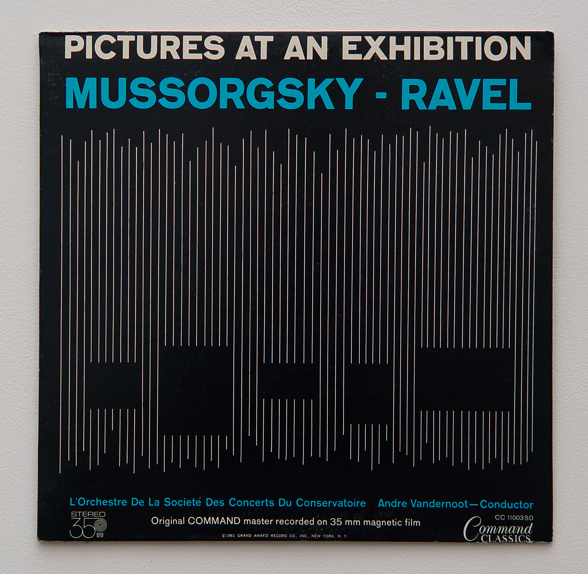
Josef Albers. Image for Command Records. Found Here.
Then I found a wonderful website, Causes of Color, which attempts to marry the aesthetics of color with the science of color. They organize the discussion of color into three causes: Light is made, light is lost, and light is moved. As I read through these pages I was thinking about Josef Albers--returning to subject matter I knew better, felt more comfortable with--something that might anchor the new. Albers's told us that color is understood through experience. He explained, "In visual perception a color is almost never seen as it really is - as it physically is. This fact makes color the most relative medium in art."

Things are not what they are. Tentative perhaps, like this post?

Wallace Stevens's musing about the blue guitar and how things are changed as they are played on that guitar had me quickly leaving Albers and thinking instead about poets,  Picasso, and a lovely book of etchings I have by British painter,  David Hockney --his homage to Stevens an Picasso.  I took a bit of time to reread "The Man with the Blue Guitar" and was stopped by these lines towards the end of the poem:
 
...Morning is not sun,
It is this posture of the nerves,

As if a blunted player clutched
The nuances of the blue guitar.

It must be this rhapsody or none,
The rhapsody of things as they are...

Counting (M.A. Reilly, 2010)
The rhapsody of things as they are is an odd truth we fight bitterly, evidenced by the way our government--both federal and state--organize "content" as deliverable products.  We lack such imagination to imagine things are only as they are and what injustice do we serve to learners when we "train" them to believe solely in such nonsense.

Way always leads on to way.  Frost knew it and so should we.  The direct route may be economical at first blush, but nomadic tendencies are more representative of thinking, of wondering, of coming to know and unknow.  


Tuesday, May 31, 2011

Learning from an Author of The Common Core Standards: A Lesson for Our Time

Today I attended the acting NJ commissioner of education's convocation, designed to introduce superintendent and curriculum directors to the Common Core Standards (CCS) and PARCC (see my post about PARCC here).  There are many things I might write about, but it is the afternoon session that I want to describe and comment. The afternoon session (about 2 hours) was dedicated to listening to a lecture about what is emphasized in the CCS and why. We were told that we want students to "read like a detective and write like an investigative reporter."  David Coleman, an author of the Common Core Standards and founder and CEO of Student Achievement Partners, LLC wanted us to understand what a CCS "model" literacy lesson would look like and so "taught" the 600 of us present using Dr. King's Letter from a Birmingham Jail.  Mr. Coleman said that the instruction he would be "doing" would occur across 6 days, emphasizing the need to "go slow".  

How might a teacher begin such a complex task?

Mr. Coleman offered three ways to not begin:
  1. Forget giving background information. Mr. Coleman said an introduction would simplify the text. Mr. Coleman believes that doing this would undermine the complexity of the text as he assumes that instead of reading the text, students would base their understanding of the text solely on the opening remarks. If students did not do this? Mr. Coleman did not address that potential reality.
  2. Mr. Coleman told us to also forget using pre-reading strategies. He explained that it makes no sense to predict ahead of time and referenced how foolish it would be to predict what a movie might be if you had no knowledge of the movie.  I am unsure how Mr. Coleman defines pre-reading strategies, but guessing has never been a pre-reading strategy of any merit. I'm confident that Mr. Coleman does not understand what pre-reading actually might mean as he characterizes such strategies as tangential, not directly related to the actual text that is being read.  Don't readers skim a text? Don't readers think about what they might know about a topic or author in preparation to reading?  Why are these methods wrong?
  3. The third method to avoid is to conduct any type of strategy lesson. Mr. Coleman said the surest way to ruin a text is to ask students to read with a main idea in mind. Yet, one of his questions while modeling was for us to consider three reasons Dr. King offers to support his main thesis.  Does this question not shape the reading?  It is at this point that I begin to understand why Mr. Coleman carries on as he does. Mr. Coleman believes that meaning exists inside a text and the reader's job is to extract meaning, as if meaning was a nugget the author left (remember your job as a reader is to be a detective) that remains whole, untainted by human experience and misunderstanding.  Meaning is not composed in transactions between the reader and the text, rather meaning is found. 
So how did Mr. Coleman begin his model lesson?

He began by reading the text aloud. None of us, apart from Mr. Coleman, had a copy of the text and that fact did not seem to have any influence on Mr. Coleman's pedagogical decisions.  Mr. Coleman read paragraph by paragraph stopping to ask us questions that on only one occasion did any "student" offer a response. 

For the rest of the "model lesson" only Mr. Coleman spoke. 

No one else offered even a modest utterance.  Mr. Coleman's questions were mostly recall questions. For example, Mr. Coleman asked, "Does anyone know who makes their second appearance in the letter?" No one responded. He paused for a couple of seconds and then answered his own question letting us know that Socrates is mentioned twice.  Mr. Coleman read aloud, offered his insights, and asked and answered his own questions.  By the conclusion of his model lesson, the audience dwindled to what looked like less than 100 people.

What might we make of such a model that Mr. Coleman says we should be emulating? Mr. Coleman educated at Yale and Oxford seems to be a student of  New Criticism, a literary theory employed in colleges and high schools beginning in the 1940s and displaced by other theories by the 1960s.  Some New Critics discounted reader's emotional or personal response to a text, believing the text to be autonomous and privileged close reading methods. Mr. Coleman and his business associate, a former math director from NJ, were quick to demean the value of Reader-response Theory, misrepresenting it as an approach that simply asks students how they feel.  In April of this year in Albany in an address to New York state educators, Mr. Coleman told his audience, "People don't really give a shit about what you feel and what you think."  (You can access that "talk" here). 


Is that really the message we want to convey to our 5-, 10-, or 15-year old students? Is it even true?  Are there no occasions when how one feels in the business sector is valued? Is thinking a cognitive function divorced from feeling? Was e.e. cummings wrong when he wrote, since feeling is first?  Creating false dichotomies is not a way to begin.


I'm guessing that Mr. Coleman hasn't spent any considerable time actually teaching children or young adults.  Had he, I would hope he might have learned that it is a costly mistake to assume any single approach, including the one he advocates, is what is needed to teach millions of children and young adults how to read powerfully.  Reading aloud a text and stopping to frequently ask questions is hardly a novel approach and given that 5/6 of the audience left one might assume it may not be a credible one either.  What is disheartening about this afternoon is that I believe Mr. Coleman thinks his "teaching" is inspired, as he gave a similar lesson last month. Mr. Coleman has the ear of powerful politicians and foundations and I worry as an educator and a mom that his vision of learning will prevail.  

The lesson I took from the afternoon is that equally compelling voices must be sounded so that children are not harmed by such an impoverished understanding of what it means to teach and learn. We need to offer alternatives to the vision of teaching that Mr. Coleman would have us enact. I have little doubt if enacted as Mr. Coleman represents in his model, we will deeply fail learners.

Sunday, May 8, 2011

Remove the Records and Someone Will Learn to Sing


Trio (Central Park, 2010)

"A lady            from Texas               said:            I live in Texas            .
                                    We have no music    in Texas.              The reason they've no
music in Texas                                               is because            they have recordings
in Texas.                        Remove the records from Texas
                                    and someone               will learn to sing
                                    Everybody                        has a song
                                    which is                               no                                song at all  :
                                    it is a process             of singing                                     ,
                         and when you sing                            ,
                                    you are                                 where you are                               .
                                                                       
                                                                  John Cage
                                                            from  Silence, "Lecture on Nothing," p. 126.

Listening For Silenced Voices
During the opening weeks of the semester I met with Kathy, a single mother, who had recently started college after securing her G.E.D.  She told me, “I want to make something outta my life. Something for me and my kid.”  After class and over coffee Kathy told me that she had read her first book during the previous semester.  She told me this slowly, hesitantly as if she might be revealing too much, too quickly and I think perhaps she was.  She dropped her voice and said,  “It was a young adult book, but I really liked it. It was the first book I could read.”
She continued explaining that she “got mostly A’s” on her papers the previous semester in Developmental Writing I.  She also said that her teacher rarely commented about her writing.  That was when she asked me if I would read the same essays as she was considering then for her portfolio. I said yes and she then confided in a lower voice that she didn’t believe the grades her work received were warranted.
“I think she just gave me the grades because she liked me.”
I read and reread the essays Kathy gave me. The texts were brief, averaging slightly longer than a paragraph of two to three sentences.  They were rather lifeless texts, insomuch as the spirit that Kathy showed during our conversations outside of class was difficult for me to discern within the texts. As she had indicated to me, the compositions were each topped with a red A and the sparse cryptic markings of correction, such as c/s and awk.  The one essay that stood out had no teacher remarks or a grade.  It was the one essay that Kathy would later tell me she did not hand in.  In this essay she wrote about being a single mother receiving welfare, a topic she knew first-hand.  It was her most sustained effort of seven sentences and the one she kept silent.  In sharing this writing with me, I thought of her courage to tell her heart especially after she explained that she didn’t hand the essay in “cause it didn’t belong at school.”

Years later, I still wonder what belongs at school. Whose stories matter? It was 1994 when I wrote that opening to a ten-chapter inquiry about women and courage.  I was beginning course work toward a doctorate and teaching at a community college in NJ. I didn't know then that Kathy's understanding of what belonged and did not belong at school would be so prophetic. I would learn though that Kathy was right: Matters of the heart have no place in a standards-based world.

I've been thinking about the terrible constraint the Common Core Standards impose on learners.  I've read through the document a few times and I can't find the section that acknowledges that matters of the heart are central to learning.  Instead I find statements situated as writing objectives that say sixth graders need to "demonstrate sufficient command of keyboarding skills to type a minimum of three pages in a single sitting." Why three pages? Why in a single sitting? Is this behavior anticipated in preparation for the computer testing that is being developed for sixth graders by groups like PARCC?

Bass (Central Park, 2010)
Lost in all the racing about is what makes for great learning: caring relationships, courage, perseverance, diversity, autonomy, and love. As these cannot easily be tested we no longer find them in what is privileged curriculum via national standards. The more we privilege standards and measurements that narrowly test those standards, the more I think John Cage was right.  He was wise to discern the difference between a recording and music.  Instead of the real deal, the people in Texas have only the fake.  And I think that what is true about the relationship between records and music is also true between standards and learning.

The Common Core Standards wall out important learning by narrowly attending to lists of ten and by paying xenophobic attention to mostly "foundational" texts.  Additionally, now that national tests are being made based on these extremely narrow standards, the most students can hope for are records, not music.

It makes me wonder: if we were to remove the standards, might students not learn to learn?

Saturday, March 26, 2011

Colonizing Classrooms: ASCD

I was angry and disappointed by the time I finished reading Susan Ohanian's recent blog post about ASCD receiving and accepting a $3 million grant from the Bill & Melinda Gates Foundation to help "districts and states realize the capacity of the new standards to fundamentally change the learning experience of students."  

Ok, let's take a minute to dissect that intention.  Think agency and ask yourself, Where is the teacher's and students' agency in ASCD's intention?  

There is no agency by teachers or the students. 

ASCD is the actual agent.  Everyone else is a receiver (district, states, and students). Teachers are missing. I would surely agree that ASCD and its agents who carry out this task may well learn.  But know this: There is no positive learning without agency, be it by the teacher, administrator, or student. As Maxine Greene (1988) so wisely reminds us "A teacher in search of his/her own freedom may be the only kind of teacher who can arouse young persons to go in search of their own" (p.14).  It is the educator acting and the student acting that leads to meaningful learning.

Transactional theory (Rosenblatt, 1978) allows us to know that the standards are nothing more than marks on a page.  They, like any other marks on a page, have no meaning, until they are acted upon by a reader.  That transaction is where meaning happens and such transactions cannot result in the same meaning being composed by x # of individuals. Meaning, contrary to what ASCD says it is planning, cannot be packaged and sent ahead, like some manifest destiny run amok.  

ASCD says that it is "committed to translating high-quality research about how students learn into practical professional development for teachers".  Hmm. Translating.  Does ASCD believe that translation and meaning making are the same thing?  Meaning is made at points of utterance (Bakhtin, 1984). It is dialogic. “Language,” Mikhail Bakhtin writes, “is not a neutral medium that passes freely and easily into the private property of the speaker's intentions; it is populated—overpopulated—with the intentions of others” (1981, p. 294). 

It is simply foolish to believe that an utterance will mean the same thing for everyone, and more importantly that marks on a page have a set meaning that remain static. What these core content standards mean is ALWAYS dependent upon the speaker's intentions.  If we eliminate the speaker, or in this case the teacher, and ship the standards ahead, we have nothing left but an empty law that district administrators will be expected to ensure happens through imposed practices and policies. These attempts will only create more division among educators. Consider William Carlos Williams who in The Desert Music told us:
The law?  The law gives up nothing
but a corpse, wrapped in a dirty mantle.
The law is based on murder and confinement,
long delayed...(p.109)

These understandings of meaning are fundamental.  As such, this is not a semantic argument, but rather a philosophical and theoretical one.  If we believe that the marks on the page someone has named as standards are that which will "fundamentally change the learning experience of students"--we have situated learning and learners as epic. An epic is a place where everything has been predetermined. It is a time not of the present where one singer sings of that time and no one including the singer can alter the events of that past.  They are sealed from the present moment where meaning always exists.  Epics cannot be a metaphor for learning, classrooms, or schools.

 Mikhail Bakhtin (1986) suggests that meaning: 

only reveals its depths once it has encountered and come into contact with another, foreign meaning: they engage in a kind of dialogue...Such a dialogic encounter of two cultures does not result in merging or mixing. Each retains its own unity and open totality, but they are mutually enriched (p. 7, emphasis in original).
We want schools where administrators, teachers, and students retain their "own unity and open totality, but they are mutually enriched."  We do not want what ASCD states it will do: "translate the standards into multiple instructional techniques to ensure teacher understanding of the underlying concepts targeted in the common core standards". We know that meaning is made in classrooms between and among learners, that there are no "best practices" that exist outside of the context of teachers, students, school and community--no matter the intentions of ASCD who earns its money selling such promises through membership, books, DVDs, and packaged professional development.  Meaning cannot be sent ahead via the implementation of standards, no mater how one attempts to define that reality. 

Let us not be fooled into dressing up ASCD's attempt to colonize United States classrooms as professional learning. Learning requires agency, not translation. 
 

Works Cited
Bakhtin, Mikhail M. 1981. The dialogic imagination. (Michael Holquist, Ed., & Caryl Emerson, Trans.). Austin: University of Texas Press.
------------------------. 1986. Speech genres & other late essays. (Vern W. McGee, Trans.). Austin: University of Texas Press.
Greene, Maxine. 1988. The dialogic imagination. New york: Teachers College Press. 
Rosenblatt, Louise. 1978. The reader, the text, the poem: The transactional theory of the literary work. Carbondale, IL: Southern Illinois University Press.
Williams, William Carlos. 1962. Pictures from Brueghel and other poems. NY: New Directions Books.


Saturday, December 11, 2010

Guest Blog: Children of Color and the Poor Left Way Behind in the National Governors Association and State Education Chiefs Common Core State Standards Initiative: “Text Exemplars” for Kindergarten through 5th Grade


Jane M. Gangi
 This week's guest blog is authored by a friend, colleague and coauthor of Deepening Literacy Learning, Jane M. Gangi.  In this post, Jane analyzes the K-5 text exemplars recommended in the Common Core State Standards in order to see the racial representation of the texts. It always disappoints me and angers me that limited representation of African American, Asian, Latino/a, and Native American people in the texts offered as exemplars is so often done. Jane's article, "The Unbearable Whiteness of Literacy Instruction: Realizing the Implications of the Proficient Reader Research"(MC Review, 2008) referenced in this blog post offers an important critique of racial representation in the literacy textbooks for teachers and teacher candidates.


Jane M. Gangi, Ph.D.
December 11, 2010

Despite comprising 40% of the population in the United States (and 70% of the world’s), in the K-5 Text Exemplars in the National Governors Association and State Education Chiefs Common Core State Standards Initiative, children of color are represented in just 21% of the selections. Decades of research have taught us that, to become proficient readers, children must be able to make text-to-self connections; they must be able to activate their prior knowledge. When the books we offer children represent mostly European American and middle-class children, European American middle-class children are hugely advantaged.
I analyzed the 88 books in the categories of K-1 stories, poetry, read-aloud stories, and read-aloud poetry; Grades 2-3 stories, poetry, read-aloud stories, and read-aloud poetry; and Grades 4-5 stories, poetry, read-aloud stories, and read-aloud poetry. Of the authors represented 69 were European American; 10 were African American; 3 were Asian American; 5 were Latino; and 1 was American Indian (see Table 1). Of the 88 books, 6 focused on poor and working class children: 7%, at a time when 21% of America’s children live in poverty—about 13 million children. Yet, in many of the stories and poems they find in school, the world is portrayed as white, middle-to-upper-class, and happy. (The informational texts recommended also looked mostly white.)
This pattern continues patterns documented elsewhere—patterns that, taken as an aggregate—persistently marginalize children of color and the poor. For a summary of the  treatment of children of color and the poor in classroom collections, book fairs and book order forms, awards, book lists, children’s literature and literacy text and professional books (the books that teach teachers how to teach), see Hughes-Hassell, Barkley, & Koehler (2010) at http://www.ala.org/ala/mgrps/divs/aasl/aaslpubsandjournals/slmrb/slmrcontents/volume12/hughes_hassell.cfm ,and my article (Gangi, 2008), “The Unbearable Whiteness of Literacy Instruction,” at http://www.mcreview.com/members_login/2008/Spring/whitenessofliteracy_article2.pdf .
The Grade 6 and up “Text Exemplars” seem more multicultural than those for Kindergarten through 5th grade—but there are six long years before grade 6 when children can learn they don’t belong, don’t count, don’t have a voice, and that they are “deficient” or “substandard.” When we wonder why so many children of color and the poor drop out of high school, perhaps we should look at our classrooms for the ways we invite children in—or not. And perhaps we should listen to Stephen Krashen and David Berliner who repeatedly illuminate the international comparisons in which the U. S. takes a trouncing: When American students who live in districts with less than 10% poverty are compared internationally, the United States does just as well as Finland, which has a 3% poverty rate, compared to our 21% poverty rate. The National Governors Association and State Education Chiefs Common Core State Standards Initiative Text Exemplars ensures that the status quo will remain the status quo.
The good news is that there are many wonderful multicultural books and authors. Please visit my website for multiple resources at: http://www.wcsu.edu/sps/fbiojgangi.asp. Or email me at gangij@wcsu.edu.

TABLE 1
K-5 “Text Exemplars” Authors and Poets

European American (EA)
African American
(Af A)
Asian American
(As A)
Latino

(L)
American Indian
(A I)
Total
%
K-1 Stories
8
0
0
0
0
8
100% EA
0% Af A
0% As A
0% L
0% AI
K-1 Poetry
7
4
0
1
0
13*

54% EA
31% Af A
0% As A
8% L
0% A O
K-1 Read-Aloud Stories
7
0
1
2
0
10
70% EA
0% Af A
10% As A
20% L
0% A I
K-1 Read-Aloud Poetry
3
1
0
0
0
5*
60% EA
20% Af A
0% As A
0% L
0% AI
2-3 Stories
13
0
0
0
0
13
100% EA
0% Af A
0% As I
0% L
0% A I
2-3 Poetry
7
2
0
1
0
10
70% EA
20% Af A
0% As A
10% L
0% A I
2-3 Read-Aloud Stories
5
1
1
0
0
7
71% EA
14%% Af A
14% % As A
0% L
0% A I
2-3 Read-Aloud Poetry
5
0
0
0
0
5
100% EA
0% Af A
0% As A
0 % L
0% A I
Grades 4-5 Stories
6
2
1
0
1
10
60% EA
20% Af A
10% As A
10% A I
Grades 4-5 Poetry
8
0
0
1
0
9
89% EA
0% Af A
0% As A
11% L
0% A I
Total
69
10
3
5
1
88
78% EA
11% Af A
3% As A
6% L
1% A I
*1 author was anonymous